Quote Atlassourced quotes & context
Named source · 1843

Past and Present Quotes by Thomas Carlyle: Context & Meanings

3 quotations linked to Past and Present by or associated with Thomas Carlyle, with source notes, explanations and related topics.

About this source

1843 social and historical critique

Topics and ideas

Work, duty, social disorder, endurance, present action, religious meaning and Carlyle’s comparison of medieval and industrial England.

Read the source

Open a public or archival text connected with these quotations

Use these links when you want to inspect the wording in its wider work or edition.

Represented passages

3 quotations with source context and meaning

Source identified1
All true Work is sacred

“All true Work is sacred”

Carlyle gives honest work religious significance, arguing that the moral quality of labor matters beyond its immediate economic result.

Source details

Past and Present, Book III, Chapter XII, “Reward,” printed page 251 in Thomas Carlyle’s Collected Works, Library Edition, Vol. XIII (London: Chapman and Hall), Project Gutenberg #26159. “All true Work is sacred” begins Carlyle’s theological claim that true labour contains “something of divineness”; it remains Victorian religious and social-polemical rhetoric rather than an empirical claim about every form of employment.
Source identified2
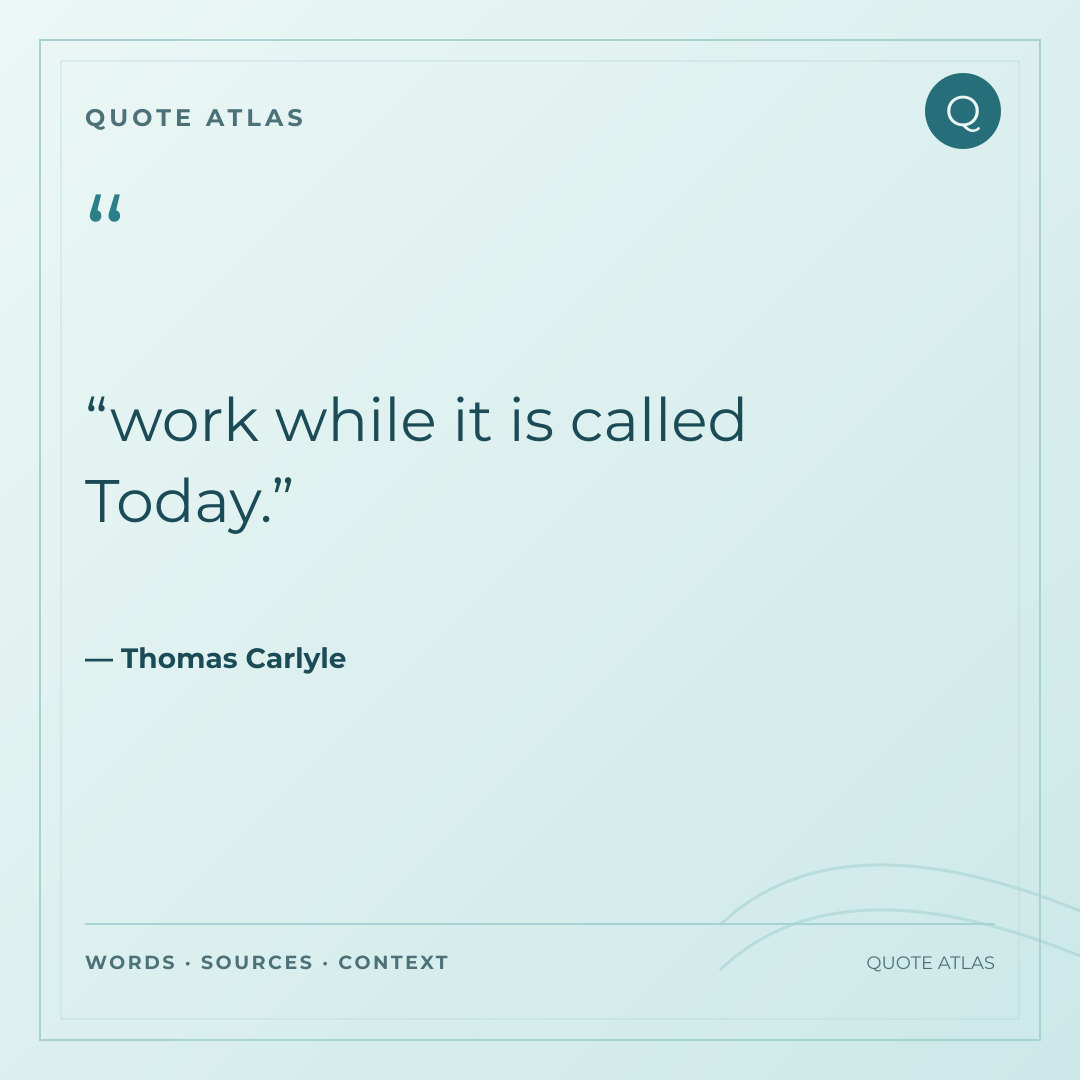
work while it is called Today.

“work while it is called Today.”

The sentence places useful effort in the time actually available now, making present action more important than indefinite postponement.

Source details

Past and Present, Book III, Chapter XII, “Reward,” printed page 251 in Thomas Carlyle’s Collected Works, Library Edition, Vol. XIII (London: Chapman and Hall), Project Gutenberg #26159. Carlyle says one shall “work while it is called Today” immediately before “For the Night cometh, wherein no man can work,” retaining the biblical allusion and nineteenth-century religious exhortation rather than reframing it as productivity science.

Source identified3
Work, and therein have well-being.

“Work, and therein have well-being.”

Carlyle links active work with well-being in a deliberately moral and religious account of labor as a way of ordering life and confronting disorder.

Source details

Past and Present, Book III, Chapter XII, “Reward,” printed page 250 in Thomas Carlyle’s Collected Works, Library Edition, Vol. XIII (London: Chapman and Hall), Project Gutenberg #26159. “Work, and therein have well-being” opens Carlyle’s enduring “Gospel” of work inside explicitly Christian Victorian social criticism. This collection preserves that historical moral-religious setting and does not present the sentence as a modern health, wellness or employment guarantee.