Quote Atlassourced quotes & context
Named source · c. 1606

Macbeth Quotes by William Shakespeare: Context & Meanings

3 quotations linked to Macbeth by or associated with William Shakespeare, with source notes, explanations and related topics.

About this source

William Shakespeare’s tragedy Macbeth

Topics and ideas

Grief, irreversible action, deception, appearance, guilt, violence and the language characters use while confronting political and personal catastrophe.

Read the source

Open a public or archival text connected with these quotations

Use these links when you want to inspect the wording in its wider work or edition.

Represented passages

3 quotations with source context and meaning

Source identified1
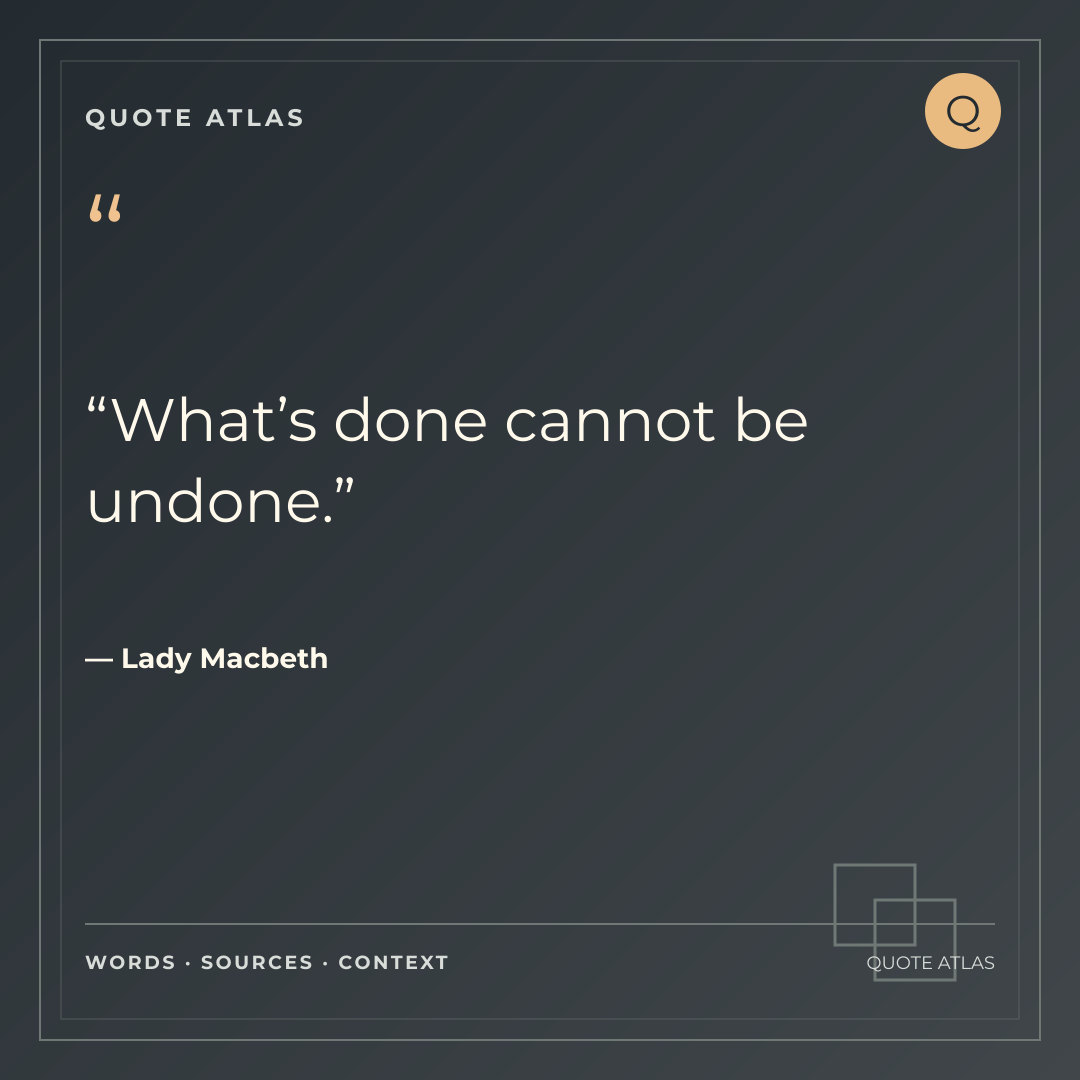
What’s done cannot be undone.

“What’s done cannot be undone.”

Voice: Fictional character · Lady Macbeth

Some consequences cannot be reversed, so the practical question becomes how to respond now rather than how to erase the past.

Source details

Macbeth, Act V, Scene I, reviewed against the scan-backed 1918 Yale text. Lady Macbeth says 'What's done cannot be undone' during the sleepwalking scene; the dramatic context is guilt and psychological disintegration, not generic advice that consequences should simply be accepted.

Source identified2
There’s daggers in men’s smiles.

“There’s daggers in men’s smiles.”

Voice: Fictional character · Donalbain

Friendly appearance can conceal harmful intent, so trust should consider patterns of conduct rather than expressions alone.

Source details

Macbeth, Act II, Scene III, reviewed against the scan-backed 1918 Yale text and the First Folio facsimile. Donalbain's 'There's daggers in men's smiles' follows Duncan's murder as Malcolm and Donalbain decide to flee; it is fictional suspicion under immediate danger rather than a universal claim about trust.

Source identified3
Give sorrow words; the grief that does not speak Whispers the o’er-fraught heart and bids it break.

“Give sorrow words; the grief that does not speak Whispers the o’er-fraught heart and bids it break.”

Voice: Fictional character · Malcolm

Putting grief into words can make suffering more shareable; silence may intensify pressure when pain has no form of expression.

Source details

Macbeth, Act IV, Scene III, reviewed against the scan-backed 1918 Yale text. Malcolm tells Macduff 'Give sorrow words; the grief that does not speak / Whispers the o'er-fraught heart and bids it break.' The frozen catalog row instead reads 'knits up the o'er-wrought heart'; that substantive inherited wording variation is disclosed rather than silently rewritten. The passage remains dramatic grief counsel, not clinical guidance.