Quote Atlassourced quotes & context
Author & topic collection

Mary Wollstonecraft Quotes About Growth

Browse 7 quotations connecting Mary Wollstonecraft with Growth, with meanings, source notes and related themes.

Sources

Where these growth quotations appear

Sources represented here include Thoughts on the Education of Daughters, A Vindication of the Rights of Woman, Letters Written During a Short Residence in Sweden, Norway, and Denmark.

7 shown
Quotations

7 matching quotations with meanings and source context

Source identified1
I wish to persuade women to endeavour to acquire strength, both of mind and body.
Image design Lavender

“I wish to persuade women to endeavour to acquire strength, both of mind and body.”

Wollstonecraft rejects cultivated helplessness and argues for developing women's intellectual and physical capacities so they can stand as rational agents rather than depend on flattering ideals of weakness.

Source details

A Vindication of the Rights of Woman, Introduction, Project Gutenberg #3420. The frozen quotation 'I wish to persuade women to endeavour to acquire strength, both of mind and body' is a clause from a longer sentence beginning 'I earnestly wish to point out...' and continuing through Wollstonecraft's criticism of delicacy and weakness as feminine ideals. It remains eighteenth-century feminist political-moral argument rather than a modern clinical or physiological prescription.

Source identified2
Make them free, and they will quickly become wise and virtuous, as men become more so.

“Make them free, and they will quickly become wise and virtuous, as men become more so.”

Freedom and development are linked: people become more capable by exercising reason and responsibility, not by being kept dependent for their supposed protection.

Source details

A Vindication of the Rights of Woman, concluding discussion of women as rational citizens and the mutual improvement of both sexes.

Source identified3
What a long time it requires to know ourselves, and yet every one has more of this knowledge than he is willing to own.
Image design Lavender

“What a long time it requires to know ourselves, and yet every one has more of this knowledge than he is willing to own.”

Self-knowledge develops slowly, and the second clause suggests that people may resist acknowledging what experience has already taught them about their own motives or limitations.

Source details

Letters Written During a Short Residence in Sweden, Norway, and Denmark, Letter IX; represented Cassell & Company 1889 text in Project Gutenberg #3529. The frozen catalog reads “What a long time it requires to know ourselves, and yet every one has more of this knowledge than he is willing to own,” while the represented witness reads “What a long time it requires to know ourselves; and yet almost every one has more of this knowledge than he is willing to own, even to himself.” This collection retains its legacy shortened wording and explicitly records the omitted “almost” / closing phrase rather than silently rewriting it. Wollstonecraft is reflecting on her own solitude, experience and knowledge of the heart.

Source identified4
Judicious books enlarge the mind and improve the heart.

“Judicious books enlarge the mind and improve the heart.”

Good reading can develop both judgment and moral feeling, making intellectual enlargement and character formation parts of the same educational process.

Source details

Thoughts on the Education of Daughters (1787), “READING,” printed page 49, Project Gutenberg #67466. “Judicious books enlarge the mind and improve the heart” appears in Wollstonecraft’s case for carefully chosen reading that joins intellectual cultivation with moral formation; the passage remains historical educational and conduct writing.

Source identified5
The governing of our temper is truly the business of our whole lives.

“The governing of our temper is truly the business of our whole lives.”

Emotional self-command is not a childhood lesson completed once; it remains a lifelong practice because new circumstances continually test established habits.

Source details

Thoughts on the Education of Daughters (1787), “The TEMPER,” printed page 62, Project Gutenberg #67466. Wollstonecraft calls governing the temper the business of the whole life while discussing habits of self-command and conduct; the passage is moral-educational argument rather than clinical emotion-regulation advice.

Source identified6
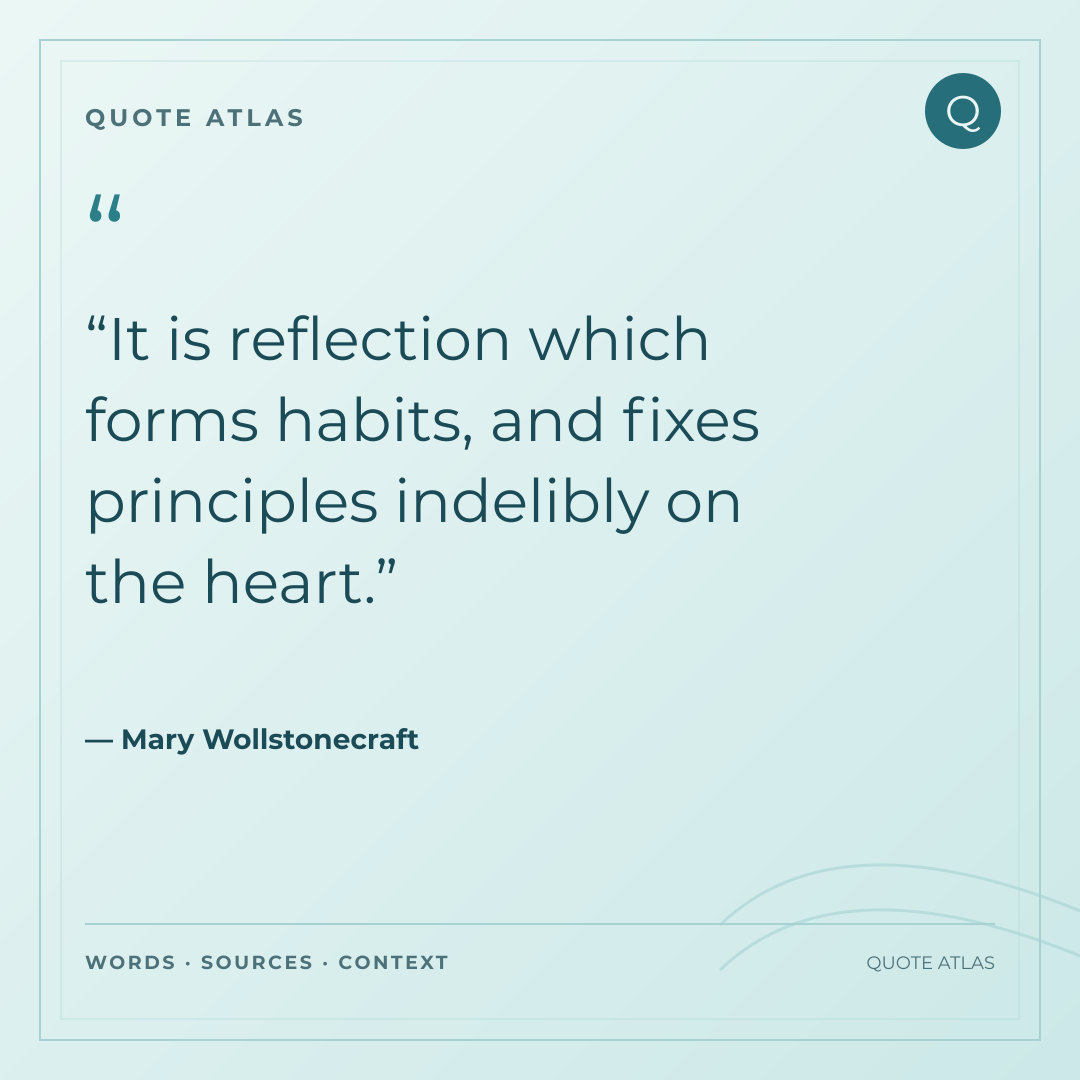
It is reflection which forms habits, and fixes principles indelibly on the heart.

“It is reflection which forms habits, and fixes principles indelibly on the heart.”

Habit formation becomes stronger when action is joined with reflection, because principles understood and revisited are more likely to guide later choices.

Source details

Thoughts on the Education of Daughters (1787), “THE BENEFITS WHICH ARISE FROM DISAPPOINTMENTS,” printed page 111, Project Gutenberg #67466. Wollstonecraft says reflection forms habits and fixes principles while opening a religious-moral discussion of disappointment, self-examination and character.

Source identified7
Reading is the most rational employment, if people seek food for the understanding.

“Reading is the most rational employment, if people seek food for the understanding.”

Reading is valuable when it feeds judgment and understanding rather than becoming a performance of remembering words without examining their ideas.

Source details

Thoughts on the Education of Daughters (1787), “READING,” printed page 49, Project Gutenberg #67466. Wollstonecraft calls reading the most rational employment when people seek food for the understanding, contrasting reflective reading with merely collecting words or quotations; this is eighteenth-century educational argument rather than a current evidence-based teaching prescription.

More from this author

Other topic collections for Mary Wollstonecraft