Quote Atlassourced quotes & context
Page 3 of 3 · 172 quotations total

Present moment quotes — Page 3

This continuation page contains additional source-backed quotations not shown in the initial 50-quotation overview. Return to the topic guide and browse collection.

22 shown · 172 total
Source identified151
The present time is short, the future is doubtful, the past is certain.

“The present time is short, the future is doubtful, the past is certain.”

Seneca divides time into three conditions and gives the present special urgency because it is both available and quickly passing.

Source details

On the Shortness of Life, Chapter X; opening distinction between past, present and future.

Source identified153
Now while the blood is hot, we must enter with brisk step upon the better course.

“Now while the blood is hot, we must enter with brisk step upon the better course.”

Improvement is treated as work for the available present, not a project reserved for an imagined later period when energy and opportunity may be smaller.

Source details

On the Shortness of Life, Chapter XIX; Seneca urges a move from borrowed busyness toward study, virtue, and a more deliberate course of life.

Source identified154
Yet no one will bring back the years, no one will bestow you once more on yourself.

“Yet no one will bring back the years, no one will bestow you once more on yourself.”

Lost time cannot be restored in the way money or possessions sometimes can, so protecting one’s years becomes a form of protecting oneself.

Source details

On the Shortness of Life, Chapter VIII; Seneca warns that even people who know time is precious often give it away without noticing the loss.

Source identified155
Life will follow the path it started upon, and will neither reverse nor check its course.

“Life will follow the path it started upon, and will neither reverse nor check its course.”

Time continues without negotiating with status or preference, making acceptance of its direction a reason to use the available part more deliberately.

Source details

On the Shortness of Life, Chapter VIII; the sentence follows Seneca’s warning that lost years will not be returned.

Source identified156
If these wish to know how short their life is, let them reflect how small a part of it is their own.

“If these wish to know how short their life is, let them reflect how small a part of it is their own.”

The felt shortness of life is linked with how little of it remains under one’s own direction after obligations and borrowed priorities consume the rest.

Source details

On the Shortness of Life, Chapter XIX; Seneca closes by asking the engrossed to measure how much of their lifetime was actually their own.

Source identified157
the sum of knowledge for all of us.

“the sum of knowledge for all of us.”

Carlyle says understanding the present includes asking what the present situation requires people to do, joining interpretation of one’s time with practical judgment.

Source details

Latter-Day Pamphlets, No. I “The Present Time”; Project Gutenberg #1140. The excerpt completes Carlyle’s sentence about knowing the present time and what it bids people do; the local political context remains essential.

Source identified158
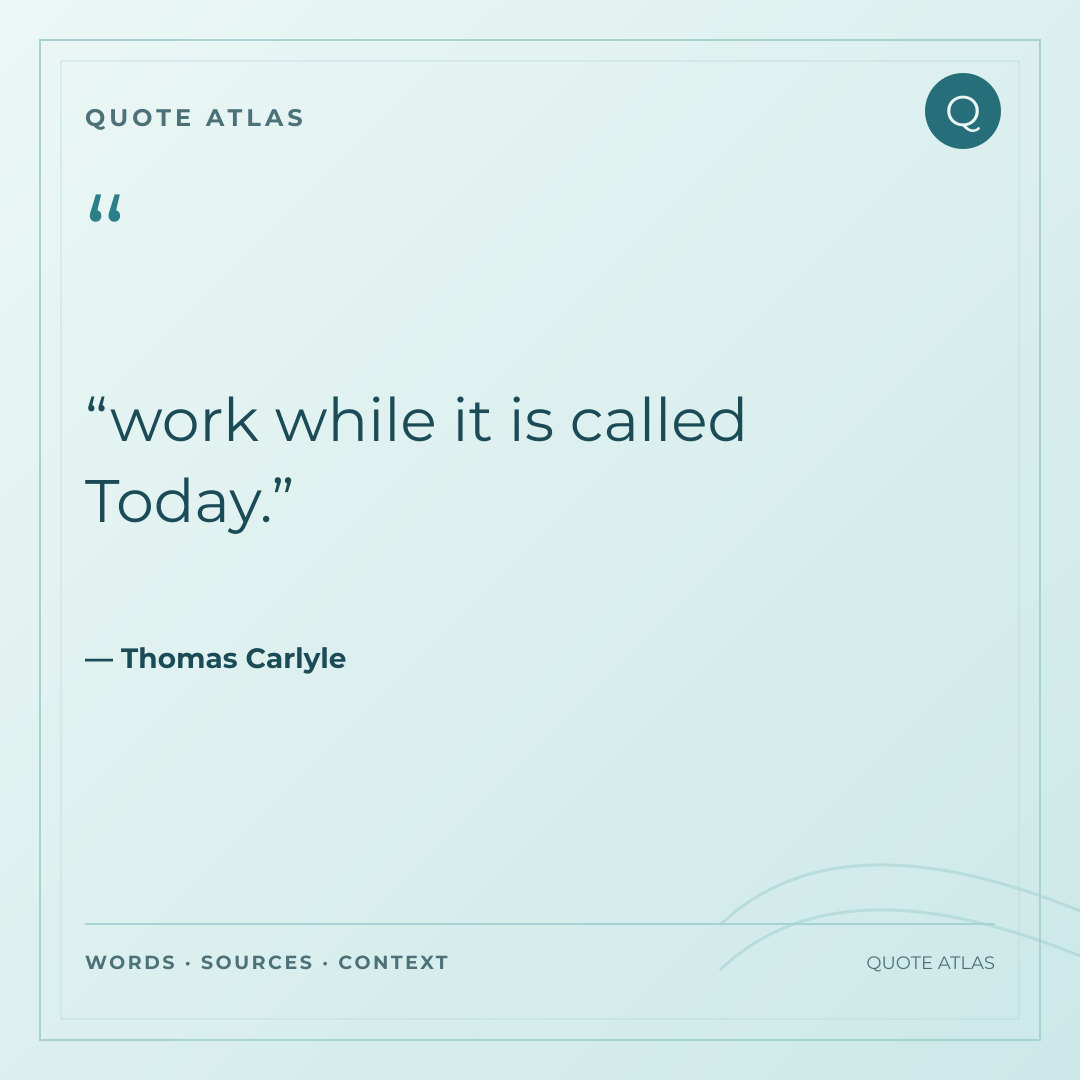
work while it is called Today.

“work while it is called Today.”

The sentence places useful effort in the time actually available now, making present action more important than indefinite postponement.

Source details

Past and Present, Book III, Chapter XII, “Reward,” printed page 251 in Thomas Carlyle’s Collected Works, Library Edition, Vol. XIII (London: Chapman and Hall), Project Gutenberg #26159. Carlyle says one shall “work while it is called Today” immediately before “For the Night cometh, wherein no man can work,” retaining the biblical allusion and nineteenth-century religious exhortation rather than reframing it as productivity science.

Source identified159
Thus meet we five, in this still place, At this point of time, at this point in space.

“Thus meet we five, in this still place, At this point of time, at this point in space.”

The speaker's quiet encounter with small nocturnal creatures is fixed to one precise moment and place, making attention itself the poem's central event.

Source details

“An August Midnight,” Poems of the Past and the Present (1901), Project Gutenberg #3168. The five include the speaker and small creatures gathered around his writing table.

Source identified160
Wintertime nighs; But my bereavement-pain It cannot bring again: Twice no one dies.

“Wintertime nighs; But my bereavement-pain It cannot bring again: Twice no one dies.”

Returning winter cannot recreate the first shock of bereavement, suggesting that repeated seasons may revisit memory without reproducing an earlier loss in exactly the same form.

Source details

“De Profundis I,” Poems of the Past and the Present (1901), Project Gutenberg #3168. The poem reflects on recurring seasons and a past bereavement; it does not prescribe a universal grief timetable.

Source identified162
The future is no more uncertain than the present.

“The future is no more uncertain than the present.”

Whitman refuses to treat the future as uniquely unknowable: within the poem's larger meditation on what endures, present conditions are themselves unstable and changing, so uncertainty belongs to both horizons.

Source details

Leaves of Grass (1882), “Song of the Broad-Axe,” section 4; Wikisource 1882 transcription. The line appears after “And the dead advance as much as the living advance” and before Whitman turns from institutions and structures toward the personal qualities he says endure.

Source identified163
Not the fruit of experience, but experience itself, is the end.

“Not the fruit of experience, but experience itself, is the end.”

Pater shifts emphasis from a final product extracted from life toward the quality and intensity of lived experience itself, within his aesthetic philosophy of the Conclusion.

Source details

The Renaissance, Conclusion; Project Gutenberg #2398. This is an aesthetic-philosophical thesis, not a universal empirical rule for how everyone ought to live.

Source identified164
To see a World in a Grain of Sand and a Heaven in a Wild Flower.

“To see a World in a Grain of Sand and a Heaven in a Wild Flower.”

The image invites attention to scale and wonder, suggesting that profound meaning can appear inside ordinary and easily overlooked details.

Source details

Opening of “Auguries of Innocence”; Blake places vastness inside tiny natural forms.

Source identified165
He who binds to himself a joy does the winged life destroy.

“He who binds to himself a joy does the winged life destroy.”

Trying to possess a joyful moment permanently can damage it, while accepting impermanence allows experience to remain alive and free.

Source details

Short poem commonly titled “Eternity”; Blake contrasts grasping with the passing movement of joy.

Source identified166
The future is yet to come

“The future is yet to come”

The brief phrase anchors Hazlitt’s argument that the future does not possess greater reality merely because it has not happened yet; he compares its status with the already completed past.

Source details

Table-Talk, Volume I, Essay III, “On the Past and Future,” Project Gutenberg #3020. “The future is yet to come” occurs in Hazlitt’s comparison of the already-existing past with the not-yet-existing future: the full sentence continues that the future “has never been anything.” The retained short excerpt is therefore part of a philosophical contrast, not a prediction, forecasting rule or scientific proposition.

Source identified167
I have some desire to enjoy the present good, and some fondness for the past

“I have some desire to enjoy the present good, and some fondness for the past”

Hazlitt states his own temporal bias plainly: he values present experience and retains an attachment to what has already been lived rather than treating only the future as significant.

Source details

Table-Talk, Volume I, Essay III, “On the Past and Future,” Project Gutenberg #3020. “I have some desire to enjoy the present good, and some fondness for the past” appears in the opening paragraph, where Hazlitt states his own lack of sanguine expectation before developing the essay’s argument. This is first-person literary-philosophical reflection, not an empirical claim about how people should value past, present or future.

Source identified168
Life in day-tight compartments.

“Life in day-tight compartments.”

Osler compresses his daily-living method into a boundary around the present day: yesterday and tomorrow are acknowledged without being allowed to consume the work and choices available now.

Source details

A Way of Life, section I, printed page 5, London: Constable & Company Ltd. (1913), Project Gutenberg #73116. Osler condenses his proposed daily-living habit into “Life in day-tight compartments,” using the metaphor of watertight ship compartments. This remains historical conduct-of-life rhetoric, not a treatment for anxiety or other health conditions.

Source identified169
Realise how much time there is, how long the day is.

“Realise how much time there is, how long the day is.”

The line reframes a day as a substantial block of usable time, encouraging deliberate attention rather than the constant feeling that useful work must be rushed.

Source details

A Way of Life, section IV, printed page 12, London: Constable & Company Ltd. (1913), Project Gutenberg #73116. Osler says “Realise how much time there is, how long the day is” while discussing deliberate control of the mind, study and avoidance of hurry and worry; this collection does not convert the period medical rhetoric into current clinical or productivity guidance.

Source identified170
I wasted time, and now doth time waste me.

“I wasted time, and now doth time waste me.”

Voice: Fictional character · King Richard II

Time ignored earlier becomes painfully visible later, when opportunities narrow and delay can no longer be recovered.

Source details

Richard II, Act V, Scene V in the represented 1921 Yale edition. Richard's 'I wasted time, and now doth time waste me' occurs in the prison soliloquy as he compares broken musical time with his ruined political life. The First Folio facsimile numbers the corresponding prison scene differently, so the Yale route is used to preserve this collection's modern scene numbering.