King James Bible Quotes: Sources, Meanings & Themes
Browse quotations represented under King James Bible with named sources, context notes, meanings and recurring themes.
Source identified1

Read & copy
“Rejoice evermore.”
Meaning & context
The brief instruction treats joy as an enduring orientation to be practiced repeatedly rather than a feeling reserved only for easy circumstances.
Source details
1 Thessalonians 5:16 in the King James Version; a concise instruction within a series of practical exhortations.

Source identified2

Read & copy
“Providing for honest things, not only in the sight of the Lord, but also in the sight of men.”
Meaning & context
Integrity includes conduct that can withstand public scrutiny as well as private conviction.
Source details
2 Corinthians 8:21 in the King James Version.

Source identified3

Read & copy
“For God hath not given us the spirit of fear; but of power, and of love, and of a sound mind.”
Meaning & context
Fear is contrasted with capacities for strength, care, and disciplined judgment, encouraging action that is not governed solely by anxiety.
Source details
2 Timothy 1:7 in the King James Version; the verse contrasts fear with power, love, and disciplined-mindedness.

Source identified4

Read & copy
“And whatsoever ye do, do it heartily, as to the Lord, and not unto men.”
Meaning & context
Work is framed around wholehearted effort and an internal standard of responsibility rather than dependence on external praise or supervision.
Source details
Colossians 3:23 in the King James Version; the instruction emphasizes wholehearted work and a higher standard of accountability.

Source identified5

Read & copy
“Lie not one to another.”
Meaning & context
The short instruction makes honesty a basic requirement of life with other people.
Source details
Colossians 3:9 in the King James Version; the opening command is quoted here.

Source identified6

Read & copy
“A time to weep, and a time to laugh; a time to mourn, and a time to dance.”
Meaning & context
Different seasons of life call for different emotional responses; mourning is not a permanent failure but one legitimate part of human time.
Source details
Ecclesiastes 3:4 in the King James Version.

Source identified7

Read & copy
“Better is the end of a thing than the beginning thereof.”
Meaning & context
Starting matters, but finishing reveals whether effort was sustained through the middle of the work.
Source details
Ecclesiastes 7:8 in the King James Version; the verse continues by praising patience over pride.

Source identified8

Read & copy
“Wherefore putting away lying, speak every man truth with his neighbour.”
Meaning & context
Truthfulness is framed as a responsibility within relationship, not merely as a private personal preference.
Source details
Ephesians 4:25 in the King James Version; the first clause and command are quoted here.

Source identified9

Read & copy
“Honour thy father and thy mother.”
Meaning & context
Respect within family life is framed as an enduring obligation rather than something owed only when relationships are easy or convenient.
Source details
Exodus 20:12 in the King James Version; the commandment places honor for parents among core covenant duties.

Source identified10

Read & copy
“Bear ye one another’s burdens, and so fulfil the law of Christ.”
Meaning & context
Support becomes concrete when people help carry difficulties that would otherwise be faced alone.
Source details
Galatians 6:2 in the King James Version.

Source identified11

Read & copy
“Blessed are they that mourn: for they shall be comforted.”
Meaning & context
Mourning is not treated as failure or weakness; the promise of comfort gives grief dignity while leaving room for pain to be real.
Source details
Matthew 5:4 in the King James Version; one of the Beatitudes, addressing those who mourn.

Source identified12

Read & copy
“Take therefore no thought for the morrow.”
Meaning & context
The teaching redirects attention from imagined future trouble toward responsibilities that actually belong to today.
Source details
Matthew 6:34 in the King James Version; the opening sentence is quoted here.

Source identified13

Read & copy
“He that walketh uprightly walketh surely.”
Meaning & context
Consistent upright conduct reduces the need to maintain conflicting stories or hidden motives.
Source details
Proverbs 10:9 in the King James Version; the opening clause is quoted here.

Source identified14

Read & copy
“Where no counsel is, the people fall: but in the multitude of counsellors there is safety.”
Meaning & context
Good leadership benefits from informed counsel instead of assuming one perspective is always sufficient.
Source details
Proverbs 11:14 in the King James Version.

Source identified15

Read & copy
“When pride cometh, then cometh shame: but with the lowly is wisdom.”
Meaning & context
Pride is linked with poor judgment while humility is linked with wisdom, suggesting that accurate self-estimation improves decision making.
Source details
Proverbs 11:2 in the King James Version.

Source identified16

Read & copy
“The integrity of the upright shall guide them.”
Meaning & context
Integrity functions as an internal guide when a person has to choose without knowing every consequence in advance.
Source details
Proverbs 11:3 in the King James Version; the opening clause is quoted here.

Source identified17

Read & copy
“Lying lips are abomination to the LORD: but they that deal truly are his delight.”
Meaning & context
The proverb contrasts deception with dependable truthfulness and treats honesty as a moral practice.
Source details
Proverbs 12:22 in the King James Version.

Source identified18

Read & copy
“A soft answer turneth away wrath: but grievous words stir up anger.”
Meaning & context
Tone can change the direction of conflict: a measured response may reduce escalation while harsh speech can intensify it.
Source details
Proverbs 15:1 in the King James Version.

Source identified19

Read & copy
“The fear of the LORD is the instruction of wisdom; and before honour is humility.”
Meaning & context
Humility is presented as preparation for wisdom and honour rather than as weakness, emphasizing teachability before status.
Source details
Proverbs 15:33 in the King James Version.

Source identified20
Read & copy
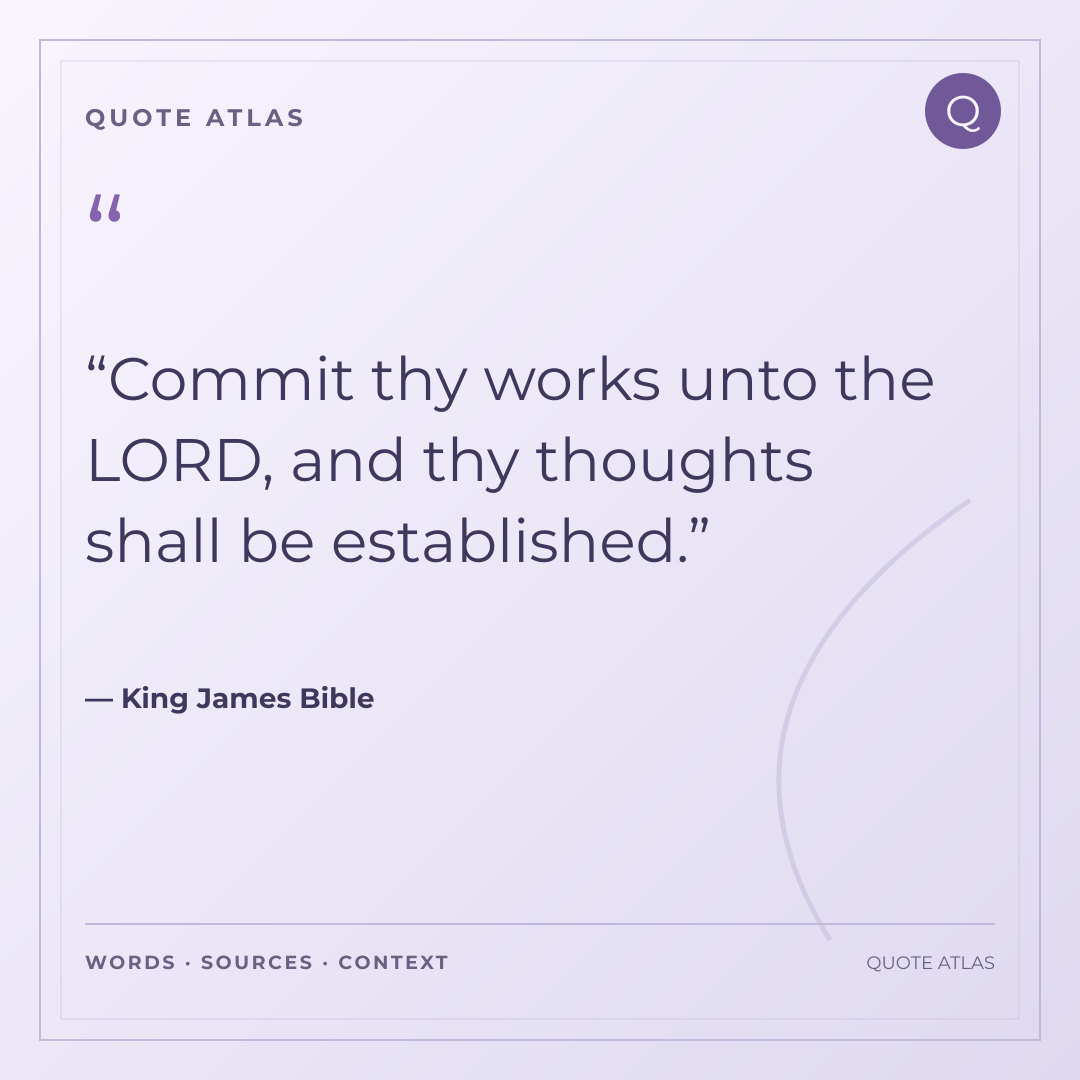
“Commit thy works unto the LORD, and thy thoughts shall be established.”
Meaning & context
The proverb joins committed action with an ordered mind, treating purpose as something expressed through work.
Source details
Proverbs 16:3 in the King James Version.

Source identified21

Read & copy
“He that is slow to anger is better than the mighty.”
Meaning & context
Self-command is valued above outward dominance, redefining strength as the ability to govern one’s response.
Source details
Proverbs 16:32 in the King James Version; the first comparison is quoted here.

Source identified22

Read & copy
“Better is a little with righteousness than great revenues without right.”
Meaning & context
The proverb ranks ethical conduct above larger income, treating the means by which wealth is obtained as more important than the amount.
Source details
Proverbs 16:8 in the King James Version.

Source identified23

Read & copy
“A man’s heart deviseth his way: but the LORD directeth his steps.”
Meaning & context
Planning has value while remaining limited; the verse holds intention and humility about outcomes together.
Source details
Proverbs 16:9 in the King James Version.

Source identified24

Read & copy
“The thoughts of the diligent tend only to plenteousness.”
Meaning & context
Steady planning and effort are contrasted with haste, making diligence a long-term rather than impulsive strategy.
Source details
Proverbs 21:5 in the King James Version; the first clause is quoted here.

Source identified25

Read & copy
“By humility and the fear of the LORD are riches, and honour, and life.”
Meaning & context
The proverb connects humility with a larger conception of flourishing, placing character before the rewards associated with status or wealth.
Source details
Proverbs 22:4 in the King James Version.

Source identified26

Read & copy
“Happy is the man that findeth wisdom, and the man that getteth understanding.”
Meaning & context
Happiness is connected with gaining wisdom and understanding, suggesting that a good life depends on discernment as well as circumstance.
Source details
Proverbs 3:13 in the King James Version; the verse begins a passage praising the value of wisdom.

Source identified27

Read & copy
“Keep thy heart with all diligence; for out of it are the issues of life.”
Meaning & context
Guarding inner life is presented as practical because attention and motives influence conduct downstream.
Source details
Proverbs 4:23 in the King James Version.

Source identified28

Read & copy
“Enter into his gates with thanksgiving, and into his courts with praise: be thankful unto him, and bless his name.”
Meaning & context
Gratitude is expressed actively through thanksgiving and praise, turning appreciation into a deliberate practice rather than a private feeling alone.
Source details
Psalm 100:4 in the King James Version; thanksgiving is presented as the posture for entering worship.

Source identified29

Read & copy
“This is the day which the LORD hath made; we will rejoice and be glad in it.”
Meaning & context
The verse directs attention toward the present day as something to receive with gratitude and deliberate gladness rather than overlook while waiting for another moment.
Source details
Psalm 118:24 in the King James Version; the verse joins the present day with rejoicing and gratitude.

Source identified30

Read & copy
“He healeth the broken in heart, and bindeth up their wounds.”
Meaning & context
Healing is pictured as careful repair of emotional wounds, offering language of comfort without pretending that pain disappears instantly.
Source details
Psalm 147:3 in the King James Version; the verse describes care for people whose hearts have been broken.

Source identified31

Read & copy
“He restoreth my soul.”
Meaning & context
Restoration is expressed as renewal of the inner person, a compact image for recovering steadiness after depletion, fear, or difficulty.
Source details
Psalm 23:3 in the King James Version; restoration follows the psalm’s images of rest and still waters.

Source identified32

Read & copy
“Weeping may endure for a night, but joy cometh in the morning.”
Meaning & context
Sorrow is acknowledged as real while being placed inside a larger horizon in which pain can change and joy can return.
Source details
Psalm 30:5 in the King James Version.

Source identified33

Read & copy
“The LORD is nigh unto them that are of a broken heart.”
Meaning & context
The verse frames closeness and care as especially relevant during brokenness, making it a restrained source of comfort for difficult emotional moments.
Source details
Psalm 34:18 in the King James Version; the verse speaks of divine nearness to the brokenhearted.

Source identified34

Read & copy
“Be still, and know that I am God.”
Meaning & context
Stillness is paired with trust, shifting attention away from frantic control and toward a larger frame of confidence and perspective.
Source details
Psalm 46:10 in the King James Version; the verse places stillness and trust inside a psalm about turmoil and refuge.

Source identified35

Read & copy
“What time I am afraid, I will trust in thee.”
Meaning & context
Fear is acknowledged directly rather than denied, then paired with a deliberate act of trust.
Source details
Psalm 56:3 in the King James Version.

Source identified36

Read & copy
“So teach us to number our days, that we may apply our hearts unto wisdom.”
Meaning & context
Awareness of limited time is turned into a reason to choose more wisely rather than merely fear mortality.
Source details
Psalm 90:12 in the King James Version.

Source identified37

Read & copy
“We glory in tribulations also: knowing that tribulation worketh patience.”
Meaning & context
Difficulty is interpreted as a setting in which endurance can be formed rather than as a final verdict on the person experiencing it.
Source details
Romans 5:3 in the King James Version.
