Quote Atlassourced quotes & context
Page 6 of 7 · 605 quotations total

Inspirational Quotes About Hope, Courage & Possibility — Page 6

This continuation page contains additional source-backed quotations not shown in the initial 70-quotation overview. Return to the topic guide and browse collection.

100 shown · 605 total
Source identified471
There is not so helpless and pitiable an object in the world as a landsman beginning a sailor’s life.

“There is not so helpless and pitiable an object in the world as a landsman beginning a sailor’s life.”

Dana remembers how bewildering the first hours of shipboard life felt to a novice suddenly surrounded by unfamiliar orders, sounds and tasks.

Source details

Two Years Before the Mast, Chapter I, “Departure,” Project Gutenberg #2055. Dana describes his own bewilderment on first going to sea and calls a landsman beginning a sailor’s life uniquely helpless and pitiable. It is first-person maritime memoir shaped by rhetorical exaggeration, not a literal universal ranking of helplessness.

Source identified472
Stone walls doe not a prison make, Nor iron bars a cage;

“Stone walls doe not a prison make, Nor iron bars a cage;”

Lovelace’s imprisoned speaker claims that external confinement cannot fully control a mind and inner life that still experience loyalty, love and spiritual freedom.

Source details

“To Althea, from Prison,” in Lucasta, Project Gutenberg #703. The poem was written in the context of Lovelace’s imprisonment and expresses Cavalier political and personal loyalty; its claim about freedom is poetic rather than a denial of the real harms of incarceration.

Source identified473
Ah, but a man's reach should exceed his grasp, Or what's a heaven for?

“Ah, but a man's reach should exceed his grasp, Or what's a heaven for?”

Browning’s dramatic speaker contrasts flawless technical execution with aspiration beyond present achievement, suggesting that striving toward a higher ideal can matter even when complete attainment is impossible.

Source details

“Andrea del Sarto,” first published in Men and Women (1855), represented by Poetry Foundation. The line is spoken by Browning’s fictionalized Renaissance painter Andrea del Sarto while reflecting on artistic perfection, ambition and limitation; it is dramatic monologue rather than Browning speaking autobiographically.

Source identified474
God's in his heaven—All's right with the world!

“God's in his heaven—All's right with the world!”

Pippa’s song voices a moment of religious confidence and ordinary delight whose effect in the drama depends on other characters hearing it at morally decisive moments.

Source details

Pippa Passes (1841), represented in the Project Gutenberg Robert Browning works edition #59123. The lyric is sung by Pippa inside a verse drama; its Christian optimism is a character-song within the play, not a factual guarantee that every event is good.

Source identified475
Grow old along with me! The best is yet to be,

“Grow old along with me! The best is yet to be,”

Browning’s dramatic speaker frames aging not merely as decline but as part of a larger spiritual development in which later life can complete what youth only begins.

Source details

“Rabbi Ben Ezra” (1864), represented in Project Gutenberg #59123, The Works of Robert Browning. The poem speaks through Browning’s imagined Rabbi Ben Ezra and is explicitly theistic; its confidence about age and providence is poetic-religious argument rather than a factual guarantee about later life.

Source identified476
There is no duty we so much underrate as the duty of being happy.

“There is no duty we so much underrate as the duty of being happy.”

Stevenson argues that a person’s happiness can benefit others socially, so cheerfulness is not merely private pleasure in the essay’s deliberately provocative moral accounting.

Source details

‘An Apology for Idlers,’ represented in Project Gutenberg #69825, a 1905 Thomas B. Mosher reprint of the essay first published in the Cornhill Magazine in July 1877. ‘There is no duty we so much underrate as the duty of being happy’ appears in Stevenson's argument that cheerfulness can confer anonymous benefits on others. It remains provocative conduct-of-life essay rhetoric rather than clinical mental-health guidance or a universally binding moral duty.

Source identified477
To travel hopefully is a better thing than to arrive, and the true success is to labour.
Image design Coastal

“To travel hopefully is a better thing than to arrive, and the true success is to labour.”

The value of a journey can lie in purposeful movement and effort rather than only in the moment of arrival.

Source details

Essay “El Dorado.”

Source identified478
Thus it is: added difficulty, added beauty;

“Thus it is: added difficulty, added beauty;”

In the specific context of verse technique, Stevenson argues that an additional formal constraint can create another opportunity for artistic achievement and aesthetic interest.

Source details

Essays in the Art of Writing, “On Some Technical Elements of Style in Literature”; Project Gutenberg #492. “Difficulty” here concerns literary form and craft, not a universal claim that hardship automatically makes things better.

Source identified479
To be what we are, and to become what we are capable of becoming, is the only end of life.

“To be what we are, and to become what we are capable of becoming, is the only end of life.”

Stevenson’s formulation links self-acceptance with development: a worthwhile life is not imitation of someone else’s pattern but fuller realization of capacities that belong to one’s own character.

Source details

Familiar Studies of Men and Books, essay ‘Henry David Thoreau: His Character and Opinions,’ section V, Project Gutenberg #425, transcribed from the 1896 Chatto & Windus edition. The surrounding paragraph quotes several Thoreau statements, but ‘To be what we are, and to become what we are capable of becoming...’ is Stevenson's own connective judgment before he returns to quoted Thoreau language. It therefore remains Stevenson literary-biographical criticism rather than a Thoreau quotation or a clinical rule about self-development.

Source identified480
This ground is hallowed by the heroes of defeat.

“This ground is hallowed by the heroes of defeat.”

The phrase grants dignity to people who struggled without conventional victory, reframing defeat as compatible with courage and a life still worthy of remembrance.

Source details

Memories and Portraits, in Stevenson’s reflection on graves and failed lives; Project Gutenberg #381. The sentence is literary commemoration, not a claim that every defeat is heroic.

Source identified482
And lose, and start again at your beginnings.

“And lose, and start again at your beginnings.”

Starting again after loss is presented as a test of composure rather than as evidence that the earlier effort was meaningless.

Source details

If—, third stanza; the surrounding passage describes losing one’s winnings and beginning again.

Source identified483
If you can dream—and not make dreams your master.

“If you can dream—and not make dreams your master.”

Ambition is useful when it guides action without becoming fantasy detached from judgment and work.

Source details

Poem “If—,” second stanza; the speaker treats dreams as useful aims that must not become masters.

Source identified484
If you can meet with Triumph and Disaster And treat those two impostors just the same.

“If you can meet with Triumph and Disaster And treat those two impostors just the same.”

Kipling’s speaker recommends maintaining steadiness toward both success and failure rather than allowing either outcome to determine one’s character or judgment.

Source details

“If—,” in Rewards and Fairies, Project Gutenberg #556. The poem presents a period ideal of masculine self-command through a sequence of conditional tests; the stored lines are literary and moral rhetoric, not a requirement to suppress normal emotion.

Source identified485
Every man has the opportunity to make more of himself than he does in his own environment.

“Every man has the opportunity to make more of himself than he does in his own environment.”

Opportunity can exist close to present circumstances when a person develops skill, attention, and initiative instead of assuming progress is available only somewhere else.

Source details

Acres of Diamonds; Conwell repeatedly argues that useful opportunity can be found and developed near one’s existing circumstances.

Source identified486
Your future stands before you like a block of unwrought marble. You can work it into what you will.

“Your future stands before you like a block of unwrought marble. You can work it into what you will.”

Voice: Authorial / signed preface voice · Russell H. Conwell

Conwell uses the image of uncarved marble to stress deliberate agency: future outcomes are shaped in part by the choices and sustained effort a person brings to them.

Source details

What You Can Do With Your Will Power, Chapter I, Project Gutenberg #33952. Conwell compares the future to unwrought marble while arguing for will and determination; the surrounding 1917 passage makes sweeping claims about heredity, environment, health and success. This remains historical motivational rhetoric rather than modern psychological or scientific evidence.

Source identified487
Human life is everywhere a state in which much is to be endured and little to be enjoyed.

“Human life is everywhere a state in which much is to be endured and little to be enjoyed.”

Voice: Fictional character · Imlac

The novel resists fantasies of perfect circumstances by emphasizing that difficulty follows people across different places and conditions.

Source details

Rasselas, Chapter XVI; spoken by Imlac while comparing European life with the travelers’ expectations of happiness.

Source identified488
we have suffered our purposes to sleep till the time of action is past

“we have suffered our purposes to sleep till the time of action is past”

Johnson describes procrastination as allowing intended work to remain dormant until the opportunity to act has disappeared.

Source details

The Idler, No. 88; this clause comes from Johnson’s reflection on private ambitions that remain unfinished while days and years pass.

Source identified489
Self-confidence is the first requisite to great undertakings.

“Self-confidence is the first requisite to great undertakings.”

Johnson presents accurate confidence in one's own powers as necessary before attempting difficult work, while the next sentence warns that confidence formed without comparison to real ability can still be mistaken.

Source details

The Lives of the Most Eminent English Poets, “Pope”; Wikisource transcription of Johnson's Life of Pope. Johnson writes the sentence while discussing Alexander Pope's early estimate of his own abilities and immediately qualifies it by warning that isolated self-estimation can err.

Source identified491
Not a day passes without its discipline, whether for good or for evil.

“Not a day passes without its discipline, whether for good or for evil.”

Daily experience is always training something, so ordinary choices can reinforce either constructive habits or patterns that make later self-command harder.

Source details

Character, Chapter I, “Influence of Character,” Project Gutenberg #2541. Smiles introduces the sentence while explaining that character is formed by many minute circumstances under partial individual control, so each day contributes discipline for good or ill.

Source identified492
Every action, every thought, every feeling, contributes to the education of the temper, the habits, and understanding.

“Every action, every thought, every feeling, contributes to the education of the temper, the habits, and understanding.”

Education continues through everyday conduct: repeated thoughts and actions train emotional responses, habits, and practical judgment even outside formal study.

Source details

Character, Chapter I, “Influence of Character,” Project Gutenberg #2541. It immediately follows the discussion of small acts and daily discipline, with Smiles describing action, thought and feeling as continuously educating temper, habits and understanding.

Source identified493
This was, in truth the secret of his success

“This was, in truth the secret of his success”

Smiles uses Bianconi’s minute-conscious working habits to illustrate how disciplined use of time contributed to practical business success.

Source details

Men of Invention and Industry, Chapter IX, “Charles Bianconi: A Lesson of Self-Help in Ireland”; Project Gutenberg #725. This excerpt is Smiles’s narrative conclusion immediately after an anecdote about saving time.

Source identified494
His efforts were long, laborious, and sometimes apparently hopeless.

“His efforts were long, laborious, and sometimes apparently hopeless.”

Smiles emphasizes the duration and difficulty of John Harrison’s work before success, making perseverance visible as sustained labor rather than instant inspiration.

Source details

Men of Invention and Industry, Chapter III, “John Harrison: Inventor of the Marine Chronometer”; Project Gutenberg #725. This is Smiles’s biographical narration, not Harrison speaking in first person.

Source identified495
We learn wisdom from failure much more than from success.

“We learn wisdom from failure much more than from success.”

Failure can expose what does not work and force closer observation, turning setbacks into information that uncomplicated success may never reveal.

Source details

Self-Help, Chapter XI, “Self-Culture—Facilities and Difficulties,” Project Gutenberg #935. The passage follows Charles James Fox’s contrast between early success and perseverance after failure, then leads into examples of discoveries and learning produced through mistakes and failed attempts.

Source identified496
Progress, however, of the best kind, is comparatively slow.

“Progress, however, of the best kind, is comparatively slow.”

Smiles treats durable progress as incremental rather than instantaneous, arguing that worthwhile results are built through repeated effort and patience instead of expecting one dramatic breakthrough.

Source details

Self-Help, Chapter IV, “Application and Perseverance,” Project Gutenberg #935. The sentence opens a paragraph that continues, “Great results cannot be achieved at once,” and compares advancement in life to walking step by step.

Source identified497
The spirit of self-help is the root of all genuine growth in the individual.

“The spirit of self-help is the root of all genuine growth in the individual.”

Personal development begins with active responsibility for one’s own effort and choices, even when circumstances and institutions still matter.

Source details

Self-Help, Chapter I, “Self-Help—National and Individual,” Project Gutenberg #935. This is the opening chapter’s statement of Smiles’s self-help argument, where individual initiative is presented as a source of personal growth and, in his period framework, national strength.

Source identified498
Want of confidence is perhaps a greater obstacle to improvement than is generally imagined.

“Want of confidence is perhaps a greater obstacle to improvement than is generally imagined.”

Smiles argues that underestimating one’s ability can prevent effort before ability is ever tested; lack of confidence becomes harmful when it turns into hesitation and chronic non-attempt rather than realistic modesty.

Source details

Self-Help, Chapter XI, “Self-Culture—Facilities and Difficulties,” Project Gutenberg #935. In the discussion of decision and promptitude, Smiles argues that excessive guidance can weaken self-reliance and that lack of confidence can obstruct improvement by discouraging prompt action.

Source identified499
Help from without is often enfeebling in its effects, but help from within invariably invigorates.

“Help from without is often enfeebling in its effects, but help from within invariably invigorates.”

Smiles contrasts external direction with cultivated internal agency, arguing in his nineteenth-century self-help framework that people become stronger by exercising their own capacities rather than depending entirely on outside support.

Source details

Self-Help, Chapter I, “Self-Help—National and Individual,” Project Gutenberg #935. The sentence immediately follows Smiles’s statement that the spirit of self-help is the root of individual growth. It is preserved as Victorian conduct-of-life rhetoric, not as evidence that receiving help is generally harmful.

Source identified500
The battle of life is, in most cases, fought up-hill; and to win it without a struggle were perhaps to win it without honour.

“The battle of life is, in most cases, fought up-hill; and to win it without a struggle were perhaps to win it without honour.”

Difficulty is not treated as evidence that effort is pointless; resistance can be part of the process by which achievement acquires substance.

Source details

Self-Help, Chapter XI, “Self-Culture—Facilities and Difficulties,” Project Gutenberg #935. The passage comes immediately after Hodson’s reflection on resolutely doing difficult duties and continues by presenting difficulty as a stimulus to people of resolution and valour.

Source identified501
His motto was 'Persevere!'

“His motto was 'Persevere!'”

Smiles condenses Stephenson’s response to repeated engineering and institutional obstacles into a single governing principle of continued effort.

Source details

The Life of George Stephenson and of his Son Robert Stephenson, Chapter XI, “Chat Moss—Construction of the Railway”; represented 1868 revised edition, Project Gutenberg #46229. The motto appears in Smiles’s surrounding narration immediately after the quoted Chat Moss recollection.

Source identified502
There was no help for it, however, but to go on.

“There was no help for it, however, but to go on.”

Voice: Quoted historical voice · George Stephenson

During the Chat Moss crisis, continuing became the practical choice after heavy investment and discouraging expert opinion had narrowed the alternatives.

Source details

The Life of George Stephenson and of his Son Robert Stephenson, Chapter XI, “Chat Moss—Construction of the Railway”; represented 1868 revised edition, Project Gutenberg #46229. Smiles records Stephenson’s first-person recollection of the directors’ crisis over Chat Moss in quoted speech.

Source identified503
Labour of all kinds is dignifying and honourable

“Labour of all kinds is dignifying and honourable”

Smiles attaches dignity and honour to labour itself, making useful work part of his account of character and social self-respect.

Source details

Thrift, Chapter IV, “Means of Saving,” Project Gutenberg #14418. Smiles is arguing that working people should reject the idea that labour is degrading and use leisure for cultivation; the surrounding passage contains period class judgments that are not adopted as present-day social evidence.

Source identified504
Thrift is not a natural instinct. It is an acquired principle of conduct.

“Thrift is not a natural instinct. It is an acquired principle of conduct.”

Careful use of resources is described as learned behavior, which means it can be strengthened through repeated practice rather than treated as fixed temperament.

Source details

Thrift, Chapter I, “Industry,” Project Gutenberg #14418. After describing thrift as learned rather than instinctive, Smiles defines it as an acquired principle of conduct involving self-denial, reason, forethought and prudence.

Source identified505
All that is great in man comes of labour;—greatness in art, in literature, in science.

“All that is great in man comes of labour;—greatness in art, in literature, in science.”

Smiles presents major artistic, literary and scientific achievement as inseparable from labour, reflecting the book’s strong Victorian ethic of industry.

Source details

Thrift, Chapter I, “Industry,” Project Gutenberg #14418. Smiles broadens his defence of labour from material production to art, literature, science and knowledge; the universal wording is his historical moral claim, not an empirical rule that effort alone guarantees greatness.

Source identified506
Labour and skill applied to the vulgarest things invest them at once with precious value.

“Labour and skill applied to the vulgarest things invest them at once with precious value.”

Skill can transform ordinary material through workmanship, connecting value not only with the object itself but with knowledgeable effort applied to it.

Source details

Thrift, Chapter I, “Industry,” Project Gutenberg #14418. Smiles moves from mutual dependence among workers to the value added by labour and skill; “vulgarest” preserves the period wording for common or ordinary things.

Source identified507
In all the individual reforms or improvements that we desire, we must begin with ourselves.

“In all the individual reforms or improvements that we desire, we must begin with ourselves.”

Large ambitions become more credible when a person begins with conduct they can actually govern instead of assigning all responsibility to external conditions.

Source details

Thrift, Chapter II, “Habits of Thrift,” Project Gutenberg #14418. The sentence summarizes Smiles’s preceding argument that social improvement begins with individual conduct, example and self-respect before one attempts to elevate others.

Source identified508
thus art and handicraft, the knowledge of mechanical appliances and materials, continued to be preserved.

“thus art and handicraft, the knowledge of mechanical appliances and materials, continued to be preserved.”

Creative and practical knowledge survives through teaching and example, making craft continuity a collective process rather than an isolated act of invention.

Source details

Thrift, Chapter I, “Industry,” Project Gutenberg #14418. The phrase completes Smiles’s account of practical knowledge passing from one generation to another through teaching and example, preserving art, handicraft, tools and materials.

Source identified509
Our birthright is made up of something far more imperishable. It consists of the sum of the useful effects of human skill and labour.

“Our birthright is made up of something far more imperishable. It consists of the sum of the useful effects of human skill and labour.”

Smiles values inherited skill and labour more highly than material wealth alone, framing social inheritance as accumulated useful human capability.

Source details

Thrift, Chapter I, “Industry,” Project Gutenberg #14418. Smiles contrasts inherited material wealth with the more durable inheritance of useful human skill and labour transmitted across generations by teaching and example.

Source identified510
however rich or poor we may be, all that we eat, all that we are clothed with, all that shelters us, from the palace to the cottage, is the result of labour.

“however rich or poor we may be, all that we eat, all that we are clothed with, all that shelters us, from the palace to the cottage, is the result of labour.”

Everyday necessities are traced back to human labour, encouraging recognition of the usually invisible work supporting food, clothing and shelter.

Source details

Thrift, Chapter I, “Industry,” Project Gutenberg #14418. The sentence follows Smiles’s description of cooperation with nature and argues that food, clothing and shelter all depend on labour; it is a broad moral-economic claim, not a complete production model.

Source identified511
the growth of true friendship may be a lifelong affair.

“the growth of true friendship may be a lifelong affair.”

Voice: Fictional narrator · First-person narrator

The narrator distinguishes immediate attraction from friendship that deepens slowly through sustained familiarity, experience and shared life.

Source details

The Country of the Pointed Firs, opening chapter, represented by Project Gutenberg #367. This is first-person literary narration about the narrator’s return to Dunnet Landing; the lower-case opening is preserved because the quotation is a clause excerpted from a longer sentence.

Source identified512
So look forward to better things.

“So look forward to better things.”

The advice resists suffering in advance: when the feared event has not happened, the present still leaves room for a better outcome.

Source details

Moral Letters to Lucilius, Letter 13, section 11, Richard M. Gummere translation.

Source identified513
For manliness gains much strength by being challenged.

“For manliness gains much strength by being challenged.”

Difficulty can exercise courage the way resistance exercises a muscle, giving strength an opportunity to become practiced rather than theoretical.

Source details

Moral Letters to Lucilius, Letter 13, section 3, Richard M. Gummere translation.

Source identified514
Each day acquire something that will fortify you against poverty, against death, indeed against other misfortunes as well.

“Each day acquire something that will fortify you against poverty, against death, indeed against other misfortunes as well.”

Daily learning is framed as preparation for hardship, making philosophy a repeated practice rather than occasional consolation.

Source details

Moral Letters to Lucilius, Letter 2, section 4, Richard M. Gummere translation.

Source identified515
Fortune has often in the past got the upper hand of you, and yet you have not surrendered, but have leaped up and stood your ground still more eagerly.

“Fortune has often in the past got the upper hand of you, and yet you have not surrendered, but have leaped up and stood your ground still more eagerly.”

Past recovery is evidence of present capacity: being struck down by fortune is different from surrendering to it.

Source details

Moral Letters to Lucilius, Letter 13, section 3, Richard M. Gummere translation.

Source identified516
That from which you are running is within you.

“That from which you are running is within you.”

Changing places cannot solve a conflict that is carried internally; the difficult work is changing judgment and character.

Source details

Letter 104 argues that travel cannot by itself cure inward restlessness.

Source identified517
Do not hope without despair, or despair without hope.

“Do not hope without despair, or despair without hope.”

Hope and fear can mirror each other when both depend on uncertain futures; steadier judgment avoids being ruled by either extreme.

Source details

Letter 104 discusses travel, anxiety, and the need to change the mind rather than merely the location.

Source identified519
Real joy, believe me, is a stern matter.

“Real joy, believe me, is a stern matter.”

Real joy requires disciplined judgment because it must survive fear, pain, poverty, and uncertainty instead of depending on entertainment.

Source details

Letter 23 describes philosophical joy as solid and difficult rather than merely cheerful.

Source identified520
He who does not wish to die cannot have wished to live.

“He who does not wish to die cannot have wished to live.”

Awareness of mortality is treated as part of accepting life itself, because refusing death means refusing a condition built into living.

Source details

Letter 30 reflects on death, courage, and the completion of a life.

Source identified521
God is near you, he is with you, he is within you.

“God is near you, he is with you, he is within you.”

The line turns attention inward, suggesting that moral seriousness and steadiness are not dependent on external display or distance.

Source details

Letter 41 argues that the divine and the noble life are encountered within a person’s moral character.

Source identified522
Can one rise superior to fortune unless God helps him to rise?

“Can one rise superior to fortune unless God helps him to rise?”

Rising above fortune means refusing to let changing circumstances become the final measure of character or inner freedom.

Source details

Letter 41 discusses the source of moral greatness and resistance to fortune.

Source identified523
Joy can be attained only by the wise.

“Joy can be attained only by the wise.”

Seneca uses joy in a demanding sense: not passing excitement, but steadiness grounded in sound judgment and character.

Source details

Letter 59 distinguishes real joy from ordinary cheerfulness and unstable pleasure.

Source identified524
It is a characteristic of real joy that it never ceases.

“It is a characteristic of real joy that it never ceases.”

Durable joy is defined by continuity; if it collapses with every external change, Seneca would not count it as the deepest kind.

Source details

Letter 59 describes philosophical joy as stable rather than dependent on circumstances.

Source identified525
Let not the eyes be dry when we have lost a friend, nor let them overflow.

“Let not the eyes be dry when we have lost a friend, nor let them overflow.”

Grief is neither forbidden nor allowed to consume everything; the line recommends honest mourning held within proportion.

Source details

Letter 63, on grief for lost friends, argues against both emotional numbness and endless mourning.

Source identified526
Virtue needs nothing to set it off.

“Virtue needs nothing to set it off.”

Moral worth does not need decoration from wealth, fame, or comfort; its value is supposed to stand on its own.

Source details

Letter 66 compares different circumstances while arguing for the equality and sufficiency of virtue.

Source identified527
Virtue is desirable, which enables us patiently to endure hardships.

“Virtue is desirable, which enables us patiently to endure hardships.”

Endurance becomes admirable when it is guided by character rather than passive suffering or lack of alternatives.

Source details

Letter 67 considers whether difficult experiences can be desired insofar as they exercise courageous virtue.

Source identified528
The Supreme Good is that which is honourable.

“The Supreme Good is that which is honourable.”

Seneca defines the highest good in moral rather than material terms, making honorable character the standard for judging success.

Source details

Letter 71 argues that what is honorable is the only complete good.

Source identified529
Whatever shall remain to be done virtue can do with courage and readiness.

“Whatever shall remain to be done virtue can do with courage and readiness.”

Courage is framed as readiness to meet whatever duty remains, rather than confidence that circumstances will become easy.

Source details

Letter 74 examines virtue, fortune, and the steadiness required when external conditions change.

Source identified530
Wisdom comes haphazard to no man.

“Wisdom comes haphazard to no man.”

Wisdom requires deliberate effort; unlike status or money, it cannot simply arrive through luck or be handed over by someone else.

Source details

Letter 76 contrasts wisdom and virtue with external goods that may arrive by chance.

Source identified531
As long as you live, keep learning how to live.

“As long as you live, keep learning how to live.”

Voice: Quoted proverb / inherited saying · Anonymous proverb quoted by Seneca

Living well is treated as a lifelong subject, so age is not a reason to stop revising judgment, habits, and character.

Source details

Letter 76, on learning wisdom in old age, cites the proverb while defending continued philosophical study.

Source identified532
Wrestle bravely with disease.

“Wrestle bravely with disease.”

The command treats illness as a circumstance to meet with courage while keeping the focus on character rather than promising any medical outcome.

Source details

Letter 78 uses the language of struggle while discussing Seneca’s own experiences of illness and endurance.

Source identified533
For sometimes it is an act of bravery even to live.

“For sometimes it is an act of bravery even to live.”

Enduring a difficult period can itself require courage when continuing responsibly is harder than dramatic gestures or escape.

Source details

Letter 78 discusses illness, endurance, and the courage required to continue living under hardship.

Source identified534
The prudent man is happy.

“The prudent man is happy.”

Voice: Quoted school / doctrinal position · Stoic school syllogism presented by Seneca

Happiness is tied to prudent judgment rather than accumulation, making the quality of decisions central to a good life.

Source details

Letter 85 develops Stoic arguments connecting virtue, prudence, and the sufficiency of the happy life.

Source identified535
If you would be loved, love.

“If you would be loved, love.”

Voice: Quoted historical voice · Hecato of Rhodes

Seneca treats affection as reciprocal practice: the desire to receive love begins with becoming someone who actively gives it.

Source details

Letter 9, on philosophy and friendship; Seneca quotes Hecato while discussing how friendship is formed.

Source identified536
Virtue needs training and unremitting practice.

“Virtue needs training and unremitting practice.”

Character is not treated as an automatic possession; it must be reinforced through repeated practice and deliberate choices.

Source details

Letter 90 contrasts technical invention with the philosophical training required for virtue.

Source identified537
One who sustains himself by any prop may fall.

“One who sustains himself by any prop may fall.”

When inner stability depends entirely on an external support, losing that support can collapse the whole structure of confidence.

Source details

Letter 92 contrasts self-sustaining virtue with happiness dependent on external props.

Source identified538
What is the happy life? It is peace of mind, and lasting tranquillity.

“What is the happy life? It is peace of mind, and lasting tranquillity.”

Happiness is defined as durable mental order rather than constant excitement, pleasure, or favorable luck.

Source details

Letter 92 asks what makes a happy life and connects it with peace of mind and stable judgment.

Source identified539
Now while the blood is hot, we must enter with brisk step upon the better course.

“Now while the blood is hot, we must enter with brisk step upon the better course.”

Improvement is treated as work for the available present, not a project reserved for an imagined later period when energy and opportunity may be smaller.

Source details

On the Shortness of Life, Chapter XIX; Seneca urges a move from borrowed busyness toward study, virtue, and a more deliberate course of life.

Source identified540
The good fighters of old first put themselves beyond the possibility of defeat, and then waited for an opportunity of defeating the enemy.

“The good fighters of old first put themselves beyond the possibility of defeat, and then waited for an opportunity of defeating the enemy.”

Strong strategy begins by reducing one’s own avoidable vulnerabilities before depending on an opportunity created by the opponent.

Source details

The Art of War, Chapter IV 'Tactical Dispositions,' section 1, Lionel Giles translation (1910), original scan leaf 82. The sentence about good fighters first making themselves secure against defeat opens the chapter's tactical argument; it remains ancient military-strategy reasoning rather than a universal self-help rule.

Source identified541
It is not the critic who counts.

“It is not the critic who counts.”

Participation matters more than detached fault-finding when achievement requires risk, effort, mistakes, and responsibility for an outcome.

Source details

Citizenship in a Republic, commonly called the Man in the Arena speech; Roosevelt contrasts action with spectatorship.

Source identified542
If he fails, at least fails while daring greatly.

“If he fails, at least fails while daring greatly.”

Roosevelt distinguishes honorable failure in serious effort from the safety of never attempting anything demanding.

Source details

Citizenship in a Republic; this short clause comes from the “man in the arena” passage.

Source identified543
To live in hearts we leave behind, Is not to die.

“To live in hearts we leave behind, Is not to die.”

Campbell suggests that a person’s influence can continue through the memories and moral lives of others even after biological death.

Source details

“Hallowed Ground,” represented in The Poetical Works of Thomas Campbell, Project Gutenberg #59788. The stanza reflects on memory, public service, death and what makes ground or remembrance sacred.

Source identified544
’Tis distance lends enchantment to the view, And robes the mountain in its azure hue.

“’Tis distance lends enchantment to the view, And robes the mountain in its azure hue.”

Voice: Poetic speaker · Poetic narrator

Campbell uses a distant mountain to show how remoteness can make a scene—and, by analogy, anticipated future happiness—appear especially attractive.

Source details

The Pleasures of Hope, Part I, represented in The Poetical Works of Thomas Campbell, Project Gutenberg #59788. ‘’Tis distance lends enchantment to the view’ appears in the poem's opening mountain image and immediately leads into a comparison with imagined future joys appearing more pleasing from afar. It remains Romantic poetic analogy and philosophical observation rather than an empirical law of visual perception, memory or decision-making.

Source identified545
Here is my work, here or nowhere.

“Here is my work, here or nowhere.”

Carlyle’s imagined capable leader locates responsibility in the actual sphere available to him rather than waiting for a more convenient setting in which to act.

Source details

Latter-Day Pamphlets, No. IV “The New Downing Street”; Project Gutenberg #1140. The sentence occurs inside Carlyle’s controversial political argument about leadership; this collection uses it for work/responsibility while retaining that historical context.

Source identified546
All true Work is sacred

“All true Work is sacred”

Carlyle gives honest work religious significance, arguing that the moral quality of labor matters beyond its immediate economic result.

Source details

Past and Present, Book III, Chapter XII, “Reward,” printed page 251 in Thomas Carlyle’s Collected Works, Library Edition, Vol. XIII (London: Chapman and Hall), Project Gutenberg #26159. “All true Work is sacred” begins Carlyle’s theological claim that true labour contains “something of divineness”; it remains Victorian religious and social-polemical rhetoric rather than an empirical claim about every form of employment.

Source identified547
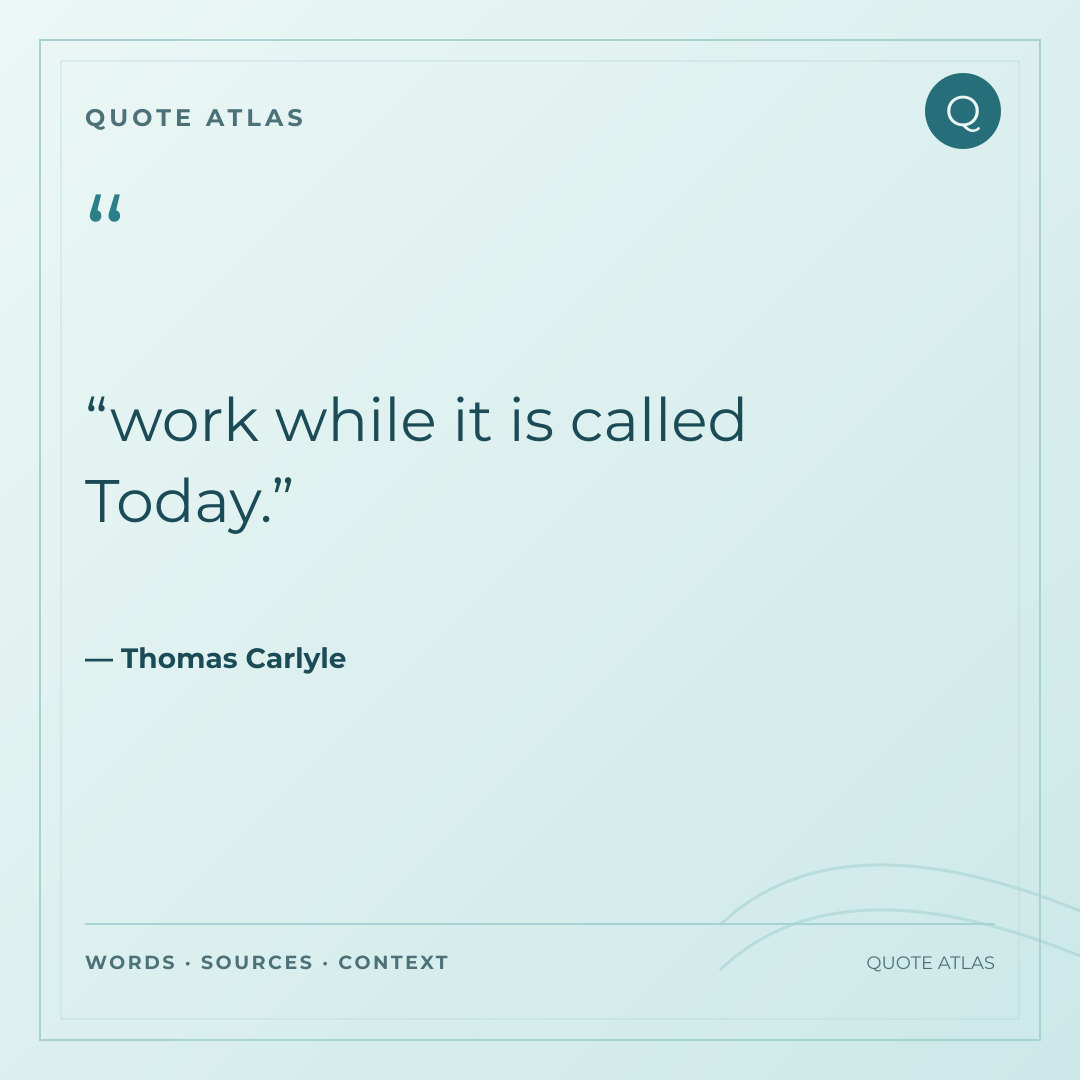
work while it is called Today.

“work while it is called Today.”

The sentence places useful effort in the time actually available now, making present action more important than indefinite postponement.

Source details

Past and Present, Book III, Chapter XII, “Reward,” printed page 251 in Thomas Carlyle’s Collected Works, Library Edition, Vol. XIII (London: Chapman and Hall), Project Gutenberg #26159. Carlyle says one shall “work while it is called Today” immediately before “For the Night cometh, wherein no man can work,” retaining the biblical allusion and nineteenth-century religious exhortation rather than reframing it as productivity science.

Source identified548
Work, and therein have well-being.

“Work, and therein have well-being.”

Carlyle links active work with well-being in a deliberately moral and religious account of labor as a way of ordering life and confronting disorder.

Source details

Past and Present, Book III, Chapter XII, “Reward,” printed page 250 in Thomas Carlyle’s Collected Works, Library Edition, Vol. XIII (London: Chapman and Hall), Project Gutenberg #26159. “Work, and therein have well-being” opens Carlyle’s enduring “Gospel” of work inside explicitly Christian Victorian social criticism. This collection preserves that historical moral-religious setting and does not present the sentence as a modern health, wellness or employment guarantee.

Source identified549
Do the Duty which lies nearest thee

“Do the Duty which lies nearest thee”

Voice: Fictional narrator · Diogenes Teufelsdröckh (framed voice)

The advice narrows attention from an overwhelming field of possibilities to the responsibility that is already clear enough to act on, with later duties expected to become clearer through action.

Source details

Sartor Resartus, Book II, Chapter IX, “The Everlasting Yea,” printed page 156 / Wikisource scan leaf 188 in The Works of Thomas Carlyle, Centenary Edition, Vol. I (New York: Charles Scribner’s Sons, 1896). “Do the Duty which lies nearest thee” follows the doubt/action sentence and is explicitly described as a precept that was of invaluable service to Teufelsdröckh. It remains fictional-philosophical and religious conduct-of-life rhetoric rather than a context-free productivity command.

Source identified550
An aged thrush, frail, gaunt, and small, In blast-beruffled plume, Had chosen thus to fling his soul Upon the growing gloom.

“An aged thrush, frail, gaunt, and small, In blast-beruffled plume, Had chosen thus to fling his soul Upon the growing gloom.”

A physically frail bird sings into a bleak winter scene, creating a contrast in which hope appears through action even though the speaker does not understand its source.

Source details

“The Darkling Thrush,” Poems of the Past and the Present; Project Gutenberg #3168. The poem's final hope remains uncertain to the speaker rather than becoming a guarantee of optimism.

Source identified551
A long habit of not thinking a thing wrong, gives it a superficial appearance of being right.

“A long habit of not thinking a thing wrong, gives it a superficial appearance of being right.”

Custom can disguise error by making the familiar feel legitimate; critical judgment requires re-examining practices that have escaped scrutiny through repetition.

Source details

Common Sense (1776), Introduction. The represented opening sentence is verified in Project Gutenberg #147 and the validated scan-backed Wikisource transcription; Paine argues that familiarity can make a wrong practice appear right before public argument unsettles the custom.

Source identified552
These are the times that try men's souls.

“These are the times that try men's souls.”

Crisis reveals commitment because principles become costly to maintain precisely when fear, fatigue, and uncertainty make retreat easier.

Source details

Opening of The American Crisis No. I; Paine addresses perseverance during a difficult stage of the American Revolution.

Source identified553
that we must cultivate our garden.

“that we must cultivate our garden.”

Voice: Fictional character · Candide

Candide turns away from endless abstract explanation toward concrete shared work, making the garden a practical answer to the suffering and argument that have filled the story.

Source details

Candide, Chapter XXX, Project Gutenberg #19942, uncredited public-domain English translation. Candide says “that we must cultivate our garden” to Pangloss and Martin near the tale’s close after reflecting on the old Turk’s life of work. This is translated fictional dialogue and literary resolution, not Voltaire autobiography or a literal guarantee that work resolves every hardship.

Source identified554
I sound my barbaric yawp over the roofs of the world.

“I sound my barbaric yawp over the roofs of the world.”

The exuberant image celebrates unapologetic self-expression and a voice that refuses to become small merely to fit social expectations.

Source details

Near the close of “Song of Myself”; Whitman turns self-expression into a large, physical cry.

Source identified555
in literary as in all other art, structure is all-important

“in literary as in all other art, structure is all-important”

Pater treats structure as a governing discipline: a work should be conceived as a whole whose parts remain related to its beginning, direction and intended end.

Source details

Appreciations, with an Essay on Style, essay “Style,” printed page 21 in the Macmillan 1910 Library Edition pagination reproduced by Project Gutenberg #4037. “in literary as in all other art, structure is all-important” introduces Pater’s architectural account of composition, where a work’s end is foreseen in its beginning and each part remains conscious of the rest.

Source identified556
makes the reading of Wordsworth an excellent sort of training towards the things of art and poetry.

“makes the reading of Wordsworth an excellent sort of training towards the things of art and poetry.”

Pater presents sustained engagement with a difficult poet as a form of aesthetic training, implying that taste and discrimination can be developed through repeated attentive reading.

Source details

Appreciations, with an Essay on Style, essay “Wordsworth,” printed page 41 in the Macmillan 1910 Library Edition pagination reproduced by Project Gutenberg #4037. Pater says that the contrast between Wordsworth’s higher and lower poetic moods “makes the reading of Wordsworth an excellent sort of training towards the things of art and poetry.” This remains Pater’s critical judgment about aesthetic training, not an experimentally established educational outcome.

Source identified557
a habit of reading between the lines, a faith in the effect of concentration and collectedness of mind in the right appreciation of poetry

“a habit of reading between the lines, a faith in the effect of concentration and collectedness of mind in the right appreciation of poetry”

Pater describes demanding reading as training in concentration and inference, where appreciation grows through disciplined attention instead of quick surface consumption.

Source details

Appreciations, with an Essay on Style, essay “Wordsworth,” printed page 42 in the Macmillan 1910 Library Edition pagination reproduced by Project Gutenberg #4037. The reading-between-the-lines passage follows Pater’s claim that Wordsworth-reading can train aesthetic discrimination; he attributes to receptive readers a habit of inference plus faith in concentration and collectedness of mind. This remains nineteenth-century literary criticism rather than cognitive-science evidence.

Source identified558
all progress of mind consists for the most part in differentiation, in the resolution of an obscure and complex object into its component aspects

“all progress of mind consists for the most part in differentiation, in the resolution of an obscure and complex object into its component aspects”

Pater describes intellectual progress as learning to distinguish parts within what initially seems confused, a method that makes clearer categories and more exact judgment possible.

Source details

Appreciations, with an Essay on Style, essay “Style,” printed page 5 in the standard Macmillan 1910 Library Edition pagination reproduced by Project Gutenberg #4037. “all progress of mind consists for the most part in differentiation...” opens Pater’s argument by distinguishing prose, verse and poetry. This is literary-aesthetic criticism, not a modern experimental claim about cognition or learning.

Source identified559
To burn always with this hard, gemlike flame, to maintain this ecstasy, is success in life.

“To burn always with this hard, gemlike flame, to maintain this ecstasy, is success in life.”

The famous image defines success through intensity and alertness of experience rather than conventional achievement, fitting Pater’s larger argument against living automatically through habit.

Source details

The Renaissance, Conclusion; Project Gutenberg #2398. The metaphor belongs to Pater’s aesthetic philosophy and should not be reduced to generic productivity advice.

Source identified560
The service of philosophy, of speculative culture, towards the human spirit is to rouse, to startle it into sharp and eager observation.

“The service of philosophy, of speculative culture, towards the human spirit is to rouse, to startle it into sharp and eager observation.”

Pater values philosophy for sharpening attention: its practical intellectual service is to make perception more alert rather than allowing experience to pass unnoticed through habit.

Source details

The Renaissance, Conclusion; Project Gutenberg #2398. The line belongs to Pater’s historically controversial conclusion on experience and culture.

Source identified561
What we have to do is to be for ever curiously testing new opinions and courting new impressions, never acquiescing in a facile orthodoxy

“What we have to do is to be for ever curiously testing new opinions and courting new impressions, never acquiescing in a facile orthodoxy”

Pater recommends intellectual openness and repeated testing rather than easy conformity, making revision and exposure to new impressions part of an active critical life.

Source details

The Renaissance, Conclusion; Project Gutenberg #2398. The sentence names Comte, Hegel and one’s own orthodoxy in its immediate continuation.

Source identified562
Come one, come all! this rock shall fly From its firm base as soon as I.

“Come one, come all! this rock shall fly From its firm base as soon as I.”

Fitz-James refuses intimidation despite being surrounded, using the rock image to express a determination not to be moved from his position by threats.

Source details

The Lady of the Lake, Canto V, “The Combat,” stanza X, Project Gutenberg #45888. Fitz-James says “Come one, come all!” with his back against a rock after Roderick Dhu’s signal reveals armed followers around him. The defiant rock image is fictional martial speech in Scott’s historical romance in verse rather than current safety, combat or self-help advice.

Source identified563
There is no hope, if we look back at the past: there may be hope, if we look on to the future.

“There is no hope, if we look back at the past: there may be hope, if we look on to the future.”

Mr Pendril urges Miss Garth to focus on what can still change rather than treating past disaster as proof that every future possibility is closed.

Source details

No Name, Project Gutenberg #1438. Mr Pendril speaks after the Vanstone sisters lose their legal and financial position; the surrounding dialogue immediately qualifies the hope as uncertain and dependent on future events.

Source identified564
Artistic growth is, more than it is anything else, a refining of the sense of truthfulness.

“Artistic growth is, more than it is anything else, a refining of the sense of truthfulness.”

Cather’s narrator presents artistic development as increasingly exact honesty about perception and expression rather than as mere technical display or sudden inspiration.

Source details

The Song of the Lark, Part VI, Chapter X, Project Gutenberg #44. ‘Artistic growth is... a refining of the sense of truthfulness’ is narrator reflection immediately after Harsanyi calls passion the artist's ‘open secret’ and as Thea Kronborg comes into fuller command of her mature performance. It belongs to Cather's fictional account of artistic formation and performance, not an empirical measurement of artistic development or a guarantee that all artists mature in the same way.

Source identified565
He who desires but acts not breeds pestilence.
Image design Rose Studio

“He who desires but acts not breeds pestilence.”

Unacted desire can turn stagnant; the line pushes toward action rather than indefinite wishing.

Source details

“Proverbs of Hell.”

Source identified566
The road of excess leads to the palace of wisdom.

“The road of excess leads to the palace of wisdom.”

The proverb provocatively suggests that excess can teach limits through direct experience, though it is not a simple instruction to pursue excess.

Source details

The Marriage of Heaven and Hell, “Proverbs of Hell”; Blake presents the line as a deliberately paradoxical aphorism about experience and limits.

Source identified567
So live, that when thy summons comes to join The innumerable caravan, which moves To that mysterious realm,

“So live, that when thy summons comes to join The innumerable caravan, which moves To that mysterious realm,”

Bryant turns the poem’s long meditation on universal mortality into an appeal to live in a way that makes eventual death less degrading or fearful.

Source details

“Thanatopsis,” represented in Project Gutenberg #29700. These lines begin the poem’s closing counsel after its extended description of death and nature; the language is poetic and spiritual rather than clinical end-of-life guidance.

Source identified568
Truth, crushed to earth, shall rise again;

“Truth, crushed to earth, shall rise again;”

Bryant expresses confidence that truth can survive temporary defeat and re-emerge even when public power, violence or opinion appears to have buried it.

Source details

“The Battlefield,” represented in Project Gutenberg #29700. The line belongs to a civic-religious meditation on conflict, sacrifice and moral endurance; its resurrection imagery expresses poetic conviction rather than a literal law of history.

Source identified569
In the long way that I must tread alone, Will lead my steps aright.

“In the long way that I must tread alone, Will lead my steps aright.”

The speaker takes the waterfowl’s guided migration as a religious image of trust that his own solitary path can also have direction.

Source details

“To a Waterfowl,” represented in Project Gutenberg #29700. The closing lines explicitly infer providential guidance from the bird’s flight; the claim remains Christian-inflected lyric reflection, not evidence about supernatural intervention.

Source identified570
My head is bloody, but unbowed.

“My head is bloody, but unbowed.”

The speaker acknowledges injury without surrendering inward posture, making the line a compact image of retaining agency and self-possession under circumstances that have already caused real harm.

Source details

“Invictus,” first published in Henley’s 1888 Book of Verses (written 1875) and represented through the public-domain poem text. This is the second stanza’s closing line, following “Under the bludgeonings of chance”; this collection keeps the poem’s defiant lyric voice rather than treating it as a guarantee that adversity can always be mastered.