Quote Atlassourced quotes & context
Page 5 of 6 · 537 quotations total

Life quotes — Page 5

This continuation page contains additional source-backed quotations not shown in the initial 80-quotation overview. Return to the topic guide and browse collection.

100 shown · 537 total
Source identified381
And this is why knowledge is more honourable and excellent than true opinion, because fastened by a chain.
Image design Charcoal

“And this is why knowledge is more honourable and excellent than true opinion, because fastened by a chain.”

Voice: Dialogue speaker · Socrates

Socrates compares an accurate opinion with understanding that can remain stable because it is connected to an explanation. In his illustration, true beliefs are useful but may slip away until they are secured by an account of their causes; the chain is a metaphor, not a claim about literal memory storage.

Source details

Meno, around Stephanus 97e–98a, Socrates addressing Meno after the Daedalus-statue comparison. The quoted standalone sentence immediately follows Socrates’s argument that right opinions can guide action but need to be tied down by an account of their cause. Benjamin Jowett English translation, Project Gutenberg #1643. The text and translational phrasing are Jowett’s; the dialogue does not treat every true opinion as worthless.

Source identified382
But now, inasmuch as the soul is manifestly immortal, there is no release or salvation from evil except the attainment of the highest virtue and wisdom.
Image design Linen

“But now, inasmuch as the soul is manifestly immortal, there is no release or salvation from evil except the attainment of the highest virtue and wisdom.”

Voice: Dialogue speaker · Socrates

Near the end of the Phaedo, Socrates connects the way a person lives with the care and formation of the soul. His claim depends on an argument for immortality advanced inside the dialogue; it is a philosophical and religious position, not a scientific finding about an afterlife.

Source details

Plato, Phaedo, approximately 107c, Socrates addressing his companions after the arguments concerning the soul; Benjamin Jowett English, Gutenberg #1658. This sentence is in the dialogue proper, not the translator introduction. Preserve the surrounding conditional argument about the soul and historical belief in immortality.

Source identified383
For wisdom is a most beautiful thing, and Love is of the beautiful; and therefore Love is also a philosopher or lover of wisdom

“For wisdom is a most beautiful thing, and Love is of the beautiful; and therefore Love is also a philosopher or lover of wisdom”

Voice: Reported speaker · Diotima, recounted by Socrates

Diotima links love with philosophy by treating wisdom as something beautiful that the lover does not fully possess but continues to seek, placing philosophical desire between ignorance and completed wisdom.

Source details

Symposium, Socrates recounting Diotima’s teaching, Benjamin Jowett translation, Project Gutenberg #1600. The represented wording belongs to Diotima’s account of Love as intermediate between the wise and the ignorant.

Source identified384
Knowledge which is acquired under compulsion obtains no hold on the mind.

“Knowledge which is acquired under compulsion obtains no hold on the mind.”

Voice: Dialogue speaker · Socrates

Learning forced without engagement may fail to become durable understanding because the learner has not made the knowledge intellectually their own.

Source details

The Republic, Book VII, Jowett translation; Socrates argues that education should draw the mind rather than rely only on compulsion.

Source identified385
The direction in which education starts a man, will determine his future life.

“The direction in which education starts a man, will determine his future life.”

Voice: Dialogue speaker · Socrates

Early education shapes habits of attention and judgment, so its direction can influence the kind of person someone later becomes.

Source details

The Republic, Book IV in Benjamin Jowett’s translation; the line appears during discussion of education and civic character.

Source identified386
Is the attempt to determine the way of man’s life so small a matter in your eyes—to determine how life may be passed by each one of us to the greatest advantage?
Image design Charcoal

“Is the attempt to determine the way of man’s life so small a matter in your eyes—to determine how life may be passed by each one of us to the greatest advantage?”

Voice: Dialogue speaker · Socrates

In Book I Socrates refuses to treat the dispute about justice as mere verbal sparring, because the argument bears on the kind of life people should choose. He addresses Thrasymachus while challenging whether injustice really benefits a person; his question does not settle that dispute on its own.

Source details

Plato, The Republic, Book I, around 344e, Socrates in dialogue with Thrasymachus. Wording verified in Benjamin Jowett, third edition (1888), transcribed in Gutenberg #55201. This is dialogue speech following Thrasymachus’s defence of injustice, not the translator’s prefatory analysis. Edition-specific wording must be preserved.

Source identified387
Whoso loveth instruction loveth knowledge: but he that hateth reproof is brutish.

“Whoso loveth instruction loveth knowledge: but he that hateth reproof is brutish.”

Learning requires willingness to be corrected; rejecting every form of reproof blocks the feedback needed for growth.

Source details

Proverbs 12:1, King James Version.

Source identified389
He that is of a merry heart hath a continual feast.

“He that is of a merry heart hath a continual feast.”

A glad disposition can make ordinary life feel abundant even when circumstances are modest, because experience is shaped partly by the heart meeting it.

Source details

Proverbs 15:15 in the King James Version; concluding clause of the verse.

Source identified390
Pride goeth before destruction, and an haughty spirit before a fall.

“Pride goeth before destruction, and an haughty spirit before a fall.”

The proverb treats pride as a warning sign that can blind judgment before a serious mistake.

Source details

Proverbs 16:18 in the King James Version; the proverb warns that pride and haughtiness can precede destruction or a fall.

Source identified392
Hear counsel, and receive instruction, that thou mayest be wise in thy latter end.

“Hear counsel, and receive instruction, that thou mayest be wise in thy latter end.”

Listening to correction and counsel is presented as an investment whose value becomes clearer over the course of a life.

Source details

Proverbs 19:20, King James Version.

Source identified393
Make no friendship with an angry man; and with a furious man thou shalt not go:

“Make no friendship with an angry man; and with a furious man thou shalt not go:”

The proverb treats repeated fury as socially contagious, warning that close association can shape habits and judgment.

Source details

Proverbs 22:24 in the King James Version; the next verse warns that a person can learn the ways of the habitually angry.

Source identified394
Iron sharpeneth iron; so a man sharpeneth the countenance of his friend.

“Iron sharpeneth iron; so a man sharpeneth the countenance of his friend.”

Good relationships can improve judgment and character through challenge, conversation, and mutual influence.

Source details

Proverbs 27:17 in the King James Version; the proverb uses sharpening as an image for the way one person can strengthen or refine another.

Source identified395
Go to the ant, thou sluggard; consider her ways, and be wise.

“Go to the ant, thou sluggard; consider her ways, and be wise.”

The proverb uses the ant as an example of self-directed preparation, turning observation of repeated practical behavior into a lesson about disciplined habits.

Source details

Proverbs 6:6 in the King James Version; the following verses describe the ant preparing food without an overseer.

Source identified397
As men, we are all equal in the presence of death.

“As men, we are all equal in the presence of death.”

Death strips away rank and status, emphasizing a condition shared by every person regardless of position or wealth.

Source details

The Moral Sayings of Publius Syrus, maxim 1, in Darius Lyman’s 1856 English rendering; maxim order can vary across editions.

Source identified398
The evil you do to others you may expect in return.

“The evil you do to others you may expect in return.”

Harm has consequences that often return through retaliation, damaged trust, reputation, or the patterns of conduct we create.

Source details

The Moral Sayings of Publius Syrus, maxim 2, in Darius Lyman’s 1856 English rendering; maxim order can vary across editions.

Source identified399
Adversity shows whether we have friends, or only the shadows of friends.

“Adversity shows whether we have friends, or only the shadows of friends.”

Difficulty tests whether a relationship has substance because support under pressure reveals more than companionship during easy circumstances.

Source details

The Moral Sayings of Publius Syrus, saying 35, D. Lyman Jr. translation (1856).

Source identified400
I live in the hope of meeting with him

“I live in the hope of meeting with him”

The speaker continues to wait in hope despite an unfulfilled meeting, making expectation itself part of the devotional life rather than proof that fulfillment has already arrived.

Source details

Gitanjali, poem 13; Project Gutenberg #7164. The “him” is the poem’s spiritual addressee, so the record preserves devotional context instead of converting the sentence into a secular promise.

Source identified401
And it shall be my endeavour to reveal thee in my actions

“And it shall be my endeavour to reveal thee in my actions”

Tagore connects devotion with conduct: inward belief is meant to become visible through what a person actually does rather than remain only an interior feeling.

Source details

Gitanjali, poem 4, in Tagore’s own prose translations from Bengali; Project Gutenberg #7164. The omitted continuation explicitly attributes the strength to act to the divine addressee, so the line remains religious rather than generic productivity advice.

Source identified402
MAN is a born child, his power is the power of growth.

“MAN is a born child, his power is the power of growth.”

Tagore defines human power through continued capacity to develop, using childhood as an image of openness to change rather than completed maturity.

Source details

Stray Birds, aphorism 25, translated by Tagore from Bengali; Project Gutenberg #6524. The compact line is poetic-philosophical and is not presented as a modern developmental-psychology claim.

Source identified404
My life is for itself and not for a spectacle.

“My life is for itself and not for a spectacle.”

The line rejects living primarily for public display and treats a life’s inward reality as more important than performing goodness for outside approval.

Source details

Self-Reliance, in Emerson’s discussion of genuine action rather than virtue performed as spectacle.

Source identified405
Character is higher than intellect.

“Character is higher than intellect.”

Emerson ranks lived character above intellect considered by itself, insisting that thinking gains its fullest value when it belongs to an integrated way of living.

Source details

“The American Scholar” (1837), represented in Emerson’s Essays, Project Gutenberg #16643. Emerson contrasts thought as a partial function with the fuller act of living one’s truth; the line elevates character without dismissing intellectual life.

Source identified406
Life is a search after power.

“Life is a search after power.”

Emerson treats living as an active search for capacity and agency, so growth involves finding and using the powers that let a person act effectively.

Source details

The Conduct of Life, essay II, “Power,” Project Gutenberg #39827. “Life is a search after power” appears at the opening of Emerson’s prose discussion after the verse epigraph and introduces his account of capacity, agency and human influence. It remains nineteenth-century Transcendentalist conduct-of-life philosophy rather than an empirical law of motivation or success.

Source identified407
The purpose of life is unquestionably unfoldment, growth, advancement

“The purpose of life is unquestionably unfoldment, growth, advancement”

Trine states his view of purpose directly: life should continue to develop rather than settle into mental or moral stagnation.

Source details

The Higher Powers of Mind and Spirit; Project Gutenberg #28163. The surrounding text describes evolution from “lower” to “higher” in spiritual terms; this is Trine’s philosophical-religious position, not a scientific law of human development.

Source identified408
There are moments in the lives of all of us when we catch glimpses of a life—our life—that is infinitely beyond the life we are now living.

“There are moments in the lives of all of us when we catch glimpses of a life—our life—that is infinitely beyond the life we are now living.”

The opening image treats dissatisfaction with present limits as awareness of unrealized possibility, turning a glimpse of a better life into a reason for deliberate development.

Source details

The Higher Powers of Mind and Spirit, Chapter I, “The Silent, Subtle Building Forces of Mind and Spirit,” Project Gutenberg #28163. Trine opens with moments when people glimpse a life beyond their present one, then develops New Thought and metaphysical claims about latent powers, spirit and “mental and spiritual science.” It is historical religious-metaphysical self-development rhetoric, not modern psychology or neuroscience.

Source identified409
the true joy of existence comes from living to one's highest.

“the true joy of existence comes from living to one's highest.”

The sentence locates fulfillment in trying to live at one’s best level of character and capacity, making aspiration itself part of the purpose of life.

Source details

What All The World’s A-Seeking, Part III, “The Unfoldment,” printed page 75 in the represented 1896 page-text witness, cross-checked against Project Gutenberg #14312. Trine says “the true joy of existence comes from living to one’s highest” immediately after urging the reader to “live to your highest.” It remains historical New Thought / conduct-of-life counsel rather than a claim that striving automatically removes hardship or produces happiness in every circumstance.

Source identified410
There is not so helpless and pitiable an object in the world as a landsman beginning a sailor’s life.

“There is not so helpless and pitiable an object in the world as a landsman beginning a sailor’s life.”

Dana remembers how bewildering the first hours of shipboard life felt to a novice suddenly surrounded by unfamiliar orders, sounds and tasks.

Source details

Two Years Before the Mast, Chapter I, “Departure,” Project Gutenberg #2055. Dana describes his own bewilderment on first going to sea and calls a landsman beginning a sailor’s life uniquely helpless and pitiable. It is first-person maritime memoir shaped by rhetorical exaggeration, not a literal universal ranking of helplessness.

Source identified411
I think of the drift of time

“I think of the drift of time”

Seasonal change prompts Jefferies to experience time as movement visible in buds, flowers and remembered observation, linking temporal awareness to close attention to the natural world.

Source details

Field and Hedgerow, in the essay “Hours of Spring”; Project Gutenberg #7030. The book was collected posthumously by Jefferies’s widow, so individual essays may predate the 1889 volume.

Source identified412
The gap of time since I had seen him last had made no impression on me

“The gap of time since I had seen him last had made no impression on me”

Jefferies describes memory resisting elapsed time: the remembered person remains vivid even though years have passed and death has created an irreversible break in the present.

Source details

Field and Hedgerow; Project Gutenberg #7030. The sentence occurs in a recollection of John Brown after his death and is kept in that personal-memory context rather than generalized into abstract grief advice.

Source identified413
It is eternity now.

“It is eternity now.”

Jefferies collapses ordinary chronological distinctions into an intensely experienced present, describing the current moment as participation in eternity rather than a point merely passing toward the future.

Source details

The Story of My Heart (1883), Chapter III, Project Gutenberg #2317. The inherited Chapter I note is corrected: ‘It is eternity now’ occurs in Jefferies’s tumulus meditation after he writes that, recognising his inner consciousness / psyche, he cannot understand time. It is speculative spiritual autobiography and metaphysical-poetic reflection, not a scientific theory of time, physics or consciousness.

Source identified414
Reading is to the mind what exercise is to the body.

“Reading is to the mind what exercise is to the body.”

Regular reading is compared with physical exercise because repeated intellectual use can strengthen attention, knowledge, and mental capacity over time.

Source details

The Tatler No. 147; the comparison presents reading as a form of regular exercise for the mind.

Source identified415
God's in his heaven—All's right with the world!

“God's in his heaven—All's right with the world!”

Pippa’s song voices a moment of religious confidence and ordinary delight whose effect in the drama depends on other characters hearing it at morally decisive moments.

Source details

Pippa Passes (1841), represented in the Project Gutenberg Robert Browning works edition #59123. The lyric is sung by Pippa inside a verse drama; its Christian optimism is a character-song within the play, not a factual guarantee that every event is good.

Source identified416
Grow old along with me! The best is yet to be,

“Grow old along with me! The best is yet to be,”

Browning’s dramatic speaker frames aging not merely as decline but as part of a larger spiritual development in which later life can complete what youth only begins.

Source details

“Rabbi Ben Ezra” (1864), represented in Project Gutenberg #59123, The Works of Robert Browning. The poem speaks through Browning’s imagined Rabbi Ben Ezra and is explicitly theistic; its confidence about age and providence is poetic-religious argument rather than a factual guarantee about later life.

Source identified417
Wee modest crimson-tippèd flow’r, Thou’s met me in an evil hour; For I maun crush amang the stoure Thy slender stem:

“Wee modest crimson-tippèd flow’r, Thou’s met me in an evil hour; For I maun crush amang the stoure Thy slender stem:”

The speaker addresses the small flower with regret as the plough destroys it, turning an accidental act against nature into a meditation on vulnerability.

Source details

“To a Mountain Daisy,” written 1786, represented in Project Gutenberg #18388. This is the opening excerpt; Burns later extends the flower’s fate into reflections on human fragility and uncertainty.

Source identified418
The best laid schemes o’ mice an’ men Gang aft agley,

“The best laid schemes o’ mice an’ men Gang aft agley,”

Burns reflects that careful plans can still be overturned by circumstances, linking the mouse’s ruined nest with the wider human experience of disappointed expectations.

Source details

“To a Mouse,” written in November 1785 and represented in Project Gutenberg #1279. The Scots wording appears in a poem that moves from sympathy with an animal to reflection on human foresight, regret and fear of the future.

Source identified419
Gather ye rosebuds while ye may, Old Time is still a-flying:

“Gather ye rosebuds while ye may, Old Time is still a-flying:”

Herrick’s speaker uses rapidly fading flowers as a carpe-diem image, urging action while youth and opportunity remain available.

Source details

“To the Virgins, to Make Much of Time,” published in Hesperides in 1648. The poem’s later marriage exhortation reflects its seventeenth-century social setting; the opening image is retained as literary carpe-diem rhetoric, not universal relationship advice.

Source identified420
To travel hopefully is a better thing than to arrive, and the true success is to labour.
Image design Coastal

“To travel hopefully is a better thing than to arrive, and the true success is to labour.”

The value of a journey can lie in purposeful movement and effort rather than only in the moment of arrival.

Source details

Essay “El Dorado.”

Source identified421
To be what we are, and to become what we are capable of becoming, is the only end of life.

“To be what we are, and to become what we are capable of becoming, is the only end of life.”

Stevenson’s formulation links self-acceptance with development: a worthwhile life is not imitation of someone else’s pattern but fuller realization of capacities that belong to one’s own character.

Source details

Familiar Studies of Men and Books, essay ‘Henry David Thoreau: His Character and Opinions,’ section V, Project Gutenberg #425, transcribed from the 1896 Chatto & Windus edition. The surrounding paragraph quotes several Thoreau statements, but ‘To be what we are, and to become what we are capable of becoming...’ is Stevenson's own connective judgment before he returns to quoted Thoreau language. It therefore remains Stevenson literary-biographical criticism rather than a Thoreau quotation or a clinical rule about self-development.

Source identified422
there falls along with him a whole wing of the palace of our life.

“there falls along with him a whole wing of the palace of our life.”

The death of a close friend is pictured as structural loss inside the survivor’s own life because shared memory, recognition and companionship disappear with that person.

Source details

Memories and Portraits; Project Gutenberg #381. The surrounding passage describes friendship, mortality and memory; the architectural metaphor is kept as grief writing rather than literal psychology.

Source identified423
If you can meet with Triumph and Disaster And treat those two impostors just the same.

“If you can meet with Triumph and Disaster And treat those two impostors just the same.”

Kipling’s speaker recommends maintaining steadiness toward both success and failure rather than allowing either outcome to determine one’s character or judgment.

Source details

“If—,” in Rewards and Fairies, Project Gutenberg #556. The poem presents a period ideal of masculine self-command through a sequence of conditional tests; the stored lines are literary and moral rhetoric, not a requirement to suppress normal emotion.

Source identified424
A distinct university walks about under each man's hat.

“A distinct university walks about under each man's hat.”

Voice: Authorial / signed preface voice · Russell H. Conwell

Conwell’s metaphor presents each person’s powers of observation and reflection as a continuing source of self-education beyond formal institutions.

Source details

Every Man His Own University, Chapter I, “Every Man’s University,” Project Gutenberg #36955, copyright 1917 witness. Conwell opens the chapter with “A distinct university walks about under each man’s hat” and develops the metaphor through observation, reading and independent thought. It is historical motivational/educational rhetoric, not evidence that formal education is unnecessary.

Source identified425
Very few live by choice.

“Very few live by choice.”

Voice: Fictional character · Imlac

People often inherit circumstances they did not select, which can make neighboring lives appear more desirable than their own.

Source details

Rasselas, Chapter XXI; spoken by Imlac while challenging the assumption that apparently wise people deliberately chose the condition they inhabit.

Source identified426
Example is always more efficacious than precept.

“Example is always more efficacious than precept.”

Voice: Fictional character · Imlac

Observed practice can teach more effectively than instruction alone because it shows principles operating in concrete action.

Source details

Rasselas, Chapter XXX; spoken by Imlac during a discussion of history, art and the practical use of studying what earlier people accomplished.

Source identified427
The present state of things is the consequence of the former.

“The present state of things is the consequence of the former.”

Voice: Fictional character · Imlac

Understanding present conditions requires tracing the earlier choices and causes that produced them rather than treating the present as isolated.

Source details

Rasselas, Chapter XXX; Imlac argues that studying history helps people understand the sources of present benefits and harms.

Source identified428
Human life is everywhere a state in which much is to be endured and little to be enjoyed.

“Human life is everywhere a state in which much is to be endured and little to be enjoyed.”

Voice: Fictional character · Imlac

The novel resists fantasies of perfect circumstances by emphasizing that difficulty follows people across different places and conditions.

Source details

Rasselas, Chapter XVI; spoken by Imlac while comparing European life with the travelers’ expectations of happiness.

Source identified429
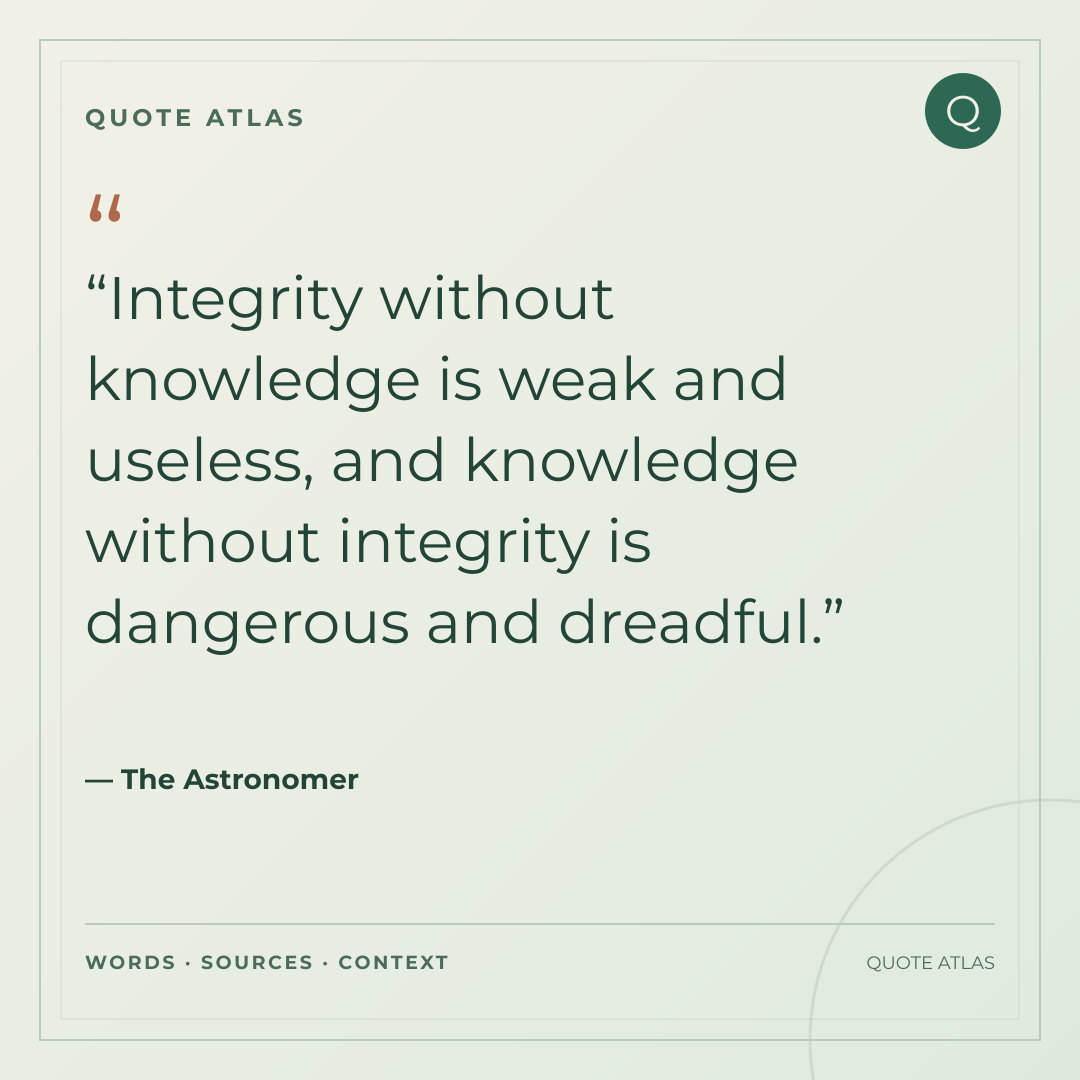
Integrity without knowledge is weak and useless, and knowledge without integrity is dangerous and dreadful.

“Integrity without knowledge is weak and useless, and knowledge without integrity is dangerous and dreadful.”

Voice: Fictional character · The Astronomer

Knowledge needs ethical direction, while good intentions need understanding; either quality becomes inadequate when separated from the other.

Source details

Chapter 41; the Astronomer explains why both competence and moral character are needed for trust.

Source identified430
We do not indeed so often disappoint others as ourselves.

“We do not indeed so often disappoint others as ourselves.”

Private expectations can exceed what anyone else demands of us, so a life may feel disappointing chiefly by comparison with unfulfilled plans known only to oneself.

Source details

The Idler, No. 88; the surrounding paragraph concerns private hopes, proposed tasks and the gap between imagined achievement and lived action.

Source identified432
And pause awhile from Learning to be wise;

“And pause awhile from Learning to be wise;”

Johnson distinguishes accumulating learning from exercising judgment, asking the scholar to interrupt pursuit of knowledge long enough to examine what wisdom requires.

Source details

The Vanity of Human Wishes (1749), first-edition scholar passage, Wikisource scan leaf 28. “And pause awhile from Learning to be wise” turns from the ambitious student’s pursuit of knowledge toward Johnson’s satirical warning that learning does not by itself remove grief, danger or error. This is eighteenth-century moral-satirical poetry after Juvenal, not a modern educational rule.

Source identified433
There is no act, however trivial, but has its train of consequences.

“There is no act, however trivial, but has its train of consequences.”

Small actions matter because repetition creates habits and consequences that can accumulate long after a single choice seemed insignificant.

Source details

Character, Chapter I, “Influence of Character,” Project Gutenberg #2541. The sentence follows Smiles’s claim that character is formed through minute circumstances and daily discipline, emphasizing that even apparently trivial acts carry consequences.

Source identified434
The most influential of all the virtues are those which are the most in request for daily use.

“The most influential of all the virtues are those which are the most in request for daily use.”

Virtues become socially important when they guide routine dealings with other people rather than appearing only in exceptional or ceremonial situations.

Source details

Character, Chapter I, “Influence of Character,” Project Gutenberg #2541. In the chapter’s discussion of duty in ordinary life, Smiles argues that the virtues most needed in everyday conduct exert the widest and most lasting influence.

Source identified435
We learn wisdom from failure much more than from success.

“We learn wisdom from failure much more than from success.”

Failure can expose what does not work and force closer observation, turning setbacks into information that uncomplicated success may never reveal.

Source details

Self-Help, Chapter XI, “Self-Culture—Facilities and Difficulties,” Project Gutenberg #935. The passage follows Charles James Fox’s contrast between early success and perseverance after failure, then leads into examples of discoveries and learning produced through mistakes and failed attempts.

Source identified436
Progress, however, of the best kind, is comparatively slow.

“Progress, however, of the best kind, is comparatively slow.”

Smiles treats durable progress as incremental rather than instantaneous, arguing that worthwhile results are built through repeated effort and patience instead of expecting one dramatic breakthrough.

Source details

Self-Help, Chapter IV, “Application and Perseverance,” Project Gutenberg #935. The sentence opens a paragraph that continues, “Great results cannot be achieved at once,” and compares advancement in life to walking step by step.

Source identified437
The education of character is very much a question of models.

“The education of character is very much a question of models.”

People absorb conduct from examples around them, so lived models can teach more powerfully than rules that are contradicted by behavior.

Source details

Self-Help, Chapter XII, “Example—Models,” Project Gutenberg #935. Smiles argues that character education depends heavily on models because people unconsciously mould themselves after the characters, manners, habits and opinions around them.

Source identified438
Lost wealth may be replaced by industry, lost knowledge by study, lost health by temperance or medicine, but lost time is gone for ever.

“Lost wealth may be replaced by industry, lost knowledge by study, lost health by temperance or medicine, but lost time is gone for ever.”

Many losses can be repaired through later effort, but spent time cannot be recovered, giving attention and method unusual importance.

Source details

Self-Help, Chapter IX, “Men of Business,” Project Gutenberg #935. The sentence appears in Smiles’s discussion of method, punctuality and the economical use of time, contrasting losses that may be repaired with time once spent, which cannot be recovered.

Source identified439
So much patient perseverance could not but eventually succeed

“So much patient perseverance could not but eventually succeed”

Smiles describes Stephenson’s progress in arithmetic as the cumulative result of study and patient persistence rather than easy aptitude.

Source details

The Life of George Stephenson and of his Son Robert Stephenson, Chapter IV, “The Stephensons at Killingworth—Education and Self-Education of Father and Son”; represented 1868 revised edition, Project Gutenberg #46229. The excerpt is Smiles’s narration of Stephenson’s patient arithmetic study under John Wigham.

Source identified440
It works for to-day, but also provides for to-morrow.

“It works for to-day, but also provides for to-morrow.”

Good stewardship balances present needs with future obligations instead of treating either immediate enjoyment or distant security as the only concern.

Source details

Thrift, Chapter I, “Industry,” Project Gutenberg #14418. The sentence occurs in the same definition of thrift as an acquired principle of conduct: present enjoyment is subordinated to forethought so that action serves today while providing for tomorrow.

Source identified441
Thrift is merely common sense in every-day working action.

“Thrift is merely common sense in every-day working action.”

The principle is made practical rather than glamorous: ordinary, repeated decisions about work and spending matter more than occasional dramatic gestures.

Source details

Thrift, Chapter II, “Habits of Thrift,” Project Gutenberg #14418. Smiles says thrift requires neither exceptional courage nor intellect but ordinary common sense, resistance to selfish enjoyment and patient self-denial.

Source identified442
In all the individual reforms or improvements that we desire, we must begin with ourselves.

“In all the individual reforms or improvements that we desire, we must begin with ourselves.”

Large ambitions become more credible when a person begins with conduct they can actually govern instead of assigning all responsibility to external conditions.

Source details

Thrift, Chapter II, “Habits of Thrift,” Project Gutenberg #14418. The sentence summarizes Smiles’s preceding argument that social improvement begins with individual conduct, example and self-respect before one attempts to elevate others.

Source identified443
however rich or poor we may be, all that we eat, all that we are clothed with, all that shelters us, from the palace to the cottage, is the result of labour.

“however rich or poor we may be, all that we eat, all that we are clothed with, all that shelters us, from the palace to the cottage, is the result of labour.”

Everyday necessities are traced back to human labour, encouraging recognition of the usually invisible work supporting food, clothing and shelter.

Source details

Thrift, Chapter I, “Industry,” Project Gutenberg #14418. The sentence follows Smiles’s description of cooperation with nature and argues that food, clothing and shelter all depend on labour; it is a broad moral-economic claim, not a complete production model.

Source identified444
Each day acquire something that will fortify you against poverty, against death, indeed against other misfortunes as well.

“Each day acquire something that will fortify you against poverty, against death, indeed against other misfortunes as well.”

Daily learning is framed as preparation for hardship, making philosophy a repeated practice rather than occasional consolation.

Source details

Moral Letters to Lucilius, Letter 2, section 4, Richard M. Gummere translation.

Source identified445
He who does not wish to die cannot have wished to live.

“He who does not wish to die cannot have wished to live.”

Awareness of mortality is treated as part of accepting life itself, because refusing death means refusing a condition built into living.

Source details

Letter 30 reflects on death, courage, and the completion of a life.

Source identified446
Wisdom comes haphazard to no man.

“Wisdom comes haphazard to no man.”

Wisdom requires deliberate effort; unlike status or money, it cannot simply arrive through luck or be handed over by someone else.

Source details

Letter 76 contrasts wisdom and virtue with external goods that may arrive by chance.

Source identified447
As long as you live, keep learning how to live.

“As long as you live, keep learning how to live.”

Voice: Quoted proverb / inherited saying · Anonymous proverb quoted by Seneca

Living well is treated as a lifelong subject, so age is not a reason to stop revising judgment, habits, and character.

Source details

Letter 76, on learning wisdom in old age, cites the proverb while defending continued philosophical study.

Source identified448
One who sustains himself by any prop may fall.

“One who sustains himself by any prop may fall.”

When inner stability depends entirely on an external support, losing that support can collapse the whole structure of confidence.

Source details

Letter 92 contrasts self-sustaining virtue with happiness dependent on external props.

Source identified449
How little of yourself was left to you.

“How little of yourself was left to you.”

The question reframes time management as self-possession: what matters is not only busyness but how much of one’s life remained available for chosen purposes.

Source details

On the Shortness of Life, Chapter III; part of Seneca’s inventory of where a lifetime disappears.

Source identified450
Life, if you know how to use it, is long.

“Life, if you know how to use it, is long.”

The problem is not simply the number of years available but whether those years are directed toward purposes a person actually values.

Source details

On the Shortness of Life, Chapter II; opening claim before Seneca lists ways people become engrossed.

Source identified451
The part of life we really live is small.

“The part of life we really live is small.”

Voice: Quoted earlier source · Earlier poet quoted by Seneca — identity uncertain

Seneca distinguishes existing from deliberately living, warning that a large calendar can still contain very little time that feels genuinely one’s own.

Source details

On the Shortness of Life, Chapter II; Seneca cites the line while arguing that much existence is merely time.

Source identified452
You live as if you were destined to live forever.

“You live as if you were destined to live forever.”

Ignoring mortality can make postponement feel harmless, so Seneca treats awareness of limits as a reason to choose more deliberately now.

Source details

On the Shortness of Life, Chapter III; Seneca asks an older person to reckon honestly with how time was spent.

Source identified453
The life we receive is not short, but we make it so.

“The life we receive is not short, but we make it so.”

Seneca shifts responsibility from nature to the way a person spends attention and time: life feels shortened when it is repeatedly surrendered to distraction.

Source details

On the Shortness of Life, Chapter I; sentence from Seneca’s argument that life is ample when ordered well.

Source identified454
Our life is amply long for him who orders it properly.

“Our life is amply long for him who orders it properly.”

A finite life can still be sufficient when attention is deliberately ordered instead of being scattered across pursuits that do not deserve it.

Source details

On the Shortness of Life, Chapter I; John W. Basore translation, concluding Seneca’s opening comparison between life and wealth under a good guardian.

Source identified455
What guarantee, pray, have you that your life will last longer?

“What guarantee, pray, have you that your life will last longer?”

Future plans are not rejected, but Seneca refuses to treat longevity as a certainty that can justify endless postponement.

Source details

On the Shortness of Life, Chapter III; Seneca challenges plans to begin living only after retirement from public duties.

Source identified456
How late it is to begin to live just when we must cease to live!

“How late it is to begin to live just when we must cease to live!”

The line challenges plans that postpone meaningful living until an imagined later stage when there may be little time left to use.

Source details

On the Shortness of Life, Chapter III; Seneca criticizes reserving wisdom and leisure for very old age.

Source identified457
You will see that you have fewer years to your credit than you count.

“You will see that you have fewer years to your credit than you count.”

Calendar age can overstate the amount of life a person has actually directed for themselves when large portions were lost to distraction and obligation.

Source details

On the Shortness of Life, Chapter III; Seneca’s imagined reckoning of an older person’s years.

Source identified458
Now while the blood is hot, we must enter with brisk step upon the better course.

“Now while the blood is hot, we must enter with brisk step upon the better course.”

Improvement is treated as work for the available present, not a project reserved for an imagined later period when energy and opportunity may be smaller.

Source details

On the Shortness of Life, Chapter XIX; Seneca urges a move from borrowed busyness toward study, virtue, and a more deliberate course of life.

Source identified459
Yet no one will bring back the years, no one will bestow you once more on yourself.

“Yet no one will bring back the years, no one will bestow you once more on yourself.”

Lost time cannot be restored in the way money or possessions sometimes can, so protecting one’s years becomes a form of protecting oneself.

Source details

On the Shortness of Life, Chapter VIII; Seneca warns that even people who know time is precious often give it away without noticing the loss.

Source identified460
Life will follow the path it started upon, and will neither reverse nor check its course.

“Life will follow the path it started upon, and will neither reverse nor check its course.”

Time continues without negotiating with status or preference, making acceptance of its direction a reason to use the available part more deliberately.

Source details

On the Shortness of Life, Chapter VIII; the sentence follows Seneca’s warning that lost years will not be returned.

Source identified461
If these wish to know how short their life is, let them reflect how small a part of it is their own.

“If these wish to know how short their life is, let them reflect how small a part of it is their own.”

The felt shortness of life is linked with how little of it remains under one’s own direction after obligations and borrowed priorities consume the rest.

Source details

On the Shortness of Life, Chapter XIX; Seneca closes by asking the engrossed to measure how much of their lifetime was actually their own.

Source identified462
He will win who knows when to fight and when not to fight.

“He will win who knows when to fight and when not to fight.”

Judgment includes restraint: choosing the wrong contest can be as damaging as fighting badly once the contest begins.

Source details

The Art of War, Chapter III “Attack by Stratagem,” section 17, Lionel Giles translation (1910), printed page 24 / scan leaf 80 in the original Giles edition on Wikisource, cross-checked against Project Gutenberg #17405. “He will win who knows when to fight and when not to fight” is the first of five listed military essentials for victory; it remains battlefield-strategy judgment rather than a context-free maxim about every disagreement.

Source identified463
The good fighters of old first put themselves beyond the possibility of defeat, and then waited for an opportunity of defeating the enemy.

“The good fighters of old first put themselves beyond the possibility of defeat, and then waited for an opportunity of defeating the enemy.”

Strong strategy begins by reducing one’s own avoidable vulnerabilities before depending on an opportunity created by the opponent.

Source details

The Art of War, Chapter IV 'Tactical Dispositions,' section 1, Lionel Giles translation (1910), original scan leaf 82. The sentence about good fighters first making themselves secure against defeat opens the chapter's tactical argument; it remains ancient military-strategy reasoning rather than a universal self-help rule.

Source identified464
I never call myself old because I shall be young until the crack of doom.

“I never call myself old because I shall be young until the crack of doom.”

Voice: Authorial / signed preface voice · Susan B. Anthony

Anthony humorously refuses to let chronological age define her sense of energy or continued participation in the suffrage cause.

Source details

House Committee on the Judiciary woman-suffrage hearing, January 18, 1892. The Library of Congress preserves the official eight-page hearing pamphlet and confirms Anthony among its speakers; the exact interjection is reported in History of Woman Suffrage, Volume IV, edited by Susan B. Anthony and Ida Husted Harper and represented by Project Gutenberg #29870. Anthony makes the remark at the close of Lucy Stone’s argument while introducing Isabella Beecher Hooker. It is Anthony’s live speaker voice within a multi-speaker hearing.

Source identified465
The fool who knows his foolishness, is wise at least so far. But a fool who thinks himself wise, he is called a fool indeed.

“The fool who knows his foolishness, is wise at least so far. But a fool who thinks himself wise, he is called a fool indeed.”

The verse treats recognition of one’s own foolishness as the beginning of wisdom, while self-certainty without understanding becomes a deeper form of ignorance.

Source details

Dhammapada 63, Chapter V, “The Fool,” F. Max Müller translation, Project Gutenberg #2017. The verse belongs to a Buddhist canonical collection and remains a textual source voice rather than a modern individual-author quotation.

Source identified466
Far and away the best prize that life offers is the chance to work hard at work worth doing.

“Far and away the best prize that life offers is the chance to work hard at work worth doing.”

Work is valuable not merely because it is difficult, but because the difficulty is attached to something judged worth doing.

Source details

Speech at Syracuse, New York, September 7, 1903.

Source identified467
Be thankful, therefore, for the least benefit and thou shalt be worthy to receive greater.

“Be thankful, therefore, for the least benefit and thou shalt be worthy to receive greater.”

The devotional instruction treats gratitude as a discipline of scale: small benefits should not disappear merely because larger gifts are desired, since attention to what is received is itself part of humility.

Source details

The Imitation of Christ, Book II, Chapter X, “Of gratitude for the Grace of God,” William Benham translation, Project Gutenberg #1653. The sentence appears in the chapter’s fifth paragraph and treats gratitude for even the least divine benefit as part of humility; this remains explicitly Christian devotional teaching rather than a general promise of material reward.

Source identified468
Life is a pure flame, and we live by an invisible sun within us.

“Life is a pure flame, and we live by an invisible sun within us.”

Browne uses the image of flame to contrast fragile embodied life with the inward spiritual principle through which he interprets mortality and immortality.

Source details

Hydriotaphia, Urn Burial, Chapter V, Project Gutenberg #586. The represented 1869 J. W. Willis Bund collection states that its Hydriotaphia text is taken from the 1686 folio edition. “Life is a pure flame” occurs inside Browne’s Christian meditation on burial, resurrection, mortality and posthumous memory; the “invisible sun” is metaphysical-religious imagery, not scientific evidence.

Source identified469
’Tis distance lends enchantment to the view, And robes the mountain in its azure hue.

“’Tis distance lends enchantment to the view, And robes the mountain in its azure hue.”

Voice: Poetic speaker · Poetic narrator

Campbell uses a distant mountain to show how remoteness can make a scene—and, by analogy, anticipated future happiness—appear especially attractive.

Source details

The Pleasures of Hope, Part I, represented in The Poetical Works of Thomas Campbell, Project Gutenberg #59788. ‘’Tis distance lends enchantment to the view’ appears in the poem's opening mountain image and immediately leads into a comparison with imagined future joys appearing more pleasing from afar. It remains Romantic poetic analogy and philosophical observation rather than an empirical law of visual perception, memory or decision-making.

Source identified470
The true University of these days is a Collection of Books.

“The true University of these days is a Collection of Books.”

Carlyle emphasizes independent access to accumulated thought, treating books as an education that extends beyond institutions.

Source details

On Heroes, Hero-Worship, and the Heroic in History, the lecture on the Hero as Man of Letters.

Source identified471
All that Mankind has done, thought, gained or been: it is lying as in magic preservation in the pages of Books.

“All that Mankind has done, thought, gained or been: it is lying as in magic preservation in the pages of Books.”

Books preserve human experience beyond individual lifetimes, allowing later readers to encounter accumulated thought, achievement, conflict, and memory.

Source details

On Heroes, Hero-Worship, and the Heroic in History; Carlyle describes books as durable containers of human memory and achievement.

Source identified472
years that were far asunder were bound together by subtle links of suffering derived from a common root.

“years that were far asunder were bound together by subtle links of suffering derived from a common root.”

Voice: Authorial / signed preface voice · Thomas De Quincey (autobiographical narrator)

De Quincey describes how pain separated by many years can still feel connected when later suffering grows from an earlier unresolved source.

Source details

Confessions of an English Opium-Eater, from the autobiographical narrative first published in the London Magazine in 1821 and represented by Project Gutenberg #2040. The passage belongs to De Quincey’s historical life-writing around opium use and suffering; it is not medical guidance about addiction or trauma.

Source identified473
The moments were numbered; the strife was finished; the vision was closed.

“The moments were numbered; the strife was finished; the vision was closed.”

Voice: Authorial / signed preface voice · Thomas De Quincey (first-person essay narrator)

The compressed sentence captures the instant in which a terrifying encounter becomes irreversible memory, emphasizing how abruptly danger can pass into recollection.

Source details

The English Mail-Coach, represented by Project Gutenberg #6359 in the volume The English Mail-Coach and Joan of Arc. The sentence follows the near-collision / dream-fugue sequence and is highly literary first-person prose, not an objective report of measured time.

Source identified474
The Paths of Glory lead but to the Grave.

“The Paths of Glory lead but to the Grave.”

Gray compresses the elegy’s meditation on mortality into the reminder that wealth, beauty, status and public achievement do not remove the common human endpoint of death.

Source details

An Elegy Wrote in a Country Church Yard (1751 first edition), represented by Project Gutenberg #15409. The capitalization follows the represented edition; the line is poetic reflection on mortality and social distinction.

Source identified475
Where Ignorance is Bliss, ’Tis Folly to be wise.

“Where Ignorance is Bliss, ’Tis Folly to be wise.”

Gray ends by suggesting that foreknowledge of adult suffering would destroy the apparent happiness of youth, making ignorance temporarily protective within the poem’s tragic perspective.

Source details

Ode on a Distant Prospect of Eton College, first edition 1747, represented by the Thomas Gray Archive. The famous line concludes a poem cataloguing the future troubles awaiting schoolboys; it is ironic poetic reflection, not a general recommendation against knowledge.

Source identified476
What female heart can gold despise? What cat's averse to fish?

“What female heart can gold despise? What cat's averse to fish?”

Gray humorously gives the cat both human vanity and animal appetite, using the joke to set up a mock-moral warning about attractive things that conceal danger.

Source details

“Ode on the Death of a Favourite Cat, Drowned in a Tub of Gold Fishes,” represented in Project Gutenberg #11254. The poem is comic mock-moral verse about Horace Walpole’s cat Selima; the gendered eighteenth-century joke remains historical literary language rather than a modern claim about women.

Source identified477
Since then, keen lessons that love deceives, And wrings with wrong, have shaped to me Your face, and the God-curst sun, and a tree, And a pond edged with grayish leaves.

“Since then, keen lessons that love deceives, And wrings with wrong, have shaped to me Your face, and the God-curst sun, and a tree, And a pond edged with grayish leaves.”

The speaker remembers a painful relationship through the landscape that surrounded it, showing how later experience can fuse emotional lessons with particular natural images.

Source details

“Neutral Tones,” Wessex Poems and Other Verses; Project Gutenberg #3167. The statement belongs to the poem's speaker and should not be treated as Hardy's universal doctrine that love deceives.

Source identified478
Blessings emblazoned that day Everything glowed with a gleam; Yet we were looking away!

“Blessings emblazoned that day Everything glowed with a gleam; Yet we were looking away!”

Looking backward reveals value that was not fully noticed while the moment was being lived, giving the remembered family scene both warmth and regret.

Source details

“The Self-Unseeing,” Project Gutenberg #3168. The exclamation closes a poem of retrospective domestic memory and should not be detached from that remembered household scene.

Source identified479
When angry, count ten, before you speak; if very angry, an hundred.

“When angry, count ten, before you speak; if very angry, an hundred.”

Jefferson’s practical rule inserts a deliberate delay between anger and speech, giving judgment time to return before emotion becomes an irreversible response.

Source details

Thomas Jefferson to Thomas Jefferson Smith, February 21, 1825, Founders Online / National Archives. The sentence is item 10 in a short list of “canons of conduct” sent to his namesake relative; the archive currently labels the transcription an Early Access document rather than a final authoritative edition.

Source identified480
A long habit of not thinking a thing wrong, gives it a superficial appearance of being right.

“A long habit of not thinking a thing wrong, gives it a superficial appearance of being right.”

Custom can disguise error by making the familiar feel legitimate; critical judgment requires re-examining practices that have escaped scrutiny through repetition.

Source details

Common Sense (1776), Introduction. The represented opening sentence is verified in Project Gutenberg #147 and the validated scan-backed Wikisource transcription; Paine argues that familiarity can make a wrong practice appear right before public argument unsettles the custom.