Page 8 of 18 · 1746 quotations totalShort quotes — Page 8
This continuation page contains additional source-backed quotations not shown in the initial 50-quotation overview. Return to the topic guide and browse collection.
Source identified651
Read & copy“I, even I, am he that blotteth out thy transgressions.”
Voice: Reported speaker · The LORD
Meaning & contextThe image of blotting out a record presents forgiveness as active removal rather than a vague change of mood.
Source details
Isaiah 43:25 in the King James Version; excerpt from the verse about blotting out transgressions.
Source identified652
Read & copy“He is despised and rejected of men; a man of sorrows, and acquainted with grief.”
Meaning & contextThe passage links rejection with sustained familiarity with sorrow, portraying grief as something known through lived suffering rather than observed from a distance.
Source details
Isaiah 53:3, King James Version; the line belongs to the suffering-servant passage and combines social rejection with sorrow and grief.
Source identified653
Read & copy“And if thou draw out thy soul to the hungry, and satisfy the afflicted soul.”
Meaning & contextThe line places human flourishing inside mutual care: strength, resources, attention, or opportunity become responsibilities toward other people.
Source details
Isaiah 58:10 in the King James Version.
Source identified654
Read & copy“To die will be an awfully big adventure.”
Meaning & contextPeter turns his immediate fear of death into the language of adventure, revealing the bravado and imaginative self-conception that define the character.
Source details
Peter Pan / Peter and Wendy, Project Gutenberg #16. Peter says the line while stranded on Marooners’ Rock as the water rises; it is fictional character speech in a perilous scene, not advice about death or risk-taking.
Source identified655
Read & copy“the moment you doubt whether you can fly, you cease for ever to be able to do it.”
Voice: Fictional narrator · Narrator
Meaning & contextInside Barrie's fantasy narration, Peter's ability to fly is tied to undivided belief in that ability; as a quotation, the line works as a literary image of doubt interrupting action rather than as a literal psychological law.
Source details
Peter Pan in Kensington Gardens, Project Gutenberg #26998. The narrator comments on Peter after he feels shunned by the birds, explaining that losing faith in his power to fly would itself end that power within the story's fantasy logic. The line is narrator voice, not an autobiographical claim by Barrie.
Source identified656
Read & copy“I am not young enough to know everything.”
Meaning & contextBarrie reverses the cliché that age brings complete wisdom, making youthful certainty—not age—the comic claim to omniscience.
Source details
The Admirable Crichton, Act I, Project Gutenberg #3490. Ernest Woolley repeatedly delivers “I am not young enough to know everything” as a self-consciously clever epigram while Agatha, Treherne and the others struggle to understand it; Crichton later says he has no idea what Ernest meant. It remains fictional comic dialogue rather than J. M. Barrie autobiography or a factual claim about age and knowledge.
Source identified657
Read & copy“There is an ecstasy that marks the summit of life, and beyond which life cannot rise.”
Meaning & contextLondon’s narrator describes Buck’s intense absorption in movement and instinct as a peak state of aliveness within the novel’s imaginative account of the animal’s experience.
Source details
The Call of the Wild, Project Gutenberg #215. The sentence introduces a passage about Buck leading the pack and is literary narration that also compares artistic and martial absorption; it is not a scientific definition of peak experience.
Source identified658
Read & copy“Growth is life, and life is for ever destined to make for light.”
Meaning & contextThe narrator uses the wolf cub’s urge to leave the cave as a metaphorically charged picture of growth pushing living things toward wider experience despite fear and restraint.
Source details
White Fang, Part II, Chapter IV, ‘The Wall of the World,’ Project Gutenberg #910. The narrator says ‘Growth is life, and life is for ever destined to make for light’ as the grey cub disobeys fear and moves toward the cave opening. It remains literary animal-development narration and metaphor rather than a modern biological, developmental or behavioral law.
Source identified659
Read & copy“The problem of the children is the problem of the State.”
Voice: Authorial / signed preface voice · Jacob A. Riis
Meaning & contextRiis frames the treatment and prospects of children as a public responsibility rather than merely a private household concern.
Source details
The Children of the Poor, opening chapter, represented by Project Gutenberg #32609. The sentence is Riis’s Progressive-era social-reform argument; surrounding observations and statistics belong to their historical setting and are not presented as current policy data.
Source identified660
Read & copy“my hopes rose high that somewhere in this teeming hive there would be a place for me.”
Voice: Authorial / signed preface voice · Jacob A. Riis (autobiographical narrator)
Meaning & contextLooking back on arrival in New York, Riis remembers hope that even an overwhelming city might contain a place where he could begin a life.
Source details
The Making of an American, represented by Project Gutenberg #6125. This clause is retained from Riis’s first-person immigrant autobiography as he recalls arriving in New York; it is personal retrospective narrative rather than a general claim about immigration outcomes.
Source identified661
Read & copy“Let every man be swift to hear, slow to speak, slow to wrath.”
Meaning & contextGood judgment starts by hearing more quickly than speaking or reacting, especially when anger is close to the surface.
Source details
James 1:19 in the King James Version, pairing readiness to listen with restraint in speech and anger.
Source identified662
Read & copy“My brethren, count it all joy when ye fall into divers temptations.”
Meaning & contextJoy here does not mean enjoying difficulty; it means interpreting hardship within a larger process of endurance and growth.
Source details
James 1:2 in the King James Version.
Source identified663
Read & copy“For the wrath of man worketh not the righteousness of God.”
Meaning & contextAnger is not automatically justified by intensity; the verse separates human wrath from the moral outcome a person may claim to be pursuing.
Source details
James 1:20 in the King James Version, immediately following the instruction to be slow to wrath.
Source identified664
Read & copy“If any of you lack wisdom, let him ask of God, that giveth to all men liberally.”
Meaning & contextThe verse treats wisdom as something worth actively seeking and asking for rather than assuming one already possesses enough.
Source details
James 1:5, King James Version.
Source identified665
Read & copy“Mercy rejoiceth against judgment.”
Meaning & contextThe brief clause gives mercy the final emphasis in a discussion of judgment, making compassion more than an optional softness.
Source details
James 2:13 in the King James Version; concluding clause of the verse.
Source identified666
Read & copy“God resisteth the proud, but giveth grace unto the humble.”
Meaning & contextPride is treated as a barrier while humility is presented as a posture open to correction, help, and grace.
Source details
James 4:6 in the King James Version.
Source identified667
Read & copy“The tree of Freedom is rooted in Duty.”
Meaning & contextThe metaphor makes responsibility a condition of meaningful freedom, opposing the idea that liberty consists only in escaping obligation.
Source details
All These Things Added (1903), Part II, “The Heavenly Life,” chapter “Perfect Freedom,” printed page 140 / Wikisource scan leaf 146. “The tree of Freedom is rooted in Duty” introduces Allen’s claim that willing duty belongs to the inward freedom he is describing. The retained context is explicitly religious and moral rather than a universal clinical, legal or political rule.
Source identified668
Read & copy“Freedom resides in individual self-conquest.”
Meaning & contextWithin Allen’s spiritual argument, freedom begins with mastery of impulses and ignorance before it can be discussed as an outward condition.
Source details
All These Things Added (1903), Part II, “The Heavenly Life,” chapter “Perfect Freedom,” printed page 139 / Wikisource scan leaf 145. “Freedom resides in individual self-conquest” appears in Allen’s contrast between outward agitation and the inward emancipation he associates with mastery of passion, error and ignorance; this remains his spiritual-moral conception of freedom, not a modern political definition.
Source identified669
Read & copy“By self-enlightenment is Perfect Freedom found.”
Meaning & contextAllen connects freedom with understanding one’s own desires, emotions and thought patterns rather than treating liberty as purely external.
Source details
All These Things Added (1903), Part II, “The Heavenly Life,” chapter “Perfect Freedom,” printed page 138 / Wikisource scan leaf 144. “By self-enlightenment is Perfect Freedom found” opens Allen’s argument that inward self-knowledge and self-mastery are prerequisites for the freedom he describes. The explicitly religious and moral framework is retained rather than converted into modern political, clinical or psychological guidance.
Source identified670
Read & copy“Clean thoughts make clean habits.”
Meaning & contextThe line treats habits as downstream from repeated attention and intention, not as isolated acts.
Source details
As a Man Thinketh, in the discussion of thought, health, and habit.
Source identified671
Read & copy“He who would achieve much must sacrifice much.”
Meaning & contextLarge aims usually require giving up some competing comforts, distractions, or immediate rewards.
Source details
As a Man Thinketh, “Achievement”; this is the middle clause of Allen’s three-part conclusion.
Source identified672
Read & copy“The will to do springs from the knowledge that we can do.”
Meaning & contextBelief in possible action strengthens willingness to act, connecting confidence with persistence.
Source details
As a Man Thinketh, “Thought and Purpose.”
Source identified673
Read & copy“He who has conquered doubt and fear has conquered failure.”
Meaning & contextAllen frames fear and doubt as forces that can stop effort before circumstances have actually decided the outcome.
Source details
As a Man Thinketh, “Thought and Purpose.”
Source identified674
Read & copy“Dream lofty dreams, and as you dream, so shall you become.”
Meaning & contextAmbitious ideals can shape development when they influence what a person practices and pursues.
Source details
As a Man Thinketh, “Visions and Ideals.”
Source identified675
Read & copy“Calmness of mind is one of the beautiful jewels of wisdom.”
Meaning & contextCalmness is treated as a cultivated capacity arising from self-control and understanding rather than as a temperament a person either possesses or lacks.
Source details
As a Man Thinketh, chapter “Serenity”; Allen presents calmness as the result of long and patient effort in self-control.
Source identified676
Read & copy“There can be no progress, no achievement without sacrifice.”
Meaning & contextProgress requires giving up competing habits or comforts so that effort can stay directed toward the chosen end.
Source details
As a Man Thinketh, chapter “The Thought-Factor in Achievement.”
Source identified677
Read & copy“The greatest achievement was at first and for a time a dream.”
Meaning & contextLarge achievements begin before they are visible, as imagined possibilities that must survive long enough to become plans and sustained effort.
Source details
As a Man Thinketh, chapter “Visions and Ideals”; Allen follows with natural images of the oak in the acorn and the bird in the egg.
Source identified678
Read & copy“Circumstance does not make the man; it reveals him to himself.”
Meaning & contextCircumstances can expose habits of thought and character that were already present, turning difficulty into information about what needs attention or change.
Source details
As a Man Thinketh; Allen uses circumstance as a mirror for character and habitual thought.
Source identified679
Read & copy“Men do not attract that which they want, but that which they are.”
Meaning & contextThe line distinguishes wishing from character: repeated patterns of thought and conduct matter more than desire by itself.
Source details
As a Man Thinketh, chapter “Effect of Thought on Circumstances.”
Source identified680
Read & copy“A man can only rise, conquer, and achieve by lifting up his thoughts.”
Meaning & contextAllen connects achievement with deliberately raising the standards and direction of one’s thinking.
Source details
As a Man Thinketh, “Achievement.”
Source identified681
Read & copy“Self-control is strength; Right Thought is mastery; Calmness is power.”
Meaning & contextStrength is defined internally: governing thought and response creates steadiness that is more durable than reacting to every disturbance.
Source details
As a Man Thinketh, closing lines of “Serenity”; capitalization follows the represented public-domain edition.
Source identified682
Read & copy“Not what he wishes and prays for does a man get, but what he justly earns.”
Meaning & contextWanting an outcome is separated from doing the work and developing the character that can sustain it.
Source details
As a Man Thinketh, chapter “Effect of Thought on Circumstances.”
Source identified683
Read & copy“Victories attained by right thought can only be maintained by watchfulness.”
Meaning & contextReaching a good result is not the end of the work; maintaining it requires continued attention to the habits and judgments that produced it.
Source details
As a Man Thinketh, chapter “The Thought-Factor in Achievement.”
Source identified684
Read & copy“Until thought is linked with purpose there is no intelligent accomplishment.”
Meaning & contextPurpose gives thought a direction, turning ideas into a standard for choosing and completing useful work.
Source details
As a Man Thinketh, “Thought and Purpose.”
Source identified685
Read & copy“Achievement, of whatever kind, is the crown of effort, the diadem of thought.”
Meaning & contextAllen presents achievement as the visible result of sustained effort guided by deliberate thought.
Source details
As a Man Thinketh, chapter “The Thought-Factor in Achievement.”
Source identified686
Read & copy“Cherish your visions; cherish your ideals; cherish the music that stirs in your heart.”
Meaning & contextSustained ideals can organize attention and effort, giving a person a picture of the kind of life or work they intend to build.
Source details
As a Man Thinketh, chapter “Visions and Ideals”; this is an excerpt from Allen’s longer exhortation to remain true to constructive ideals.
Source identified687
Read & copy“Men are anxious to improve their circumstances, but are unwilling to improve themselves.”
Meaning & contextChanging conditions without changing the habits that produce them may leave the underlying problem intact.
Source details
As a Man Thinketh, “Effect of Thought on Circumstances.”
Source identified688
Read & copy“A man is literally what he thinks, his character being the complete sum of all his thoughts.”
Meaning & contextAllen links repeated thought patterns with character, arguing that inner habits eventually shape outward conduct.
Source details
As a Man Thinketh, “Thought and Character.”
Source identified689
Read & copy“Life is ever unfolding from within, and revealing itself to the light.”
Meaning & contextAllen treats outward conduct as an expression of inward patterns, so durable change requires attention to the thoughts and motives repeatedly cultivated within.
Source details
Out from the Heart, opening section; Allen develops the metaphor of life unfolding from the hidden conditions of the heart and mind.
Source identified690
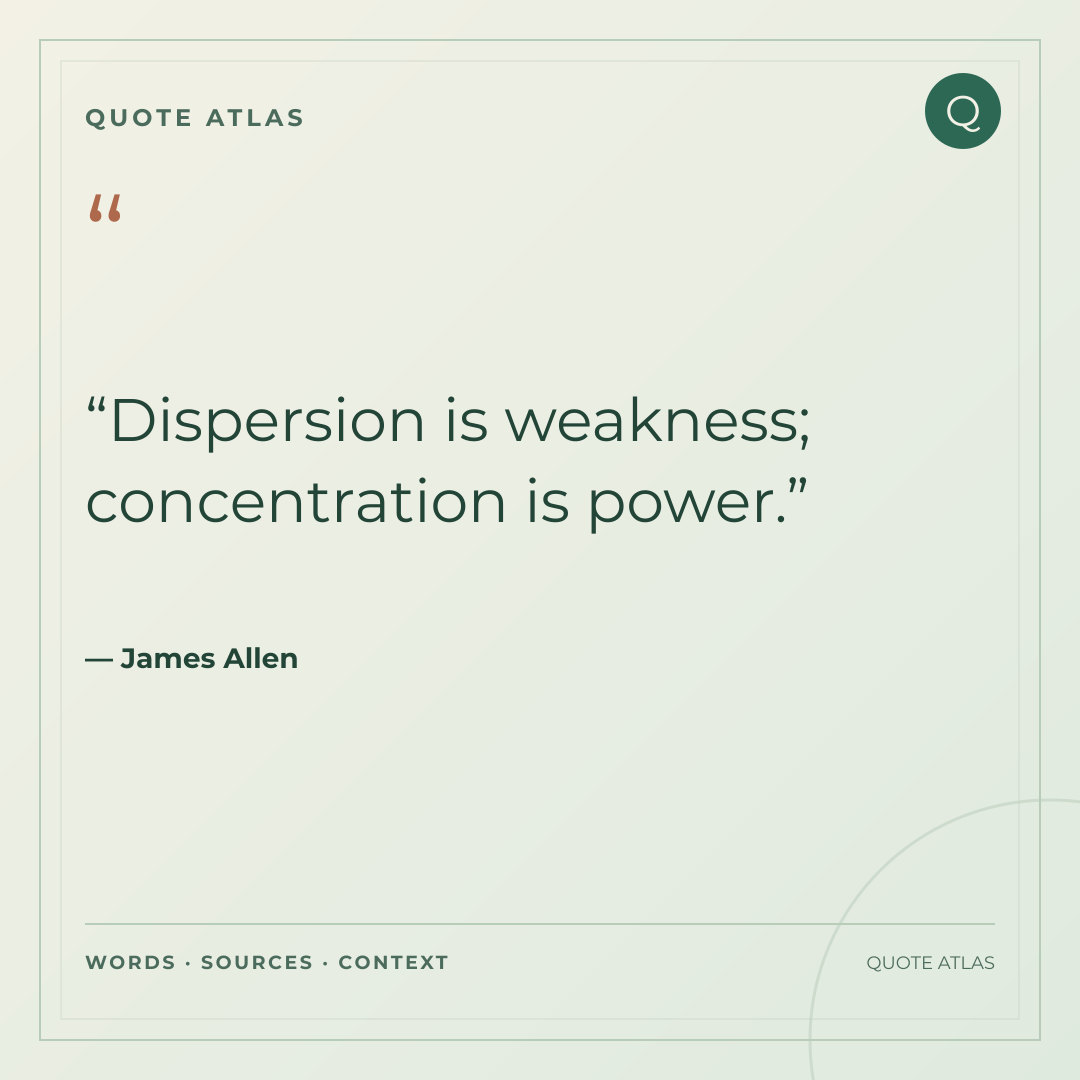
Read & copy“Dispersion is weakness; concentration is power.”
Meaning & contextThe contrast argues that scattered attention weakens useful effort while concentrated attention increases the force available for a chosen task.
Source details
The Mastery of Destiny, opening of “The Power of Purpose”; Wikisource 1909 text. The sentence is Allen’s own framing, not an attributed example.
Source identified691
Read & copy“Do vigorously, and at once, whatever has to be done.”
Meaning & contextThe rule turns decision into immediate execution, treating delay as an obstacle to disciplined and purposeful action.
Source details
The Mastery of Destiny, “Training of the Will,” rule four; Wikisource 1909 text. It is practical self-discipline advice in Allen’s period framework.
Source identified692
Read & copy“Purpose is the key-stone in the temple of achievement.”
Meaning & contextAllen presents concentrated purpose as the structural element that holds effort together and directs it toward a defined achievement.
Source details
The Mastery of Destiny, “The Power of Purpose”; Wikisource 1909 text. This compact sentence follows Allen’s contrast between scattered thought and concentrated purpose.
Source identified693
Read & copy“Holiness alone is undying peace.”
Meaning & contextAllen contrasts lasting peace with temporary comfort or outward victory, then immediately connects the durable state he describes with self-control and an increasing orientation toward wisdom.
Source details
The Way of Peace, “The Realization of Perfect Peace,” Project Gutenberg #10740. The sentence follows Allen’s contrast between temporary peace from comfort or worldly victory and what he calls the enduring “Peace of Heaven”; the theological framework is retained rather than recast as clinical advice.
Source identified694
Read & copy“This inward peace, this silence, this harmony, this Love, is the Kingdom of Heaven.”
Meaning & contextAllen describes spiritual fulfillment as an inward condition of peace, harmony, and love rather than as a reward measured primarily by external circumstance.
Source details
The Way of Peace; the sentence belongs to Allen’s account of the inward qualities he associates with spiritual peace and selfless love.
Source identified695
Read & copy“As you succeed in overcoming self you will begin to see things in their right relations.”
Meaning & contextFor Allen, clearer perception follows disciplined work on one’s own impulses and biases; self-mastery changes not only conduct but the proportions in which problems are seen.
Source details
The Way of Peace; Allen links self-mastery with clearer perception and a less distorted relationship to circumstances and other people.
Source identified696
Read & copy“Of your own accord you cling to your unrest; of your own accord you can come to abiding peace.”
Meaning & contextWithin Allen’s spiritual framework, the line emphasizes personal participation in habits of unrest and in the disciplined change he believes can lead toward a more settled inward life.
Source details
The Way of Peace, “The Realization of Perfect Peace,” Project Gutenberg #10740. Allen places this sentence in a religious exhortation about surrendering selfish desires and entering what he calls an inward resting-place; it is period spiritual teaching, not a claim that distress is always voluntarily chosen.
Source identified697
Read & copy“One by one they were all becoming shades.”
Meaning & contextGabriel’s thoughts widen from one dead young man to the mortality of everyone around him, preparing the story’s final meditation on memory and the living and dead.
Source details
“The Dead,” in Dubliners, Project Gutenberg #2814. The line belongs to Gabriel Conroy’s interior reflection after Gretta tells him about Michael Furey; it is fictional free-indirect narration.
Source identified698
Read & copy“History is a nightmare from which I am trying to awake.”
Meaning & contextStephen compresses his troubled relation to inherited political, religious and personal history into an image of trying to wake from something oppressive that still shapes the present.
Source details
Ulysses, Episode 2 (“Nestor”), Project Gutenberg #4300. Stephen Dedalus says the line during his conversation with Mr Deasy; it is fictional dialogue inside a modernist novel and should not be flattened into Joyce’s direct historical thesis.
Source identified699
Read & copy“If men were angels, no government would be necessary.”
Meaning & contextMadison uses the hypothetical contrast with angels to explain why constitutional institutions need checks on both governed people and those who exercise governmental power.
Source details
The Federalist No. 51, February 1788. The line sits inside Madison’s argument for checks and balances and institutional controls; it is political theory about constitutional design rather than a factual measurement of human nature.
Source identified700
Read & copy“to hold the Union of the States as the basis of their peace and happiness;”
Meaning & contextMadison presents preservation of the federal union as one of the governing principles he intends to follow in office.
Source details
First Inaugural Address, March 4, 1809, represented by Founders Online / National Archives. This clause occurs in Madison’s long statement of presidential principles and remains historical political rhetoric rather than a prediction or current constitutional instruction.
Source identified701
Read & copy“The Religion then of every man must be left to the conviction and conscience of every man;”
Meaning & contextMadison argues that religious belief and practice should follow individual conviction rather than civil compulsion.
Source details
Memorial and Remonstrance against Religious Assessments, represented by Founders Online / National Archives. Madison wrote against a proposed Virginia assessment supporting teachers of Christianity. The sentence is historical religious-liberty argument, not current legal advice.
Source identified702
Read & copy“For action is indeed the sole medium of expression for ethics.”
Meaning & contextAddams argues that ethical ideas become meaningful as social morality only when they are tested through concrete choices and conduct rather than remaining abstract commentary.
Source details
Democracy and Social Ethics, chapter “Political Reform,” Project Gutenberg #15487. Addams immediately contrasts moral action with merely speculating about morality, placing the sentence inside her Progressive Era social-ethics argument.
Source identified703
Read & copy“There is no charm equal to tenderness of heart.”
Voice: Fictional character · Emma Woodhouse
Meaning & contextAusten gives emotional gentleness greater value than surface charm or social performance.
Source details
Emma, Volume II, Chapter XIII, scan-backed 1816 John Murray first edition on Wikisource. This corrects the inherited Volume III note: Emma says to herself that there is no charm equal to tenderness of heart after Harriet’s gratitude and affection move her to reassess Harriet’s character.
Source identified704
Read & copy“There is nothing like staying at home for real comfort.”
Voice: Fictional character · Mrs. Elton
Meaning & contextHome is valued not for spectacle but for familiarity, ease, and the freedom to lower one’s guard.
Source details
Emma, Volume II, Chapter XIV, scan-backed 1816 John Murray first edition on Wikisource. Mrs. Elton declares that there is nothing like staying at home for real comfort while boasting at length about her supposed devotion to home, Maple Grove and social independence; the comic context makes this fictional character speech rather than Austen’s unqualified domestic maxim.
Source identified705
Read & copy“If I loved you less, I might be able to talk about it more.”
Voice: Fictional character · George Knightley
Meaning & contextThe difficulty of speaking is used as evidence of emotional depth, contrasting sincere feeling with polished or excessive declaration.
Source details
Emma, Volume III, Chapter XIII, scan-backed 1816 John Murray first edition on Wikisource. George Knightley tells Emma “If I loved you less, I might be able to talk about it more” during his declaration, explicitly contrasting the depth of his feeling with his difficulty making polished speeches.
Source identified706
Read & copy“One half of the world cannot understand the pleasures of the other.”
Voice: Fictional character · Emma Woodhouse
Meaning & contextPeople often mistake their own preferences for universal standards, while real understanding requires room for different tastes and experiences.
Source details
Emma, Volume I, Chapter IX, scan-backed 1816 John Murray first edition on Wikisource. Emma tells her father that one half of the world cannot understand the pleasures of the other while explaining why his grandchildren enjoy rough play that he himself cannot comprehend; this is Emma Woodhouse’s fictional dialogue, not Austen speaking autobiographically.
Source identified707
Read & copy“Seldom, very seldom, does complete truth belong to any human disclosure.”
Voice: Narrator voice · Narrator
Meaning & contextAusten observes that even sincere accounts can contain omission, disguise, or misunderstanding, which makes careful listening and humility important in judging what people say.
Source details
Emma, Volume III, Chapter XIII, scan-backed 1816 John Murray first edition on Wikisource. The narrator observes that complete truth seldom belongs to any human disclosure while explaining that even the Emma–Knightley understanding contains mistaken conduct alongside genuine feeling.
Source identified708
Read & copy“Silly things do cease to be silly if they are done by sensible people in an impudent way.”
Voice: Fictional character · Emma Woodhouse
Meaning & contextAusten’s ironic narration shows how confidence and a favorable opinion of someone can make observers excuse behavior they would otherwise call foolish.
Source details
Emma, Volume II, Chapter VIII, scan-backed 1816 John Murray first edition on Wikisource. After Frank Churchill returns from an impulsive haircut, Emma “moralised to herself” that silly things can cease to seem silly when sensible people do them impudently. This is Emma Woodhouse’s ironic private judgment inside the novel, not Austen endorsing impudence as a general rule.
Source identified709
Read & copy“Selfishness must always be forgiven you know, because there is no hope of a cure.”
Voice: Fictional character · Mary Crawford
Meaning & contextThe line is comic rather than literal advice, using exaggeration to expose how readily people excuse entrenched self-interest.
Source details
Mary Crawford makes the remark while discussing motives and conduct in company.
Source identified710
Read & copy“Friendship is certainly the finest balm for the pangs of disappointed love.”
Voice: Narrator voice · Narrator
Meaning & contextFriendship is framed as practical emotional support when romantic hopes fail, without pretending it instantly removes disappointment.
Source details
Northanger Abbey.
Source identified711
Read & copy“You pierce my soul. I am half agony, half hope.”
Voice: Fictional character · Captain Frederick Wentworth (letter)
Meaning & contextWentworth’s letter holds pain and possibility together: the renewed declaration is intense because he still does not know whether Anne’s feelings have survived their long separation.
Source details
Persuasion, Chapter XXIII, Project Gutenberg #105. Captain Frederick Wentworth writes the line to Anne Elliot while listening to her conversation with Captain Harville; the letter is signed “F. W.” and is fictional character writing, not Austen autobiography.
Source identified712
Read & copy“I must learn to brook being happier than I deserve.”
Voice: Fictional character · Captain Frederick Wentworth
Meaning & contextThe line combines joy with humility: Wentworth recognizes that his renewed happiness exceeds what his earlier pride and mistakes make him feel he has earned.
Source details
Persuasion, Chapter XXIII. Captain Frederick Wentworth says this to Anne Elliot while reflecting on the six years of separation his pride helped prolong.
Source identified713
Read & copy“We live at home, quiet, confined, and our feelings prey upon us.”
Voice: Fictional character · Anne Elliot
Meaning & contextAnne links emotional persistence partly to social circumstance: restricted movement and occupation can leave fewer external demands to interrupt sustained feeling.
Source details
Persuasion, Chapter XXIII, Project Gutenberg #105. Anne Elliot says this to Captain Harville while contrasting women’s domestic confinement with men’s professions, business, travel and continual occupation. It is a historically situated fictional argument, not a modern mental-health claim.
Source identified714
Read & copy“Angry people are not always wise.”
Voice: Narrator voice · Narrator
Meaning & contextStrong emotion can narrow judgment, so being certain while angry is not the same as being correct.
Source details
Pride and Prejudice; the line is preserved in the novel’s dialogue about anger, judgment, and the limits of certainty while emotions are high.
Source identified715
Read & copy“My good opinion once lost, is lost forever.”
Voice: Fictional character · Fitzwilliam Darcy
Meaning & contextDarcy presents trust and esteem as difficult to restore once serious judgment has turned against someone, revealing both the firmness and the potential rigidity of his early character.
Source details
Pride and Prejudice, Chapter XI, Project Gutenberg #1342. Fitzwilliam Darcy says this to Elizabeth Bennet during their discussion of faults; Elizabeth immediately identifies the position as implacable resentment, so the novel itself does not leave the maxim unchallenged.
Source identified716
Read & copy“I declare after all there is no enjoyment like reading!”
Voice: Fictional character · Caroline Bingley
Meaning & contextThe line is memorable as praise of reading, though its comic context matters because Miss Bingley says it while performing interest for Darcy.
Source details
Pride and Prejudice, Chapter 11; context is ironic.
Source identified717
Read & copy“I am not a great reader, and have pleasure in many things.”
Voice: Fictional character · Elizabeth Bennet
Meaning & contextElizabeth lightly rejects the performance of bookish superiority, keeping reading in proportion to a broader and more independent personality.
Source details
Pride and Prejudice; Elizabeth answers a conversation in which reading is being used as a social signal.
Source identified718
Read & copy“Think only of the past as its remembrance gives you pleasure.”
Voice: Fictional character · Elizabeth Bennet
Meaning & contextThe advice does not erase the past; it questions repeated attention to memories that no longer help the present.
Source details
Pride and Prejudice, Chapter 58.
Source identified719
Read & copy“I have a high respect for your nerves. They are my old friends.”
Voice: Fictional character · Mr. Bennet
Meaning & contextMr. Bennet turns Mrs. Bennet’s recurring complaint into dry affection, using understatement to expose a long-established family pattern.
Source details
Pride and Prejudice, Volume 1, Chapter 1; Mr. Bennet responds to his wife’s complaint about her nerves.
Source identified720
Read & copy“For what do we live, but to make sport for our neighbours, and laugh at them in our turn?”
Voice: Fictional character · Mr. Bennet
Meaning & contextMr. Bennet’s joke treats social observation as reciprocal: everyone is somebody else’s entertainment, including the people doing the laughing.
Source details
Pride and Prejudice, Chapter 57; Mr. Bennet comments on the absurd rumour concerning Elizabeth and Darcy.
Source identified721
Read & copy“I will forgive their iniquity, and I will remember their sin no more.”
Voice: Reported speaker · The LORD
Meaning & contextPardon is paired with refusing to keep wrongdoing permanently present, making forgiveness a movement away from endless moral accounting toward restored relationship.
Source details
Jeremiah 31:34, King James Version; the promise appears in the description of a new covenant and includes forgiveness and no further remembrance of sin.
Source identified722
Read & copy“it is the greatest happiness of the greatest number that is the measure of right and wrong”
Voice: Authorial / signed preface voice · Jeremy Bentham
Meaning & contextBentham states the utilitarian standard he uses to judge laws and institutions: their moral evaluation should turn on the happiness produced for the people affected.
Source details
A Fragment on Government, Preface (1776). Bentham introduces the 'greatest happiness of the greatest number' formulation as a fundamental axiom while arguing for criticism and reform of established law. This remains eighteenth-century utilitarian legal/political philosophy rather than a settled universal ethical or policy metric.
Source identified723
Read & copy“The question is not, Can they reason? nor, Can they talk? but, Can they suffer?”
Meaning & contextBentham shifts the basis for moral consideration of animals away from intelligence or speech and toward the capacity to experience suffering.
Source details
An Introduction to the Principles of Morals and Legislation, Chapter XVII, section 1 footnote, reviewed against the represented Liberty Fund text. Bentham's 'Can they suffer?' question appears in his argument that sentience, not species membership or speech, is morally relevant to cruelty; it remains historical utilitarian philosophy rather than current legal doctrine.
Source identified724
Read & copy“That wastes time just as well and does not look so bad.”
Meaning & contextThe narrator recommends smoking over continued idle talk because both waste time but only one looks more respectable, turning appearance into the joke’s practical standard.
Source details
The Idle Thoughts of an Idle Fellow, “On Being Idle”; the line follows the suggestion to stop talking and have a smoke.
Source identified725
Read & copy“Love is like the measles; we all have to go through it.”
Meaning & contextRomantic love is compared to an unavoidable childhood illness, making intense emotion comic by treating it as something people catch, endure, and eventually recover from.
Source details
The Idle Thoughts of an Idle Fellow, “On Being in Love”; the comparison opens the essay’s mock-medical treatment of romance.
Source identified726
Read & copy“A boy’s love comes from a full heart; a man’s is more often the result of a full stomach.”
Meaning & contextThe contrast punctures mature romantic eloquence by suggesting comfort and appetite can masquerade as passion, while youthful awkwardness may reveal more direct feeling.
Source details
The Idle Thoughts of an Idle Fellow, “On Being in Love”; the narrator contrasts youthful shyness with the polished declarations of older men.
Source identified727
Read & copy“Being only a chemist hampers me.”
Voice: Fictional character · Chemist
Meaning & contextThe chemist’s dry reply makes the absurd prescription funny: beefsteak, beer, walking, sleep, and common sense require a shop far broader than an ordinary pharmacy.
Source details
Three Men in a Boat, Chapter I; the chemist says this after reading the doctor’s non-pharmaceutical prescription.
Source identified728
Read & copy“Life is brief, and you might pass away before I had finished.”
Voice: Fictional narrator · J. (first-person narrator)
Meaning & contextThe narrator uses mortality to excuse not listing his countless imagined diseases, turning a serious phrase about short life into an absurdly practical time-saving joke.
Source details
Three Men in a Boat, Chapter I; spoken by the narrator to his doctor before he explains the one ailment he believes he does not have.
Source identified729
Read & copy“I like work: it fascinates me. I can sit and look at it for hours.”
Voice: Fictional narrator · J. (first-person narrator)
Meaning & contextThe sentence reverses the usual praise of work by making passive observation the narrator’s preferred relationship to labor, creating a durable joke about procrastination.
Source details
Three Men in a Boat, Chapter XV; the narrator defends himself while arguing about how the rowing work should be divided.
Source identified730
Read & copy“The only malady I could conclude I had not got was housemaid’s knee.”
Voice: Fictional narrator · J. (first-person narrator)
Meaning & contextAfter reading through a medical reference alphabetically, the narrator is disappointed to find only one illness missing, making hypochondria funny through impossible comprehensiveness.
Source details
Three Men in a Boat, Chapter I; after reading disease symptoms at the British Museum, the narrator concludes housemaid’s knee is the sole exception.
Source identified731
Read & copy“Montmorency’s ambition in life, is to get in the way and be sworn at.”
Voice: Fictional narrator · J. (first-person narrator)
Meaning & contextThe narrator gives the dog a mock life-purpose centered on obstruction and provoking people, turning ordinary pet mischief into a grand statement of ambition.
Source details
Three Men in a Boat, packing episode; the narrator describes Montmorency repeatedly inserting himself into whatever the men are trying to pack.
Source identified732
Read & copy“I had walked into that reading-room a happy, healthy man. I crawled out a decrepit wreck.”
Voice: Fictional narrator · J. (first-person narrator)
Meaning & contextNothing physical has changed, but the narrator’s interpretation has transformed completely; the comic contrast shows how anxious reading can alter felt experience without new evidence.
Source details
Three Men in a Boat, Chapter I; this sentence ends the British Museum self-diagnosis sequence.
Source identified733
Read & copy“It is more blessed to give than to receive.”
Voice: Reported speaker · Jesus, quoted by Paul
Meaning & contextThe remembered saying shifts attention from acquisition to contribution, presenting generosity as a source of value for the giver as well as the recipient.
Source details
Acts 20:35 in the King James Version; Paul recalls the saying while urging support for the weak.
Source identified734
Voice: Narrator voice · Gospel narrator
Meaning & contextThe shortest sentence records grief without explanation or denial, showing sorrow as compatible with love, presence, and compassion in the face of death.
Source details
John 11:35, King James Version; Jesus weeps shortly before the raising of Lazarus, within a scene of mourning and bereavement.
Source identified735
Read & copy“A new commandment I give unto you, That ye love one another; as I have loved you.”
Voice: Reported speaker · Jesus
Meaning & contextLove is presented as an active obligation shaped by example, not merely a private feeling.
Source details
John 13:34, King James Version.
Source identified736
Read & copy“Peace I leave with you, my peace I give unto you.”
Voice: Reported speaker · Jesus
Meaning & contextThe line offers peace as something deeper than favorable circumstances and distinct from the reassurance the world ordinarily gives.
Source details
John 14:27 in the King James Version; opening clauses.
Source identified737
Read & copy“Peace I leave with you, my peace I give unto you: not as the world giveth, give I unto you.”
Voice: Reported speaker · Jesus
Meaning & contextThe promise distinguishes inward peace from security based only on changing external circumstances, placing calm within a spiritual relationship rather than worldly control.
Source details
John 14:27 in the King James Version; the verse continues, “Let not your heart be troubled, neither let it be afraid.”
Source identified738
Read & copy“Greater love hath no man than this, that a man lay down his life for his friends.”
Voice: Reported speaker · Jesus
Meaning & contextThe verse defines love through costly action, making willingness to sacrifice for friends a measure of devotion rather than merely affectionate language.
Source details
John 15:13 in the King James Version.
Source identified739
Read & copy“I have called you friends.”
Voice: Reported speaker · Jesus
Meaning & contextThe brief phrase reframes the relationship from mere obedience toward disclosed trust and personal closeness.
Source details
John 15:15 in the King James Version; Jesus contrasts servants with friends who have been told what he has heard.
Source identified740
Read & copy“Ask, and ye shall receive, that your joy may be full.”
Voice: Reported speaker · Jesus
Meaning & contextFull joy is connected with asking and receiving inside a relationship of trust, rather than with passive wishfulness.
Source details
John 16:24 in the King James Version; concluding clause of the verse.
Source identified741
Read & copy“In the world ye shall have tribulation: but be of good cheer.”
Voice: Reported speaker · Jesus
Meaning & contextThe line acknowledges hardship directly before calling for courage, so cheer is not based on pretending that trouble does not exist.
Source details
John 16:33 in the King James Version; excerpt from Jesus’s closing words to the disciples.
Source identified742
Read & copy“And ye shall know the truth, and the truth shall make you free.”
Voice: Reported speaker · Jesus
Meaning & contextTruth is connected with freedom, suggesting that clearer understanding can loosen the control of falsehood and confusion.
Source details
John 8:32, King James Version.
Source identified743
Read & copy“For unto whomsoever much is given, of him shall be much required.”
Voice: Reported speaker · Jesus
Meaning & contextGreater resources, knowledge, or authority create greater obligations rather than simply greater privilege.
Source details
Luke 12:48 in the King James Version; this excerpt keeps the central responsibility clause.
Source identified744
Read & copy“If thy brother trespass against thee, rebuke him; and if he repent, forgive him.”
Voice: Reported speaker · Jesus
Meaning & contextThis passage does not equate forgiveness with silence about harm: it places honest confrontation and forgiveness in the same sequence when repentance follows.
Source details
Luke 17:3 in the King James Version.
Source identified745
Read & copy“If he trespass against thee seven times in a day ... thou shalt forgive him.”
Voice: Reported speaker · Jesus
Meaning & contextRepeated offence makes forgiveness harder, which is exactly the point of the passage: the moral demand is not limited to the first easy opportunity to forgive.
Source details
Luke 17:4 in the King James Version; the middle repetition is shortened with an ellipsis while preserving the verse’s instruction.
Source identified746
Read & copy“Father, forgive them; for they know not what they do.”
Voice: Reported speaker · Jesus
Meaning & contextThe request for forgiveness is made in the middle of injury rather than after conditions become comfortable, giving the line its unusually demanding moral force.
Source details
Luke 23:34 in the King James Version.
Source identified747
Read & copy“And as ye would that men should do to you, do ye also to them likewise.”
Voice: Reported speaker · Jesus
Meaning & contextThe line places human flourishing inside mutual care: strength, resources, attention, or opportunity become responsibilities toward other people.
Source details
Luke 6:31 in the King James Version.
Source identified748
Read & copy“Forgive, and ye shall be forgiven.”
Voice: Reported speaker · Jesus
Meaning & contextThe short instruction treats forgiveness as a practice rather than merely a feeling: release is something a person does in response to another person’s fault.
Source details
Luke 6:37 in the King James Version; excerpt from the verse’s instruction about judgment and forgiveness.
Source identified749
Read & copy“Her sins, which are many, are forgiven; for she loved much.”
Voice: Reported speaker · Jesus
Meaning & contextThe line links forgiveness with a transformed response of love, emphasizing that mercy changes the meaning of a person’s past rather than denying it.
Source details
Luke 7:47 in the King James Version; Jesus explains the woman’s actions during the meal at the Pharisee’s house.
Source identified750
Read & copy“And when ye stand praying, forgive, if ye have ought against any.”
Voice: Reported speaker · Jesus
Meaning & contextThe instruction makes unresolved resentment relevant even in a private act of prayer: a grievance cannot simply be separated from the way a person approaches reconciliation and mercy.
Source details
Mark 11:25 in the King James Version; excerpt from the verse.