Quote Atlassourced quotes & context
Page 3 of 18 · 1746 quotations total

Short quotes — Page 3

This continuation page contains additional source-backed quotations not shown in the initial 50-quotation overview. Return to the topic guide and browse collection.

100 shown · 1746 total
Source identified151
Choose what interests you.

“Choose what interests you.”

Bennett recommends beginning intellectual cultivation with a subject capable of sustaining real attention instead of selecting study solely for appearance or prestige.

Source details

Mental Efficiency, discussion of reading and self-development. The short imperative belongs to Bennett’s practical advice about choosing a field for sustained personal study.

Source identified152
The past is never more than an experiment.

“The past is never more than an experiment.”

Past conduct provides information rather than an unchangeable verdict; Bennett uses that distinction to argue that present habits can still be revised.

Source details

Mental Efficiency, “Breaking with the Past.” The sentence frames prior experience as material for correction rather than a permanent identity.

Source identified153
One man cannot tell another man where the other man wants to go.

“One man cannot tell another man where the other man wants to go.”

Self-development begins with aims that actually belong to the individual; another person can suggest methods but cannot supply a genuinely personal destination.

Source details

Mental Efficiency, opening discussion of self-development. Project Gutenberg #23347. Bennett is distinguishing method from personal purpose, not claiming that advice or collaboration has no value.

Source identified154
My subject was mental efficiency as a means to self-development.

“My subject was mental efficiency as a means to self-development.”

Efficiency is presented as instrumental rather than an end in itself: better use of attention and thought is valuable insofar as it supports deliberate personal development.

Source details

Mental Efficiency. Bennett explicitly defines the scope of his argument as mental efficiency serving self-development; this is period conduct-of-life writing rather than modern cognitive-science evidence.

Source identified155
You can control nothing but your own mind.

“You can control nothing but your own mind.”

Bennett redirects the desire to manage other people or circumstances toward the sphere he treats as directly governable: one’s own response and attention.

Source details

The Human Machine, discussion of mental control. The maxim belongs to Bennett’s period self-discipline philosophy and should not be read as a clinical claim that thoughts or symptoms are always voluntarily controllable.

Source identified156
It is a capital mistake to theorize before one has data.

“It is a capital mistake to theorize before one has data.”

Holmes argues that explanations should follow evidence because an early theory can tempt a person to force later facts into a preferred story.

Source details

“A Scandal in Bohemia,” The Adventures of Sherlock Holmes (1891), Project Gutenberg #1661. Holmes immediately warns that premature theorizing leads people to twist facts to suit theories; it is fictional detective dialogue.

Source identified157
The world is full of obvious things which nobody by any chance ever observes.

“The world is full of obvious things which nobody by any chance ever observes.”

Holmes distinguishes mere visibility from real observation: information can be plainly present and still go unused when attention remains superficial.

Source details

The Hound of the Baskervilles, Chapter III, “The Problem,” Project Gutenberg #2852. Sherlock Holmes says that the world is full of obvious things nobody observes after inferring from Watson’s clean clothes and boots that he spent the rainy day indoors, then asks Watson to infer where Holmes himself has been. It remains fictional detective dialogue illustrating Holmes’s observational method rather than a universal scientific rule.

Source identified158
Say not the struggle nought availeth, The labour and the wounds are vain,

“Say not the struggle nought availeth, The labour and the wounds are vain,”

Clough begins by challenging the despairing assumption that visible setbacks prove sustained effort has accomplished nothing or that a difficult cause is already lost.

Source details

“Say Not the Struggle Nought Availeth,” first published as “The Struggle” in The Crayon, August 1855; text represented by Representative Poetry Online. The poem’s military imagery is metaphorical encouragement shaped by the political disappointments of the 1848–49 era.

Source identified159
God forbid you should ever be aught but yourself, my Elspie!

“God forbid you should ever be aught but yourself, my Elspie!”

Voice: Fictional character · Philip

Philip answers Elspie’s fear that marriage and class expectations might require her to become someone else by insisting that he wants her to remain herself.

Source details

The Bothie of Tober-na-Vuolich (1848), represented in Project Gutenberg’s Poems of Arthur Hugh Clough. Philip speaks to Elspie during their courtship conversation after she says she does not want to become “a lady.” The line is fictional verse dialogue and is kept under Philip’s local voice rather than treated as Clough autobiography.

Source identified160
These crests only rise on the back of constant labour.

“These crests only rise on the back of constant labour.”

Peak creative moments are described as resting on repeated labor, rejecting the idea that successful writing can be separated from sustained preparation.

Source details

On The Art of Reading, Lecture V, Project Gutenberg #16579; “crests” refers to exceptional moments of successful writing described immediately before.

Source identified161
So, in writing, only out of long preparation can come the truly triumphant flash

“So, in writing, only out of long preparation can come the truly triumphant flash”

The sudden-looking breakthrough is placed at the end of preparation rather than outside it: memorable execution is supported by work accumulated beforehand.

Source details

On The Art of Reading, Lecture V, Project Gutenberg #16579; excerpted from Quiller-Couch’s analogy between writing practice and concentrated performance.

Source identified162
Murder your darlings.

“Murder your darlings.”

The memorable command advises writers to delete showy passages they love when those passages serve vanity or ornament more than the work as a whole.

Source details

On the Art of Writing, Lecture XII, “On Style,” Project Gutenberg #17470; the phrase concludes Quiller-Couch’s warning against purchased or extraneous ornament.

Source identified163
Literature is a living art, to be practised.

“Literature is a living art, to be practised.”

The short formulation emphasizes that literary skill develops through use and practice rather than through passive admiration of established works alone.

Source details

On the Art of Writing, Lecture XII, “On Style,” Project Gutenberg #17470; excerpted from Quiller-Couch’s summary of the course.

Source identified164
Style, for example, is not—can never be—extraneous Ornament.

“Style, for example, is not—can never be—extraneous Ornament.”

Style is separated from decoration added after the fact; effective prose should grow from the thought, purpose, voice and structure of the writing itself.

Source details

On the Art of Writing, Lecture XII, “On Style,” Project Gutenberg #17470; typographic dashes are normalized from the represented plain-text edition.

Source identified165
Jargon, which is not so much bad writing as the avoidance of writing.

“Jargon, which is not so much bad writing as the avoidance of writing.”

Jargon is criticized as evasive language that circles around meaning instead of doing the harder work of choosing direct, responsible words.

Source details

On the Art of Writing, Lecture VI, Project Gutenberg #17470; Quiller-Couch is recalling the preceding lecture’s argument about jargon and prose.

Source identified166
Literature is not a mere Science, to be studied; but an Art, to be practised.

“Literature is not a mere Science, to be studied; but an Art, to be practised.”

Quiller-Couch treats literature as an active craft: serious understanding should eventually lead beyond analysis into the disciplined practice of making language.

Source details

On the Art of Writing, Preface, Project Gutenberg #17470. Quiller-Couch states the governing premise of the Cambridge lectures: 'Literature is not a mere Science, to be studied; but an Art, to be practised.' The sentence belongs to his historical writing pedagogy and argument for continued practice, not a scientific classification of literature or a measurable guarantee of writing success.

Source identified167
In a world where all is fleeting, change alone endures.

“In a world where all is fleeting, change alone endures.”

Stability is temporary, so practical judgment requires expecting change rather than treating present arrangements as permanent.

Source details

Counsels and Maxims, T. Bailey Saunders translation, in a discussion of fortune and apparent stability.

Source identified168
For the safest way of not being very miserable is not to expect to be very happy.

“For the safest way of not being very miserable is not to expect to be very happy.”

Lowering unrealistic expectations can reduce avoidable disappointment, though the maxim deliberately sets a restrained rather than exuberant ideal of happiness.

Source details

Counsels and Maxims, opening general rules on happiness and avoiding unnecessary suffering.

Source identified169
We have to forfeit three-fourths of ourselves in order to become like other people.

“We have to forfeit three-fourths of ourselves in order to become like other people.”

Conformity is described as costly when fitting in requires surrendering too much individuality, judgment, or temperament.

Source details

Counsels and Maxims, in Schopenhauer’s discussion of society and individuality; T. Bailey Saunders translation.

Source identified170
The art of not reading is highly important.

“The art of not reading is highly important.”

Selecting what not to read protects limited attention from being consumed by material that is merely fashionable, noisy, or low-value.

Source details

Essay “On Books and Reading”; the surrounding passage explains selective reading rather than hostility to books generally.

Source identified171
Reading is thinking with some one else's head instead of one's own.

“Reading is thinking with some one else's head instead of one's own.”

Reading supplies another mind’s thought, but Schopenhauer warns that consuming ideas should not replace the work of forming one’s own connected judgment.

Source details

Essay “On Books and Reading,” in a public-domain English collection of Schopenhauer’s essays.

Source identified172
it is only when he has turned it over that he can be said to know it.

“it is only when he has turned it over that he can be said to know it.”

Learning becomes knowledge, in this account, when material has been actively reconsidered and integrated rather than merely encountered or memorized.

Source details

The Art of Literature, section “On Thinking for Oneself,” T. Bailey Saunders translation; Project Gutenberg #10714. The preceding sentence says a person must first learn something before turning it over in the mind.

Source identified173
less depends upon what befalls us than upon the way in which it is met

“less depends upon what befalls us than upon the way in which it is met”

The maxim shifts attention from events alone to the way a person receives and interprets them, making response and temperament part of Schopenhauer’s account of well-being.

Source details

The Wisdom of Life, T. Bailey Saunders translation; Project Gutenberg #10741. This is a philosophical claim about temperament, not a denial that external circumstances can matter greatly.

Source identified174
Otherwise, a man is the slave of what other people are pleased to think.

“Otherwise, a man is the slave of what other people are pleased to think.”

Dependence on approval can turn other people’s judgments into a form of control; self-respect requires allowing outside opinion to inform rather than govern one’s sense of worth.

Source details

The Wisdom of Life; the sentence appears in Schopenhauer’s criticism of giving excessive weight to reputation and social opinion.

Source identified175
What a man is, and so what he has in his own person, is always the chief thing to consider.

“What a man is, and so what he has in his own person, is always the chief thing to consider.”

The line directs attention toward qualities carried within the person rather than status or possessions, grounding a durable sense of value in character, capacity, and inner life.

Source details

The Wisdom of Life; Schopenhauer develops a three-part distinction between what a person is, what a person has, and what a person represents in the eyes of others.

Source identified176
The world is my idea.

“The world is my idea.”

Schopenhauer opens his system by arguing that the experienced world is always presented in relation to a knowing subject, making perception and consciousness conditions of the world as it is known.

Source details

The World as Will and Idea, Vol. I, First Book, §1, Haldane and Kemp translation, Project Gutenberg #38427. “Idea” translates Vorstellung in this historical philosophical vocabulary and should not be read as the everyday sense of a passing thought.

Source identified177
Stand for truth, and ’tis enough.

“Stand for truth, and ’tis enough.”

Jonson argues that loyalty should attach to what is true rather than to a teacher, sect or personal faction.

Source details

Timber, or Discoveries Made Upon Men and Matter, represented by Project Gutenberg #5134. Jonson follows the sentence with his refusal to have readers defend a position merely because it is his; the aphorism belongs to a direct prose reflection on independent judgment and truth.

Source identified178
Drink to me only with thine eyes, And I will pledge with mine;

“Drink to me only with thine eyes, And I will pledge with mine;”

Jonson’s lyric speaker imagines exchanged looks as a sufficient pledge of affection, replacing an ordinary drinking toast with an idealized form of intimacy.

Source details

“To Celia,” first published in The Forest in 1616. The couplet belongs to a stylized Renaissance love lyric whose imagery develops through wine, nectar, kisses and a returned wreath.

Source identified179
Good morning to the day; and next, my gold: Open the shrine, that I may see my Saint.

“Good morning to the day; and next, my gold: Open the shrine, that I may see my Saint.”

Voice: Fictional character · Volpone

Volpone’s opening worship of his hoarded gold immediately turns wealth into an object of devotion, establishing the comedy’s satire of avarice.

Source details

Volpone, Act I, Scene 1, Project Gutenberg #4039. Volpone opens the comedy by greeting his gold as a saint while Mosca reveals the hoard; the religious imagery establishes his avarice. It is fictional dramatic speech, not Ben Jonson autobiography, financial advice or a literal religious claim.

Source identified180
Blessedness is not the reward of virtue, but virtue itself;

“Blessedness is not the reward of virtue, but virtue itself;”

Spinoza argues that the highest form of flourishing is not an external prize paid for virtuous conduct but is bound up with the activity he calls virtue itself.

Source details

Ethics, Part V, Proposition XLII, R. H. M. Elwes translation represented by Project Gutenberg #3800. ‘Blessedness is not the reward of virtue, but virtue itself’ introduces Spinoza's proposition linking blessedness, knowledge, virtue and control of the emotions. It remains translation-mediated seventeenth-century metaphysical ethics, not a universal psychological measurement or clinical prescription.

Source identified181
Waste neither Time nor Money, but make the best Use of both.

“Waste neither Time nor Money, but make the best Use of both.”

Franklin compresses practical discipline into stewardship of two limited resources: time and money.

Source details

Advice to a Young Tradesman, 21 July 1748; concluding advice on industry and frugality.

Source identified182
From a child I was fond of reading.

“From a child I was fond of reading.”

Franklin identifies reading as an early habit that shaped his self-education, curiosity, writing, and later public life.

Source details

Autobiography of Benjamin Franklin; Franklin recalls spending his small amounts of money on books as a child.

Source identified183
Resolve to perform what you ought; perform without fail what you resolve.

“Resolve to perform what you ought; perform without fail what you resolve.”

Resolution becomes useful only when followed by execution; the maxim links deliberate standards with the habit of carrying them through.

Source details

The Autobiography of Benjamin Franklin, Part II, thirteen-virtue table: Resolution. Project Gutenberg #148 (Charles W. Eliot / Harvard Classics, 1909) preserves the represented wording; the reviewed direct locator is Wikisource Section Thirty Six.

Source identified184
In reality, there is, perhaps, no one of our natural passions so hard to subdue as pride.

“In reality, there is, perhaps, no one of our natural passions so hard to subdue as pride.”

Franklin treats humility as a continuing discipline rather than a completed achievement: pride is difficult precisely because it can survive attempts to suppress it and can even attach itself to the appearance of modesty.

Source details

The Autobiography of Benjamin Franklin, Part II, Humility discussion near the close of the Passy 1784 continuation. Franklin reflects that pride survives attempts to suppress it and can attach itself even to apparent humility; the reviewed direct locator is Wikisource Section Thirty Nine.

Source identified185
America is the Land of Labour

“America is the Land of Labour”

Franklin rejects European fantasies of effortless prosperity in eighteenth-century North America, emphasizing that newcomers should expect productive labor rather than automatic wealth or patronage.

Source details

Information to Those Who Would Remove to America, before March 1784; Founders Online. This is historical emigration advice written for Europeans and is not a claim about present-day U.S. labor or immigration conditions.

Source identified186
he must work and be industrious to live.

“he must work and be industrious to live.”

Franklin tells prospective emigrants without inherited wealth that livelihood would depend on work and industry, directly countering expectations of effortless advancement after arrival.

Source details

Information to Those Who Would Remove to America, before March 1784; Founders Online. The lowercase opening is retained because this is a clause from Franklin’s longer sentence about strangers, law, liberty and industry.

Source identified187
every one will enjoy securely the Profits of his Industry.

“every one will enjoy securely the Profits of his Industry.”

Franklin presents secure enjoyment of earned returns as one advantage he associated with laws and liberty in the North America of his period.

Source details

Information to Those Who Would Remove to America, before March 1784; Founders Online. The statement is eighteenth-century description and advocacy, not modern financial, employment or immigration guidance.

Source identified189
Little strokes fell great oaks.

“Little strokes fell great oaks.”

Small repeated efforts can accomplish work that seems too large for a single burst of effort, making consistency itself a practical form of strength.

Source details

Poor Richard’s Almanack; a compact maxim about cumulative effort.

Source identified191
Diligence is the mother of good luck.

“Diligence is the mother of good luck.”

Persistent effort improves the odds of useful results because steady work creates more opportunities for progress than waiting for favorable circumstances.

Source details

Poor Richard’s Almanack; the maxim appears in Franklin’s collected Poor Richard material.

Source identified192
Fish and visitors stink in three days.

“Fish and visitors stink in three days.”

Hospitality has limits, and the humor works by comparing an overlong visit with something that naturally becomes unpleasant over time.

Source details

Poor Richard’s Almanack; a comic maxim about hospitality, boundaries, and overstaying a welcome.

Source identified193
Drive thy business, or it will drive thee.

“Drive thy business, or it will drive thee.”

Work becomes harder to control when it is left unmanaged; the maxim favors deliberate direction, priorities, and active stewardship over reactive pressure.

Source details

Poor Richard’s Almanack; a compact maxim about managing work before accumulated demands begin managing you.

Source identified194
Keep thy shop, and thy shop will keep thee.
Image design Golden Hour

“Keep thy shop, and thy shop will keep thee.”

Attending steadily to the basic work of an enterprise is presented as the foundation of the livelihood it is meant to support.

Source details

Poor Richard’s Almanack.

Source identified195
Creditors have better memories than debtors.

“Creditors have better memories than debtors.”

Debt can feel less urgent to the borrower than to the person awaiting repayment, making the line a dry reminder about financial obligations and accountability.

Source details

Poor Richard’s Almanack for 1736; Franklin uses a short contrast to emphasize the persistence of financial obligations.

Source identified197
Three may keep a secret, if two of them are dead.

“Three may keep a secret, if two of them are dead.”

The joke exaggerates how difficult secrecy becomes once information is shared, making discretion the safest form of confidentiality.

Source details

Poor Richard’s Almanack; one of Franklin’s compact maxims about secrecy and human behavior.

Source identified198
He that lies down with dogs shall rise up with fleas.

“He that lies down with dogs shall rise up with fleas.”

The proverb uses a comic physical image to make a serious point: companions and environments often leave consequences behind.

Source details

Poor Richard’s Almanack; Franklin uses the image as a warning about association and consequences.

Source identified199
Employ thy time well, if thou meanest to gain leisure.

“Employ thy time well, if thou meanest to gain leisure.”

Leisure is easier to protect when working time is used deliberately, linking time management with freedom rather than treating organization as an end in itself.

Source details

Poor Richard’s Almanack; the maxim connects disciplined use of working time with the ability to gain leisure.

Source identified201
Keep your eyes wide open before marriage, half shut afterwards.

“Keep your eyes wide open before marriage, half shut afterwards.”

The maxim pairs careful choice before commitment with tolerance afterward, compressing a practical relationship philosophy into a comic contrast.

Source details

Poor Richard’s Almanack; a marital maxim later repeated in discussions of Franklin’s proverbial advice.

Source identified202
Early to bed and early to rise, makes a man healthy, wealthy, and wise.

“Early to bed and early to rise, makes a man healthy, wealthy, and wise.”

The proverb links routine and self-discipline with health, productivity, and practical judgment.

Source details

Poor Richard’s Almanack; proverb on routine, work and practical discipline.

Source identified203
Hide not your talents. They for use were made. What’s a sundial in the shade?
Image design Coastal

“Hide not your talents. They for use were made. What’s a sundial in the shade?”

Ability has little practical value when it is permanently hidden; talent becomes useful through application and visibility.

Source details

Poor Richard’s Almanack.

Source identified204
Dost thou love life? Then do not squander time, for that is the stuff life is made of.

“Dost thou love life? Then do not squander time, for that is the stuff life is made of.”

Time is treated as the substance from which life is built, so wasting it means spending something that cannot be recovered.

Source details

Poor Richard’s Almanack; the maxim connects the value of life directly with the use of time.

Source identified205
If your adversary is long in playing, you ought not to hurry him.

“If your adversary is long in playing, you ought not to hurry him.”

Franklin makes patience part of fair competition, arguing that disturbing an opponent’s concentration displays rudeness or craft rather than genuine skill.

Source details

Benjamin Franklin, The Morals of Chess, rule 4 in the reviewed public-domain Wikisource transcription. Franklin tells a player not to hurry or distract a slow opponent and immediately lists singing, whistling, watch-checking, reading and tapping as examples; the passage is historical conduct advice about fair play.

Source identified206
moderate your desire of victory over your adversary, and be pleased with one over yourself.

“moderate your desire of victory over your adversary, and be pleased with one over yourself.”

Franklin shifts the measure of victory from exploiting another player’s mistakes toward self-command, generosity and the ability to restrain one’s own competitive appetite.

Source details

The Morals of Chess; Founders Online authoritative Franklin Papers text. The wording begins mid-sentence after Franklin’s condition that the game is not being played rigorously; source context is preserved here.

Source identified207
Lying rides upon Debt’s back.

“Lying rides upon Debt’s back.”

Voice: Authorial persona / framed maxim · Poor Richard maxim, repeated through Father Abraham

The compact maxim warns that unpaid obligations can create incentives for evasion, delay, or false promises when payment becomes difficult.

Source details

The Way to Wealth, debt-and-credit section; Project Gutenberg #43855. The line immediately reinforces Franklin’s warning about debt and truthfulness.

Source identified208
He that hath a trade hath an estate.

“He that hath a trade hath an estate.”

Voice: Authorial persona / framed maxim · Poor Richard maxim, repeated through Father Abraham

A useful skill or trade is treated as a durable asset because it can keep producing value even when stored wealth is limited.

Source details

The Way to Wealth, where Father Abraham repeats maxims associated with Poor Richard.

Source identified209
At a great pennyworth pause a while.

“At a great pennyworth pause a while.”

Voice: Authorial persona / framed maxim · Poor Richard maxim, repeated through Father Abraham

An unusually cheap offer deserves scrutiny because apparent savings can still produce a bad purchase when the buyer has no real need for it.

Source details

The Way to Wealth, frugality section; Project Gutenberg #43855. The maxim introduces Franklin’s distinction between apparent cheapness and genuine value.

Source identified210
Ere fancy you consult, consult your purse.

“Ere fancy you consult, consult your purse.”

Voice: Authorial persona / framed maxim · Poor Richard maxim, repeated through Father Abraham

Desired appearance should be tested against actual means before spending, placing affordability ahead of fashion or social comparison.

Source details

The Way to Wealth, frugality section; Project Gutenberg #43855. The line appears in a short verse warning against pride-driven spending on dress.

Source identified211
Many have been ruined by buying good pennyworths.

“Many have been ruined by buying good pennyworths.”

Voice: Authorial persona / framed maxim · Poor Richard maxim, repeated through Father Abraham

A low price does not make a purchase beneficial when the item is unnecessary or when buying it leaves too little for more important needs.

Source details

The Way to Wealth, frugality section; Project Gutenberg #43855. “Pennyworth” refers to an apparent bargain and the warning is about false economy.

Source identified212
Industry pays debts, while despair increaseth them.

“Industry pays debts, while despair increaseth them.”

Voice: Authorial persona / framed maxim · Poor Richard maxim, repeated through Father Abraham

Franklin contrasts productive effort with passive discouragement, presenting earned income and continued work as practical ways to reduce obligations.

Source details

The Way to Wealth / Poor Richard Improved, industry section; represented by Project Gutenberg #43855. Father Abraham is compiling maxims from Franklin’s earlier Almanacks.

Source identified213
The second vice is lying, the first is running in debt.

“The second vice is lying, the first is running in debt.”

Voice: Authorial persona / framed maxim · Poor Richard maxim, repeated through Father Abraham

Franklin links avoidable debt with later pressure to make excuses or break promises, presenting financial obligation as a potential test of honesty.

Source details

The Way to Wealth, debt-and-credit section; Project Gutenberg #43855. This is eighteenth-century moral rhetoric and should not be read as a judgment that indebted people are inherently dishonest.

Source identified214
Never leave that till tomorrow, which you can do to-day.

“Never leave that till tomorrow, which you can do to-day.”

Voice: Authorial persona / framed maxim · Poor Richard maxim, repeated through Father Abraham

The maxim turns prompt action into a habit: work that can reasonably be completed now should not be needlessly transferred to an uncertain tomorrow.

Source details

The Way to Wealth; a Poor Richard maxim on delay and useful employment of time.

Source identified215
It is foolish to lay out money in a purchase of repentance.

“It is foolish to lay out money in a purchase of repentance.”

Voice: Authorial persona / framed maxim · Poor Richard maxim, repeated through Father Abraham

Money spent on an unnecessary bargain can create regret rather than value, making restraint part of good purchasing judgment.

Source details

The Way to Wealth, frugality section; Project Gutenberg #43855. Father Abraham uses the maxim while warning auction buyers against purchases made only because they seem cheap.

Source identified216
Beware of little expenses; a small leak will sink a great ship.

“Beware of little expenses; a small leak will sink a great ship.”

Voice: Authorial persona / framed maxim · Poor Richard maxim, repeated through Father Abraham

Small recurring costs can matter more than they appear individually, so careful attention to minor spending is part of long-term financial discipline.

Source details

The Way to Wealth; Father Abraham repeats the Poor Richard maxim while warning about small but cumulative expenses.

Source identified217
If you would be wealthy, think of saving as well as of getting.

“If you would be wealthy, think of saving as well as of getting.”

Voice: Authorial persona / framed maxim · Poor Richard maxim, repeated through Father Abraham

Income alone does not create financial security; keeping part of what is earned is presented as a necessary companion to earning it.

Source details

The Way to Wealth, Franklin’s compilation of Poor Richard maxims.

Source identified218
Beware of little expences; A small leak will sink a great ship.

“Beware of little expences; A small leak will sink a great ship.”

Voice: Authorial persona / framed maxim · Poor Richard maxim, repeated through Father Abraham

Small recurring expenses can become significant when repeated, so minor purchases deserve attention when they steadily erode a limited budget.

Source details

The Way to Wealth, frugality section; Project Gutenberg #43855 preserves the historical spelling “expences.” The ship image is one of the Poor Richard maxims quoted by Father Abraham.

Source identified219
If you would know the value of money, go and try to borrow some.

“If you would know the value of money, go and try to borrow some.”

Voice: Authorial persona / framed maxim · Poor Richard maxim, repeated through Father Abraham

Borrowing makes the cost and scarcity of money concrete, turning an abstract idea of value into an immediate obligation.

Source details

The Way to Wealth, in Franklin’s discussion of debt and credit.

Source identified220
A ploughman on his legs is higher than a gentleman on his knees.

“A ploughman on his legs is higher than a gentleman on his knees.”

Voice: Authorial persona / framed maxim · Poor Richard maxim, repeated through Father Abraham

Financial independence earned through ordinary work is valued above status maintained through borrowing, dependence, or costly appearance.

Source details

The Way to Wealth, frugality section; Project Gutenberg #43855. Father Abraham contrasts industrious people with those reduced to borrowing by extravagance.

Source identified221
Buy what thou hast no need of, and ere long thou shalt sell thy necessaries.

“Buy what thou hast no need of, and ere long thou shalt sell thy necessaries.”

Voice: Authorial persona / framed maxim · Poor Richard maxim, repeated through Father Abraham

Unnecessary consumption can eventually threaten necessary resources, making restraint a practical part of financial independence.

Source details

The Way to Wealth, section III, frugality discussion, Project Gutenberg #43855. Father Abraham repeats the Poor Richard maxim “Buy what thou hast no need of, and ere long thou shalt sell thy necessaries” while warning auction-goers that an apparent bargain can become dear when the purchase is unnecessary. The persona and eighteenth-century moral-financial context remain explicit; this is not individualized financial advice.

Source identified222
Always taking out of the meal-tub, and never putting in, soon comes to the bottom.

“Always taking out of the meal-tub, and never putting in, soon comes to the bottom.”

Voice: Authorial persona / framed maxim · Poor Richard maxim, repeated through Father Abraham

Resources decline when withdrawals are not matched by replenishment, turning a household image into a warning about spending down finite savings.

Source details

The Way to Wealth, frugality section; Project Gutenberg #43855. The meal-tub is Franklin’s domestic metaphor for continual consumption without replacement.

Source identified223
We do not want all men to be alike.

“We do not want all men to be alike.”

Human development should not be forced into one standardized mold because individuality and creative difference are themselves goods worth protecting.

Source details

Political Ideals, early discussion of individual development. Russell immediately criticizes the bad teacher who imposes one opinion and produces pupils giving the same answer to doubtful questions.

Source identified224
A certain kind of self-respect or native pride is necessary to a good life.

“A certain kind of self-respect or native pride is necessary to a good life.”

Russell treats a durable sense of inward worth as necessary for living without surrendering completely to defeat, pressure or external judgment.

Source details

Political Ideals, discussion of what social institutions should make possible for individuals. Russell immediately connects self-respect with courage, hope and living by the best within oneself despite obstacles.

Source identified225
The value of philosophy is, in fact, to be sought largely in its very uncertainty.

“The value of philosophy is, in fact, to be sought largely in its very uncertainty.”

Russell argues that uncertainty can be intellectually valuable because it loosens inherited assumptions and makes room for examined alternatives.

Source details

The Problems of Philosophy, Chapter XV, “The Value of Philosophy,” printed page 242 / scan leaf 246 in the 1912 Williams & Norgate edition on Wikisource, cross-checked against Project Gutenberg #5827. “The value of philosophy is, in fact, to be sought largely in its very uncertainty” begins Russell’s concluding account of how philosophical doubt can loosen unexamined certainty; this is philosophical argument, not an empirical psychological finding.

Source identified226
The present letter is a very long one, simply because I had no leisure to make it shorter.

“The present letter is a very long one, simply because I had no leisure to make it shorter.”

Pascal humorously links brevity with revision time: concise expression can require more deliberate work than writing at length under pressure.

Source details

The Provincial Letters, Letter XVI, dated December 4, 1656, Project Gutenberg #73959. Pascal apologizes for the unusual length and rapid succession of his letters, saying the present one is long because he had no leisure to make it shorter. The sentence belongs to translated seventeenth-century religious polemic and is a witty observation about composition, not a measured productivity law.

Source identified227
The heart has its reasons, which reason knows not.

“The heart has its reasons, which reason knows not.”

Human judgment includes forms of intuition, feeling, and commitment that cannot always be reduced to explicit logical argument.

Source details

Pensées; Pascal contrasts forms of knowing associated with the heart and with discursive reason.

Source identified228
Discourses on humility give occasion for pride to the boastful, and for humility to the humble.

“Discourses on humility give occasion for pride to the boastful, and for humility to the humble.”

Pascal points to a self-referential danger: even learning or speaking about humility can become another stage for vanity unless a person is willing to examine the motives behind the performance.

Source details

The Thoughts of Blaise Pascal, C. Kegan Paul translation, Project Gutenberg #46921. The next sentence extends the paradox by observing how difficult it is to speak humbly about humility.

Source identified229
Diversity repels; likeness attracts.

“Diversity repels; likeness attracts.”

The concise axiom is one premise in Boethius’s metaphysical argument: things are described as tending toward what is like them, not as a modern empirical rule about human attraction or relationships.

Source details

How Substances Can Be Good in Virtue of Their Existence Without Being Absolute Goods (De Hebdomadibus), preliminary proposition IX, H. F. Stewart / E. K. Rand 1918 edition, Project Gutenberg #13316. Kept as a historical metaphysical premise, not social-science evidence.

Source identified230
All things, then, seek the good.

“All things, then, seek the good.”

Boethius frames action as movement toward some perceived good, making the nature of genuine goodness central to understanding desire, purpose, and happiness.

Source details

The Consolation of Philosophy, Book III, Chapter XI, H. R. James translation (Elliot Stock, 1897), printed page 149 in Project Gutenberg #14328. Lady Philosophy reaches ‘All things, then, seek the good’ after arguing that things naturally seek continued existence and unity, and that unity and goodness are the same. This remains late-antique metaphysical/philosophical argument mediated by translation, not an empirical description of every human motive or modern behavioral science.

Source identified231
Nothing is wretched, but thinking makes it so.

“Nothing is wretched, but thinking makes it so.”

Misfortune and judgment are separated: external circumstances can be painful, but the interpretation attached to them strongly influences whether a life is experienced as wholly ruined.

Source details

The Consolation of Philosophy, Book II, Chapter IV, H. R. James translation (Elliot Stock, 1897), printed page 60 in Project Gutenberg #14328. The retained catalog wording ‘Nothing is wretched, but thinking makes it so.’ is a frozen clause extract from James’s longer sentence beginning ‘So true is it that...’ in Lady Philosophy’s argument about Fortune, judgment and the instability of external circumstances. It remains late-antique philosophical consolation mediated by translation, not modern cognitive-science or clinical mental-health evidence.

Source identified232
Do your work quietly.

“Do your work quietly.”

Useful work does not need constant display; quiet concentration can keep attention on the quality of the task rather than recognition for performing it.

Source details

Character Building, “Some Great Little Things,” Project Gutenberg #60484. Washington places this instruction among small daily habits of order, quiet, cleanliness, reading and reflection that he treats as important parts of character formation.

Source identified233
Be regular in all your habits.

“Be regular in all your habits.”

Reliability grows from regular behavior because stable routines make useful conduct less dependent on mood or last-minute pressure.

Source details

Character Building, “Some Great Little Things,” Project Gutenberg #60484. Near the close of the address, Washington urges regular times for study, recreation, sleep, reading and reflection, treating regularity as part of everyday self-discipline.

Source identified234
Go home and lead a simple life.

“Go home and lead a simple life.”

A simpler life can redirect attention toward useful work, family obligations, and sustainable choices instead of maintaining appearances that create pressure.

Source details

Character Building, “Last Words,” Project Gutenberg #60484. In the closing address, Washington warns departing students not to feel superior to their families after schooling and then tells them to go home, live simply, help their parents and practise politeness.

Source identified235
The thing for you to do is to fight it out.

“The thing for you to do is to fight it out.”

Difficulty is answered with continued effort rather than self-pity, while the surrounding advice remains focused on practical persistence rather than bravado.

Source details

Character Building, “The Cultivation of Stable Habits,” Project Gutenberg #60484. After describing two Tuskegee graduates who finished what they undertook, Washington tells students to “fight it out” and stick to their course despite discouragement and material difficulty.

Source identified236
Get into the habit of being orderly and neat.

“Get into the habit of being orderly and neat.”

Order is treated as trainable behavior that reduces avoidable friction and supports reliability in work, study, and shared environments.

Source details

Character Building, “Some Great Little Things,” Project Gutenberg #60484. Washington tells students to make order and neatness habitual in crowded rooms, immediately before his advice to work and close doors quietly.

Source identified237
Grow into the habit of talking about the bright side of life.

“Grow into the habit of talking about the bright side of life.”

Washington presents constructive speech as a cultivated habit rather than an automatic temperament, while the surrounding lecture still acknowledges life’s darker side.

Source details

Character Building, “Two Sides of Life,” Project Gutenberg #60484. The advice belongs to a longer argument against habitual discouraging talk.

Source identified238
No matter what the thing is, put your conscience into it; do your best.

“No matter what the thing is, put your conscience into it; do your best.”

Work gains moral weight when effort and conscience remain present even in tasks that seem small, routine, or unlikely to attract praise.

Source details

Character Building, “What Is To Be Our Future?”, Project Gutenberg #60484. Washington asks whether Tuskegee will remain worthy of public confidence and answers by requiring each student and worker to put conscience and full effort into every kind of work.

Source identified239
how anxious they are that your school life here will not be successful.

“how anxious they are that your school life here will not be successful.”

Washington asks students to imagine the concern carried by people close to them, turning family anxiety into a reason to take school responsibilities seriously.

Source details

Character Building, “Growth,” Project Gutenberg #60484. The line sits inside a longer appeal to remember parents and others invested in the student’s success.

Source identified240
those who have done the most for you, those who have stood by you most closely.

“those who have done the most for you, those who have stood by you most closely.”

The phrase directs attention toward the people whose sustained presence and help deserve to be remembered when evaluating one’s own conduct.

Source details

Character Building, “Have You Done Your Best?”, Project Gutenberg #60484. Washington is asking students to imagine answering to parents or their nearest and dearest friends.

Source identified241
Whatever I have done I have honestly endeavored to do to the best of my ability.

“Whatever I have done I have honestly endeavored to do to the best of my ability.”

Honesty and effort are joined in a self-assessment standard based on doing the best one can, rather than on appearance or outside praise.

Source details

Character Building, “What Is To Be Our Future?”, Project Gutenberg #60484. This sentence completes Washington’s model declaration about conscientious study and work.

Source identified242
Education is meant to make us appreciate the things that are beautiful in nature.

“Education is meant to make us appreciate the things that are beautiful in nature.”

Learning should enlarge perception as well as employability, helping a person notice value and beauty that might otherwise pass without attention.

Source details

Character Building, “The Highest Education,” Project Gutenberg #60484. Washington places appreciation of beauty in nature alongside truth, justice, generosity and service as outcomes of education; this sentence belongs to the later address identified here rather than the earlier education address.

Source identified243
place yourselves in the presence of those who stand by and support this institution

“place yourselves in the presence of those who stand by and support this institution”

Remembering the people who support an institution becomes a test of accountability, encouraging students to connect present opportunity with obligations to a wider community.

Source details

Character Building, “Have You Done Your Best?”, Project Gutenberg #60484. The excerpt is part of Washington’s invitation to review the school year honestly.

Source identified244
I have put my whole soul into my study, into my work, into whatever I have attempted.

“I have put my whole soul into my study, into my work, into whatever I have attempted.”

The model statement asks a student to be able to say that study and work received full engagement rather than minimal compliance.

Source details

Character Building, “What Is To Be Our Future?”, Project Gutenberg #60484. Washington offers the sentence as a standard students should be able to affirm about their own effort.

Source identified245
those who are near and dear to you, those who have done more for you than anybody else

“those who are near and dear to you, those who have done more for you than anybody else”

The address explicitly centers people who have given sustained help, making awareness of that support part of the motivation for continued growth.

Source details

Character Building, “Growth,” Project Gutenberg #60484. Washington uses the phrase while urging students to make the coming year their best.

Source identified246
Call the attention of your near neighbour at the table to the excellence of the coffee.

“Call the attention of your near neighbour at the table to the excellence of the coffee.”

The deliberately ordinary example turns gratitude into a social habit: notice what is good and make that appreciation visible to another person.

Source details

Character Building, “Two Sides of Life,” Project Gutenberg #60484. Washington contrasts excellent coffee with poor rolls as a small exercise in selective attention.

Source identified247
The more you do to make somebody else happy, the more happiness will you receive in turn.

“The more you do to make somebody else happy, the more happiness will you receive in turn.”

Happiness is tied to outward service in Washington’s address, with care for another person treated as a source of meaning rather than a purely private feeling.

Source details

Character Building, “Helping Others,” Project Gutenberg #60484. This is Washington’s moral counsel to students, not a guaranteed psychological formula.

Source identified248
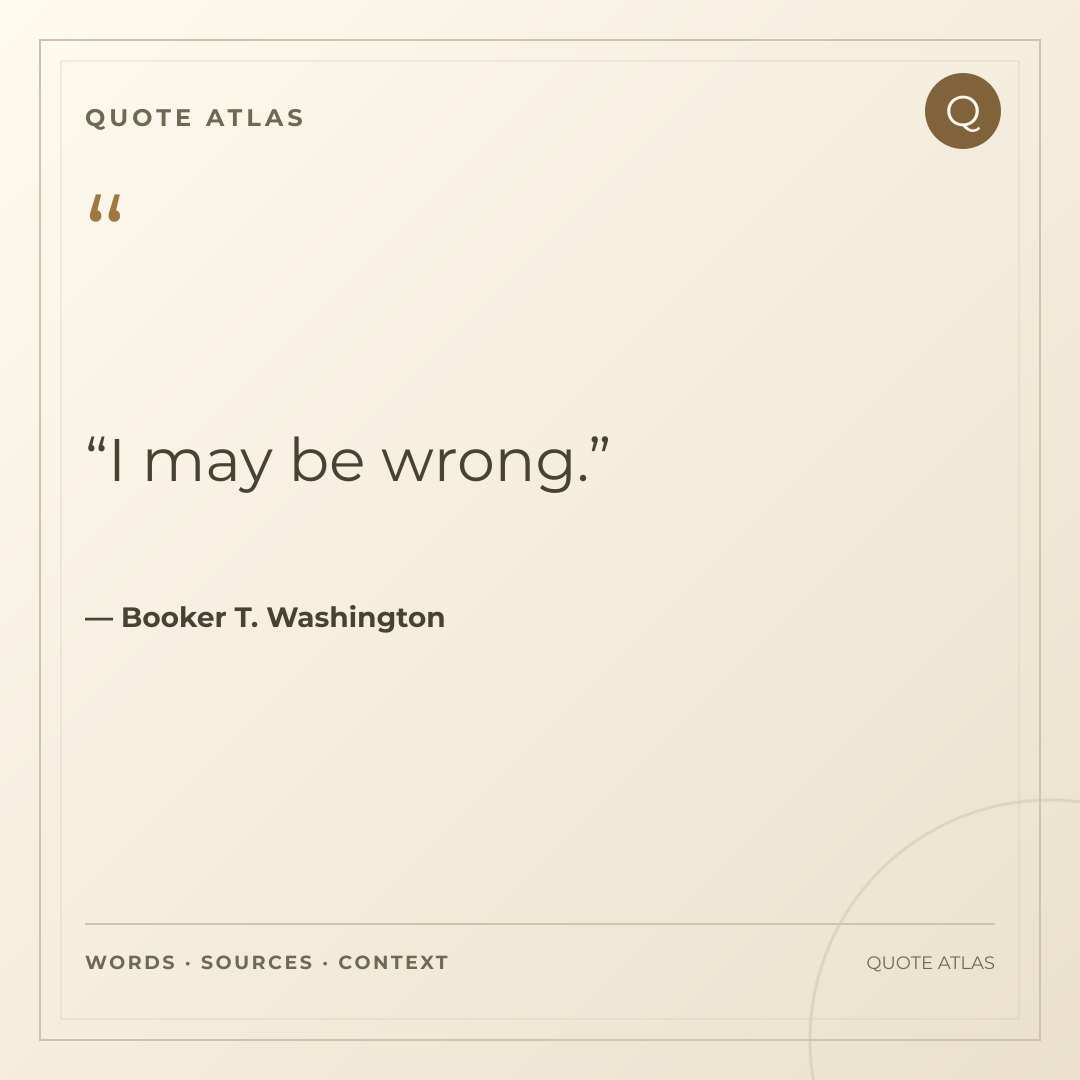
I may be wrong.

“I may be wrong.”

The admission places a limit on Washington’s own policy claims and models intellectual uncertainty rather than presenting judgment as infallible.

Source details

The Future of the American Negro, Chapter VIII; Project Gutenberg #26507. The sentence appears in Washington’s closing policy discussion immediately after his summary of dangers and immediately before his qualification that he may also be in some degree right.

Source identified249
stand by principle at all hazards.

“stand by principle at all hazards.”

Washington distinguishes tactical cooperation from questions of right and wrong, where he advises maintaining principle despite possible cost.

Source details

The Future of the American Negro, Chapter VIII; Project Gutenberg #26507. This short excerpt appears in Washington’s closing policy discussion, where he distinguishes ordinary political cooperation from cases involving a question of right or wrong and advises standing by principle in those cases.

Source identified250
an intelligent producer as well as a consumer.

“an intelligent producer as well as a consumer.”

Washington argues that post-emancipation advancement requires access to skills and productive economic roles, not consumption or formal status alone.

Source details

The Future of the American Negro, Chapter III; Project Gutenberg #26507. This is a deliberately short excerpt from Washington’s 1899 argument about becoming a producer as well as a consumer; historical racial context is retained in the source note.