Quote Atlassourced quotes & context
Page 2 of 2 · 148 quotations total

Mindset quotes — Page 2

This continuation page contains additional source-backed quotations not shown in the initial 50-quotation overview. Return to the topic guide and browse collection.

98 shown · 148 total
Source identified51
To err is human; to forgive, divine.

“To err is human; to forgive, divine.”

Error is treated as ordinary human limitation, while forgiveness requires an additional act of generosity.

Source details

An Essay on Criticism, Part III; Pope joins good nature and good sense before contrasting ordinary human error with the higher moral act of forgiveness.

Source identified52
A little learning is a dangerous thing.

“A little learning is a dangerous thing.”

Partial knowledge can produce misplaced confidence; the warning favors deeper study over shallow certainty.

Source details

An Essay on Criticism, Part II; Pope warns that shallow learning can produce premature confidence before deeper study tempers judgment.

Source identified53
You can turn over a new leaf every hour if you choose.

“You can turn over a new leaf every hour if you choose.”

A failed plan need not govern the remainder of the day; Bennett frames each hour as another practical opportunity to restart deliberate action.

Source details

How to Live on 24 Hours a Day, discussion of beginning a programme of self-directed use of spare time. The sentence is practical encouragement within Bennett’s period self-improvement argument.

Source identified54
My subject was mental efficiency as a means to self-development.

“My subject was mental efficiency as a means to self-development.”

Efficiency is presented as instrumental rather than an end in itself: better use of attention and thought is valuable insofar as it supports deliberate personal development.

Source details

Mental Efficiency. Bennett explicitly defines the scope of his argument as mental efficiency serving self-development; this is period conduct-of-life writing rather than modern cognitive-science evidence.

Source identified55
If a man is to turn everything whatsoever into his own calm, dignity, and happiness, he must make this use even of his own failures.

“If a man is to turn everything whatsoever into his own calm, dignity, and happiness, he must make this use even of his own failures.”

Failure becomes useful when it is examined and incorporated into future conduct instead of being allowed to settle a person’s sense of dignity or possibility.

Source details

The Human Machine, discussion of using experience for self-command. Bennett’s claim is philosophical self-training advice; it does not imply that every failure is beneficial or emotionally easy.

Source identified56
Literature is a living art, to be practised.

“Literature is a living art, to be practised.”

The short formulation emphasizes that literary skill develops through use and practice rather than through passive admiration of established works alone.

Source details

On the Art of Writing, Lecture XII, “On Style,” Project Gutenberg #17470; excerpted from Quiller-Couch’s summary of the course.

Source identified57
We may not be capable of much; but we can all write better than that, if we take a little trouble.

“We may not be capable of much; but we can all write better than that, if we take a little trouble.”

Improvement is framed as practical rather than mystical: even modest writers can remove avoidable weakness when they slow down and revise deliberately.

Source details

On the Art of Writing, Lecture V, “Interlude: On Jargon,” Project Gutenberg #17470; Quiller-Couch contrasts direct prose with inflated official phrasing.

Source identified58
That you must master the secret for yourselves lay implicit in our bargain, and you were never promised that a writer's training would be easy.

“That you must master the secret for yourselves lay implicit in our bargain, and you were never promised that a writer's training would be easy.”

Learning to write is presented as demanding practice rather than a shortcut: difficulty belongs to the training and does not by itself signal failure.

Source details

On the Art of Writing, Lecture XII, “On Style,” Project Gutenberg #17470; excerpted from Quiller-Couch’s reminder that students must master craft for themselves.

Source identified59
the first forty years of life furnish the text, while the remaining thirty supply the commentary

“the first forty years of life furnish the text, while the remaining thirty supply the commentary”

The age-specific metaphor presents later experience as reinterpretation of earlier life, suggesting that events can acquire coherence only after enough time has supplied comparison and perspective.

Source details

Counsels and Maxims, T. Bailey Saunders translation; Project Gutenberg #10715. The numerical life span reflects Schopenhauer’s nineteenth-century aphoristic framing rather than a modern lifespan rule.

Source identified60
it is only when he has turned it over that he can be said to know it.

“it is only when he has turned it over that he can be said to know it.”

Learning becomes knowledge, in this account, when material has been actively reconsidered and integrated rather than merely encountered or memorized.

Source details

The Art of Literature, section “On Thinking for Oneself,” T. Bailey Saunders translation; Project Gutenberg #10714. The preceding sentence says a person must first learn something before turning it over in the mind.

Source identified61
Good writing should be governed by the rule that a man can think only one thing clearly at a time

“Good writing should be governed by the rule that a man can think only one thing clearly at a time”

Schopenhauer makes clarity of sentence structure answer to the limits of attention, arguing that prose should help the reader follow one thought distinctly instead of forcing several at once.

Source details

The Art of Literature, section “On Style,” T. Bailey Saunders translation; Project Gutenberg #10714. The following discussion criticizes overloaded parenthetical sentence construction.

Source identified62
less depends upon what befalls us than upon the way in which it is met

“less depends upon what befalls us than upon the way in which it is met”

The maxim shifts attention from events alone to the way a person receives and interprets them, making response and temperament part of Schopenhauer’s account of well-being.

Source details

The Wisdom of Life, T. Bailey Saunders translation; Project Gutenberg #10741. This is a philosophical claim about temperament, not a denial that external circumstances can matter greatly.

Source identified63
So the first and most essential element in our life's happiness is what we are,—our personality

“So the first and most essential element in our life's happiness is what we are,—our personality”

The line locates a central condition of happiness in personality because it accompanies a person across changing circumstances, possessions and public opinion.

Source details

The Wisdom of Life, T. Bailey Saunders translation; Project Gutenberg #10741. The surrounding argument contrasts what a person is, has and represents to others.

Source identified64
The world in which a man lives shapes itself chiefly by the way in which he looks at it, and so it proves different to different men

“The world in which a man lives shapes itself chiefly by the way in which he looks at it, and so it proves different to different men”

Schopenhauer emphasizes interpretation as a major part of lived experience: the same world can appear very different depending on the qualities and habits of the person perceiving it.

Source details

The Wisdom of Life, T. Bailey Saunders translation; Project Gutenberg #10741. The claim belongs to Schopenhauer’s philosophical account of personality and subjective experience.

Source identified65
The only thing that stands in our power to achieve, is to make the most advantageous use possible of the personal qualities we possess

“The only thing that stands in our power to achieve, is to make the most advantageous use possible of the personal qualities we possess”

Within his restrictive view of personality, Schopenhauer still assigns agency to choosing pursuits that use and develop one’s actual capacities rather than leaving them idle or mismatched.

Source details

The Wisdom of Life, T. Bailey Saunders translation; Project Gutenberg #10741. The following clause recommends pursuits suited to the development of one’s capacities.

Source identified66
moderate your desire of victory over your adversary, and be pleased with one over yourself.

“moderate your desire of victory over your adversary, and be pleased with one over yourself.”

Franklin shifts the measure of victory from exploiting another player’s mistakes toward self-command, generosity and the ability to restrain one’s own competitive appetite.

Source details

The Morals of Chess; Founders Online authoritative Franklin Papers text. The wording begins mid-sentence after Franklin’s condition that the game is not being played rigorously; source context is preserved here.

Source identified67
Nothing is wretched, but thinking makes it so.

“Nothing is wretched, but thinking makes it so.”

Misfortune and judgment are separated: external circumstances can be painful, but the interpretation attached to them strongly influences whether a life is experienced as wholly ruined.

Source details

The Consolation of Philosophy, Book II, Chapter IV, H. R. James translation (Elliot Stock, 1897), printed page 60 in Project Gutenberg #14328. The retained catalog wording ‘Nothing is wretched, but thinking makes it so.’ is a frozen clause extract from James’s longer sentence beginning ‘So true is it that...’ in Lady Philosophy’s argument about Fortune, judgment and the instability of external circumstances. It remains late-antique philosophical consolation mediated by translation, not modern cognitive-science or clinical mental-health evidence.

Source identified68
There is no education which one can get from books and costly apparatus that is equal to that which can be gotten from contact with great men and women.

“There is no education which one can get from books and costly apparatus that is equal to that which can be gotten from contact with great men and women.”

Books matter, but lived contact with admirable people can teach standards, courage and conduct that abstract instruction alone may not communicate.

Source details

Up from Slavery, Chapter III, “The Struggle For An Education,” Project Gutenberg #2376. Washington describes General Samuel Chapman Armstrong’s influence at Hampton and argues that sustained contact with exemplary people can itself be a powerful form of education.

Source identified69
The worth of work with the hands

“The worth of work with the hands”

Washington opens the book by treating manual work as capable of contributing to education, dignity and practical development rather than merely supplying labor.

Source details

Working With the Hands, Chapter I, opening sentence; Project Gutenberg #64504. This deliberately short excerpt is presented with its educational context.

Source identified70
education ought to do more for a boy

“education ought to do more for a boy”

Washington rejects an overly narrow definition of schooling and asks whether education can improve the practical conditions and responsibilities of life.

Source details

Working With the Hands, Chapter I; Project Gutenberg #64504. This short excerpt precedes Washington’s discussion of poverty, family responsibility and practical education.

Source identified71
Is it not pleasant to learn with a constant perseverance and application?

“Is it not pleasant to learn with a constant perseverance and application?”

Learning becomes satisfying when it is sustained through repeated application rather than treated as a single act of exposure.

Source details

The Analects of Confucius, James Legge’s public-domain English translation; Book I opens by connecting learning with steady practice.

Source identified72
To have faults and not to reform them,—this, indeed, should be pronounced having faults.

“To have faults and not to reform them,—this, indeed, should be pronounced having faults.”

Making an error is less serious than refusing to correct it after the problem has become visible.

Source details

The Analects of Confucius, James Legge’s public-domain English translation; Book XV distinguishes ordinary faults from the refusal to reform them.

Source identified73
The more you draw, the better. Draw everything you can.

“The more you draw, the better. Draw everything you can.”

Voice: Fictional character · Loristan

Repeated drawing is treated as the route to improvement, making practice and quantity of attempts part of developing a useful skill.

Source details

The Lost Prince; Project Gutenberg #384. Loristan encourages Marco to strengthen a sketching ability useful to the story’s secret mission.

Source identified74
To make each one many times was the best way to imbed it in his memory.

“To make each one many times was the best way to imbed it in his memory.”

Voice: Narrator voice · Narrator

The narration connects repeated practice with stronger recall, showing Marco deliberately using repetition to make a learned association more durable.

Source details

The Lost Prince; Project Gutenberg #384. The exercise involves repeatedly sketching faces connected with places for the novel’s secret mission.

Source identified75
After a third day's concentration they knew by heart everything given to them to learn.

“After a third day's concentration they knew by heart everything given to them to learn.”

Voice: Narrator voice · Narrator

The narration connects sustained concentration across several days with mastery of the assigned material rather than portraying learning as instantaneous.

Source details

The Lost Prince; Project Gutenberg #384. The material being memorized is fictional mission information, while the quoted sentence simply describes the learning process.

Source identified76
It is well to observe everything and to train one's self to remember faces and circumstances.

“It is well to observe everything and to train one's self to remember faces and circumstances.”

Voice: Fictional character · Loristan

Observation and memory are presented as trainable abilities strengthened by deliberate attention rather than fixed talents that either appear or do not.

Source details

The Lost Prince; Project Gutenberg #384. Loristan is training Marco for a fictional diplomatic and political mission, so the advice belongs to that narrative setting.

Source identified77
The game he had amused himself with so long—the game of trying to remember pictures and people and places clearly and in detail—had been a wonderful training.

“The game he had amused himself with so long—the game of trying to remember pictures and people and places clearly and in detail—had been a wonderful training.”

Voice: Narrator voice · Narrator

A game repeatedly practiced for pleasure becomes useful preparation, showing skill growing out of accumulated attention rather than appearing only when the stakes become serious.

Source details

The Lost Prince; Project Gutenberg #384. The narration refers to Marco’s long-running memory game, which later becomes useful inside the novel’s fictional secret mission.

Source identified78
I had to try myself at the same time, of course.

“I had to try myself at the same time, of course.”

Voice: Fictional character · Colin Craven

Colin explicitly adds his own effort to the encouragement he received, keeping agency and practice inside the novel’s language of 'Magic.'

Source details

The Secret Garden (1911), Chapter XXIII, “Magic.” Immediately after recalling Mary’s encouragement, Colin says that he had to try himself at the same time. The line keeps effort inside the novel’s fictional experiment/Magic rhetoric and is not clinical guidance.

Source identified79
At first people refuse to believe that a strange new thing can be done, then they begin to hope it can be done.

“At first people refuse to believe that a strange new thing can be done, then they begin to hope it can be done.”

Voice: Narrator voice · Narrator

New possibilities often move through stages from disbelief to curiosity and finally hope, especially when evidence begins to challenge settled expectations.

Source details

The Secret Garden (1911), Chapter XXVII, “In the Garden.” This collection keeps a shortened opening excerpt of the narrator’s longer sentence: strange possibilities move from disbelief to hope, then to demonstrated possibility and eventual accomplishment. It remains narrator commentary inside the novel rather than a scientific law of progress.

Source identified80
Knowledge is power.

“Knowledge is power.”

The maxim connects understanding with the capacity to act effectively rather than treating knowledge as decoration.

Source details

From the Latin “ipsa scientia potestas est”; common English rendering.

Source identified81
Reading maketh a full man; conference a ready man; and writing an exact man.

“Reading maketh a full man; conference a ready man; and writing an exact man.”

Bacon distinguishes what reading, conversation, and writing each contribute to intellectual development.

Source details

Of Studies; Bacon distinguishes the intellectual uses of reading, conversation, and writing within the essay’s compact account of study and judgment.

Source identified82
If a man will begin with certainties, he shall end in doubts; but if he will be content to begin with doubts, he shall end in certainties.

“If a man will begin with certainties, he shall end in doubts; but if he will be content to begin with doubts, he shall end in certainties.”

Intellectual confidence can be improved by beginning with questions rather than pretending certainty too early.

Source details

The Advancement of Learning, First Book, Project Gutenberg #5500, transcribed from the 1893 Cassell & Company edition. Bacon contrasts impatience of doubt with mature suspension of judgment and then sets out two ways of contemplation before saying that beginning with certainties ends in doubts while beginning with doubts can end in certainties. It remains early-modern epistemological argument rather than a modern experimental rule for scientific method.

Source identified83
A man may know much about educating himself, and but little about the proper means for educating others.
Image design Linen

“A man may know much about educating himself, and but little about the proper means for educating others.”

Douglass distinguishes learning independently from knowing how to teach someone else. He values self-education yet cautions that overcoming personal obstacles does not automatically make a person an expert in educational institutions or instruction.

Source details

Self-Made Men, in the section considering criticisms of successful self-educated people. This wording follows the Teaching American History transcript (1872 editorial date). Douglass delivered and revised the lecture over time; the precise wording is tied to this transcript and should not be silently projected onto every manuscript version.

Source identified84
Progress, far from consisting in change, depends on retentiveness.

“Progress, far from consisting in change, depends on retentiveness.”

Change by itself is not improvement; progress requires preserving useful lessons and achievements while moving beyond what no longer works.

Source details

The Life of Reason, Reason in Common Sense; the sentence follows Santayana’s discussion of memory and historical learning.

Source identified85
the desire and will to work is optimism itself.

“the desire and will to work is optimism itself.”

Optimism is defined here as willingness to participate and act, sharply distinguishing Keller’s position from passive expectation that circumstances will improve on their own.

Source details

Optimism: An Essay (1903), Project Gutenberg #31622. Keller is describing her future-facing desire for useful activity as college ends.

Source identified86
Optimism is the faith that leads to achievement; nothing can be done without hope.

“Optimism is the faith that leads to achievement; nothing can be done without hope.”

Hope is presented as an active foundation for achievement: confidence in possibility helps sustain the effort needed to move from intention to result.

Source details

Optimism: An Essay; Keller connects optimism with purposeful action rather than passive cheerfulness.

Source identified87
I must think over things for myself and get to understand them.

“I must think over things for myself and get to understand them.”

Voice: Fictional character · Nora Helmer

Nora claims the responsibility to examine received beliefs for herself, making independent thought part of her attempt to understand her own identity and circumstances.

Source details

A Doll’s House, Act III, R. Farquharson Sharp translation, Project Gutenberg #15492. Nora Helmer says she must think things over for herself during the final confrontation with Torvald, after saying she must educate herself and stand alone. This is fictional dramatic speech, not Ibsen autobiography or contemporary family / legal guidance.

Source identified89
What a man thinks of himself, that it is which determines, or rather indicates, his fate.

“What a man thinks of himself, that it is which determines, or rather indicates, his fate.”

Thoreau argues that private self-judgment can become a powerful constraint or permission, shaping choices more strongly than public opinion alone.

Source details

Walden, “Economy,” in the passage contrasting public opinion with a person’s own private opinion of himself.

Source identified90
It is a trite but true observation, that examples work more forcibly on the mind than precepts.

“It is a trite but true observation, that examples work more forcibly on the mind than precepts.”

Voice: Fictional narrator · Narrator

Fielding’s narrator argues that visible examples of conduct can shape imitation more powerfully than abstract instruction alone.

Source details

Joseph Andrews, Book I, Chapter I, Project Gutenberg #9611. Fielding opens his narrator’s discussion of exemplary lives by observing that examples work more forcibly on the mind than precepts, then develops the claim through imitation and the moral purpose he assigns to writing. It is eighteenth-century literary argument, not a modern experimental finding about learning.

Source identified91
Circumstance does not make the man; it reveals him to himself.

“Circumstance does not make the man; it reveals him to himself.”

Circumstances can expose habits of thought and character that were already present, turning difficulty into information about what needs attention or change.

Source details

As a Man Thinketh; Allen uses circumstance as a mirror for character and habitual thought.

Source identified94
Men are anxious to improve their circumstances, but are unwilling to improve themselves.

“Men are anxious to improve their circumstances, but are unwilling to improve themselves.”

Changing conditions without changing the habits that produce them may leave the underlying problem intact.

Source details

As a Man Thinketh, “Effect of Thought on Circumstances.”

Source identified95
All that a man achieves and all that he fails to achieve is the direct result of his own thoughts.

“All that a man achieves and all that he fails to achieve is the direct result of his own thoughts.”

Achievement is connected to the quality and direction of thought, while responsibility is placed on the person rather than on luck alone.

Source details

As a Man Thinketh, chapter “Thought and Purpose,” in the authorized edition.

Source identified96
Man is buffeted by circumstances so long as he believes himself to be the creature of outside conditions.

“Man is buffeted by circumstances so long as he believes himself to be the creature of outside conditions.”

Allen argues that treating circumstances as the whole explanation of one’s life can obscure the role of habits, thought and deliberate change.

Source details

As a Man Thinketh, chapter “Effect of Thought on Circumstances”; the sentence introduces Allen’s claim that self-examination can change a person’s relation to circumstances.

Source identified97
The Vision that you glorify in your mind, the Ideal that you enthrone in your heart—this you will build your life by, this you will become.

“The Vision that you glorify in your mind, the Ideal that you enthrone in your heart—this you will build your life by, this you will become.”

Repeatedly honored ideals influence choices and habits, so the picture a person keeps returning to can become a practical standard for action.

Source details

As a Man Thinketh, end of “Visions and Ideals”; Allen summarizes the chapter by linking dominant ideals with the life a person builds.

Source identified98
Let a man realize that life in its totality proceeds from the mind, and lo, the way of blessedness is opened up to him!

“Let a man realize that life in its totality proceeds from the mind, and lo, the way of blessedness is opened up to him!”

Allen’s idealist claim makes mental discipline central to change, proposing that recognizing the role of thought can open a more deliberate way of living.

Source details

Out from the Heart; the sentence introduces Allen’s argument that ruling the mind changes one’s relation to conduct and experience.

Source identified99
I declare after all there is no enjoyment like reading!

“I declare after all there is no enjoyment like reading!”

Voice: Fictional character · Caroline Bingley

The line is memorable as praise of reading, though its comic context matters because Miss Bingley says it while performing interest for Darcy.

Source details

Pride and Prejudice, Chapter 11; context is ironic.

Source identified100
Experience is primarily an active-passive affair; it is not primarily cognitive.

“Experience is primarily an active-passive affair; it is not primarily cognitive.”

Dewey treats experience as a combination of doing and undergoing consequences, with understanding developing through the relationship between action and what follows from it.

Source details

Democracy and Education (1916), Chapter XI, “Experience and Thinking.” Dewey describes experience as a relation between doing and undergoing consequences, then immediately qualifies the active-passive formulation by saying that valuable experience includes cognition insofar as relationships and continuities are perceived. Verified against Project Gutenberg #852 and the scan-backed Wikisource Chapter XI transcription. The sentence is not a denial that cognition matters and is not presented as modern neuroscientific evidence.

Source identified101
A pupil from whom nothing is ever demanded which he cannot do, never does all he can.

“A pupil from whom nothing is ever demanded which he cannot do, never does all he can.”

The sentence argues that education needs genuine stretch: always keeping demands inside proven ability can leave capacity underused.

Source details

Autobiography, Chapter I; Mill reflects critically on his father’s demanding teaching while preserving this principle about intellectual effort.

Source identified102
We glory in tribulations also: knowing that tribulation worketh patience.

“We glory in tribulations also: knowing that tribulation worketh patience.”

Difficulty is interpreted as a setting in which endurance can be formed rather than as a final verdict on the person experiencing it.

Source details

Romans 5:3 in the King James Version.

Source identified103
Tomorrow is always fresh, with no mistakes in it yet.

“Tomorrow is always fresh, with no mistakes in it yet.”

A new day is treated as a practical reset: past mistakes remain real without having to occupy every future choice.

Source details

Anne of Green Gables, Anne’s hopeful reflection about tomorrow.

Source identified104
It is not a lost year, but one that may prove the most helpful of any you ever know.

“It is not a lost year, but one that may prove the most helpful of any you ever know.”

Voice: Fictional character · Jo Bhaer

A painful or disappointing period can still become useful experience when it changes judgment, humility, resolve, and the way a person begins again.

Source details

Jo's Boys; the reassurance follows a setback and reframes a difficult year as experience that may later prove unusually helpful rather than simply wasted time.

Source identified105
How happy I am, that my friend Marcus Cornelius, so distinguished as an orator and so noble as a man, thinks me worth praising and blaming.

“How happy I am, that my friend Marcus Cornelius, so distinguished as an orator and so noble as a man, thinks me worth praising and blaming.”

Marcus values a relationship in which admiration does not exclude correction: Fronto’s willingness to praise and blame him is presented as a mark of trusted friendship rather than mere approval.

Source details

Project Gutenberg #2680, Appendix “Correspondence of M. Aurelius Antoninus and M. Cornelius Fronto,” identifies this line as Ad M. Caes. iii. 17. The wording is preserved as correspondence context, not treated as a maxim from the Meditations.

Source identified106
The desire of the child to attain an end which he knows, leads him to correct himself.

“The desire of the child to attain an end which he knows, leads him to correct himself.”

A clear goal can support self-correction because the learner can compare the result with the intended end and revise without waiting for every error to be externally identified.

Source details

Dr. Montessori's Own Handbook, discussion of self-correcting didactic material. Project Gutenberg #29635. Montessori immediately describes the child’s own intelligence, rather than the teacher, as detecting and correcting the error.

Source identified107
The mind has formed itself by a special exercise of attention, observing, comparing, and classifying.

“The mind has formed itself by a special exercise of attention, observing, comparing, and classifying.”

Montessori describes repeated acts of attention and comparison as formative intellectual practice that organizes experience instead of merely supplying memorized content.

Source details

Dr. Montessori's Own Handbook, discussion of sensory didactic material. The statement reflects Montessori’s historical theory of mental development and is not labeled as a current neuroscientific finding.

Source identified108
Give the child an environment in which everything is constructed in proportion to himself, and let him live therein.

“Give the child an environment in which everything is constructed in proportion to himself, and let him live therein.”

An environment designed around the learner’s scale and capacities can make independent activity observable and give development room to emerge without constant adult substitution.

Source details

Spontaneous Activity in Education, Chapter I, “A Survey of the Child’s Life,” around printed page 20, Florence Simmonds translation, Project Gutenberg #24727. Montessori proposes a child-scaled environment and immediately develops the claim through the language of active and spiritual life. This is historical Montessori pedagogy and observation, not a universally established modern developmental outcome.

Source identified109
Our task is to offer the child the instruments of education, to keep pure within him the springs of his intellectual growth, of his life of feeling.

“Our task is to offer the child the instruments of education, to keep pure within him the springs of his intellectual growth, of his life of feeling.”

Teaching is presented as furnishing tools and protecting conditions for intellectual and emotional development rather than attempting to manufacture every insight directly.

Source details

The Montessori Elementary Material (1917), Arthur Livingston translation, Part II, Reading, Chapter I, subsection “The Most Popular Books,” printed page 201, Project Gutenberg #42869. Montessori says education should supply essential instruments while preserving the child’s intellectual and emotional springs, then argues that method should assist development without repressing spontaneous activity. This is historical Montessori pedagogy rather than an experimentally established modern educational-outcome rule.

Source identified110
Eagerness for surmounting difficulties and for high attainment is much more frequently found in children than we, judging by our own experience as adults, easily suspect.

“Eagerness for surmounting difficulties and for high attainment is much more frequently found in children than we, judging by our own experience as adults, easily suspect.”

Montessori cautions adults against underestimating children’s willingness to engage with challenge, arguing that observed performance can reveal stronger motivation and aptitude than adult assumptions predict.

Source details

The Montessori Elementary Material (1917), Arthur Livingston translation, Part VI, Music, Chapter I, “The Scale,” beginning on printed page 322 and continuing onto page 323, Project Gutenberg #42869. After describing children’s differing interest in bell exercises, Montessori argues that adults often underestimate children’s eagerness for difficulty and high attainment and says actual performance reveals particular aptitude. This remains her historical educational observation rather than a modern validated aptitude test or clinical claim.

Source identified111
The pedagogical method of observation has for its base the liberty of the child; and liberty is activity.

“The pedagogical method of observation has for its base the liberty of the child; and liberty is activity.”

Montessori links observation-based teaching with room for children to act, treating activity as necessary evidence for understanding development rather than mere classroom disorder.

Source details

The Montessori Method, section “Discipline,” Anne E. George translation. Project Gutenberg #39863. This is historical Montessori pedagogy and should not be presented as a universal modern experimental finding.

Source identified112
Training is everything. The peach was once a bitter almond; cauliflower is nothing but cabbage with a college education.

“Training is everything. The peach was once a bitter almond; cauliflower is nothing but cabbage with a college education.”

Voice: Epigraph / fictional source voice · Pudd’nhead Wilson’s Calendar

The exaggerated botany turns education and training into a comic theory of transformation, while still preserving the broader idea that development changes what something can become.

Source details

Pudd’nhead Wilson, Chapter V epigraph; the cauliflower comparison appears as a Calendar maxim before the chapter.

Source identified113
I must studiously and faithfully unlearn a great many things I have somehow absorbed concerning Palestine.

“I must studiously and faithfully unlearn a great many things I have somehow absorbed concerning Palestine.”

Direct experience forces revision of inherited mental pictures, making learning partly an act of discarding assumptions that no longer fit observed reality.

Source details

The Innocents Abroad (1869), Chapter XLVI. In Palestine Twain says he must studiously and faithfully unlearn many inherited ideas because direct observation has altered the scale and meaning of what he had imagined. Verified against the scan-backed 1869 first edition.

Source identified114
You can’t yourself, but exterior influences can do it.

“You can’t yourself, but exterior influences can do it.”

Voice: Dialogue speaker · Old Man

The Old Man claims that opinions can change, but attributes the change to new evidence, conversation, study, and other influences entering from outside the individual.

Source details

What Is Man?, Old Man replying to the Young Man’s question about changing an automatic opinion; this is dialogic determinism, not neutral cognitive science.

Source identified115
Prejudices must be removed by outside influences or not at all.

“Prejudices must be removed by outside influences or not at all.”

Voice: Dialogue speaker · Old Man

The Old Man argues that entrenched assumptions change through encounters, teaching, experience, and other influences rather than simply disappearing by private command.

Source details

What Is Man?, opening dialogue between the Old Man and Young Man; this sentence belongs to the Old Man’s deterministic argument about education and outside influence.

Source identified116
Everything has its limit—iron ore cannot be educated into gold.

“Everything has its limit—iron ore cannot be educated into gold.”

Voice: Dialogue speaker · Old Man

The metaphor distinguishes growth from limitless transformation: training can develop capacities, but the dialogue also insists that development occurs within constraints.

Source details

What Is Man?, opening machine-and-metal analogy; the Old Man uses iron and gold to argue for limits within his deterministic model of human development.

Source identified117
A rational mind will be employ’d, it will never be satisfy’d in doing nothing, and if you neglect to furnish it with good materials, ’tis like to take up with such as come to hand.

“A rational mind will be employ’d, it will never be satisfy’d in doing nothing, and if you neglect to furnish it with good materials, ’tis like to take up with such as come to hand.”

Voice: Authorial / signed preface voice · Mary Astell

Astell argues that the mind naturally seeks occupation, so denying people serious intellectual material does not make the mind inactive; it leaves it to whatever material happens to be available.

Source details

A Serious Proposal to the Ladies, Part I, printed page 56 in the represented 1697 two-part edition, Project Gutenberg #54984. Astell writes that a rational mind will be employed while arguing that women denied serious intellectual education may be driven toward inferior materials. Original spelling is retained; the passage belongs to her explicitly religious and educational proposal, not contemporary educational-outcome research.

Source identified118
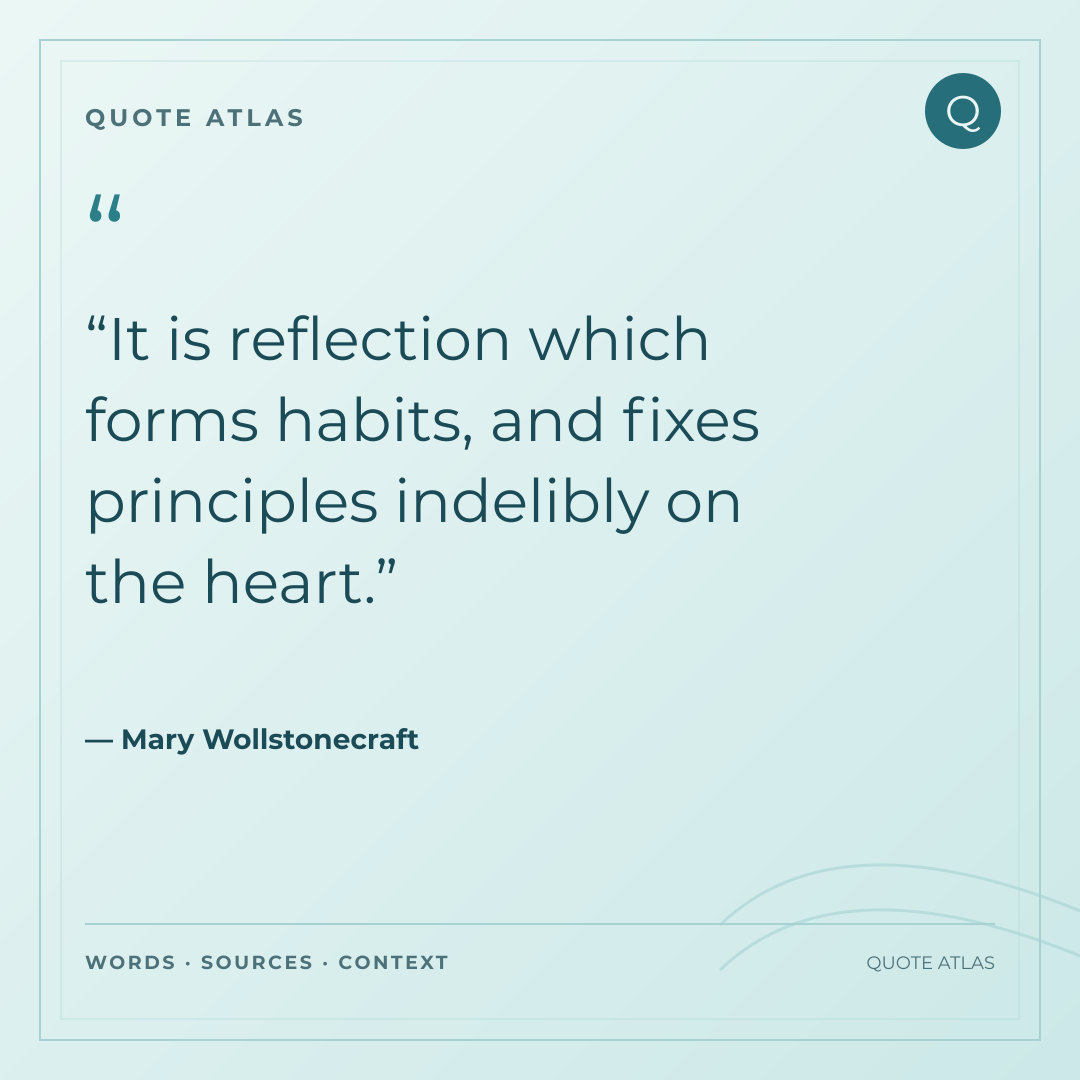
It is reflection which forms habits, and fixes principles indelibly on the heart.

“It is reflection which forms habits, and fixes principles indelibly on the heart.”

Habit formation becomes stronger when action is joined with reflection, because principles understood and revisited are more likely to guide later choices.

Source details

Thoughts on the Education of Daughters (1787), “THE BENEFITS WHICH ARISE FROM DISAPPOINTMENTS,” printed page 111, Project Gutenberg #67466. Wollstonecraft says reflection forms habits and fixes principles while opening a religious-moral discussion of disappointment, self-examination and character.

Source identified119
Reading is the most rational employment, if people seek food for the understanding.

“Reading is the most rational employment, if people seek food for the understanding.”

Reading is valuable when it feeds judgment and understanding rather than becoming a performance of remembering words without examining their ideas.

Source details

Thoughts on the Education of Daughters (1787), “READING,” printed page 49, Project Gutenberg #67466. Wollstonecraft calls reading the most rational employment when people seek food for the understanding, contrasting reflective reading with merely collecting words or quotations; this is eighteenth-century educational argument rather than a current evidence-based teaching prescription.

Source identified120
Unless we are transformed we cannot finally stand, and without more light we cannot be transformed.

“Unless we are transformed we cannot finally stand, and without more light we cannot be transformed.”

Arnold links durable social improvement to transformation in understanding, arguing that inherited energy and honesty are insufficient without greater intellectual light.

Source details

Discourses in America, Preface, Project Gutenberg #44919. Arnold argues that England’s inherited energy, courage and moral conduct are insufficient without intellectual “light,” concluding that transformation requires more understanding. This is Victorian cultural-political criticism and metaphorical rhetoric, not a scientific or therapeutic claim.

Source identified121
My trade and art is to live.

“My trade and art is to live.”

Montaigne makes lived experience itself the central field of inquiry, treating ordinary life as material for reflection rather than a distraction from philosophy.

Source details

Essays of Montaigne, Book II, Chapter VI, “Use Makes Perfect,” Charles Cotton translation, W. C. Hazlitt 1877 edition, Project Gutenberg #3600. “My trade and art is to live” occurs while Montaigne defends speaking from his own sense, experience and practice. It remains early-modern autobiographical essay and moral reflection rather than modern therapeutic or behavioral-science evidence.

Source identified122
Every now and then a man’s mind is stretched by a new idea or sensation, and never shrinks back to its former dimensions.

“Every now and then a man’s mind is stretched by a new idea or sensation, and never shrinks back to its former dimensions.”

Voice: Authorial persona / framed maxim · The Autocrat

The Autocrat persona pictures significant ideas and experiences as permanently enlarging the range through which a person can think.

Source details

The Autocrat of the Breakfast-Table, represented by Project Gutenberg #751. The line is spoken in Holmes’s table-talk authorial persona and followed by an Alpine image; it is a literary metaphor for intellectual expansion, not a neurological claim.

Source identified123
Experience is merely the name men gave to their mistakes.

“Experience is merely the name men gave to their mistakes.”

Voice: Narrator voice · Narrator, focalized through Lord Henry

The wit turns “experience” into a retrospective label for errors, suggesting that mistakes become useful only when understood.

Source details

The Picture of Dorian Gray, 1891 edition, Chapter 4; third-person narration focalized through Lord Henry reflects that experience is the name people give to their mistakes.

Source identified124
The direction in which education starts a man, will determine his future life.

“The direction in which education starts a man, will determine his future life.”

Voice: Dialogue speaker · Socrates

Early education shapes habits of attention and judgment, so its direction can influence the kind of person someone later becomes.

Source details

The Republic, Book IV in Benjamin Jowett’s translation; the line appears during discussion of education and civic character.

Source identified125
Hard is it to correct a habit already formed.

“Hard is it to correct a habit already formed.”

Repeated behavior becomes easier to continue and harder to reverse, which makes early choices about habit formation especially consequential.

Source details

The Moral Sayings of Publius Syrus, maxim 11, in Darius Lyman’s 1856 English rendering; maxim order can vary across editions.

Source identified127
Reading is to the mind what exercise is to the body.

“Reading is to the mind what exercise is to the body.”

Regular reading is compared with physical exercise because repeated intellectual use can strengthen attention, knowledge, and mental capacity over time.

Source details

The Tatler No. 147; the comparison presents reading as a form of regular exercise for the mind.

Source identified128
And lose, and start again at your beginnings.

“And lose, and start again at your beginnings.”

Starting again after loss is presented as a test of composure rather than as evidence that the earlier effort was meaningless.

Source details

If—, third stanza; the surrounding passage describes losing one’s winnings and beginning again.

Source identified129
A distinct university walks about under each man's hat.

“A distinct university walks about under each man's hat.”

Voice: Authorial / signed preface voice · Russell H. Conwell

Conwell’s metaphor presents each person’s powers of observation and reflection as a continuing source of self-education beyond formal institutions.

Source details

Every Man His Own University, Chapter I, “Every Man’s University,” Project Gutenberg #36955, copyright 1917 witness. Conwell opens the chapter with “A distinct university walks about under each man’s hat” and develops the metaphor through observation, reading and independent thought. It is historical motivational/educational rhetoric, not evidence that formal education is unnecessary.

Source identified131
Every action, every thought, every feeling, contributes to the education of the temper, the habits, and understanding.

“Every action, every thought, every feeling, contributes to the education of the temper, the habits, and understanding.”

Education continues through everyday conduct: repeated thoughts and actions train emotional responses, habits, and practical judgment even outside formal study.

Source details

Character, Chapter I, “Influence of Character,” Project Gutenberg #2541. It immediately follows the discussion of small acts and daily discipline, with Smiles describing action, thought and feeling as continuously educating temper, habits and understanding.

Source identified132
The education of character is very much a question of models.

“The education of character is very much a question of models.”

People absorb conduct from examples around them, so lived models can teach more powerfully than rules that are contradicted by behavior.

Source details

Self-Help, Chapter XII, “Example—Models,” Project Gutenberg #935. Smiles argues that character education depends heavily on models because people unconsciously mould themselves after the characters, manners, habits and opinions around them.

Source identified133
So much patient perseverance could not but eventually succeed

“So much patient perseverance could not but eventually succeed”

Smiles describes Stephenson’s progress in arithmetic as the cumulative result of study and patient persistence rather than easy aptitude.

Source details

The Life of George Stephenson and of his Son Robert Stephenson, Chapter IV, “The Stephensons at Killingworth—Education and Self-Education of Father and Son”; represented 1868 revised edition, Project Gutenberg #46229. The excerpt is Smiles’s narration of Stephenson’s patient arithmetic study under John Wigham.

Source identified134
A long habit of not thinking a thing wrong, gives it a superficial appearance of being right.

“A long habit of not thinking a thing wrong, gives it a superficial appearance of being right.”

Custom can disguise error by making the familiar feel legitimate; critical judgment requires re-examining practices that have escaped scrutiny through repetition.

Source details

Common Sense (1776), Introduction. The represented opening sentence is verified in Project Gutenberg #147 and the validated scan-backed Wikisource transcription; Paine argues that familiarity can make a wrong practice appear right before public argument unsettles the custom.

Source identified135
makes the reading of Wordsworth an excellent sort of training towards the things of art and poetry.

“makes the reading of Wordsworth an excellent sort of training towards the things of art and poetry.”

Pater presents sustained engagement with a difficult poet as a form of aesthetic training, implying that taste and discrimination can be developed through repeated attentive reading.

Source details

Appreciations, with an Essay on Style, essay “Wordsworth,” printed page 41 in the Macmillan 1910 Library Edition pagination reproduced by Project Gutenberg #4037. Pater says that the contrast between Wordsworth’s higher and lower poetic moods “makes the reading of Wordsworth an excellent sort of training towards the things of art and poetry.” This remains Pater’s critical judgment about aesthetic training, not an experimentally established educational outcome.

Source identified136
a habit of reading between the lines, a faith in the effect of concentration and collectedness of mind in the right appreciation of poetry

“a habit of reading between the lines, a faith in the effect of concentration and collectedness of mind in the right appreciation of poetry”

Pater describes demanding reading as training in concentration and inference, where appreciation grows through disciplined attention instead of quick surface consumption.

Source details

Appreciations, with an Essay on Style, essay “Wordsworth,” printed page 42 in the Macmillan 1910 Library Edition pagination reproduced by Project Gutenberg #4037. The reading-between-the-lines passage follows Pater’s claim that Wordsworth-reading can train aesthetic discrimination; he attributes to receptive readers a habit of inference plus faith in concentration and collectedness of mind. This remains nineteenth-century literary criticism rather than cognitive-science evidence.

Source identified137
To define beauty, not in the most abstract, but in the most concrete terms possible

“To define beauty, not in the most abstract, but in the most concrete terms possible”

Pater begins aesthetic criticism by preferring close attention to particular works and experiences over a universal formula, making discrimination and concrete observation central to judgment.

Source details

The Renaissance, Preface; Project Gutenberg #2398, represented sixth-edition text. The phrase introduces Pater’s method of aesthetic criticism.

Source identified138
To burn always with this hard, gemlike flame, to maintain this ecstasy, is success in life.

“To burn always with this hard, gemlike flame, to maintain this ecstasy, is success in life.”

The famous image defines success through intensity and alertness of experience rather than conventional achievement, fitting Pater’s larger argument against living automatically through habit.

Source details

The Renaissance, Conclusion; Project Gutenberg #2398. The metaphor belongs to Pater’s aesthetic philosophy and should not be reduced to generic productivity advice.

Source identified139
What we have to do is to be for ever curiously testing new opinions and courting new impressions, never acquiescing in a facile orthodoxy

“What we have to do is to be for ever curiously testing new opinions and courting new impressions, never acquiescing in a facile orthodoxy”

Pater recommends intellectual openness and repeated testing rather than easy conformity, making revision and exposure to new impressions part of an active critical life.

Source details

The Renaissance, Conclusion; Project Gutenberg #2398. The sentence names Comte, Hegel and one’s own orthodoxy in its immediate continuation.

Source identified140
Artistic growth is, more than it is anything else, a refining of the sense of truthfulness.

“Artistic growth is, more than it is anything else, a refining of the sense of truthfulness.”

Cather’s narrator presents artistic development as increasingly exact honesty about perception and expression rather than as mere technical display or sudden inspiration.

Source details

The Song of the Lark, Part VI, Chapter X, Project Gutenberg #44. ‘Artistic growth is... a refining of the sense of truthfulness’ is narrator reflection immediately after Harsanyi calls passion the artist's ‘open secret’ and as Thea Kronborg comes into fuller command of her mature performance. It belongs to Cather's fictional account of artistic formation and performance, not an empirical measurement of artistic development or a guarantee that all artists mature in the same way.

Source identified141
Failure is often the turning-point, the pivot of circumstance that swings us to higher levels.

“Failure is often the turning-point, the pivot of circumstance that swings us to higher levels.”

A setback can force reassessment and redirect effort, so Jordan treats some failures as transitions rather than final verdicts.

Source details

Self-Control, Its Kingship and Majesty, Chapter XIV, “Failure as a Success,” Project Gutenberg #51469. “Failure is often the turning-point...” follows Jordan’s account of a failed log-rafting experiment that nevertheless generated useful hydrographic observations. The word “often” is retained: this is conduct-of-life rhetoric about possible redirection after failure, not a guarantee that failure produces improvement.

Source identified142
What, to our eyes, may seem hopeless failure is often but the dawning of a greater success.

“What, to our eyes, may seem hopeless failure is often but the dawning of a greater success.”

Immediate appearances can mislead: a failure may reveal another direction or become part of later success, so present defeat need not define the whole trajectory.

Source details

The Majesty of Calmness, “Failure as a Success.” The passage is motivational interpretation, not a promise that every loss will produce a better outcome.

Source identified143
Pragmatism unstiffens all our theories, limbers them up and sets each one at work.

“Pragmatism unstiffens all our theories, limbers them up and sets each one at work.”

James presents pragmatism as a method that makes theories answer to practical consequences and experience instead of allowing abstract formulations to remain rigid and self-sufficient.

Source details

Pragmatism, Lecture II, “What Pragmatism Means”; Project Gutenberg #5116. The sentence follows James’s claim that theories become instruments rather than final answers.

Source identified144
Our errors are surely not such awfully solemn things.

“Our errors are surely not such awfully solemn things.”

James resists treating every possible intellectual mistake as catastrophic, because an excessive fear of error can itself prevent inquiry, experience and the possibility of gaining truth.

Source details

The Will to Believe, essay “The Will to Believe”; Project Gutenberg #26659. James is contrasting the risk of being mistaken with the cost of refusing every uncertain intellectual venture.

Source identified145
what is an artist but a workman who is determined that, whatever else happens, his work shall be excellent?

“what is an artist but a workman who is determined that, whatever else happens, his work shall be excellent?”

Morris defines artistic practice through workmanship and a deliberate standard of excellence, joining creative identity to sustained attention to the quality of the work itself.

Source details

Hopes and Fears for Art, lecture “Making the Best of It”; Project Gutenberg #3773. The sentence addresses artistic workmanship rather than claiming every form of labor is art.

Source identified146
grudge no expense of trouble, patience, or courage, in the striving to accomplish the hard thing you have set yourselves to do.

“grudge no expense of trouble, patience, or courage, in the striving to accomplish the hard thing you have set yourselves to do.”

Addressing art students, Morris emphasizes the persistence, patience and courage needed to carry difficult creative work toward the standard the maker has chosen.

Source details

Hopes and Fears for Art, lecture “The Art of the People”; Project Gutenberg #3773. The counsel is explicitly directed to people studying or practicing art.

Source identified147
the main pleasure of life is the exercise of energy in the development of our special capacities.

“the main pleasure of life is the exercise of energy in the development of our special capacities.”

The line makes development itself a source of satisfaction: people flourish, in Morris’s account, when their abilities are actively exercised instead of left unused.

Source details

Signs of Change, lecture “Dawn of a New Epoch”; Project Gutenberg #3053. The sentence occurs inside Morris’s proposed organization of socially useful labor.

Source identified148
Sweet are the uses of adversity.

“Sweet are the uses of adversity.”

Voice: Fictional character · Duke Senior

Adversity is presented as capable of yielding insight or value even when the experience itself is unwelcome.

Source details

As You Like It, Act II, Scene 1, Duke Senior; 1919 Yale Shakespeare edition edited by Jack R. Crawford, printed page 24 / Wikisource scan leaf 36. “Sweet are the uses of adversity” occurs in Duke Senior’s Forest of Arden reflection on exile, winter and the lessons he claims to find outside court life. It remains fictional dramatic speech rather than Shakespeare’s autobiographical advice or a modern psychological claim about hardship.