Quote Atlassourced quotes & context
Page 2 of 3 · 178 quotations total

Creativity quotes — Page 2

This continuation page contains additional source-backed quotations not shown in the initial 50-quotation overview. Return to the topic guide and browse collection.

100 shown · 178 total
Source identified51
The Analytical Engine has no pretensions whatever to originate anything. It can do whatever we know how to order it to perform.

“The Analytical Engine has no pretensions whatever to originate anything. It can do whatever we know how to order it to perform.”

Lovelace cautions readers not to attribute independent origination to Babbage’s proposed machine, distinguishing programmed operations from the human knowledge used to specify them.

Source details

Ada Lovelace, Note G to her 1843 translation of Luigi Menabrea’s “Sketch of the Analytical Engine Invented by Charles Babbage.” The claim concerns the proposed Analytical Engine in its historical design context and is not generalized into a factual limit on modern AI systems.

Source identified52
A little learning is a dangerous thing.

“A little learning is a dangerous thing.”

Partial knowledge can produce misplaced confidence; the warning favors deeper study over shallow certainty.

Source details

An Essay on Criticism, Part II; Pope warns that shallow learning can produce premature confidence before deeper study tempers judgment.

Source identified54
All true histories contain instruction; though, in some, the treasure may be hard to find,

“All true histories contain instruction; though, in some, the treasure may be hard to find,”

Agnes opens her story by claiming that lived experience can teach, while immediately admitting that some narratives yield only modest lessons.

Source details

Agnes Grey, Chapter I, “The Parsonage,” Project Gutenberg #767. The frozen catalog is the opening clause of the narrator’s longer first sentence, which continues that the instructional “treasure” may be hard to find. Agnes Grey is a fictional first-person narrator; the passage should not be presented as literal Anne Brontë autobiography.

Source identified55
These crests only rise on the back of constant labour.

“These crests only rise on the back of constant labour.”

Peak creative moments are described as resting on repeated labor, rejecting the idea that successful writing can be separated from sustained preparation.

Source details

On The Art of Reading, Lecture V, Project Gutenberg #16579; “crests” refers to exceptional moments of successful writing described immediately before.

Source identified56
I most potently believe that the very best writing, in verse or in prose, can only be produced in moments of high excitement

“I most potently believe that the very best writing, in verse or in prose, can only be produced in moments of high excitement”

Quiller-Couch argues that exceptional writing can depend on heightened imaginative concentration, a literary-critical claim he pairs with the need for daily preparation.

Source details

On The Art of Reading, Lecture V, Project Gutenberg #16579. Quiller-Couch says he ‘most potently’ believes the best writing can be produced in moments of high excitement, then immediately qualifies that as moments of still and solemn awe produced by noble excitement. It is literary-aesthetic judgment, not a universal psychological law for composition.

Source identified57
And on top of this let me assure you that in writing, or learning to write, solid daily practice is the prescription and 'waiting upon inspiration' a lure.

“And on top of this let me assure you that in writing, or learning to write, solid daily practice is the prescription and 'waiting upon inspiration' a lure.”

Quiller-Couch puts dependable practice ahead of waiting for inspiration, making regular work the ordinary foundation from which stronger moments can emerge.

Source details

On The Art of Reading, Lecture V, Project Gutenberg #16579; the surrounding analogy connects disciplined reading with the harder sister art of writing.

Source identified58
Murder your darlings.

“Murder your darlings.”

The memorable command advises writers to delete showy passages they love when those passages serve vanity or ornament more than the work as a whole.

Source details

On the Art of Writing, Lecture XII, “On Style,” Project Gutenberg #17470; the phrase concludes Quiller-Couch’s warning against purchased or extraneous ornament.

Source identified59
Literature is a living art, to be practised.

“Literature is a living art, to be practised.”

The short formulation emphasizes that literary skill develops through use and practice rather than through passive admiration of established works alone.

Source details

On the Art of Writing, Lecture XII, “On Style,” Project Gutenberg #17470; excerpted from Quiller-Couch’s summary of the course.

Source identified60
Style, for example, is not—can never be—extraneous Ornament.

“Style, for example, is not—can never be—extraneous Ornament.”

Style is separated from decoration added after the fact; effective prose should grow from the thought, purpose, voice and structure of the writing itself.

Source details

On the Art of Writing, Lecture XII, “On Style,” Project Gutenberg #17470; typographic dashes are normalized from the represented plain-text edition.

Source identified61
Jargon, which is not so much bad writing as the avoidance of writing.

“Jargon, which is not so much bad writing as the avoidance of writing.”

Jargon is criticized as evasive language that circles around meaning instead of doing the harder work of choosing direct, responsible words.

Source details

On the Art of Writing, Lecture VI, Project Gutenberg #17470; Quiller-Couch is recalling the preceding lecture’s argument about jargon and prose.

Source identified62
Literature is not a mere Science, to be studied; but an Art, to be practised.

“Literature is not a mere Science, to be studied; but an Art, to be practised.”

Quiller-Couch treats literature as an active craft: serious understanding should eventually lead beyond analysis into the disciplined practice of making language.

Source details

On the Art of Writing, Preface, Project Gutenberg #17470. Quiller-Couch states the governing premise of the Cambridge lectures: 'Literature is not a mere Science, to be studied; but an Art, to be practised.' The sentence belongs to his historical writing pedagogy and argument for continued practice, not a scientific classification of literature or a measurable guarantee of writing success.

Source identified63
The first virtue, the touchstone of a masculine style, is its use of the active verb and the concrete noun.

“The first virtue, the touchstone of a masculine style, is its use of the active verb and the concrete noun.”

Behind the dated gendered phrase, the practical craft advice is to prefer active verbs and concrete nouns when they make prose more direct and intelligible.

Source details

On the Art of Writing, Lecture V, “Interlude: On Jargon,” Project Gutenberg #17470. “Masculine style” is retained as period wording, not endorsed as a gender standard.

Source identified64
That you must master the secret for yourselves lay implicit in our bargain, and you were never promised that a writer's training would be easy.

“That you must master the secret for yourselves lay implicit in our bargain, and you were never promised that a writer's training would be easy.”

Learning to write is presented as demanding practice rather than a shortcut: difficulty belongs to the training and does not by itself signal failure.

Source details

On the Art of Writing, Lecture XII, “On Style,” Project Gutenberg #17470; excerpted from Quiller-Couch’s reminder that students must master craft for themselves.

Source identified65
Good writing should be governed by the rule that a man can think only one thing clearly at a time

“Good writing should be governed by the rule that a man can think only one thing clearly at a time”

Schopenhauer makes clarity of sentence structure answer to the limits of attention, arguing that prose should help the reader follow one thought distinctly instead of forcing several at once.

Source details

The Art of Literature, section “On Style,” T. Bailey Saunders translation; Project Gutenberg #10714. The following discussion criticizes overloaded parenthetical sentence construction.

Source identified66
From a child I was fond of reading.

“From a child I was fond of reading.”

Franklin identifies reading as an early habit that shaped his self-education, curiosity, writing, and later public life.

Source details

Autobiography of Benjamin Franklin; Franklin recalls spending his small amounts of money on books as a child.

Source identified67
Hide not your talents. They for use were made. What’s a sundial in the shade?
Image design Coastal

“Hide not your talents. They for use were made. What’s a sundial in the shade?”

Ability has little practical value when it is permanently hidden; talent becomes useful through application and visibility.

Source details

Poor Richard’s Almanack.

Source identified68
The best life is the one in which the creative impulses play the largest part and the possessive impulses the smallest.

“The best life is the one in which the creative impulses play the largest part and the possessive impulses the smallest.”

Russell ranks creative activity above possession, presenting a good life as one organized around making, developing and contributing rather than accumulating.

Source details

Political Ideals, Chapter I, Project Gutenberg #4776. Russell distinguishes possessive impulses from creative or constructive impulses and then says that the best life gives the largest role to the latter. This remains a 1917 political-philosophy ideal about individual life and institutions, not a current empirical measure of wellbeing or creativity.

Source identified69
Words should serve the fact, and not substitute themselves for it

“Words should serve the fact, and not substitute themselves for it”

Language is assigned a supporting role: words should clarify reality instead of becoming an impressive verbal screen that displaces the thing being discussed.

Source details

The Simple Life, Chapter IV, “Simplicity of Speech,” Mary Louise Hendee translation, Project Gutenberg #23092; Wagner criticizes language that replaces fact with display.

Source identified70
Beauty is no quality in things themselves: It exists merely in the mind which contemplates them; and each mind perceives a different beauty.

“Beauty is no quality in things themselves: It exists merely in the mind which contemplates them; and each mind perceives a different beauty.”

Hume begins from the variability of aesthetic response, locating experienced beauty in the relation between an object and the perceiving mind.

Source details

“Of the Standard of Taste,” first published in 1757 and represented by Fordham’s Modern History Sourcebook transcription. Hume subsequently qualifies this apparent subjectivism by discussing practiced judgment and durable critical standards, so the sentence is not the whole essay’s conclusion.

Source identified71
There is no frigate like a book to take us lands away.

“There is no frigate like a book to take us lands away.”

Dickinson turns reading into a form of travel: language can carry a reader beyond physical limits without requiring wealth, distance, or transportation.

Source details

Poem commonly titled “A Book,” later known by its opening line; first two lines of the poem.

Source identified72
If you would be a good reader, read; if a writer, write.

“If you would be a good reader, read; if a writer, write.”

Skill grows through repeated practice rather than through wanting the identity without doing the activity.

Source details

Discourses of Epictetus, Book II, Chapter XVIII, “How we should struggle against appearances,” George Long translation; 1877 George Bell & Sons witness on Wikisource, cross-checked against Project Gutenberg #10661. Epictetus explains that habits and faculties are maintained by corresponding actions: “If you would be a good reader, read; if a writer, write.”

Source identified73
The more you draw, the better. Draw everything you can.

“The more you draw, the better. Draw everything you can.”

Voice: Fictional character · Loristan

Repeated drawing is treated as the route to improvement, making practice and quantity of attempts part of developing a useful skill.

Source details

The Lost Prince; Project Gutenberg #384. Loristan encourages Marco to strengthen a sketching ability useful to the story’s secret mission.

Source identified74
Studies serve for delight, for ornament, and for ability.

“Studies serve for delight, for ornament, and for ability.”

Bacon identifies private enjoyment, conversation, and practical judgment as different benefits of serious study.

Source details

Francis Bacon, 'Of Studies,' essay L in the 1625 Essays; independently checked against the validated 1884 Works of Francis Bacon, Volume I scan at printed page 55 / scan leaf 183. The opening sentence names delight, ornament and ability as uses of study; it remains early-modern essay argument rather than educational-outcome research.

Source identified75
Reading maketh a full man; conference a ready man; and writing an exact man.

“Reading maketh a full man; conference a ready man; and writing an exact man.”

Bacon distinguishes what reading, conversation, and writing each contribute to intellectual development.

Source details

Of Studies; Bacon distinguishes the intellectual uses of reading, conversation, and writing within the essay’s compact account of study and judgment.

Source identified76
Read not to contradict and confute; nor to believe and take for granted; but to weigh and consider.

“Read not to contradict and confute; nor to believe and take for granted; but to weigh and consider.”

Reading is presented as examination rather than ammunition or passive acceptance, making judgment part of the act of study.

Source details

Of Studies; the sentence is shortened by omitting Bacon’s middle clause about talk and discourse.

Source identified77
The more I read, the more I was led to abhor and detest my enslavers.

“The more I read, the more I was led to abhor and detest my enslavers.”

Reading gave Douglass language and arguments for realities he already felt, while clearer understanding made the injustice of slavery harder to endure passively.

Source details

Narrative, Chapter VII; the sentence follows his reading of political dialogue and speeches defending emancipation and human rights.

Source identified78
To “give style” to one’s character—that is a grand and a rare art!

“To “give style” to one’s character—that is a grand and a rare art!”

Nietzsche treats character not as a fixed inventory but as material that can be consciously shaped into a more coherent form through sustained work.

Source details

The Joyful Wisdom, aphorism 290, “One Thing is Needful”; Thomas Common translation in the 1910 Oscar Levy edition.

Source identified79
I tell you: one must still have chaos in one, to give birth to a dancing star.

“I tell you: one must still have chaos in one, to give birth to a dancing star.”

Creative transformation is pictured as emerging from unresolved inner complexity rather than from a perfectly ordered or comfortable condition.

Source details

Thus Spake Zarathustra, Zarathustra’s Prologue, Thomas Common public-domain translation, Project Gutenberg #1998. The chaos / dancing-star line occurs in Zarathustra’s address about the “last man,” longing and creation. It is philosophical-literary prophetic speech rather than empirical creativity or mental-health research.

Source identified80
Of all that is written, I love only what a person hath written with his blood.

“Of all that is written, I love only what a person hath written with his blood.”

Writing matters most here when it carries lived commitment and experience rather than remaining detached, ornamental, or merely second-hand.

Source details

Thus Spake Zarathustra, “Reading and Writing,” Thomas Common translation.

Source identified81
Falsehood is so easy, truth so difficult.

“Falsehood is so easy, truth so difficult.”

Voice: Narrator voice · Narrator

The narrator warns that invention and distortion can come more easily than an accurate rendering of reality, especially when a writer prefers a pleasing picture.

Source details

Adam Bede, Book Second, Chapter XVII, “In Which the Story Pauses a Little,” Project Gutenberg #507. “Falsehood is so easy, truth so difficult” appears in Eliot’s narrator-level defence of realistic representation and the difficulty of saying the exact truth about people and feelings. It is literary-aesthetic argument inside the novel, not an empirical psychology result.

Source identified82
It must be the expression of its author's mind.

“It must be the expression of its author's mind.”

Lewes treats style as inseparable from the writer’s actual thought and temperament rather than as a detachable surface manner copied from someone else.

Source details

The Principles of Success in Literature, chapter on Style, Project Gutenberg #10420; the sentence follows Lewes’s assertion that good style must be sincere.

Source identified83
Beauty is pleasure regarded as the quality of a thing.

“Beauty is pleasure regarded as the quality of a thing.”

Santayana defines beauty as pleasure experienced as though it belonged to the perceived object, making aesthetic value depend on an appreciative response rather than a detached physical property.

Source details

The Sense of Beauty (1896), Part I, §11, ‘The definition of beauty,’ Project Gutenberg #26842; the represented section begins on printed page 49. ‘Beauty is pleasure regarded as the quality of a thing’ is Santayana’s summary definition after describing beauty as positive, intrinsic and objectified value. This remains historical naturalistic aesthetic theory / philosophical psychology, not a modern empirical test proving an object objectively beautiful.

Source identified84
The expressiveness of everything accordingly increases with the intelligence of the observer.

“The expressiveness of everything accordingly increases with the intelligence of the observer.”

Santayana argues that expression depends partly on what an observer can associate with an object, so richer knowledge and imagination can reveal more possible meanings without guaranteeing that every interpretation is equally justified.

Source details

The Sense of Beauty (1896), Part IV, §48, ‘Expression defined,’ Project Gutenberg #26842. §48 begins on printed page 192 and §49 begins on page 198; the retained sentence occurs late in §48 after Santayana argues that expression depends on associations and on what the observer’s imagination can supply. No narrower printed page is asserted without an independently verified page break. This remains historical aesthetic/philosophical psychology, not modern intelligence testing, neuroscience or evidence that more intelligent observers always make objectively better interpretations.

Source identified85
Glory be to God for dappled things—

“Glory be to God for dappled things—”

Hopkins opens with praise for patterned difference in nature, celebrating irregular color, texture and variety within an explicitly Christian vision of creation.

Source details

“Pied Beauty,” written in 1877 and first published in Poems of Gerard Manley Hopkins (1918), represented by Project Gutenberg #22403. The poem is a Christian curtal sonnet of praise; its theological attribution of natural variety remains devotional poetry.

Source identified86
With the first word I used intelligently, I learned to live, to think, to hope.

“With the first word I used intelligently, I learned to live, to think, to hope.”

Language is remembered as opening several capacities at once—thought, hope and a fuller experience of living—rather than merely adding a vocabulary item.

Source details

Optimism: An Essay (1903), Project Gutenberg #31622. Keller is reflecting on her own early experience of language and education.

Source identified87
his quick imagination transfigured the hard, bare facts of life into new and living dreams.

“his quick imagination transfigured the hard, bare facts of life into new and living dreams.”

Keller praises historian J. R. Green for turning difficult historical facts into vivid narrative through imaginative perception rather than treating facts as lifeless material.

Source details

Optimism: An Essay (1903), Project Gutenberg #31622. Keller is describing J. R. Green after reading his biography; the sentence is her characterization of his historical imagination.

Source identified88
In a word, literature is my Utopia.

“In a word, literature is my Utopia.”

Books give Keller a realm of freedom and belonging in which physical barriers matter less than imagination, language, and thought.

Source details

The Story of My Life; Keller summarizes the central place of literature in her intellectual life.

Source identified89
That living word awakened my soul, gave it light, hope, joy, set it free!

“That living word awakened my soul, gave it light, hope, joy, set it free!”

Learning the meaning of a word becomes a symbol of intellectual freedom because language gives structure to thought and connection with the world.

Source details

The Story of My Life, Chapter IV, Project Gutenberg #2397. Keller’s “That living word awakened my soul...” follows her breakthrough in understanding the word “water” at the well-house and precedes her recollection of suddenly wanting names for everything around her. It is autobiographical testimony about her own language-learning experience, not a universal developmental timetable.

Source identified90
taste is free, and all styles are good which amuse;

“taste is free, and all styles are good which amuse;”

Voice: Authorial / signed preface voice · Henry Adams (guide-narrator)

Adams allows room for personal aesthetic preference even while asking readers to understand the very different energy and values expressed by medieval architecture.

Source details

Mont-Saint-Michel and Chartres, Chapter I, Project Gutenberg #4584. Adams’s playful guide-narrator says that “taste is free, and all styles are good which amuse” while comparing Norman seriousness with later French architectural taste before asking the reader to understand the energy expressed by Norman art. It is rhetorical aesthetic commentary rather than a complete or empirical theory of artistic value.

Source identified91
How vain it is to sit down to write when you have not stood up to live!

“How vain it is to sit down to write when you have not stood up to live!”

Thoreau connects meaningful writing with firsthand living and movement, suggesting that experience supplies material and energy that mere sitting cannot manufacture.

Source details

The Journal of Henry David Thoreau, August 19, 1851 entry, around printed page 405 in Journal II, represented by Project Gutenberg #59031. ‘How vain it is to sit down to write when you have not stood up to live!’ begins a paragraph in which Thoreau connects walking and bodily action with the flow of his own thoughts. It is dated autobiographical journal reflection and writing philosophy, not a rule that all writing requires literal standing or walking.

Source identified92
How many a man has dated a new era in his life from the reading of a book.

“How many a man has dated a new era in his life from the reading of a book.”

Thoreau treats reading as potentially transformative: a book can mark a genuine before-and-after point when it gives language to questions a reader has struggled to express.

Source details

Walden, chapter “Reading,” in the discussion of books that can reveal new possibilities and answer enduring questions.

Source identified93
Books are the treasured wealth of the world and the fit inheritance of generations and nations.

“Books are the treasured wealth of the world and the fit inheritance of generations and nations.”

Books preserve thought across generations, allowing intellectual and cultural inheritance to travel farther than the lives of individual writers and readers.

Source details

Walden, Reading chapter; Thoreau describes enduring books as a form of inherited cultural wealth.

Source identified94
But it is better to fail in originality, than to succeed in imitation.

“But it is better to fail in originality, than to succeed in imitation.”

Melville values an authentic creative attempt above technically successful copying, making independent invention more important than safe imitation.

Source details

“Hawthorne and His Mosses” (1850), represented in Billy Budd and Other Prose Pieces, Project Gutenberg #76513. Melville is arguing for literary originality and an independent American voice; the sentence is about creative imitation, not a universal ranking of every failure above every success.

Source identified95
Cherish your visions; cherish your ideals; cherish the music that stirs in your heart.

“Cherish your visions; cherish your ideals; cherish the music that stirs in your heart.”

Sustained ideals can organize attention and effort, giving a person a picture of the kind of life or work they intend to build.

Source details

As a Man Thinketh, chapter “Visions and Ideals”; this is an excerpt from Allen’s longer exhortation to remain true to constructive ideals.

Source identified96
You cannot find what the poets find in the woods until you take the poet's heart to the woods.

“You cannot find what the poets find in the woods until you take the poet's heart to the woods.”

Perception depends partly on the observer: poetic meaning in nature emerges when imagination and feeling participate alongside literal observation.

Source details

Pepacton, discussion of poetic interpretation of nature. Burroughs contrasts objective natural-history observation with the poet’s subjective idealization, using Shelley and Keats as examples.

Source identified97
Satire is of the nature of moral philosophy, as being instructive;

“Satire is of the nature of moral philosophy, as being instructive;”

Dryden treats satire as a literary form whose purpose includes moral instruction, then compares how classical satirists pursue that end.

Source details

A Discourse Concerning the Original and Progress of Satire, represented in Project Gutenberg #2615. 'Satire is of the nature of moral philosophy, as being instructive' occurs inside Dryden's comparison of Persius, Juvenal and Horace, immediately before his account of Persius's Stoic moral teaching. The source does not expose a formal subsection corresponding to the queue parser's incidental 'Discourse C' clue, so this record is routed directly to the reviewed passage without inventing a structural heading. It remains Restoration literary criticism and moral theory rather than a timeless definition binding every modern satire.

Source identified98
A thing of beauty is a joy for ever.

“A thing of beauty is a joy for ever.”

Keats opens the poem by claiming that beauty can continue to give delight beyond the instant in which it is first encountered.

Source details

Endymion: A Poetic Romance (1818), Book I, line 1, Project Gutenberg #24280, reproducing the Taylor and Hessey 1818 text. “A thing of beauty is a joy for ever” opens the poem’s mythic Romantic meditation on beauty; the statement remains a poetic proposition rather than empirical evidence that every aesthetic experience produces permanent happiness.

Source identified99
Its loveliness increases; it will never pass into nothingness

“Its loveliness increases; it will never pass into nothingness”

The continuation imagines beauty as something whose value can deepen in memory and imagination rather than simply fading with the moment.

Source details

Endymion: A Poetic Romance (1818), Book I, lines 2–3, Project Gutenberg #24280. “Its loveliness increases; it will never / Pass into nothingness” directly continues the opening “A thing of beauty” claim inside Keats’s idealizing Romantic account of beauty and imagination; it is poetry, not an experimentally established law of aesthetic memory or wellbeing.

Source identified100
Beauty is truth, truth beauty

“Beauty is truth, truth beauty”

The compressed closing formula binds beauty and truth inside the ode’s meditation on art, inviting interpretation rather than offering a settled philosophical definition.

Source details

“Ode on a Grecian Urn,” in Keats: Poems Published in 1820; Project Gutenberg #23684. The words are presented as the urn’s closing message, so the source page preserves the dramatic-poetic framing.

Source identified101
Heard melodies are sweet, but those unheard are sweeter.

“Heard melodies are sweet, but those unheard are sweeter.”

The ode privileges imagined music over audible performance, presenting imagination as capable of sustaining an ideal beauty that physical sound cannot preserve indefinitely.

Source details

“Ode on a Grecian Urn,” in Keats: Poems Published in 1820; Project Gutenberg #23684. The line addresses figures represented on the urn and belongs to the poem’s meditation on art, imagination and permanence.

Source identified104
life without industry is guilt, and industry without art is brutality

“life without industry is guilt, and industry without art is brutality”

The deliberately severe formulation joins productive effort with art, arguing that work without humane or creative form is as incomplete as life without useful industry.

Source details

Lectures on Art, Lecture III, Project Gutenberg #19164. The sentence is Ruskin’s Victorian moral rhetoric and is not treated as a modern workplace rule.

Source identified105
the first morality of a painter, as of everybody else, is to know his business

“the first morality of a painter, as of everybody else, is to know his business”

Ruskin connects artistic integrity with technical competence: good intentions do not excuse neglect of the craft a maker has undertaken to practise.

Source details

Lectures on Art, Lecture III, Project Gutenberg #19164. Ruskin makes a normative Victorian claim about workmanship and morality; this collection does not universalize it beyond that context.

Source identified106
whatever school you follow, it must be only to learn method, not to imitate result

“whatever school you follow, it must be only to learn method, not to imitate result”

Studying earlier schools should teach method without turning the student into an imitator, preserving space for an artistic response rooted in the maker’s own time and nature.

Source details

Lectures on Art, Lecture VII, Project Gutenberg #19164. The surrounding passage explicitly distinguishes learning from past masters from adopting their results as one’s own.

Source identified107
the entire vitality of art depends upon its being either full of truth, or full of use

“the entire vitality of art depends upon its being either full of truth, or full of use”

Ruskin judges art by truthful representation or serviceable purpose as well as beauty, refusing to make technical impressiveness sufficient by itself.

Source details

Lectures on Art, Lecture IV “The Relation of Art to Use,” Project Gutenberg #19164. This is Ruskin’s aesthetic criterion, not an empirical definition accepted by all art theory.

Source identified108
you have to become lowly and strong; to recognise the powers of others and to fulfil your own.

“you have to become lowly and strong; to recognise the powers of others and to fulfil your own.”

Creative development is framed as a balance between recognizing other people’s powers and taking responsibility for developing one’s own rather than copying them.

Source details

Lectures on Art, Lecture VII, Project Gutenberg #19164. Ruskin is warning students against both conceit and servile imitation.

Source identified109
the patient and indefatigable touch of a mighty master becomes more wonderful to me than to others.

“the patient and indefatigable touch of a mighty master becomes more wonderful to me than to others.”

Ruskin describes patient technical execution as something that becomes more impressive when the viewer understands, through practice, how difficult such sustained control is.

Source details

Lectures on Art, Lecture III, Project Gutenberg #19164. The sentence follows Ruskin’s admission that his own impatience helps him notice patient workmanship.

Source identified110
it is only after years of practice that they will be able to illuminate noble words rightly for the eyes

“it is only after years of practice that they will be able to illuminate noble words rightly for the eyes”

The ability to turn words into accomplished visual form is represented as a long-practiced craft rather than an effect that appears from inspiration alone.

Source details

Lectures on Art, Lecture VI, Project Gutenberg #19164. The passage discusses disciplined line, colour and illumination practice.

Source identified111
No man can read the evidence of labour who is not himself laborious, for he does not know what the work cost

“No man can read the evidence of labour who is not himself laborious, for he does not know what the work cost”

Experience of sustained effort can deepen appreciation of the labour embedded in another person’s work because the observer has some basis for understanding its cost.

Source details

Lectures on Art, Lecture III, Project Gutenberg #19164. Ruskin is discussing how practice changes the viewer’s ability to recognize workmanship in art.

Source identified112
you cannot spend an hour without definitely gaining, both in true knowledge of art, and in useful power of hand.

“you cannot spend an hour without definitely gaining, both in true knowledge of art, and in useful power of hand.”

Attentive practice is valued for two kinds of growth at once: clearer understanding of art and increased practical control of the hand.

Source details

Lectures on Art, Lecture VI, Project Gutenberg #19164. Ruskin is describing the cumulative value of the drawing method he has just prescribed.

Source identified113
give at least so much time to manual practice as may enable them to understand the nature and difficulty of executive skill.

“give at least so much time to manual practice as may enable them to understand the nature and difficulty of executive skill.”

Hands-on practice is presented as necessary for understanding what skilled artistic execution actually costs, rather than judging craft only from the finished result.

Source details

Lectures on Art, inaugural lecture, Project Gutenberg #19164. The excerpt addresses Oxford students beginning practical art study.

Source identified114
It must never exist alone—never for itself; it exists rightly only when it is the means of knowledge, or the grace of agency for life.

“It must never exist alone—never for itself; it exists rightly only when it is the means of knowledge, or the grace of agency for life.”

Art is framed as serving knowledge or enriching useful human activity, locating creative work inside a larger relationship with understanding and lived use.

Source details

Lectures on Art, Lecture IV, Project Gutenberg #19164. Ruskin’s anti-autonomist theory of art is retained as his position rather than a universal definition.

Source identified115
all you can rightly do, or honourably become, depends on the government of these two instincts of order and kindness, by this great Imaginative faculty

“all you can rightly do, or honourably become, depends on the government of these two instincts of order and kindness, by this great Imaginative faculty”

Imagination is given an ethical role in Ruskin’s argument: creative conception should be governed together with order and kindness rather than treated as detached fantasy.

Source details

Lectures on Art, Lecture III, Project Gutenberg #19164. This is Ruskin’s moral-aesthetic framework and remains a historical normative claim.

Source identified116
I do not care how slowly you do it, or with how many alterations, junctions, or re-touchings; the one thing I ask of you is, that the line shall be right

“I do not care how slowly you do it, or with how many alterations, junctions, or re-touchings; the one thing I ask of you is, that the line shall be right”

Accuracy is prioritized over speed and first-pass perfection, making revision and careful measurement legitimate parts of learning a creative skill.

Source details

Lectures on Art, Lecture VI, Project Gutenberg #19164. Ruskin is giving drawing instruction and immediately specifies measurement as the standard of correctness.

Source identified117
Genius can only breathe freely in an atmosphere of freedom.

“Genius can only breathe freely in an atmosphere of freedom.”

Original thought needs enough freedom to resist social moulds; creativity weakens when unusual minds are compressed into approved patterns.

Source details

On Liberty, Chapter III; the sentence appears in Mill’s defense of individuality and the social value of original characters.

Source identified118
The despotism of custom is everywhere the standing hindrance to human advancement.

“The despotism of custom is everywhere the standing hindrance to human advancement.”

Custom can become an obstacle when conformity is treated as an answer in itself; improvement requires room to question inherited patterns and try better ones.

Source details

On Liberty, Chapter III; Mill describes custom as an enduring opponent of the spirit of liberty, progress and improvement.

Source identified119
Imagination and a fixed idea will do a great deal, and we were sure we knew the direction a dragon would naturally take.

“Imagination and a fixed idea will do a great deal, and we were sure we knew the direction a dragon would naturally take.”

Grahame humorously shows childhood imagination turning ambiguous tracks into convincing evidence, illustrating how expectation can organize perception before the facts are settled.

Source details

Dream Days, “The Reluctant Dragon,” Project Gutenberg #270. The child narrator and Charlotte are following uncertain tracks in snow and imagining a dragon; the sentence is playful literary narration about imagination and fixed expectations.

Source identified120
Why is a raven like a writing-desk?

“Why is a raven like a writing-desk?”

Voice: Fictional character · Mad Hatter

The riddle is memorable because it originally arrives without a practical answer, making nonsense itself part of the social game at the tea party.

Source details

Alice’s Adventures in Wonderland, Chapter 7; the Mad Hatter asks Alice the famous riddle at the tea party.

Source identified121
Why, sometimes I’ve believed as many as six impossible things before breakfast.

“Why, sometimes I’ve believed as many as six impossible things before breakfast.”

Voice: Fictional character · White Queen

The absurd boast celebrates imaginative flexibility and the ability to entertain possibilities before demanding immediate proof.

Source details

Through the Looking-Glass, Chapter V, “Wool and Water,” printed page 100 / scan leaf 120 in the fully validated 1872 Macmillan first-edition witness on Wikisource. The White Queen tells Alice that with enough practice she sometimes believed as many as six impossible things before breakfast. This collection retains its 1871 source-year convention while the evidence witness is title-dated 1872; this remains fictional nonsense-logic rather than Lewis Carroll’s literal theory of belief or instruction to accept impossible claims.

Source identified122
As to the Adjective: when in doubt, strike it out.

“As to the Adjective: when in doubt, strike it out.”

Voice: Epigraph / fictional source voice · Pudd’nhead Wilson’s Calendar

The mock rule is comic in its bluntness but also functions as concise writing advice: unnecessary modifiers can weaken direct expression when the writer is unsure they earn their place.

Source details

Pudd’nhead Wilson, Chapter XI epigraph; the sentence follows the three-part author compliment in the Calendar sequence.

Source identified123
The surest way to stop writing about Rome is to stop.

“The surest way to stop writing about Rome is to stop.”

The deliberately obvious sentence mocks the difficulty of ending an overfull account when a subject offers more material than the writer can organize.

Source details

The Innocents Abroad (1869), Chapter XXVIII. Near the close of the long Rome discussion Twain says that the surest way to stop writing about Rome is to stop, immediately before abandoning his attempted guide-book chapter. Verified against the scan-backed 1869 first edition.

Source identified124
Beauty is a form of Genius—is higher, indeed, than Genius, as it needs no explanation.

“Beauty is a form of Genius—is higher, indeed, than Genius, as it needs no explanation.”

Voice: Fictional character · Lord Henry Wotton

Lord Henry’s deliberately provocative claim treats beauty as immediate and self-justifying; the novel later complicates that confidence by showing the cost of worshipping appearance.

Source details

The Picture of Dorian Gray, 1890 Lippincott magazine text, Chapter 2; Lord Henry praises Dorian’s beauty and youth.

Source identified125
All art is at once surface and symbol.

“All art is at once surface and symbol.”

Voice: Authorial / signed preface voice · Oscar Wilde — Preface

The aphorism resists a simple choice between appearance and hidden meaning: an artwork can operate through both at the same time.

Source details

The Picture of Dorian Gray, 1891 edition, Preface; part of Wilde’s warning about reading beneath artistic surfaces.

Source identified126
The artist is the creator of beautiful things.

“The artist is the creator of beautiful things.”

Voice: Authorial / signed preface voice · Oscar Wilde — Preface

Wilde opens his preface by joining artistic creation directly to beauty, defining the artist through the act of making something aesthetically meaningful.

Source details

The Picture of Dorian Gray, 1891 edition, Preface; the first aphorism in Wilde’s statement of aesthetic principles.

Source identified127
To reveal art and conceal the artist is art’s aim.
Image design Lavender

“To reveal art and conceal the artist is art’s aim.”

Voice: Authorial / signed preface voice · Oscar Wilde — Preface

Wilde proposes that art should direct attention toward the work rather than turning the creator’s private identity into the main object of interpretation.

Source details

The Picture of Dorian Gray, 1891 edition, Preface; Wilde states one of his principles about the relation between artwork and artist.

Source identified128
Those who find beautiful meanings in beautiful things are the cultivated.

“Those who find beautiful meanings in beautiful things are the cultivated.”

Voice: Authorial / signed preface voice · Oscar Wilde — Preface

The line makes beauty partly a matter of interpretation: cultivation shows itself not only in seeing a beautiful object but in discovering meaning within it.

Source details

The Picture of Dorian Gray, 1891 edition, Preface; Wilde distinguishes different ways readers and viewers respond to beauty.

Source identified129
Poets are the unacknowledged legislators of the world.

“Poets are the unacknowledged legislators of the world.”

Shelley argues that imaginative writers can reshape moral language, social possibility and public feeling without holding formal legislative office.

Source details

A Defence of Poetry, written 1821 and first published posthumously in 1840; Wikisource transcription. This is the essay’s concluding sentence and summarizes Shelley’s historical literary theory about poetry’s indirect cultural and political influence, not literal legislative authority.

Source identified130
The great instrument of moral good is the imagination; and poetry administers to the effect by acting upon the cause.

“The great instrument of moral good is the imagination; and poetry administers to the effect by acting upon the cause.”

Shelley treats imagination as the capacity that lets a person move beyond a narrow private viewpoint and enter the pains and pleasures of others, with poetry strengthening that sympathetic faculty.

Source details

A Defence of Poetry, written in 1821 and first published posthumously in 1840. The represented wording is verified in Project Gutenberg #5428 and the standalone Wikisource transcription; the immediately preceding sentences define moral imagination through identification with other people rather than through fantasy alone.

Source identified131
O wild West Wind, thou breath of Autumn’s being.

“O wild West Wind, thou breath of Autumn’s being.”

Shelley turns the wind into a living seasonal force, opening a poem where destruction, preservation, sound, and renewal are woven together.

Source details

Ode to the West Wind, opening line; Shelley addresses the autumn wind directly.

Source identified132
Still, wond'rous youth! each noble path pursue, On deathless glories fix thine ardent view:

“Still, wond'rous youth! each noble path pursue, On deathless glories fix thine ardent view:”

Wheatley praises another young Black artist and urges him to continue developing his gifts, linking visual art and poetry through shared creative aspiration.

Source details

“To S. M., a Young African Painter, on Seeing His Works,” published in Wheatley’s 1773 Poems and represented by Poetry Foundation. The poem addresses Scipio Moorhead within Wheatley’s explicitly Christian artistic vocabulary; “deathless glories” carries religious as well as artistic meaning.

Source identified133
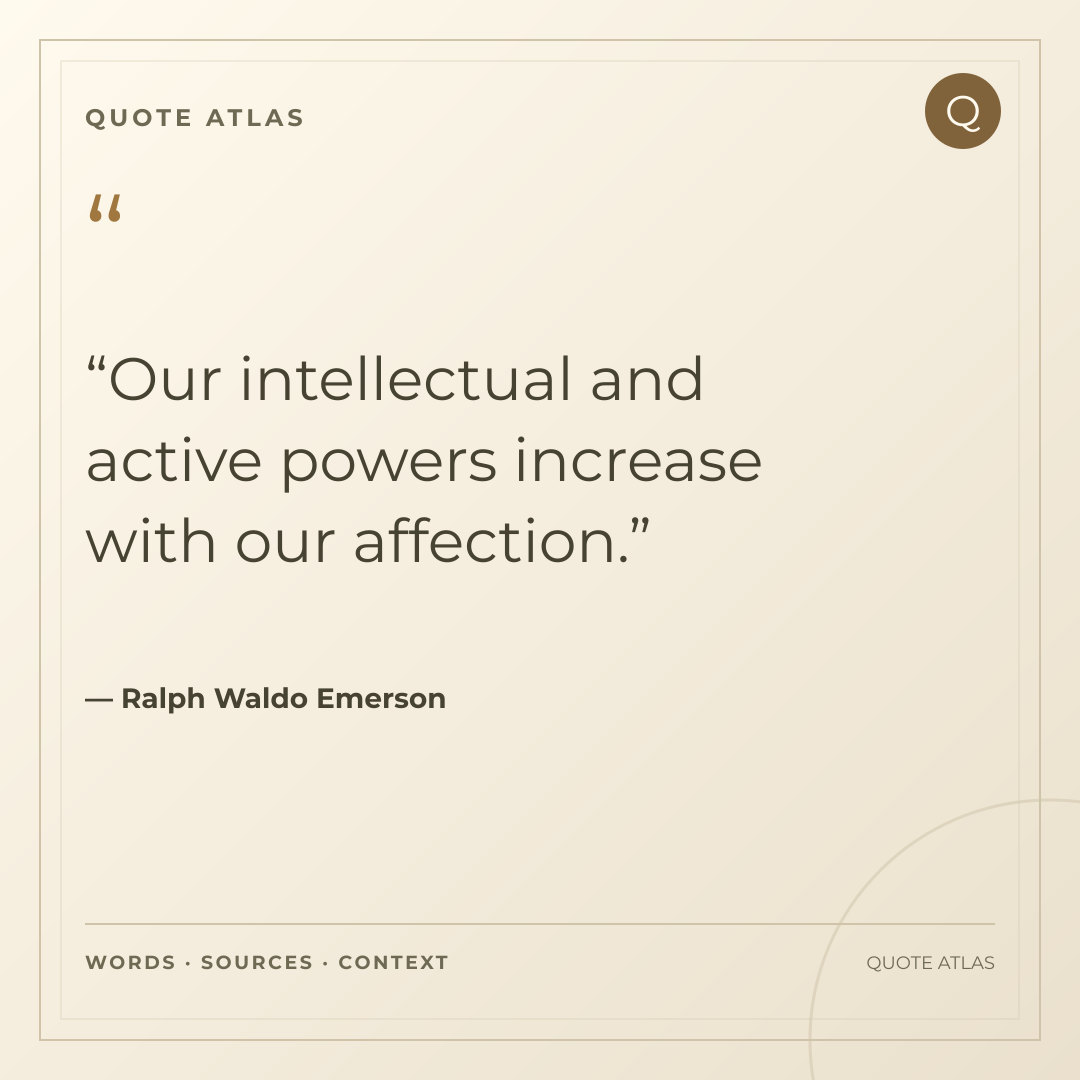
Our intellectual and active powers increase with our affection.

“Our intellectual and active powers increase with our affection.”

Affection can call forth capacities that remain dormant in isolation; Emerson illustrates the claim with a writer who suddenly finds thoughts and words when writing to a friend.

Source details

Essays: First Series, “Friendship” (1841), verified against Project Gutenberg #2944 and the page-numbered 1907 Merrill/Turpin Essays witness in Project Gutenberg #16643, printed page 117. Emerson says “Our intellectual and active powers increase with our affection” before illustrating the claim with a scholar who finds thoughts and language when writing to a friend; it remains literary-philosophical observation rather than a quantified psychological law.

Source identified135
Insist on yourself; never imitate.

“Insist on yourself; never imitate.”

Originality begins with developing one’s own capacities rather than copying another person’s surface style.

Source details

Self-Reliance; Emerson gives the imperative while arguing for originality, self-trust, and resistance to imitation rather than dependence on another person’s model.

Source identified136
Books are for nothing but to inspire.

“Books are for nothing but to inspire.”

Emerson rejects passive reverence for books: their best use is to awaken the reader’s own active thought rather than replace it.

Source details

The American Scholar; Emerson asks what the right use of books is and answers that they should inspire.

Source identified137
There is then creative reading as well as creative writing.

“There is then creative reading as well as creative writing.”

Reading can be an active intellectual act when the reader interprets, connects, questions, and produces new understanding rather than merely receiving words passively.

Source details

The American Scholar; Emerson argues that books should awaken independent thought rather than replace it.

Source identified138
Books are the best of things, well used; abused, among the worst.

“Books are the best of things, well used; abused, among the worst.”

Books are valuable when they awaken active thought; they become limiting when authority replaces independent judgment.

Source details

The American Scholar, in Emerson’s discussion of the influence and proper use of books.

Source identified139
poetry and music, and not prose and speech, are the natural expressions of the deepest and highest emotions.

“poetry and music, and not prose and speech, are the natural expressions of the deepest and highest emotions.”

Voice: Authorial / signed preface voice · Richard Henry Dana Jr. (travel narrator)

Dana treats music and poetry as forms especially suited to feelings that ordinary explanatory speech cannot fully carry.

Source details

To Cuba and Back, Chapter XVI, “Havana: Worship, Etiquette and Humanitarianism,” Project Gutenberg #33455. Dana reflects that poetry and music are natural expressions of the deepest emotions while observing Catholic worship in Havana. It is nineteenth-century first-person travel, aesthetic and religious observation rather than an empirical law about emotion or communication.

Source identified140
A sweet disorder in the dress Kindles in clothes a wantonness;

“A sweet disorder in the dress Kindles in clothes a wantonness;”

Herrick finds aesthetic charm in slight irregularity, arguing through the poem’s speaker that carefully imperfect appearance can feel more alive than rigid precision.

Source details

“Delight in Disorder,” from Hesperides (1648), represented by Project Gutenberg #1211. The poem is a seventeenth-century lyric of attraction and dress; its period language is preserved as aesthetic poetry rather than a modern norm about appearance.

Source identified141
Thus it is: added difficulty, added beauty;

“Thus it is: added difficulty, added beauty;”

In the specific context of verse technique, Stevenson argues that an additional formal constraint can create another opportunity for artistic achievement and aesthetic interest.

Source details

Essays in the Art of Writing, “On Some Technical Elements of Style in Literature”; Project Gutenberg #492. “Difficulty” here concerns literary form and craft, not a universal claim that hardship automatically makes things better.

Source identified142
We shall never learn the affinities of beauty

“We shall never learn the affinities of beauty”

Stevenson treats beauty as deeper than any complete technical explanation, warning that analysis of artistic mechanism does not exhaust why form can move or delight.

Source details

Essays in the Art of Writing, “On Some Technical Elements of Style in Literature,” represented by the 1905 Chatto & Windus edition in Project Gutenberg #492. The collection is posthumous; the excerpt concerns literary aesthetics.

Source identified143
Romance at short notice was her speciality.

“Romance at short notice was her speciality.”

The closing sentence reveals Vera’s instant invention of another plausible story, turning the tale’s deception into a compact joke about her talent for improvisation.

Source details

“The Open Window,” collected in Beasts and Super-Beasts, Project Gutenberg #269. The line follows Vera’s invented explanation for Framton Nuttel’s terrified departure; it is comic fictional narration about a deceptive storyteller.

Source identified144
To a poet nothing can be useless.

“To a poet nothing can be useless.”

Voice: Fictional character · Imlac

Creative attention turns a wide range of experience into material; knowledge that seems unrelated can later supply images, comparisons or instruction.

Source details

Rasselas, Chapter X; spoken by Imlac in his account of learning the poet’s craft through broad observation.

Source identified145
There mark what Ills the Scholar's Life assail; Toil, Envy, Want, the Garret, and the Jail.

“There mark what Ills the Scholar's Life assail; Toil, Envy, Want, the Garret, and the Jail.”

The poem refuses to romanticize scholarship by listing labor, envy, poverty and danger among the possible companions of intellectual ambition.

Source details

The Vanity of Human Wishes (1749), first-edition scholar passage, Wikisource scan leaf 28. “There mark what Ills the Scholar’s Life assail” is followed by “Toil, Envy, Want, the Garret, and the Jail.” The first-edition transcription uses a comma after “assail”; this collection’s semicolon is a retained punctuation normalization. The couplet remains satirical literary context rather than a forecast of every scholar’s life.

Source identified146
All that is great in man comes of labour;—greatness in art, in literature, in science.

“All that is great in man comes of labour;—greatness in art, in literature, in science.”

Smiles presents major artistic, literary and scientific achievement as inseparable from labour, reflecting the book’s strong Victorian ethic of industry.

Source details

Thrift, Chapter I, “Industry,” Project Gutenberg #14418. Smiles broadens his defence of labour from material production to art, literature, science and knowledge; the universal wording is his historical moral claim, not an empirical rule that effort alone guarantees greatness.

Source identified147
They discovered art and science, and we succeed to the useful effects of their labours.

“They discovered art and science, and we succeed to the useful effects of their labours.”

Creative and scientific achievements are described as an inheritance whose benefits pass beyond the original workers, inviting appreciation of accumulated human effort.

Source details

Thrift, Chapter I, “Industry,” Project Gutenberg #14418. The “they” refers to earlier generations whose tools, fabrics, art and science are presented as an inherited store of useful labour in Smiles’s historical account.

Source identified148
Labour and skill applied to the vulgarest things invest them at once with precious value.

“Labour and skill applied to the vulgarest things invest them at once with precious value.”

Skill can transform ordinary material through workmanship, connecting value not only with the object itself but with knowledgeable effort applied to it.

Source details

Thrift, Chapter I, “Industry,” Project Gutenberg #14418. Smiles moves from mutual dependence among workers to the value added by labour and skill; “vulgarest” preserves the period wording for common or ordinary things.

Source identified149
No great work has ever been done “at a heat.” It is the result of repeated efforts, and often of many failures.

“No great work has ever been done “at a heat.” It is the result of repeated efforts, and often of many failures.”

Repeated attempts and failure are treated as normal parts of producing substantial work, countering the idea that important creation happens fully formed in one effort.

Source details

Thrift, Chapter I, “Industry,” Project Gutenberg #14418. The sentence immediately follows the poetry example and presents substantial work as the product of repeated effort and failure; the absolute wording is Smiles’s rhetorical generalization.

Source identified150
Our birthright is made up of something far more imperishable. It consists of the sum of the useful effects of human skill and labour.

“Our birthright is made up of something far more imperishable. It consists of the sum of the useful effects of human skill and labour.”

Smiles values inherited skill and labour more highly than material wealth alone, framing social inheritance as accumulated useful human capability.

Source details

Thrift, Chapter I, “Industry,” Project Gutenberg #14418. Smiles contrasts inherited material wealth with the more durable inheritance of useful human skill and labour transmitted across generations by teaching and example.