Quote Atlassourced quotes & context
Page 3 of 4 · 264 quotations total

Life advice quotes — Page 3

This continuation page contains additional source-backed quotations not shown in the initial 50-quotation overview. Return to the topic guide and browse collection.

100 shown · 264 total
Source identified151
It is better to be a human being dissatisfied than a pig satisfied.

“It is better to be a human being dissatisfied than a pig satisfied.”

Quality matters alongside quantity in judging happiness: capacities for thought, dignity, and richer experience can make simple satisfaction an incomplete standard.

Source details

Utilitarianism, Chapter II, “What Utilitarianism Is,” Project Gutenberg #11224. Mill’s “human being dissatisfied / pig satisfied” comparison occurs in his argument that some pleasures associated with higher faculties have greater quality, alongside his appeal to dignity and competent judges. It is nineteenth-century normative moral philosophy, not an empirical measure of happiness or human worth.

Source identified152
The truth seems to be that it is impossible to lay the ghost of a fact.

“The truth seems to be that it is impossible to lay the ghost of a fact.”

Marlow reflects that an established event can continue to shape reputation and self-understanding even after a person tries to escape its consequences.

Source details

Lord Jim, Project Gutenberg #5658. Marlow’s narration concerns Jim’s effort to live beyond the Patna scandal; the sentence is literary reflection on memory, fact and moral consequence.

Source identified153
For life goes not backward nor tarries with yesterday.

“For life goes not backward nor tarries with yesterday.”

Life continues forward despite attachment to what has already happened, so care for the past cannot make the present remain there.

Source details

The Prophet, “On Children”; Gibran contrasts parents’ memory of yesterday with children belonging to a life that moves forward.

Source identified154
for experience does not always mean wisdom.

“for experience does not always mean wisdom.”

Voice: Fictional character · Tin Woodman

The Tin Woodman separates accumulated experience from sound judgment, suggesting that time lived does not automatically produce wisdom.

Source details

The Marvelous Land of Oz, represented by Project Gutenberg #54. The Tin Woodman—referred to in the scene as the emperor—says this to the Saw-Horse after it claims to learn quickly despite little experience. It is fictional dialogue, not Baum autobiography.

Source identified155
I know but too well how time flies along, That we live but few years, and yet fewer are young.

“I know but too well how time flies along, That we live but few years, and yet fewer are young.”

Voice: Poetic speaker · Poetic speaker

The speaker recognizes that both life and youth are brief, then uses that awareness to explain why a relationship should be worth the time and consequences it demands.

Source details

The Lover: A Ballad, represented by the University of Toronto Representative Poetry Online text from Robert Dodsley’s 1748 A Collection of Poems by Several Hands. The line belongs to a lyric speaker weighing desire against the risk of later regret; it is not treated as a verbatim autobiographical confession by Montagu.

Source identified156
It is not a lost year, but one that may prove the most helpful of any you ever know.

“It is not a lost year, but one that may prove the most helpful of any you ever know.”

Voice: Fictional character · Jo Bhaer

A painful or disappointing period can still become useful experience when it changes judgment, humility, resolve, and the way a person begins again.

Source details

Jo's Boys; the reassurance follows a setback and reframes a difficult year as experience that may later prove unusually helpful rather than simply wasted time.

Source identified157
Hope and keep busy, and whatever happens, remember that you never can be fatherless.
Image design Linen

“Hope and keep busy, and whatever happens, remember that you never can be fatherless.”

Mrs March joins hope with continued useful activity while her family faces frightening uncertainty, treating daily responsibility as a way to endure rather than a guarantee that difficulty will disappear.

Source details

Little Women, Chapter 16, “Letters,” Project Gutenberg #514. Mrs. March tells her daughters, “Hope and keep busy, and whatever happens, remember that you never can be fatherless” immediately before leaving for Washington after news of Mr. March’s illness. The line is maternal counsel in a fictional family crisis, not a claim that work removes grief, fear or uncertainty.

Source identified158
How happy I am, that my friend Marcus Cornelius, so distinguished as an orator and so noble as a man, thinks me worth praising and blaming.

“How happy I am, that my friend Marcus Cornelius, so distinguished as an orator and so noble as a man, thinks me worth praising and blaming.”

Marcus values a relationship in which admiration does not exclude correction: Fronto’s willingness to praise and blame him is presented as a mark of trusted friendship rather than mere approval.

Source details

Project Gutenberg #2680, Appendix “Correspondence of M. Aurelius Antoninus and M. Cornelius Fronto,” identifies this line as Ad M. Caes. iii. 17. The wording is preserved as correspondence context, not treated as a maxim from the Meditations.

Source identified159
Do every act of thy life as if it were the last.

“Do every act of thy life as if it were the last.”

Treating action as potentially final concentrates attention on doing the present duty carefully instead of postponing integrity or focus.

Source details

Meditations, Book II, section 5, George Long translation; this clause occurs inside a longer instruction about dignity and reason.

Source identified160
If a thing is not good for the hive, it is not good for the bee.

“If a thing is not good for the hive, it is not good for the bee.”

Personal good is linked with common good: a choice that damages the community cannot be treated as wholly beneficial to one member of it.

Source details

Meditations, Book VI, section 54, in a public-domain English translation.

Source identified161
The art of life is more like the wrestler’s art than the dancer’s.

“The art of life is more like the wrestler’s art than the dancer’s.”

Life requires readiness for unexpected pressure, closer to maintaining balance in a contest than performing a fully choreographed sequence.

Source details

Meditations, Book VII, section 61, George Long translation; the full sentence emphasizes readiness for sudden and unexpected onsets.

Source identified162
Whether this be the best way is of no consequence, if it be the one individual character points out.

“Whether this be the best way is of no consequence, if it be the one individual character points out.”

Fuller gives individual character real authority in choosing a path: the decisive question is whether the course belongs honestly to the person living it.

Source details

Summer on the Lakes, in 1843; the sentence appears in Fuller’s dialogic reflection on temperament, inquiry, and following the direction one’s own character requires.

Source identified163
The desire of the child to attain an end which he knows, leads him to correct himself.

“The desire of the child to attain an end which he knows, leads him to correct himself.”

A clear goal can support self-correction because the learner can compare the result with the intended end and revise without waiting for every error to be externally identified.

Source details

Dr. Montessori's Own Handbook, discussion of self-correcting didactic material. Project Gutenberg #29635. Montessori immediately describes the child’s own intelligence, rather than the teacher, as detecting and correcting the error.

Source identified164
The mind has formed itself by a special exercise of attention, observing, comparing, and classifying.

“The mind has formed itself by a special exercise of attention, observing, comparing, and classifying.”

Montessori describes repeated acts of attention and comparison as formative intellectual practice that organizes experience instead of merely supplying memorized content.

Source details

Dr. Montessori's Own Handbook, discussion of sensory didactic material. The statement reflects Montessori’s historical theory of mental development and is not labeled as a current neuroscientific finding.

Source identified165
Give the child an environment in which everything is constructed in proportion to himself, and let him live therein.

“Give the child an environment in which everything is constructed in proportion to himself, and let him live therein.”

An environment designed around the learner’s scale and capacities can make independent activity observable and give development room to emerge without constant adult substitution.

Source details

Spontaneous Activity in Education, Chapter I, “A Survey of the Child’s Life,” around printed page 20, Florence Simmonds translation, Project Gutenberg #24727. Montessori proposes a child-scaled environment and immediately develops the claim through the language of active and spiritual life. This is historical Montessori pedagogy and observation, not a universally established modern developmental outcome.

Source identified166
Our task is to offer the child the instruments of education, to keep pure within him the springs of his intellectual growth, of his life of feeling.

“Our task is to offer the child the instruments of education, to keep pure within him the springs of his intellectual growth, of his life of feeling.”

Teaching is presented as furnishing tools and protecting conditions for intellectual and emotional development rather than attempting to manufacture every insight directly.

Source details

The Montessori Elementary Material (1917), Arthur Livingston translation, Part II, Reading, Chapter I, subsection “The Most Popular Books,” printed page 201, Project Gutenberg #42869. Montessori says education should supply essential instruments while preserving the child’s intellectual and emotional springs, then argues that method should assist development without repressing spontaneous activity. This is historical Montessori pedagogy rather than an experimentally established modern educational-outcome rule.

Source identified167
Eagerness for surmounting difficulties and for high attainment is much more frequently found in children than we, judging by our own experience as adults, easily suspect.

“Eagerness for surmounting difficulties and for high attainment is much more frequently found in children than we, judging by our own experience as adults, easily suspect.”

Montessori cautions adults against underestimating children’s willingness to engage with challenge, arguing that observed performance can reveal stronger motivation and aptitude than adult assumptions predict.

Source details

The Montessori Elementary Material (1917), Arthur Livingston translation, Part VI, Music, Chapter I, “The Scale,” beginning on printed page 322 and continuing onto page 323, Project Gutenberg #42869. After describing children’s differing interest in bell exercises, Montessori argues that adults often underestimate children’s eagerness for difficulty and high attainment and says actual performance reveals particular aptitude. This remains her historical educational observation rather than a modern validated aptitude test or clinical claim.

Source identified168
The pedagogical method of observation has for its base the liberty of the child; and liberty is activity.

“The pedagogical method of observation has for its base the liberty of the child; and liberty is activity.”

Montessori links observation-based teaching with room for children to act, treating activity as necessary evidence for understanding development rather than mere classroom disorder.

Source details

The Montessori Method, section “Discipline,” Anne E. George translation. Project Gutenberg #39863. This is historical Montessori pedagogy and should not be presented as a universal modern experimental finding.

Source identified169
Few things are harder to put up with than the annoyance of a good example.

“Few things are harder to put up with than the annoyance of a good example.”

Voice: Epigraph / fictional source voice · Pudd’nhead Wilson’s Calendar

The epigram satirizes the irritation produced when another person’s good conduct silently exposes our own shortcomings, making moral example feel inconvenient rather than inspiring.

Source details

Pudd’nhead Wilson, Chapter XIX epigraph; one of the Calendar maxims before the chapter.

Source identified170
Let us endeavor so to live that when we come to die even the undertaker will be sorry.

“Let us endeavor so to live that when we come to die even the undertaker will be sorry.”

Voice: Epigraph / fictional source voice · Pudd’nhead Wilson’s Calendar

The undertaker supplies the comic reversal, but the underlying standard is serious: live with enough decency and human value that even someone professionally accustomed to death would feel the loss.

Source details

Pudd’nhead Wilson, Chapter VI epigraph; a Calendar maxim preceding the chapter.

Source identified171
Consider well the proportions of things. It is better to be a young June-bug than an old bird of paradise.

“Consider well the proportions of things. It is better to be a young June-bug than an old bird of paradise.”

Voice: Epigraph / fictional source voice · Pudd’nhead Wilson’s Calendar

The absurd comparison makes a serious point about proportion and stage of life: impressive status is not automatically preferable when age or circumstance changes what can actually be enjoyed.

Source details

Pudd’nhead Wilson, Calendar epigraph paired with the friendship maxim before the next narrative section.

Source identified172
Training is everything. The peach was once a bitter almond; cauliflower is nothing but cabbage with a college education.

“Training is everything. The peach was once a bitter almond; cauliflower is nothing but cabbage with a college education.”

Voice: Epigraph / fictional source voice · Pudd’nhead Wilson’s Calendar

The exaggerated botany turns education and training into a comic theory of transformation, while still preserving the broader idea that development changes what something can become.

Source details

Pudd’nhead Wilson, Chapter V epigraph; the cauliflower comparison appears as a Calendar maxim before the chapter.

Source identified173
When I reflect upon the number of disagreeable people who I know have gone to a better world, I am moved to lead a different life.

“When I reflect upon the number of disagreeable people who I know have gone to a better world, I am moved to lead a different life.”

Voice: Epigraph / fictional source voice · Pudd’nhead Wilson’s Calendar

The joke turns the conventional promise of a better afterlife into self-interested moral calculation: the speaker suddenly worries about spending eternity with people he already disliked.

Source details

Pudd’nhead Wilson, Calendar epigraph preceding the October speculation maxim.

Source identified174
Everything has its limit—iron ore cannot be educated into gold.

“Everything has its limit—iron ore cannot be educated into gold.”

Voice: Dialogue speaker · Old Man

The metaphor distinguishes growth from limitless transformation: training can develop capacities, but the dialogue also insists that development occurs within constraints.

Source details

What Is Man?, opening machine-and-metal analogy; the Old Man uses iron and gold to argue for limits within his deterministic model of human development.

Source identified175
A rational mind will be employ’d, it will never be satisfy’d in doing nothing, and if you neglect to furnish it with good materials, ’tis like to take up with such as come to hand.

“A rational mind will be employ’d, it will never be satisfy’d in doing nothing, and if you neglect to furnish it with good materials, ’tis like to take up with such as come to hand.”

Voice: Authorial / signed preface voice · Mary Astell

Astell argues that the mind naturally seeks occupation, so denying people serious intellectual material does not make the mind inactive; it leaves it to whatever material happens to be available.

Source details

A Serious Proposal to the Ladies, Part I, printed page 56 in the represented 1697 two-part edition, Project Gutenberg #54984. Astell writes that a rational mind will be employed while arguing that women denied serious intellectual education may be driven toward inferior materials. Original spelling is retained; the passage belongs to her explicitly religious and educational proposal, not contemporary educational-outcome research.

Source identified176
I ardently wished to extinguish that life which I had so thoughtlessly bestowed.

“I ardently wished to extinguish that life which I had so thoughtlessly bestowed.”

Voice: Fictional narrator · Victor Frankenstein

Victor’s regret is inseparable from responsibility and revenge: after William and Justine’s deaths, he wishes he could reverse the act of creation whose consequences he believes he failed to foresee or govern.

Source details

Frankenstein, Chapter 9 in Project Gutenberg #84. Victor narrates the wish to extinguish the life he created after William’s murder and Justine’s execution, amid remorse, guilt, hatred and a stated desire for revenge. It is fictional first-person narration, not a healthy coping model or clinical guidance.

Source identified177
Judicious books enlarge the mind and improve the heart.

“Judicious books enlarge the mind and improve the heart.”

Good reading can develop both judgment and moral feeling, making intellectual enlargement and character formation parts of the same educational process.

Source details

Thoughts on the Education of Daughters (1787), “READING,” printed page 49, Project Gutenberg #67466. “Judicious books enlarge the mind and improve the heart” appears in Wollstonecraft’s case for carefully chosen reading that joins intellectual cultivation with moral formation; the passage remains historical educational and conduct writing.

Source identified178
The governing of our temper is truly the business of our whole lives.

“The governing of our temper is truly the business of our whole lives.”

Emotional self-command is not a childhood lesson completed once; it remains a lifelong practice because new circumstances continually test established habits.

Source details

Thoughts on the Education of Daughters (1787), “The TEMPER,” printed page 62, Project Gutenberg #67466. Wollstonecraft calls governing the temper the business of the whole life while discussing habits of self-command and conduct; the passage is moral-educational argument rather than clinical emotion-regulation advice.

Source identified179
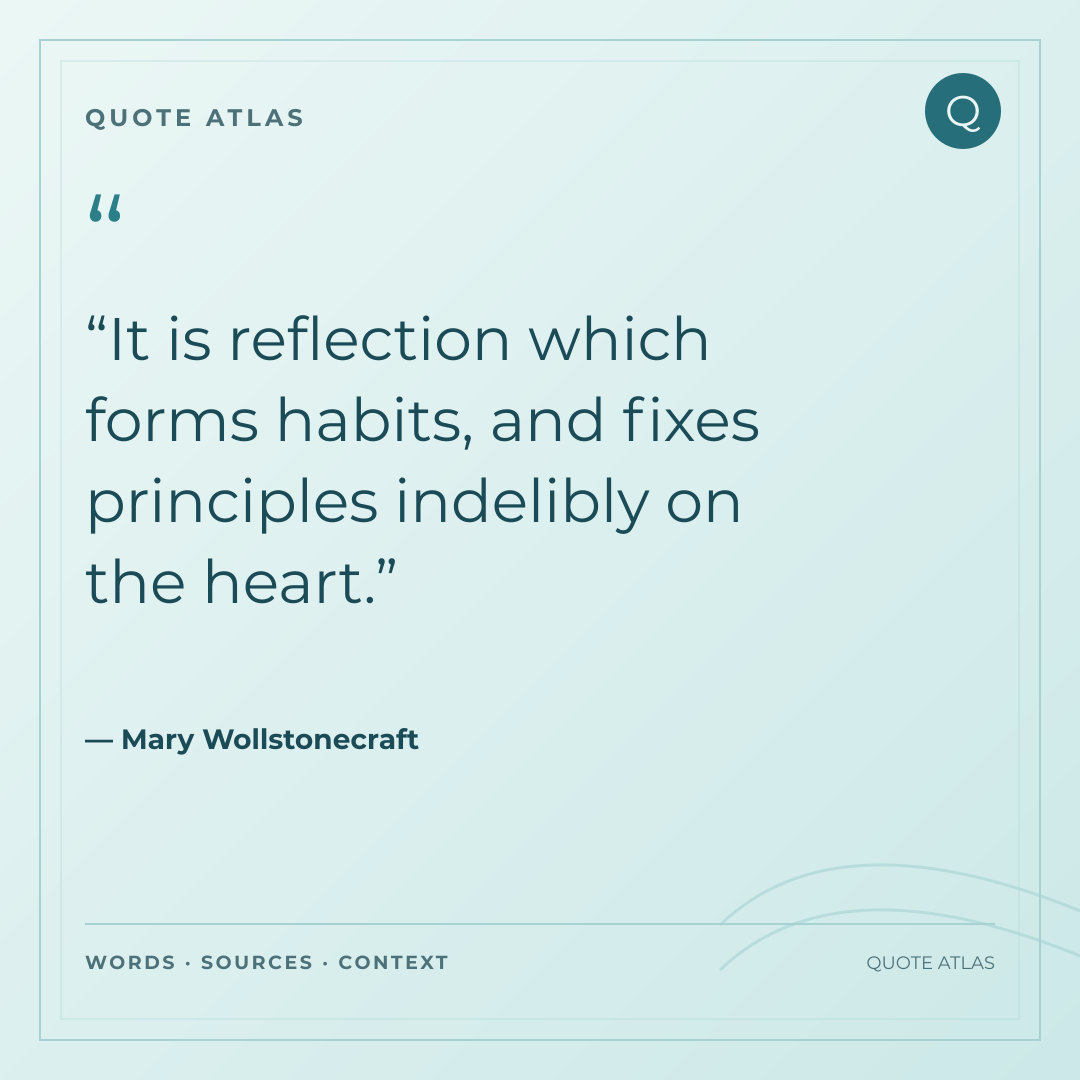
It is reflection which forms habits, and fixes principles indelibly on the heart.

“It is reflection which forms habits, and fixes principles indelibly on the heart.”

Habit formation becomes stronger when action is joined with reflection, because principles understood and revisited are more likely to guide later choices.

Source details

Thoughts on the Education of Daughters (1787), “THE BENEFITS WHICH ARISE FROM DISAPPOINTMENTS,” printed page 111, Project Gutenberg #67466. Wollstonecraft says reflection forms habits and fixes principles while opening a religious-moral discussion of disappointment, self-examination and character.

Source identified180
Reading is the most rational employment, if people seek food for the understanding.

“Reading is the most rational employment, if people seek food for the understanding.”

Reading is valuable when it feeds judgment and understanding rather than becoming a performance of remembering words without examining their ideas.

Source details

Thoughts on the Education of Daughters (1787), “READING,” printed page 49, Project Gutenberg #67466. Wollstonecraft calls reading the most rational employment when people seek food for the understanding, contrasting reflective reading with merely collecting words or quotations; this is eighteenth-century educational argument rather than a current evidence-based teaching prescription.

Source identified181
Culture is then properly described not as having its origin in curiosity, but as having its origin in the love of perfection.

“Culture is then properly described not as having its origin in curiosity, but as having its origin in the love of perfection.”

Curiosity becomes more than collecting information when it is directed toward fuller development, better judgment, and a serious desire to improve understanding.

Source details

Culture and Anarchy; Arnold distinguishes idle curiosity from the pursuit of intellectual and moral perfection.

Source identified182
Nothing noble can be performed without danger.

“Nothing noble can be performed without danger.”

Avoiding every danger can also prevent worthy action; prudence needs to distinguish reckless exposure from risks that meaningful conduct sometimes requires.

Source details

Essays of Montaigne, Book I, Chapter XXIII, ‘Various Events from the Same Counsel,’ Charles Cotton translation edited by William Carew Hazlitt (1877); Project Gutenberg Volume 04 #3584 / Complete Essays #3600. Montaigne argues that excessive security-minded distrust can destroy the courage required for noble action; the reviewed direct evidence is the matching Wikisource chapter transcription.

Source identified183
He who fears he shall suffer, already suffers what he fears.

“He who fears he shall suffer, already suffers what he fears.”

Anticipatory fear can add suffering before any feared event occurs, effectively extending pain through imagination and expectation.

Source details

Essays of Montaigne, Book III, Chapter XIII, “Of Experience,” Charles Cotton translation; Project Gutenberg Volume 19 #3599 / Complete Essays #3600. Montaigne argues that anticipatory fear can add suffering before the feared event arrives.

Source identified184
’Tis my opinion that a man should lend himself to others, and only give himself to himself.

“’Tis my opinion that a man should lend himself to others, and only give himself to himself.”

Montaigne distinguishes participating in other people’s affairs from surrendering one’s whole inward life to them: engagement can be generous without allowing every external demand to possess the will.

Source details

Essays of Montaigne, Book III, Chapter X, “Of Managing the Will,” Charles Cotton translation; Project Gutenberg Volume 18 #3598 / Complete Essays #3600. Montaigne describes lending oneself to external affairs without allowing them to possess the whole will.

Source identified185
We must learn to suffer what we cannot evade; our life, like the harmony of the world, is composed of contrary things.

“We must learn to suffer what we cannot evade; our life, like the harmony of the world, is composed of contrary things.”

Montaigne treats an imperfect mixture of pleasant and painful conditions as part of ordinary life: wisdom includes learning to live with what cannot be escaped instead of demanding a life made only of agreeable notes.

Source details

Essays of Montaigne, Book III, Chapter XIII, “Of Experience,” Charles Cotton translation; Project Gutenberg Volume 19 #3599 / Complete Essays #3600. Montaigne compares life’s unavoidable mixture of pleasant and painful conditions to harmony made from contrary tones.

Source identified186
Right occasion and opportunity have their privileges, and often hold out to ordinary folk what they deny to kings.

“Right occasion and opportunity have their privileges, and often hold out to ordinary folk what they deny to kings.”

Montaigne observes that access and success do not follow rank mechanically: timing, circumstance and temperament can open an ordinary person’s path even when status or power fails to secure the same result.

Source details

The Journal of Montaigne’s Travels in Italy, Volume II, entry for March 6, 1581 during his visit to the Vatican Library, W. G. Waters translation, Project Gutenberg #70839. The sentence follows Montaigne’s surprise that he gained access where the French ambassador had failed; it is first-person journal reflection, not a general law that opportunity always defeats privilege.

Source identified187
It looked like a good thing: but wait till I tell you.

“It looked like a good thing: but wait till I tell you.”

The narrator signals immediately that a scheme which appeared profitable will become a comic disaster, making hindsight part of the joke before the plot unfolds.

Source details

“The Ransom of Red Chief,” represented in Project Gutenberg #1595. The first-person narrator introduces the kidnappers’ scheme with comic foreshadowing; the story satirizes their criminal plan rather than endorsing it.

Source identified188
Every now and then a man’s mind is stretched by a new idea or sensation, and never shrinks back to its former dimensions.

“Every now and then a man’s mind is stretched by a new idea or sensation, and never shrinks back to its former dimensions.”

Voice: Authorial persona / framed maxim · The Autocrat

The Autocrat persona pictures significant ideas and experiences as permanently enlarging the range through which a person can think.

Source details

The Autocrat of the Breakfast-Table, represented by Project Gutenberg #751. The line is spoken in Holmes’s table-talk authorial persona and followed by an Alpine image; it is a literary metaphor for intellectual expansion, not a neurological claim.

Source identified189
He who has learned the true art of living will not waste his energies in friction, which accomplishes nothing.

“He who has learned the true art of living will not waste his energies in friction, which accomplishes nothing.”

The metaphor treats needless fretting and interpersonal friction as expenditure of energy that produces no useful result.

Source details

Cheerfulness as a Life Power; Project Gutenberg #18394. Marden is making a practical-moral argument, not a clinical claim.

Source identified191
Experience is the name everyone gives to their mistakes.

“Experience is the name everyone gives to their mistakes.”

The epigram turns a flattering word into a comic rebrand for error, suggesting that experience often arrives only after something has gone wrong.

Source details

Lady Windermere’s Fan; a characteristic Wildean epigram linking experience and mistakes.

Source identified193
The old believe everything: the middle-aged suspect everything: the young know everything.

“The old believe everything: the middle-aged suspect everything: the young know everything.”

The epigram compresses three stereotypes of certainty into one balanced joke, mocking credulity, suspicion, and youthful overconfidence at once.

Source details

“Phrases and Philosophies for the Use of the Young,” first published in The Chameleon in 1894.

Source identified194
Experience is merely the name men gave to their mistakes.

“Experience is merely the name men gave to their mistakes.”

Voice: Narrator voice · Narrator, focalized through Lord Henry

The wit turns “experience” into a retrospective label for errors, suggesting that mistakes become useful only when understood.

Source details

The Picture of Dorian Gray, 1891 edition, Chapter 4; third-person narration focalized through Lord Henry reflects that experience is the name people give to their mistakes.

Source identified195
Young men starting in life should avoid running into debt.

“Young men starting in life should avoid running into debt.”

Barnum treats consumer debt as a constraint on future choices and recommends avoiding obligations incurred simply to consume before payment is possible.

Source details

The Art of Money Getting, section “Avoid Debt”; Project Gutenberg #8581. The advice is period-specific and not a blanket claim that every productive use of credit is harmful.

Source identified196
True economy consists in always making the income exceed the out-go.

“True economy consists in always making the income exceed the out-go.”

Barnum defines practical economy through a durable margin between income and spending rather than through isolated acts of penny-pinching.

Source details

The Art of Money Getting, unheaded opening economy discussion before the first formal contents section, Project Gutenberg #8581. “True economy consists in always making the income exceed the out-go” follows Barnum’s contrast between real economy and penny-wise meanness and leads into his margin-of-income example. The queue parser’s inherited “rule i” hint is not a printed heading in this witness. This remains nineteenth-century conduct-of-life and financial rhetoric, not individualized financial planning or a guaranteed savings rule.

Source identified197
You cannot accumulate a fortune by taking the road that leads to poverty.

“You cannot accumulate a fortune by taking the road that leads to poverty.”

Barnum argues that spending patterns incompatible with saving cannot be reconciled merely by hoping for future wealth or higher income.

Source details

The Art of Money Getting, economy discussion; Project Gutenberg #8581. The road metaphor appears in Barnum’s warning against living fully up to one’s means.

Source identified198
Prosperity is a more severe ordeal than adversity, especially sudden prosperity.

“Prosperity is a more severe ordeal than adversity, especially sudden prosperity.”

Sudden financial improvement can test restraint because rising income may encourage equally rapid expansion of spending, display, and recurring obligations.

Source details

The Art of Money Getting, economy section; Project Gutenberg #8581. Barnum introduces the line while describing lifestyle expansion after financial success.

Source identified199
People ought to be as sensible on the subject of money-getting as on any other subject.

“People ought to be as sensible on the subject of money-getting as on any other subject.”

Financial choices are presented as ordinary matters for judgment and cause-and-effect reasoning rather than as exceptions governed by appearance or wishful thinking.

Source details

The Art of Money Getting, economy discussion; Project Gutenberg #8581. The sentence follows Barnum’s warning about trying to appear richer than one is.

Source identified200
In every thing give thanks: for this is the will of God in Christ Jesus concerning you.

“In every thing give thanks: for this is the will of God in Christ Jesus concerning you.”

The verse presents thanksgiving as a continuing spiritual practice rather than something reserved only for circumstances that are easy or pleasant.

Source details

1 Thessalonians 5:18 in the King James Version.

Source identified202
The best way of training the young is to train yourself at the same time; not to admonish them, but to be always carrying out your own admonitions in practice.
Image design Botanical Sage

“The best way of training the young is to train yourself at the same time; not to admonish them, but to be always carrying out your own admonitions in practice.”

Voice: Dialogue speaker · Athenian Stranger

The Athenian Stranger argues that adults teach ethical habits through consistent conduct as much as through instruction. Within the proposed city’s civic code, self-discipline and example help to shape a life shared across generations; this is not a randomized modern study of parenting.

Source details

Plato, Laws, Book V, the Athenian Stranger giving an extended civic-ethical exhortation to Cleinias and Megillus; Benjamin Jowett English, Gutenberg #1750. This is dialogue speech, not commentary in Jowett’s introduction. The local dramatic voice is the Athenian Stranger, not Socrates or Plato personally.

Source identified203
The direction in which education starts a man, will determine his future life.

“The direction in which education starts a man, will determine his future life.”

Voice: Dialogue speaker · Socrates

Early education shapes habits of attention and judgment, so its direction can influence the kind of person someone later becomes.

Source details

The Republic, Book IV in Benjamin Jowett’s translation; the line appears during discussion of education and civic character.

Source identified205
He that is of a merry heart hath a continual feast.

“He that is of a merry heart hath a continual feast.”

A glad disposition can make ordinary life feel abundant even when circumstances are modest, because experience is shaped partly by the heart meeting it.

Source details

Proverbs 15:15 in the King James Version; concluding clause of the verse.

Source identified206
Make no friendship with an angry man; and with a furious man thou shalt not go:

“Make no friendship with an angry man; and with a furious man thou shalt not go:”

The proverb treats repeated fury as socially contagious, warning that close association can shape habits and judgment.

Source details

Proverbs 22:24 in the King James Version; the next verse warns that a person can learn the ways of the habitually angry.

Source identified207
Iron sharpeneth iron; so a man sharpeneth the countenance of his friend.

“Iron sharpeneth iron; so a man sharpeneth the countenance of his friend.”

Good relationships can improve judgment and character through challenge, conversation, and mutual influence.

Source details

Proverbs 27:17 in the King James Version; the proverb uses sharpening as an image for the way one person can strengthen or refine another.

Source identified208
Go to the ant, thou sluggard; consider her ways, and be wise.

“Go to the ant, thou sluggard; consider her ways, and be wise.”

The proverb uses the ant as an example of self-directed preparation, turning observation of repeated practical behavior into a lesson about disciplined habits.

Source details

Proverbs 6:6 in the King James Version; the following verses describe the ant preparing food without an overseer.

Source identified210
Bitter for a free man is the bondage of debt.

“Bitter for a free man is the bondage of debt.”

Debt can restrict future choices and independence, so borrowing is framed not only financially but also as a constraint on freedom.

Source details

The Moral Sayings of Publius Syrus, maxim 14, in Darius Lyman’s 1856 English rendering; maxim order can vary across editions.

Source identified211
As men, we are all equal in the presence of death.

“As men, we are all equal in the presence of death.”

Death strips away rank and status, emphasizing a condition shared by every person regardless of position or wealth.

Source details

The Moral Sayings of Publius Syrus, maxim 1, in Darius Lyman’s 1856 English rendering; maxim order can vary across editions.

Source identified213
Character is higher than intellect.

“Character is higher than intellect.”

Emerson ranks lived character above intellect considered by itself, insisting that thinking gains its fullest value when it belongs to an integrated way of living.

Source details

“The American Scholar” (1837), represented in Emerson’s Essays, Project Gutenberg #16643. Emerson contrasts thought as a partial function with the fuller act of living one’s truth; the line elevates character without dismissing intellectual life.

Source identified214
Life is a succession of lessons which must be lived to be understood.

“Life is a succession of lessons which must be lived to be understood.”

Some understanding arrives only through experience: ideas about character, consequence, relationship, and judgment become clearer when they have been lived rather than merely described.

Source details

The Conduct of Life; the line connects knowledge of life with accumulated experience and the lessons that experience makes intelligible.

Source identified215
Reading is to the mind what exercise is to the body.

“Reading is to the mind what exercise is to the body.”

Regular reading is compared with physical exercise because repeated intellectual use can strengthen attention, knowledge, and mental capacity over time.

Source details

The Tatler No. 147; the comparison presents reading as a form of regular exercise for the mind.

Source identified216
The young have aspirations that never come to pass, the old have reminiscences of what never happened.

“The young have aspirations that never come to pass, the old have reminiscences of what never happened.”

Voice: Fictional character · Reginald

Reginald turns youth and old age into a comic contrast between unrealized hopes and memories reshaped by hindsight.

Source details

Reginald, represented by Project Gutenberg #2830. Reginald says this during a social conversation; it is satirical fictional dialogue from Saki’s recurring character, not a measured claim about age or memory.

Source identified217
Human life is everywhere a state in which much is to be endured and little to be enjoyed.

“Human life is everywhere a state in which much is to be endured and little to be enjoyed.”

Voice: Fictional character · Imlac

The novel resists fantasies of perfect circumstances by emphasizing that difficulty follows people across different places and conditions.

Source details

Rasselas, Chapter XVI; spoken by Imlac while comparing European life with the travelers’ expectations of happiness.

Source identified218
We do not indeed so often disappoint others as ourselves.

“We do not indeed so often disappoint others as ourselves.”

Private expectations can exceed what anyone else demands of us, so a life may feel disappointing chiefly by comparison with unfulfilled plans known only to oneself.

Source details

The Idler, No. 88; the surrounding paragraph concerns private hopes, proposed tasks and the gap between imagined achievement and lived action.

Source identified220
There is no act, however trivial, but has its train of consequences.

“There is no act, however trivial, but has its train of consequences.”

Small actions matter because repetition creates habits and consequences that can accumulate long after a single choice seemed insignificant.

Source details

Character, Chapter I, “Influence of Character,” Project Gutenberg #2541. The sentence follows Smiles’s claim that character is formed through minute circumstances and daily discipline, emphasizing that even apparently trivial acts carry consequences.

Source identified221
The most influential of all the virtues are those which are the most in request for daily use.

“The most influential of all the virtues are those which are the most in request for daily use.”

Virtues become socially important when they guide routine dealings with other people rather than appearing only in exceptional or ceremonial situations.

Source details

Character, Chapter I, “Influence of Character,” Project Gutenberg #2541. In the chapter’s discussion of duty in ordinary life, Smiles argues that the virtues most needed in everyday conduct exert the widest and most lasting influence.

Source identified222
Every action, every thought, every feeling, contributes to the education of the temper, the habits, and understanding.

“Every action, every thought, every feeling, contributes to the education of the temper, the habits, and understanding.”

Education continues through everyday conduct: repeated thoughts and actions train emotional responses, habits, and practical judgment even outside formal study.

Source details

Character, Chapter I, “Influence of Character,” Project Gutenberg #2541. It immediately follows the discussion of small acts and daily discipline, with Smiles describing action, thought and feeling as continuously educating temper, habits and understanding.

Source identified223
We learn wisdom from failure much more than from success.

“We learn wisdom from failure much more than from success.”

Failure can expose what does not work and force closer observation, turning setbacks into information that uncomplicated success may never reveal.

Source details

Self-Help, Chapter XI, “Self-Culture—Facilities and Difficulties,” Project Gutenberg #935. The passage follows Charles James Fox’s contrast between early success and perseverance after failure, then leads into examples of discoveries and learning produced through mistakes and failed attempts.

Source identified224
Progress, however, of the best kind, is comparatively slow.

“Progress, however, of the best kind, is comparatively slow.”

Smiles treats durable progress as incremental rather than instantaneous, arguing that worthwhile results are built through repeated effort and patience instead of expecting one dramatic breakthrough.

Source details

Self-Help, Chapter IV, “Application and Perseverance,” Project Gutenberg #935. The sentence opens a paragraph that continues, “Great results cannot be achieved at once,” and compares advancement in life to walking step by step.

Source identified225
The education of character is very much a question of models.

“The education of character is very much a question of models.”

People absorb conduct from examples around them, so lived models can teach more powerfully than rules that are contradicted by behavior.

Source details

Self-Help, Chapter XII, “Example—Models,” Project Gutenberg #935. Smiles argues that character education depends heavily on models because people unconsciously mould themselves after the characters, manners, habits and opinions around them.

Source identified226
Lost wealth may be replaced by industry, lost knowledge by study, lost health by temperance or medicine, but lost time is gone for ever.

“Lost wealth may be replaced by industry, lost knowledge by study, lost health by temperance or medicine, but lost time is gone for ever.”

Many losses can be repaired through later effort, but spent time cannot be recovered, giving attention and method unusual importance.

Source details

Self-Help, Chapter IX, “Men of Business,” Project Gutenberg #935. The sentence appears in Smiles’s discussion of method, punctuality and the economical use of time, contrasting losses that may be repaired with time once spent, which cannot be recovered.

Source identified227
So much patient perseverance could not but eventually succeed

“So much patient perseverance could not but eventually succeed”

Smiles describes Stephenson’s progress in arithmetic as the cumulative result of study and patient persistence rather than easy aptitude.

Source details

The Life of George Stephenson and of his Son Robert Stephenson, Chapter IV, “The Stephensons at Killingworth—Education and Self-Education of Father and Son”; represented 1868 revised edition, Project Gutenberg #46229. The excerpt is Smiles’s narration of Stephenson’s patient arithmetic study under John Wigham.

Source identified228
Thrift is the spirit of order in human life.

“Thrift is the spirit of order in human life.”

Order means aligning limited resources with real priorities so that unnecessary disorder does not repeatedly consume time, money, and attention.

Source details

Thrift, Chapter V, “Examples of Thrift,” Project Gutenberg #14418. In the chapter’s opening discussion of domestic management, Smiles develops thrift as orderly use of household resources and then calls it the spirit of order in human life.

Source identified229
It works for to-day, but also provides for to-morrow.

“It works for to-day, but also provides for to-morrow.”

Good stewardship balances present needs with future obligations instead of treating either immediate enjoyment or distant security as the only concern.

Source details

Thrift, Chapter I, “Industry,” Project Gutenberg #14418. The sentence occurs in the same definition of thrift as an acquired principle of conduct: present enjoyment is subordinated to forethought so that action serves today while providing for tomorrow.

Source identified230
Thrift is merely common sense in every-day working action.

“Thrift is merely common sense in every-day working action.”

The principle is made practical rather than glamorous: ordinary, repeated decisions about work and spending matter more than occasional dramatic gestures.

Source details

Thrift, Chapter II, “Habits of Thrift,” Project Gutenberg #14418. Smiles says thrift requires neither exceptional courage nor intellect but ordinary common sense, resistance to selfish enjoyment and patient self-denial.

Source identified231
In all the individual reforms or improvements that we desire, we must begin with ourselves.

“In all the individual reforms or improvements that we desire, we must begin with ourselves.”

Large ambitions become more credible when a person begins with conduct they can actually govern instead of assigning all responsibility to external conditions.

Source details

Thrift, Chapter II, “Habits of Thrift,” Project Gutenberg #14418. The sentence summarizes Smiles’s preceding argument that social improvement begins with individual conduct, example and self-respect before one attempts to elevate others.

Source identified232
As long as you live, keep learning how to live.

“As long as you live, keep learning how to live.”

Voice: Quoted proverb / inherited saying · Anonymous proverb quoted by Seneca

Living well is treated as a lifelong subject, so age is not a reason to stop revising judgment, habits, and character.

Source details

Letter 76, on learning wisdom in old age, cites the proverb while defending continued philosophical study.

Source identified233
How little of yourself was left to you.

“How little of yourself was left to you.”

The question reframes time management as self-possession: what matters is not only busyness but how much of one’s life remained available for chosen purposes.

Source details

On the Shortness of Life, Chapter III; part of Seneca’s inventory of where a lifetime disappears.

Source identified234
Life, if you know how to use it, is long.

“Life, if you know how to use it, is long.”

The problem is not simply the number of years available but whether those years are directed toward purposes a person actually values.

Source details

On the Shortness of Life, Chapter II; opening claim before Seneca lists ways people become engrossed.

Source identified235
The life we receive is not short, but we make it so.

“The life we receive is not short, but we make it so.”

Seneca shifts responsibility from nature to the way a person spends attention and time: life feels shortened when it is repeatedly surrendered to distraction.

Source details

On the Shortness of Life, Chapter I; sentence from Seneca’s argument that life is ample when ordered well.

Source identified236
Our life is amply long for him who orders it properly.

“Our life is amply long for him who orders it properly.”

A finite life can still be sufficient when attention is deliberately ordered instead of being scattered across pursuits that do not deserve it.

Source details

On the Shortness of Life, Chapter I; John W. Basore translation, concluding Seneca’s opening comparison between life and wealth under a good guardian.

Source identified238
Now while the blood is hot, we must enter with brisk step upon the better course.

“Now while the blood is hot, we must enter with brisk step upon the better course.”

Improvement is treated as work for the available present, not a project reserved for an imagined later period when energy and opportunity may be smaller.

Source details

On the Shortness of Life, Chapter XIX; Seneca urges a move from borrowed busyness toward study, virtue, and a more deliberate course of life.

Source identified239
If these wish to know how short their life is, let them reflect how small a part of it is their own.

“If these wish to know how short their life is, let them reflect how small a part of it is their own.”

The felt shortness of life is linked with how little of it remains under one’s own direction after obligations and borrowed priorities consume the rest.

Source details

On the Shortness of Life, Chapter XIX; Seneca closes by asking the engrossed to measure how much of their lifetime was actually their own.

Source identified240
The true University of these days is a Collection of Books.

“The true University of these days is a Collection of Books.”

Carlyle emphasizes independent access to accumulated thought, treating books as an education that extends beyond institutions.

Source details

On Heroes, Hero-Worship, and the Heroic in History, the lecture on the Hero as Man of Letters.

Source identified241
The Paths of Glory lead but to the Grave.

“The Paths of Glory lead but to the Grave.”

Gray compresses the elegy’s meditation on mortality into the reminder that wealth, beauty, status and public achievement do not remove the common human endpoint of death.

Source details

An Elegy Wrote in a Country Church Yard (1751 first edition), represented by Project Gutenberg #15409. The capitalization follows the represented edition; the line is poetic reflection on mortality and social distinction.

Source identified242
Where Ignorance is Bliss, ’Tis Folly to be wise.

“Where Ignorance is Bliss, ’Tis Folly to be wise.”

Gray ends by suggesting that foreknowledge of adult suffering would destroy the apparent happiness of youth, making ignorance temporarily protective within the poem’s tragic perspective.

Source details

Ode on a Distant Prospect of Eton College, first edition 1747, represented by the Thomas Gray Archive. The famous line concludes a poem cataloguing the future troubles awaiting schoolboys; it is ironic poetic reflection, not a general recommendation against knowledge.

Source identified243
Blessings emblazoned that day Everything glowed with a gleam; Yet we were looking away!

“Blessings emblazoned that day Everything glowed with a gleam; Yet we were looking away!”

Looking backward reveals value that was not fully noticed while the moment was being lived, giving the remembered family scene both warmth and regret.

Source details

“The Self-Unseeing,” Project Gutenberg #3168. The exclamation closes a poem of retrospective domestic memory and should not be detached from that remembered household scene.

Source identified244
When angry, count ten, before you speak; if very angry, an hundred.

“When angry, count ten, before you speak; if very angry, an hundred.”

Jefferson’s practical rule inserts a deliberate delay between anger and speech, giving judgment time to return before emotion becomes an irreversible response.

Source details

Thomas Jefferson to Thomas Jefferson Smith, February 21, 1825, Founders Online / National Archives. The sentence is item 10 in a short list of “canons of conduct” sent to his namesake relative; the archive currently labels the transcription an Early Access document rather than a final authoritative edition.

Source identified245
that we must cultivate our garden.

“that we must cultivate our garden.”

Voice: Fictional character · Candide

Candide turns away from endless abstract explanation toward concrete shared work, making the garden a practical answer to the suffering and argument that have filled the story.

Source details

Candide, Chapter XXX, Project Gutenberg #19942, uncredited public-domain English translation. Candide says “that we must cultivate our garden” to Pangloss and Martin near the tale’s close after reflecting on the old Turk’s life of work. This is translated fictional dialogue and literary resolution, not Voltaire autobiography or a literal guarantee that work resolves every hardship.

Source identified246
makes the reading of Wordsworth an excellent sort of training towards the things of art and poetry.

“makes the reading of Wordsworth an excellent sort of training towards the things of art and poetry.”

Pater presents sustained engagement with a difficult poet as a form of aesthetic training, implying that taste and discrimination can be developed through repeated attentive reading.

Source details

Appreciations, with an Essay on Style, essay “Wordsworth,” printed page 41 in the Macmillan 1910 Library Edition pagination reproduced by Project Gutenberg #4037. Pater says that the contrast between Wordsworth’s higher and lower poetic moods “makes the reading of Wordsworth an excellent sort of training towards the things of art and poetry.” This remains Pater’s critical judgment about aesthetic training, not an experimentally established educational outcome.

Source identified247
a habit of reading between the lines, a faith in the effect of concentration and collectedness of mind in the right appreciation of poetry

“a habit of reading between the lines, a faith in the effect of concentration and collectedness of mind in the right appreciation of poetry”

Pater describes demanding reading as training in concentration and inference, where appreciation grows through disciplined attention instead of quick surface consumption.

Source details

Appreciations, with an Essay on Style, essay “Wordsworth,” printed page 42 in the Macmillan 1910 Library Edition pagination reproduced by Project Gutenberg #4037. The reading-between-the-lines passage follows Pater’s claim that Wordsworth-reading can train aesthetic discrimination; he attributes to receptive readers a habit of inference plus faith in concentration and collectedness of mind. This remains nineteenth-century literary criticism rather than cognitive-science evidence.

Source identified248
all progress of mind consists for the most part in differentiation, in the resolution of an obscure and complex object into its component aspects

“all progress of mind consists for the most part in differentiation, in the resolution of an obscure and complex object into its component aspects”

Pater describes intellectual progress as learning to distinguish parts within what initially seems confused, a method that makes clearer categories and more exact judgment possible.

Source details

Appreciations, with an Essay on Style, essay “Style,” printed page 5 in the standard Macmillan 1910 Library Edition pagination reproduced by Project Gutenberg #4037. “all progress of mind consists for the most part in differentiation...” opens Pater’s argument by distinguishing prose, verse and poetry. This is literary-aesthetic criticism, not a modern experimental claim about cognition or learning.

Source identified249
What we have to do is to be for ever curiously testing new opinions and courting new impressions, never acquiescing in a facile orthodoxy

“What we have to do is to be for ever curiously testing new opinions and courting new impressions, never acquiescing in a facile orthodoxy”

Pater recommends intellectual openness and repeated testing rather than easy conformity, making revision and exposure to new impressions part of an active critical life.

Source details

The Renaissance, Conclusion; Project Gutenberg #2398. The sentence names Comte, Hegel and one’s own orthodoxy in its immediate continuation.

Source identified250
There is no hope, if we look back at the past: there may be hope, if we look on to the future.

“There is no hope, if we look back at the past: there may be hope, if we look on to the future.”

Mr Pendril urges Miss Garth to focus on what can still change rather than treating past disaster as proof that every future possibility is closed.

Source details

No Name, Project Gutenberg #1438. Mr Pendril speaks after the Vanstone sisters lose their legal and financial position; the surrounding dialogue immediately qualifies the hope as uncertain and dependent on future events.