Quote Atlassourced quotes & context
Page 2 of 2 · 144 quotations total

Personal growth quotes — Page 2

This continuation page contains additional source-backed quotations not shown in the initial 50-quotation overview. Return to the topic guide and browse collection.

94 shown · 144 total
Source identified51
This self-deceit, this fatal weakness of mankind, is the source of half the disorders of human life.

“This self-deceit, this fatal weakness of mankind, is the source of half the disorders of human life.”

Smith treats distorted self-judgment as a major moral problem because people can preserve flattering interpretations of conduct instead of examining themselves impartially.

Source details

The Theory of Moral Sentiments, Part III, discussion of self-examination and the impartial spectator; Smith is describing the difficulty of judging one’s own conduct fairly.

Source identified52
To err is human; to forgive, divine.

“To err is human; to forgive, divine.”

Error is treated as ordinary human limitation, while forgiveness requires an additional act of generosity.

Source details

An Essay on Criticism, Part III; Pope joins good nature and good sense before contrasting ordinary human error with the higher moral act of forgiveness.

Source identified53
This right to grow is sacred and inviolable.

“This right to grow is sacred and inviolable.”

Voice: Authorial / signed preface voice · Anna Julia Cooper

Cooper treats a person’s opportunity for intellectual and human development as a fundamental right rather than a privilege that institutions may arbitrarily restrict.

Source details

Address Accepting Her Diploma From the Sorbonne, University of Paris, December 29, 1925, preserved by Howard University. The row therefore remains formally frozen in HOST_REVIEW rather than receiving an inferred locator.

Source identified54
My subject was mental efficiency as a means to self-development.

“My subject was mental efficiency as a means to self-development.”

Efficiency is presented as instrumental rather than an end in itself: better use of attention and thought is valuable insofar as it supports deliberate personal development.

Source details

Mental Efficiency. Bennett explicitly defines the scope of his argument as mental efficiency serving self-development; this is period conduct-of-life writing rather than modern cognitive-science evidence.

Source identified55
If a man is to turn everything whatsoever into his own calm, dignity, and happiness, he must make this use even of his own failures.

“If a man is to turn everything whatsoever into his own calm, dignity, and happiness, he must make this use even of his own failures.”

Failure becomes useful when it is examined and incorporated into future conduct instead of being allowed to settle a person’s sense of dignity or possibility.

Source details

The Human Machine, discussion of using experience for self-command. Bennett’s claim is philosophical self-training advice; it does not imply that every failure is beneficial or emotionally easy.

Source identified56
Literature is a living art, to be practised.

“Literature is a living art, to be practised.”

The short formulation emphasizes that literary skill develops through use and practice rather than through passive admiration of established works alone.

Source details

On the Art of Writing, Lecture XII, “On Style,” Project Gutenberg #17470; excerpted from Quiller-Couch’s summary of the course.

Source identified57
the first forty years of life furnish the text, while the remaining thirty supply the commentary

“the first forty years of life furnish the text, while the remaining thirty supply the commentary”

The age-specific metaphor presents later experience as reinterpretation of earlier life, suggesting that events can acquire coherence only after enough time has supplied comparison and perspective.

Source details

Counsels and Maxims, T. Bailey Saunders translation; Project Gutenberg #10715. The numerical life span reflects Schopenhauer’s nineteenth-century aphoristic framing rather than a modern lifespan rule.

Source identified58
it is only when he has turned it over that he can be said to know it.

“it is only when he has turned it over that he can be said to know it.”

Learning becomes knowledge, in this account, when material has been actively reconsidered and integrated rather than merely encountered or memorized.

Source details

The Art of Literature, section “On Thinking for Oneself,” T. Bailey Saunders translation; Project Gutenberg #10714. The preceding sentence says a person must first learn something before turning it over in the mind.

Source identified59
So the first and most essential element in our life's happiness is what we are,—our personality

“So the first and most essential element in our life's happiness is what we are,—our personality”

The line locates a central condition of happiness in personality because it accompanies a person across changing circumstances, possessions and public opinion.

Source details

The Wisdom of Life, T. Bailey Saunders translation; Project Gutenberg #10741. The surrounding argument contrasts what a person is, has and represents to others.

Source identified60
The only thing that stands in our power to achieve, is to make the most advantageous use possible of the personal qualities we possess

“The only thing that stands in our power to achieve, is to make the most advantageous use possible of the personal qualities we possess”

Within his restrictive view of personality, Schopenhauer still assigns agency to choosing pursuits that use and develop one’s actual capacities rather than leaving them idle or mismatched.

Source details

The Wisdom of Life, T. Bailey Saunders translation; Project Gutenberg #10741. The following clause recommends pursuits suited to the development of one’s capacities.

Source identified61
In reality, there is, perhaps, no one of our natural passions so hard to subdue as pride.

“In reality, there is, perhaps, no one of our natural passions so hard to subdue as pride.”

Franklin treats humility as a continuing discipline rather than a completed achievement: pride is difficult precisely because it can survive attempts to suppress it and can even attach itself to the appearance of modesty.

Source details

The Autobiography of Benjamin Franklin, Part II, Humility discussion near the close of the Passy 1784 continuation. Franklin reflects that pride survives attempts to suppress it and can attach itself even to apparent humility; the reviewed direct locator is Wikisource Section Thirty Nine.

Source identified62
Get into the habit of being orderly and neat.

“Get into the habit of being orderly and neat.”

Order is treated as trainable behavior that reduces avoidable friction and supports reliability in work, study, and shared environments.

Source details

Character Building, “Some Great Little Things,” Project Gutenberg #60484. Washington tells students to make order and neatness habitual in crowded rooms, immediately before his advice to work and close doors quietly.

Source identified63
There is no education which one can get from books and costly apparatus that is equal to that which can be gotten from contact with great men and women.

“There is no education which one can get from books and costly apparatus that is equal to that which can be gotten from contact with great men and women.”

Books matter, but lived contact with admirable people can teach standards, courage and conduct that abstract instruction alone may not communicate.

Source details

Up from Slavery, Chapter III, “The Struggle For An Education,” Project Gutenberg #2376. Washington describes General Samuel Chapman Armstrong’s influence at Hampton and argues that sustained contact with exemplary people can itself be a powerful form of education.

Source identified64
Those that wish to be clean, clean they will be; and those that wish to be foul, foul they will be.

“Those that wish to be clean, clean they will be; and those that wish to be foul, foul they will be.”

Voice: Fictional character · Irishwoman

The fairy-tale warning connects desired moral change with the direction a person repeatedly chooses, while the surrounding story makes that lesson part of Tom’s larger transformation.

Source details

The Water-Babies, represented by Project Gutenberg #1018. Tom recalls the mysterious Irishwoman’s warning while half asleep. The cleanliness language participates in Kingsley’s Victorian Christian moral fantasy and is not a scientific claim about character or hygiene.

Source identified65
For of course rashness is the note of youth, prudence of old age.

“For of course rashness is the note of youth, prudence of old age.”

Voice: Dialogue speaker · Marcus Cato (Cato the Elder)

The contrast assigns different characteristic strengths to stages of life, valuing experience for the restraint and judgment it can develop.

Source details

Cato on Old Age, Shuckburgh translation.

Source identified66
What the superior man seeks, is in himself. What the mean man seeks, is in others.

“What the superior man seeks, is in himself. What the mean man seeks, is in others.”

Mature judgment begins with one’s own conduct and capacities rather than making other people the first explanation for every outcome.

Source details

The Analects of Confucius, James Legge’s public-domain English translation; Book XV contrasts inward self-examination with dependence on others.

Source identified67
To every thing there is a season, and a time to every purpose under the heaven.

“To every thing there is a season, and a time to every purpose under the heaven.”

The verse places change inside a larger rhythm of seasons and purposes, making it useful for thinking about acceptance when one phase of life gives way to another.

Source details

Ecclesiastes 3:1 in the King James Version, opening the sequence of contrasting times and seasons.

Source identified68
you yourself can make it beautiful if you will.

“you yourself can make it beautiful if you will.”

Voice: Fictional character · David's father (letter)

David’s father tells him that even when the world appears bleak, his own choices and actions can still contribute something beautiful to it.

Source details

Just David, represented by Project Gutenberg #440. The sentence appears in a farewell letter from David’s father that other characters read after his death. It is framed fictional advice inside the novel, not Porter speaking autobiographically, and it does not imply that personal attitude can remove every external hardship.

Source identified69
If the present arrangements of society will not admit of woman’s free development, then society must be remodeled, and adapted to the great wants of all humanity.

“If the present arrangements of society will not admit of woman’s free development, then society must be remodeled, and adapted to the great wants of all humanity.”

Blackwell argues that social arrangements should be changed when they prevent women from developing their abilities and participating fully in human life.

Source details

Elizabeth Blackwell letter to Emily Collins (1848), reproduced in History of Woman Suffrage, Volume I, Chapter V, validated scan page 91 / scan leaf 103. Blackwell argues that social arrangements must be remodeled if they prevent women's free development; this remains nineteenth-century reform argument rather than a current empirical claim about social policy.

Source identified70
My first duty is to develop all the powers given to me and to make the most of myself and my own life.

“My first duty is to develop all the powers given to me and to make the most of myself and my own life.”

Voice: Imagined speaker · Jephthah’s daughter (imagined by Stanton)

The imagined speaker refuses to let another person dispose of her life, grounding dignity in the responsibility to develop her own capacities and possibilities.

Source details

The Woman's Bible, The Book of Judges, Chapter II, Judges xi, Project Gutenberg #9880. Stanton imagines Jephthah's unnamed daughter rejecting sacrifice: ‘My first duty is to develop all the powers given to me and to make the most of myself and my own life.’ This is Stanton's invented protest voice within her commentary, not a biblical quotation or speech preserved in Judges.

Source identified71
I know the goal to high achievement lies through the dull pathway of self-conquest first

“I know the goal to high achievement lies through the dull pathway of self-conquest first”

Achievement is pictured as beginning with less glamorous inward work—self-command, small duties and repeated effort—before larger results become possible.

Source details

Poems of Progress and New Thought Pastels, “Time’s Gaze,” represented 1913 edition; Project Gutenberg #3228. This is poetic moral counsel, not a universal formula for achievement.

Source identified72
Generally then if you would make anything a habit, do it.

“Generally then if you would make anything a habit, do it.”

Repeated behavior trains the corresponding habit, so change depends on practicing the desired action rather than merely endorsing it in theory.

Source details

Discourses of Epictetus, Book II, Chapter XVIII, “How we should struggle against appearances,” George Long translation; 1877 George Bell & Sons witness on Wikisource, cross-checked against Project Gutenberg #10661. This collection lightly normalizes Long’s “any thing” to “anything”; this longer record contains the shorter retained habit excerpt represented by a separate legacy quote URL.

Source identified73
No great thing is created suddenly, any more than a bunch of grapes or a fig.

“No great thing is created suddenly, any more than a bunch of grapes or a fig.”

Epictetus treats worthwhile development as organic rather than instantaneous: ability, character and reconciliation require stages of growth that cannot be skipped simply because the final result is desired now.

Source details

Discourses of Epictetus, Book I, Chapter XV, “What Philosophy Promises,” George Long translation; 1877 George Bell & Sons witness on Wikisource, cross-checked against Project Gutenberg #10661. Epictetus answers a request for immediate improvement with the fig/grape analogy: nothing great is produced suddenly and development requires time.

Source identified74
Where you tend a rose, my lad, A thistle cannot grow.

“Where you tend a rose, my lad, A thistle cannot grow.”

Voice: Textual source voice · Unattributed embedded couplet

The gardening proverb connects what is repeatedly tended with what has less room to take over, giving cultivation both a literal and character-forming role in the novel.

Source details

The Secret Garden (1911), Chapter XXVII, “In the Garden.” The unattributed embedded couplet “Where you tend a rose, my lad, A thistle cannot grow” follows the narrator’s claim that two contrary thoughts cannot occupy one place. It is a literary gardening metaphor and must not be presented as scientific or mental-health evidence.

Source identified75
Knowledge is power.

“Knowledge is power.”

The maxim connects understanding with the capacity to act effectively rather than treating knowledge as decoration.

Source details

From the Latin “ipsa scientia potestas est”; common English rendering.

Source identified76
If a man will begin with certainties, he shall end in doubts; but if he will be content to begin with doubts, he shall end in certainties.

“If a man will begin with certainties, he shall end in doubts; but if he will be content to begin with doubts, he shall end in certainties.”

Intellectual confidence can be improved by beginning with questions rather than pretending certainty too early.

Source details

The Advancement of Learning, First Book, Project Gutenberg #5500, transcribed from the 1893 Cassell & Company edition. Bacon contrasts impatience of doubt with mature suspension of judgment and then sets out two ways of contemplation before saying that beginning with certainties ends in doubts while beginning with doubts can end in certainties. It remains early-modern epistemological argument rather than a modern experimental rule for scientific method.

Source identified77
I resolved however to work hard, and thus grow cool, and quick, and forceful.

“I resolved however to work hard, and thus grow cool, and quick, and forceful.”

Voice: Fictional narrator · Anodos

The narrator responds to anticipated responsibility by practicing deliberately, treating capability and composure as qualities that can be strengthened through effort.

Source details

Phantastes; Project Gutenberg #325. The sentence is spoken by the fictional first-person narrator while preparing for danger and should remain tied to that fantasy context.

Source identified78
the struggle which evil necessitates is one of the greatest blessings.

“the struggle which evil necessitates is one of the greatest blessings.”

Keller interprets struggle as capable of developing strength, patience and helpfulness, while speaking from her own philosophical and religious framework.

Source details

Optimism: An Essay (1903), Project Gutenberg #31622. This is Keller’s reflective claim, not a clinical assertion that suffering is inherently beneficial.

Source identified79
With the first word I used intelligently, I learned to live, to think, to hope.

“With the first word I used intelligently, I learned to live, to think, to hope.”

Language is remembered as opening several capacities at once—thought, hope and a fuller experience of living—rather than merely adding a vocabulary item.

Source details

Optimism: An Essay (1903), Project Gutenberg #31622. Keller is reflecting on her own early experience of language and education.

Source identified80
I try to increase the power God has given me to see the best in everything and every one, and make that Best a part of my life.

“I try to increase the power God has given me to see the best in everything and every one, and make that Best a part of my life.”

Keller treats constructive attention as a practice that should change her own conduct, not merely as a way of describing other people positively.

Source details

Optimism: An Essay (1903), Project Gutenberg #31622. The invocation of God and “Best” is retained as part of Keller’s religious moral framework.

Source identified82
How many a man has dated a new era in his life from the reading of a book.

“How many a man has dated a new era in his life from the reading of a book.”

Thoreau treats reading as potentially transformative: a book can mark a genuine before-and-after point when it gives language to questions a reader has struggled to express.

Source details

Walden, chapter “Reading,” in the discussion of books that can reveal new possibilities and answer enduring questions.

Source identified83
Rest, that is to say, is not a thing that can be given, but a thing to be acquired.

“Rest, that is to say, is not a thing that can be given, but a thing to be acquired.”

Voice: Authorial / signed preface voice · Henry Drummond

Drummond treats inward rest as a condition developed through changed habits and spiritual orientation rather than something another person can simply hand over.

Source details

Pax Vobiscum, represented by Project Gutenberg #9373. The sentence appears in Drummond’s Christian practical-theology discussion of rest and peace; its religious causal framework is historical devotional argument rather than clinical psychology.

Source identified84
I am gaining health daily, and almost live in the open air.

“I am gaining health daily, and almost live in the open air.”

Voice: Authorial / signed preface voice · Isabella L. Bird (travel-letter narrator)

Bird reports that outdoor travel coincided with her feeling progressively better, presenting the statement as personal experience rather than a prescription for others.

Source details

The Hawaiian Archipelago, represented by Project Gutenberg #6750. Bird writes in the first person about her own condition and outdoor life in Hawaiʻi. The historical self-report is not medical advice and does not establish that travel or open air will treat another person’s illness.

Source identified85
Growth is life, and life is for ever destined to make for light.

“Growth is life, and life is for ever destined to make for light.”

The narrator uses the wolf cub’s urge to leave the cave as a metaphorically charged picture of growth pushing living things toward wider experience despite fear and restraint.

Source details

White Fang, Part II, Chapter IV, ‘The Wall of the World,’ Project Gutenberg #910. The narrator says ‘Growth is life, and life is for ever destined to make for light’ as the grey cub disobeys fear and moves toward the cave opening. It remains literary animal-development narration and metaphor rather than a modern biological, developmental or behavioral law.

Source identified86
There can be no progress, no achievement without sacrifice.

“There can be no progress, no achievement without sacrifice.”

Progress requires giving up competing habits or comforts so that effort can stay directed toward the chosen end.

Source details

As a Man Thinketh, chapter “The Thought-Factor in Achievement.”

Source identified87
Circumstance does not make the man; it reveals him to himself.

“Circumstance does not make the man; it reveals him to himself.”

Circumstances can expose habits of thought and character that were already present, turning difficulty into information about what needs attention or change.

Source details

As a Man Thinketh; Allen uses circumstance as a mirror for character and habitual thought.

Source identified88
Cherish your visions; cherish your ideals; cherish the music that stirs in your heart.

“Cherish your visions; cherish your ideals; cherish the music that stirs in your heart.”

Sustained ideals can organize attention and effort, giving a person a picture of the kind of life or work they intend to build.

Source details

As a Man Thinketh, chapter “Visions and Ideals”; this is an excerpt from Allen’s longer exhortation to remain true to constructive ideals.

Source identified89
Man is buffeted by circumstances so long as he believes himself to be the creature of outside conditions.

“Man is buffeted by circumstances so long as he believes himself to be the creature of outside conditions.”

Allen argues that treating circumstances as the whole explanation of one’s life can obscure the role of habits, thought and deliberate change.

Source details

As a Man Thinketh, chapter “Effect of Thought on Circumstances”; the sentence introduces Allen’s claim that self-examination can change a person’s relation to circumstances.

Source identified90
Life is ever unfolding from within, and revealing itself to the light.

“Life is ever unfolding from within, and revealing itself to the light.”

Allen treats outward conduct as an expression of inward patterns, so durable change requires attention to the thoughts and motives repeatedly cultivated within.

Source details

Out from the Heart, opening section; Allen develops the metaphor of life unfolding from the hidden conditions of the heart and mind.

Source identified91
Let a man realize that life in its totality proceeds from the mind, and lo, the way of blessedness is opened up to him!

“Let a man realize that life in its totality proceeds from the mind, and lo, the way of blessedness is opened up to him!”

Allen’s idealist claim makes mental discipline central to change, proposing that recognizing the role of thought can open a more deliberate way of living.

Source details

Out from the Heart; the sentence introduces Allen’s argument that ruling the mind changes one’s relation to conduct and experience.

Source identified92
I declare after all there is no enjoyment like reading!

“I declare after all there is no enjoyment like reading!”

Voice: Fictional character · Caroline Bingley

The line is memorable as praise of reading, though its comic context matters because Miss Bingley says it while performing interest for Darcy.

Source details

Pride and Prejudice, Chapter 11; context is ironic.

Source identified93
Experience is primarily an active-passive affair; it is not primarily cognitive.

“Experience is primarily an active-passive affair; it is not primarily cognitive.”

Dewey treats experience as a combination of doing and undergoing consequences, with understanding developing through the relationship between action and what follows from it.

Source details

Democracy and Education (1916), Chapter XI, “Experience and Thinking.” Dewey describes experience as a relation between doing and undergoing consequences, then immediately qualifies the active-passive formulation by saying that valuable experience includes cognition insofar as relationships and continuities are perceived. Verified against Project Gutenberg #852 and the scan-backed Wikisource Chapter XI transcription. The sentence is not a denial that cognition matters and is not presented as modern neuroscientific evidence.

Source identified94
Character is the interpenetration of habits.

“Character is the interpenetration of habits.”

Dewey describes character as the interaction of repeated habits rather than a collection of isolated acts, emphasizing how established ways of acting continually reinforce or modify one another.

Source details

Human Nature and Conduct (1922), Part One, Section II, “Habits and Will,” printed page 38, Project Gutenberg #41386. Dewey says character would not exist if habits operated in insulated compartments; “Character is the interpenetration of habits” summarizes his account of habits continuously modifying and reinforcing one another. This is part of Dewey’s historical philosophical / early social-psychological framework, not a modern clinical definition of personality.

Source identified95
The maintenance of a due balance among the faculties now seemed to be of primary importance.

“The maintenance of a due balance among the faculties now seemed to be of primary importance.”

Mill describes a shift away from developing intellect in isolation toward cultivating a more balanced range of human capacities.

Source details

Autobiography, Chapter V; Mill is describing the intellectual and emotional lessons he drew from his mental crisis and recovery.

Source identified96
It’s no use going back to yesterday, because I was a different person then.

“It’s no use going back to yesterday, because I was a different person then.”

Voice: Fictional character · Alice

Change makes perfect return impossible; the person who revisits yesterday already carries experiences that alter the comparison.

Source details

Alice’s Adventures in Wonderland.

Source identified97
But it’s no use going back to yesterday, because I was a different person then.
Image design Linen

“But it’s no use going back to yesterday, because I was a different person then.”

Alice explains that the person she was yesterday no longer fully accounts for the changes and strange experiences of the present day.

Source details

Alice’s Adventures in Wonderland, Chapter X, “The Lobster Quadrille,” Project Gutenberg #11. Alice says this to the Mock Turtle while trying to recount a day in which her body, knowledge and sense of identity keep changing; it is character dialogue in a fantasy narrative.

Source identified98
There is reason and reality in some degree of self-reliance.

“There is reason and reality in some degree of self-reliance.”

Self-reliance becomes credible when it grows from tested knowledge of what one can actually endure and do, rather than from empty confidence or social display.

Source details

Life Without and Life Within, “The Poor Man”; Fuller argues that difficult experience can produce realistic knowledge of one’s resources and a grounded degree of self-reliance.

Source identified99
Our task is to offer the child the instruments of education, to keep pure within him the springs of his intellectual growth, of his life of feeling.

“Our task is to offer the child the instruments of education, to keep pure within him the springs of his intellectual growth, of his life of feeling.”

Teaching is presented as furnishing tools and protecting conditions for intellectual and emotional development rather than attempting to manufacture every insight directly.

Source details

The Montessori Elementary Material (1917), Arthur Livingston translation, Part II, Reading, Chapter I, subsection “The Most Popular Books,” printed page 201, Project Gutenberg #42869. Montessori says education should supply essential instruments while preserving the child’s intellectual and emotional springs, then argues that method should assist development without repressing spontaneous activity. This is historical Montessori pedagogy rather than an experimentally established modern educational-outcome rule.

Source identified100
Nothing so needs reforming as other people’s habits.

“Nothing so needs reforming as other people’s habits.”

Voice: Epigraph / fictional source voice · Pudd’nhead Wilson’s Calendar

The aphorism mocks reformers who find other people’s behavior easier to correct than their own, using a compact reversal to expose self-exemption and misplaced certainty.

Source details

Pudd’nhead Wilson, Chapter XV epigraph; a Calendar maxim immediately before the eggs-in-one-basket passage.

Source identified101
Training is everything. The peach was once a bitter almond; cauliflower is nothing but cabbage with a college education.

“Training is everything. The peach was once a bitter almond; cauliflower is nothing but cabbage with a college education.”

Voice: Epigraph / fictional source voice · Pudd’nhead Wilson’s Calendar

The exaggerated botany turns education and training into a comic theory of transformation, while still preserving the broader idea that development changes what something can become.

Source details

Pudd’nhead Wilson, Chapter V epigraph; the cauliflower comparison appears as a Calendar maxim before the chapter.

Source identified102
Everything has its limit—iron ore cannot be educated into gold.

“Everything has its limit—iron ore cannot be educated into gold.”

Voice: Dialogue speaker · Old Man

The metaphor distinguishes growth from limitless transformation: training can develop capacities, but the dialogue also insists that development occurs within constraints.

Source details

What Is Man?, opening machine-and-metal analogy; the Old Man uses iron and gold to argue for limits within his deterministic model of human development.

Source identified103
What a long time it requires to know ourselves, and yet every one has more of this knowledge than he is willing to own.

“What a long time it requires to know ourselves, and yet every one has more of this knowledge than he is willing to own.”

Self-knowledge develops slowly, and the second clause suggests that people may resist acknowledging what experience has already taught them about their own motives or limitations.

Source details

Letters Written During a Short Residence in Sweden, Norway, and Denmark, Letter IX; represented Cassell & Company 1889 text in Project Gutenberg #3529. The frozen catalog reads “What a long time it requires to know ourselves, and yet every one has more of this knowledge than he is willing to own,” while the represented witness reads “What a long time it requires to know ourselves; and yet almost every one has more of this knowledge than he is willing to own, even to himself.” This collection retains its legacy shortened wording and explicitly records the omitted “almost” / closing phrase rather than silently rewriting it. Wollstonecraft is reflecting on her own solitude, experience and knowledge of the heart.

Source identified104
Judicious books enlarge the mind and improve the heart.

“Judicious books enlarge the mind and improve the heart.”

Good reading can develop both judgment and moral feeling, making intellectual enlargement and character formation parts of the same educational process.

Source details

Thoughts on the Education of Daughters (1787), “READING,” printed page 49, Project Gutenberg #67466. “Judicious books enlarge the mind and improve the heart” appears in Wollstonecraft’s case for carefully chosen reading that joins intellectual cultivation with moral formation; the passage remains historical educational and conduct writing.

Source identified105
The governing of our temper is truly the business of our whole lives.

“The governing of our temper is truly the business of our whole lives.”

Emotional self-command is not a childhood lesson completed once; it remains a lifelong practice because new circumstances continually test established habits.

Source details

Thoughts on the Education of Daughters (1787), “The TEMPER,” printed page 62, Project Gutenberg #67466. Wollstonecraft calls governing the temper the business of the whole life while discussing habits of self-command and conduct; the passage is moral-educational argument rather than clinical emotion-regulation advice.

Source identified106
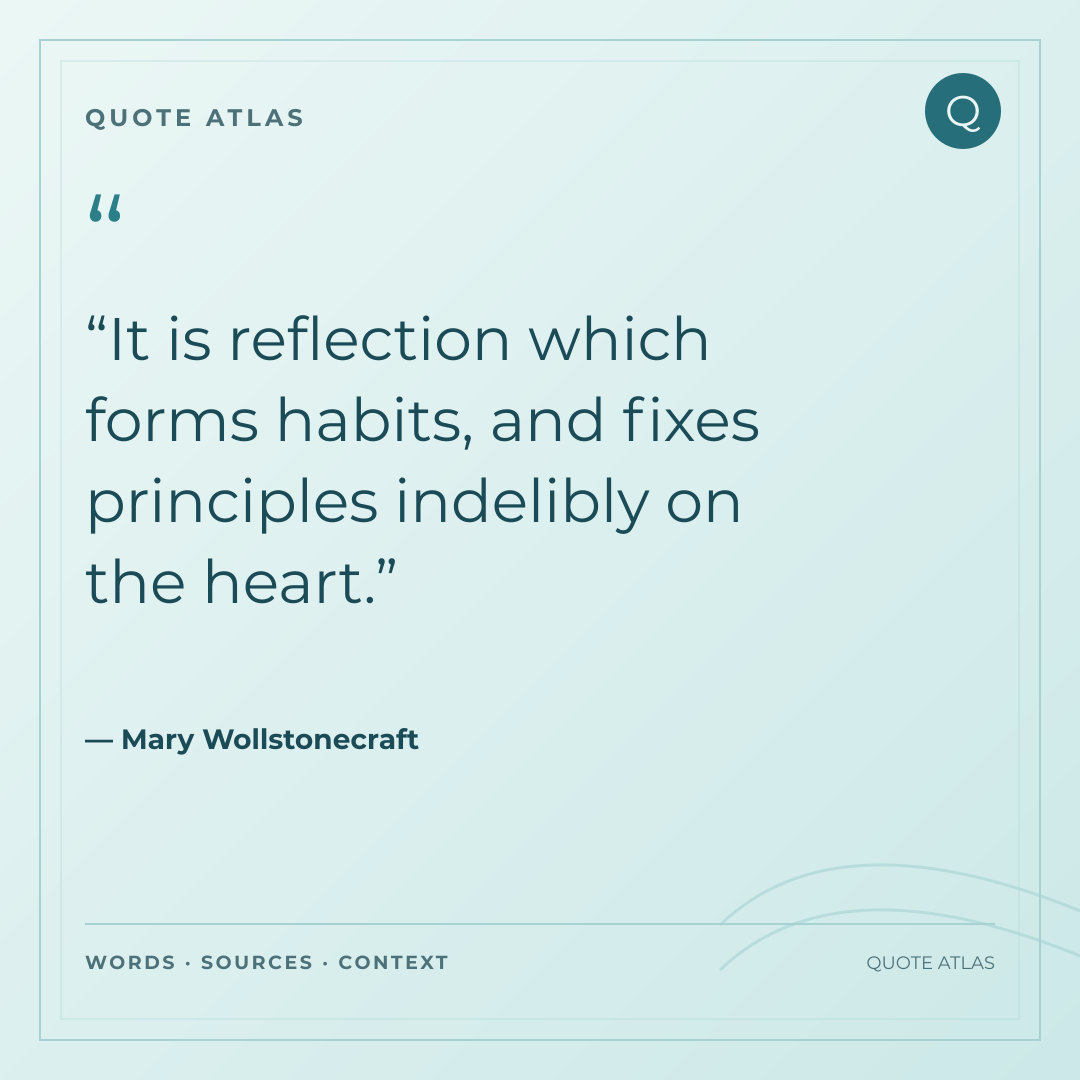
It is reflection which forms habits, and fixes principles indelibly on the heart.

“It is reflection which forms habits, and fixes principles indelibly on the heart.”

Habit formation becomes stronger when action is joined with reflection, because principles understood and revisited are more likely to guide later choices.

Source details

Thoughts on the Education of Daughters (1787), “THE BENEFITS WHICH ARISE FROM DISAPPOINTMENTS,” printed page 111, Project Gutenberg #67466. Wollstonecraft says reflection forms habits and fixes principles while opening a religious-moral discussion of disappointment, self-examination and character.

Source identified107
Every now and then a man’s mind is stretched by a new idea or sensation, and never shrinks back to its former dimensions.

“Every now and then a man’s mind is stretched by a new idea or sensation, and never shrinks back to its former dimensions.”

Voice: Authorial persona / framed maxim · The Autocrat

The Autocrat persona pictures significant ideas and experiences as permanently enlarging the range through which a person can think.

Source details

The Autocrat of the Breakfast-Table, represented by Project Gutenberg #751. The line is spoken in Holmes’s table-talk authorial persona and followed by an Alpine image; it is a literary metaphor for intellectual expansion, not a neurological claim.

Source identified108
The greatest thing a man can do in this world is to make the most possible out of the stuff that has been given to him.

“The greatest thing a man can do in this world is to make the most possible out of the stuff that has been given to him.”

Marden defines success as developing one’s available capacities rather than merely matching another person’s achievements or circumstances.

Source details

Architects of Fate; Project Gutenberg #21622. Period gendered language is preserved as source wording rather than silently modernized.

Source identified109
Experience is merely the name men gave to their mistakes.

“Experience is merely the name men gave to their mistakes.”

Voice: Narrator voice · Narrator, focalized through Lord Henry

The wit turns “experience” into a retrospective label for errors, suggesting that mistakes become useful only when understood.

Source details

The Picture of Dorian Gray, 1891 edition, Chapter 4; third-person narration focalized through Lord Henry reflects that experience is the name people give to their mistakes.

Source identified110
It requires some training, perhaps, to accomplish this economy, but when once used to it, you will find there is more satisfaction in rational saving than in irrational spending.

“It requires some training, perhaps, to accomplish this economy, but when once used to it, you will find there is more satisfaction in rational saving than in irrational spending.”

Saving is described as a learned habit whose rewards can become easier to appreciate through repeated practice rather than immediate deprivation alone.

Source details

The Art of Money Getting, opening economy section; Project Gutenberg #8581. Barnum contrasts rational saving with irrational spending in his nineteenth-century personal-finance rhetoric.

Source identified111
The direction in which education starts a man, will determine his future life.

“The direction in which education starts a man, will determine his future life.”

Voice: Dialogue speaker · Socrates

Early education shapes habits of attention and judgment, so its direction can influence the kind of person someone later becomes.

Source details

The Republic, Book IV in Benjamin Jowett’s translation; the line appears during discussion of education and civic character.

Source identified112
Iron sharpeneth iron; so a man sharpeneth the countenance of his friend.

“Iron sharpeneth iron; so a man sharpeneth the countenance of his friend.”

Good relationships can improve judgment and character through challenge, conversation, and mutual influence.

Source details

Proverbs 27:17 in the King James Version; the proverb uses sharpening as an image for the way one person can strengthen or refine another.

Source identified113
Hard is it to correct a habit already formed.

“Hard is it to correct a habit already formed.”

Repeated behavior becomes easier to continue and harder to reverse, which makes early choices about habit formation especially consequential.

Source details

The Moral Sayings of Publius Syrus, maxim 11, in Darius Lyman’s 1856 English rendering; maxim order can vary across editions.

Source identified114
MAN is a born child, his power is the power of growth.

“MAN is a born child, his power is the power of growth.”

Tagore defines human power through continued capacity to develop, using childhood as an image of openness to change rather than completed maturity.

Source details

Stray Birds, aphorism 25, translated by Tagore from Bengali; Project Gutenberg #6524. The compact line is poetic-philosophical and is not presented as a modern developmental-psychology claim.

Source identified115
The creation of a thousand forests is in one acorn.

“The creation of a thousand forests is in one acorn.”

A small beginning can contain enormous future possibility, making the acorn a compact metaphor for growth, potential, and development.

Source details

Essay “History,” in Essays: First Series; the image appears in a passage about latent possibility.

Source identified116
The purpose of life is unquestionably unfoldment, growth, advancement

“The purpose of life is unquestionably unfoldment, growth, advancement”

Trine states his view of purpose directly: life should continue to develop rather than settle into mental or moral stagnation.

Source details

The Higher Powers of Mind and Spirit; Project Gutenberg #28163. The surrounding text describes evolution from “lower” to “higher” in spiritual terms; this is Trine’s philosophical-religious position, not a scientific law of human development.

Source identified117
There are moments in the lives of all of us when we catch glimpses of a life—our life—that is infinitely beyond the life we are now living.

“There are moments in the lives of all of us when we catch glimpses of a life—our life—that is infinitely beyond the life we are now living.”

The opening image treats dissatisfaction with present limits as awareness of unrealized possibility, turning a glimpse of a better life into a reason for deliberate development.

Source details

The Higher Powers of Mind and Spirit, Chapter I, “The Silent, Subtle Building Forces of Mind and Spirit,” Project Gutenberg #28163. Trine opens with moments when people glimpse a life beyond their present one, then develops New Thought and metaphysical claims about latent powers, spirit and “mental and spiritual science.” It is historical religious-metaphysical self-development rhetoric, not modern psychology or neuroscience.

Source identified118
he who, forgetting self, makes the object of his life service, helpfulness, and kindliness to others, finds his whole nature growing and expanding

“he who, forgetting self, makes the object of his life service, helpfulness, and kindliness to others, finds his whole nature growing and expanding”

Trine makes service a life-purpose and predicts personal enlargement through it, connecting outward usefulness with an increasingly generous and developed character.

Source details

What All The World’s A-Seeking, Part I, “The Principle,” printed page 29 in the represented 1896 page-text witness, cross-checked against Project Gutenberg #14312. Trine argues that a person who forgets self in service, helpfulness and kindliness finds the self “growing and expanding.” This remains historical conduct-of-life / New Thought moral argument rather than a guaranteed psychological outcome from service.

Source identified120
Character is one of the greatest motive powers in the world.

“Character is one of the greatest motive powers in the world.”

Character is treated as an active force because reliable conduct shapes trust, influence, and the quality of choices made under ordinary pressure.

Source details

Character, Chapter I, “Influence of Character,” Project Gutenberg #2541. Smiles opens the chapter by presenting character as a major moral and social force, then distinguishes its influence from intellectual talent, wealth and position.

Source identified121
Not a day passes without its discipline, whether for good or for evil.

“Not a day passes without its discipline, whether for good or for evil.”

Daily experience is always training something, so ordinary choices can reinforce either constructive habits or patterns that make later self-command harder.

Source details

Character, Chapter I, “Influence of Character,” Project Gutenberg #2541. Smiles introduces the sentence while explaining that character is formed by many minute circumstances under partial individual control, so each day contributes discipline for good or ill.

Source identified122
Every action, every thought, every feeling, contributes to the education of the temper, the habits, and understanding.

“Every action, every thought, every feeling, contributes to the education of the temper, the habits, and understanding.”

Education continues through everyday conduct: repeated thoughts and actions train emotional responses, habits, and practical judgment even outside formal study.

Source details

Character, Chapter I, “Influence of Character,” Project Gutenberg #2541. It immediately follows the discussion of small acts and daily discipline, with Smiles describing action, thought and feeling as continuously educating temper, habits and understanding.

Source identified123
The spirit of self-help is the root of all genuine growth in the individual.

“The spirit of self-help is the root of all genuine growth in the individual.”

Personal development begins with active responsibility for one’s own effort and choices, even when circumstances and institutions still matter.

Source details

Self-Help, Chapter I, “Self-Help—National and Individual,” Project Gutenberg #935. This is the opening chapter’s statement of Smiles’s self-help argument, where individual initiative is presented as a source of personal growth and, in his period framework, national strength.

Source identified124
Want of confidence is perhaps a greater obstacle to improvement than is generally imagined.

“Want of confidence is perhaps a greater obstacle to improvement than is generally imagined.”

Smiles argues that underestimating one’s ability can prevent effort before ability is ever tested; lack of confidence becomes harmful when it turns into hesitation and chronic non-attempt rather than realistic modesty.

Source details

Self-Help, Chapter XI, “Self-Culture—Facilities and Difficulties,” Project Gutenberg #935. In the discussion of decision and promptitude, Smiles argues that excessive guidance can weaken self-reliance and that lack of confidence can obstruct improvement by discouraging prompt action.

Source identified125
Help from without is often enfeebling in its effects, but help from within invariably invigorates.

“Help from without is often enfeebling in its effects, but help from within invariably invigorates.”

Smiles contrasts external direction with cultivated internal agency, arguing in his nineteenth-century self-help framework that people become stronger by exercising their own capacities rather than depending entirely on outside support.

Source details

Self-Help, Chapter I, “Self-Help—National and Individual,” Project Gutenberg #935. The sentence immediately follows Smiles’s statement that the spirit of self-help is the root of individual growth. It is preserved as Victorian conduct-of-life rhetoric, not as evidence that receiving help is generally harmful.

Source identified126
The more the habit of thrift is practised, the easier it becomes.

“The more the habit of thrift is practised, the easier it becomes.”

Repeated practice lowers the effort required for prudent behavior, illustrating how a difficult choice can gradually become an established habit.

Source details

Thrift, Chapter II, “Habits of Thrift,” Project Gutenberg #14418. The sentence completes Smiles’s practical paragraph on forming habits of economy: repeated thrift becomes easier and eventually compensates the self-denial it initially requires.

Source identified127
Thrift is not a natural instinct. It is an acquired principle of conduct.

“Thrift is not a natural instinct. It is an acquired principle of conduct.”

Careful use of resources is described as learned behavior, which means it can be strengthened through repeated practice rather than treated as fixed temperament.

Source details

Thrift, Chapter I, “Industry,” Project Gutenberg #14418. After describing thrift as learned rather than instinctive, Smiles defines it as an acquired principle of conduct involving self-denial, reason, forethought and prudence.

Source identified128
Self-respect, originating in self-love, instigates the first step of improvement.

“Self-respect, originating in self-love, instigates the first step of improvement.”

Improvement can begin when a person values themselves enough to believe that their conduct, circumstances, and future are worth deliberate effort.

Source details

Thrift, Chapter II, “Habits of Thrift,” Project Gutenberg #14418. In a discussion of self-improvement and moral independence, Smiles presents self-respect as the impulse that makes a person rise, develop intelligence and improve condition.

Source identified129
the growth of true friendship may be a lifelong affair.

“the growth of true friendship may be a lifelong affair.”

Voice: Fictional narrator · First-person narrator

The narrator distinguishes immediate attraction from friendship that deepens slowly through sustained familiarity, experience and shared life.

Source details

The Country of the Pointed Firs, opening chapter, represented by Project Gutenberg #367. This is first-person literary narration about the narrator’s return to Dunnet Landing; the lower-case opening is preserved because the quotation is a clause excerpted from a longer sentence.

Source identified130
I am larger, better than I thought, I did not know I held so much goodness.

“I am larger, better than I thought, I did not know I held so much goodness.”

Whitman describes self-discovery as expansion rather than invention: experience reveals capacities and goodness that were already present but insufficiently recognized.

Source details

Walt Whitman, 'Song of the Open Road,' section 5 in the represented 1882 Leaves of Grass text. 'I am larger, better than I thought, I did not know I held so much goodness' follows the speaker's declaration of being loosed from imagined limits. It remains poetic first-person self-discovery rather than empirical psychology.

Source identified131
in literary as in all other art, structure is all-important

“in literary as in all other art, structure is all-important”

Pater treats structure as a governing discipline: a work should be conceived as a whole whose parts remain related to its beginning, direction and intended end.

Source details

Appreciations, with an Essay on Style, essay “Style,” printed page 21 in the Macmillan 1910 Library Edition pagination reproduced by Project Gutenberg #4037. “in literary as in all other art, structure is all-important” introduces Pater’s architectural account of composition, where a work’s end is foreseen in its beginning and each part remains conscious of the rest.

Source identified132
makes the reading of Wordsworth an excellent sort of training towards the things of art and poetry.

“makes the reading of Wordsworth an excellent sort of training towards the things of art and poetry.”

Pater presents sustained engagement with a difficult poet as a form of aesthetic training, implying that taste and discrimination can be developed through repeated attentive reading.

Source details

Appreciations, with an Essay on Style, essay “Wordsworth,” printed page 41 in the Macmillan 1910 Library Edition pagination reproduced by Project Gutenberg #4037. Pater says that the contrast between Wordsworth’s higher and lower poetic moods “makes the reading of Wordsworth an excellent sort of training towards the things of art and poetry.” This remains Pater’s critical judgment about aesthetic training, not an experimentally established educational outcome.

Source identified133
a habit of reading between the lines, a faith in the effect of concentration and collectedness of mind in the right appreciation of poetry

“a habit of reading between the lines, a faith in the effect of concentration and collectedness of mind in the right appreciation of poetry”

Pater describes demanding reading as training in concentration and inference, where appreciation grows through disciplined attention instead of quick surface consumption.

Source details

Appreciations, with an Essay on Style, essay “Wordsworth,” printed page 42 in the Macmillan 1910 Library Edition pagination reproduced by Project Gutenberg #4037. The reading-between-the-lines passage follows Pater’s claim that Wordsworth-reading can train aesthetic discrimination; he attributes to receptive readers a habit of inference plus faith in concentration and collectedness of mind. This remains nineteenth-century literary criticism rather than cognitive-science evidence.

Source identified134
What we have to do is to be for ever curiously testing new opinions and courting new impressions, never acquiescing in a facile orthodoxy

“What we have to do is to be for ever curiously testing new opinions and courting new impressions, never acquiescing in a facile orthodoxy”

Pater recommends intellectual openness and repeated testing rather than easy conformity, making revision and exposure to new impressions part of an active critical life.

Source details

The Renaissance, Conclusion; Project Gutenberg #2398. The sentence names Comte, Hegel and one’s own orthodoxy in its immediate continuation.

Source identified135
The road of excess leads to the palace of wisdom.

“The road of excess leads to the palace of wisdom.”

The proverb provocatively suggests that excess can teach limits through direct experience, though it is not a simple instruction to pursue excess.

Source details

The Marriage of Heaven and Hell, “Proverbs of Hell”; Blake presents the line as a deliberately paradoxical aphorism about experience and limits.

Source identified136
Every individual is a marvel of unknown and unrealized possibilities.

“Every individual is a marvel of unknown and unrealized possibilities.”

Jordan locates worth partly in capacities that have not yet been discovered or developed, resisting a final judgment based only on present performance.

Source details

Self-Control, Its Kingship and Majesty, later discussion of individual possibility. The sentence is motivational rhetoric about human potential rather than a measurable universal prediction.

Source identified137
Man is placed into this world not as a finality,—but as a possibility.

“Man is placed into this world not as a finality,—but as a possibility.”

A person is described as unfinished rather than fixed, leaving room for development in conduct, ability and character.

Source details

Self-Control, Its Kingship and Majesty, opening essay. Jordan’s language is philosophical and motivational, with period assumptions about agency that should not be substituted for modern psychological evidence.

Source identified138
what is an artist but a workman who is determined that, whatever else happens, his work shall be excellent?

“what is an artist but a workman who is determined that, whatever else happens, his work shall be excellent?”

Morris defines artistic practice through workmanship and a deliberate standard of excellence, joining creative identity to sustained attention to the quality of the work itself.

Source details

Hopes and Fears for Art, lecture “Making the Best of It”; Project Gutenberg #3773. The sentence addresses artistic workmanship rather than claiming every form of labor is art.

Source identified139
grudge no expense of trouble, patience, or courage, in the striving to accomplish the hard thing you have set yourselves to do.

“grudge no expense of trouble, patience, or courage, in the striving to accomplish the hard thing you have set yourselves to do.”

Addressing art students, Morris emphasizes the persistence, patience and courage needed to carry difficult creative work toward the standard the maker has chosen.

Source details

Hopes and Fears for Art, lecture “The Art of the People”; Project Gutenberg #3773. The counsel is explicitly directed to people studying or practicing art.

Source identified140
If we work thus we shall be men, and our days will be happy and eventful.

“If we work thus we shall be men, and our days will be happy and eventful.”

After describing work that engages mind, memory, imagination and the will to create, Morris presents such activity as a way of making daily life active and meaningful.

Source details

Signs of Change, lecture “Useful Work versus Useless Toil”; Project Gutenberg #3053. “Thus” refers to creative work engaging mind, memory, imagination and bodily effort.

Source identified141
the main pleasure of life is the exercise of energy in the development of our special capacities.

“the main pleasure of life is the exercise of energy in the development of our special capacities.”

The line makes development itself a source of satisfaction: people flourish, in Morris’s account, when their abilities are actively exercised instead of left unused.

Source details

Signs of Change, lecture “Dawn of a New Epoch”; Project Gutenberg #3053. The sentence occurs inside Morris’s proposed organization of socially useful labor.

Source identified142
the true secret of happiness lies in the taking a genuine interest in all the details of daily life, in elevating them by art

“the true secret of happiness lies in the taking a genuine interest in all the details of daily life, in elevating them by art”

Morris locates happiness in engaged attention to ordinary life and in making daily activity more meaningful through art, rather than treating aesthetic life as separate from routine experience.

Source details

Signs of Change, lecture “The Aims of Art”; Project Gutenberg #3053. The passage belongs to Morris’s socialist argument about labor, leisure and art in daily life.

Source identified143
Sweet are the uses of adversity.

“Sweet are the uses of adversity.”

Voice: Fictional character · Duke Senior

Adversity is presented as capable of yielding insight or value even when the experience itself is unwelcome.

Source details

As You Like It, Act II, Scene 1, Duke Senior; 1919 Yale Shakespeare edition edited by Jack R. Crawford, printed page 24 / Wikisource scan leaf 36. “Sweet are the uses of adversity” occurs in Duke Senior’s Forest of Arden reflection on exile, winter and the lessons he claims to find outside court life. It remains fictional dramatic speech rather than Shakespeare’s autobiographical advice or a modern psychological claim about hardship.

Source identified144
What’s past is prologue.

“What’s past is prologue.”

Voice: Fictional character · Antonio

The past is framed as context rather than the whole story, leaving the future open to further action.

Source details

The Tempest, Act 2, Scene 1; Antonio says this while urging Sebastian toward a conspiracy against Alonso. The phrase is therefore embedded in morally compromised dramatic persuasion rather than neutral advice.