Quote Atlassourced quotes & context
Page 3 of 4 · 305 quotations total

Responsibility quotes — Page 3

This continuation page contains additional source-backed quotations not shown in the initial 70-quotation overview. Return to the topic guide and browse collection.

100 shown · 305 total
Source identified171
My house is yours, mother, always

“My house is yours, mother, always”

Voice: Fictional character · Tom Tulliver

Tom gives his mother an unconditional place in his home, presenting adult family duty as continuing practical support rather than a temporary obligation.

Source details

The Mill on the Floss, Book VII, Project Gutenberg #6688. Tom speaks to Mrs Tulliver as she prepares to leave with Maggie.

Source identified172
Don't fret, mother. I shall soon be able to get money; I'll get a situation of some sort.

“Don't fret, mother. I shall soon be able to get money; I'll get a situation of some sort.”

Voice: Fictional character · Tom Tulliver

Tom responds to family financial collapse by trying to reassure his mother and assuming responsibility for earning, showing duty emerging under pressure.

Source details

The Mill on the Floss, Book III, Project Gutenberg #6688. Tom speaks after the Tulliver bankruptcy; the line belongs to a fictional family crisis.

Source identified173
Activity does not consist in velocity of change but in constancy of purpose.

“Activity does not consist in velocity of change but in constancy of purpose.”

Being busy or changing quickly is not the same as purposeful action; continuity of aim gives activity its direction.

Source details

The Life of Reason; the line appears in Santayana’s analysis of ideas, activity, and sustained direction.

Source identified174
The basis of our political systems is the right of the people to make and to alter their Constitutions of Government.

“The basis of our political systems is the right of the people to make and to alter their Constitutions of Government.”

Washington grounds legitimate constitutional authority in the people’s continuing right to establish and revise their form of government.

Source details

Farewell Address, September 19, 1796, preserved by Founders Online / National Archives. The sentence appears while Washington urges respect for the Constitution and laws while affirming the people’s right to alter constitutional government. It is a historical republican argument, not present-day legal advice about amendment procedures.

Source identified175
And let us consider one another to provoke unto love and to good works.

“And let us consider one another to provoke unto love and to good works.”

Attention to other people is meant to encourage constructive action, making community partly a practice of drawing out one another’s better conduct.

Source details

Hebrews 10:24 in the King James Version, immediately before an appeal to continue gathering and encouraging one another.

Source identified176
It is a mistake always to contemplate the good and ignore the evil

“It is a mistake always to contemplate the good and ignore the evil”

Keller explicitly rejects an optimism that refuses to see harm, making clear-eyed attention to difficult facts part of her constructive outlook.

Source details

Optimism: An Essay (1903), Project Gutenberg #31622. The following paragraph calls ignorant or indifferent optimism dangerous and false.

Source identified177
In politics we cannot keep our hands clean.

“In politics we cannot keep our hands clean.”

Voice: Fictional character · Senator Silas Ratcliffe

Ratcliffe bluntly argues that political action can involve morally compromising choices, exposing the novel’s conflict between expediency and personal integrity.

Source details

Democracy: An American Novel, represented by Project Gutenberg #2815. Senator Silas Ratcliffe says this to Madeleine Lee while defending questionable acts in his political career. It is fictional character dialogue in Adams’s political novel, not Adams speaking autobiographically or prescribing political conduct.

Source identified178
A teacher affects eternity; he can never tell where his influence stops.

“A teacher affects eternity; he can never tell where his influence stops.”

Adams emphasizes that teaching can shape later judgments and lives in ways the teacher cannot fully trace or control once students carry ideas beyond the classroom.

Source details

The Education of Henry Adams, chapter on teaching at Harvard, Project Gutenberg #2044. Adams follows the sentence by stressing the moral and philosophical difficulty of teaching history; it is a reflective claim about educational influence, not a measurable promise of permanent impact.

Source identified179
Under a government which imprisons any unjustly, the true place for a just man is also a prison.

“Under a government which imprisons any unjustly, the true place for a just man is also a prison.”

Thoreau argues that when imprisonment is used against people acting justly, accepting imprisonment can become a visible refusal to cooperate with the injustice of the state.

Source details

Civil Disobedience; represented Wikisource text. This sentence belongs to Thoreau’s abolitionist and antiwar case for noncooperation with an unjust government, not a context-free instruction for ordinary legal disputes.

Source identified180
What is the value of any political freedom, but as a means to moral freedom?

“What is the value of any political freedom, but as a means to moral freedom?”

Thoreau asks whether political liberty has fulfilled its purpose if people remain governed inwardly by prejudice, appetite or social pressures that prevent independent moral life.

Source details

Life Without Principle, The Atlantic Monthly, 1863; represented Wikisource text. The surrounding passage contrasts formal national freedom with what Thoreau calls moral freedom.

Source identified181
An efficient and valuable man does what he can, whether the community pay him for it or not.

“An efficient and valuable man does what he can, whether the community pay him for it or not.”

Thoreau defines useful activity independently of external payment, arguing that a person committed to meaningful work continues to exercise ability even when the community does not reward it.

Source details

Life Without Principle, The Atlantic Monthly, 1863; represented Wikisource text. The line follows Thoreau’s claim that a community cannot buy a wise person away from work that genuinely occupies him.

Source identified182
The object of this publication is to tell the facts,

“The object of this publication is to tell the facts,”

Wells states the documentary purpose of her anti-lynching work plainly: public action requires facts about violence that institutions and public narratives had obscured.

Source details

The Red Record (1895), “A Field for Practical Work,” represented by Project Gutenberg #14977. Wells immediately asks supporters to circulate documented facts and figures about lynching; the record preserves the historical anti-lynching campaign context.

Source identified183
The problem of the children is the problem of the State.

“The problem of the children is the problem of the State.”

Voice: Authorial / signed preface voice · Jacob A. Riis

Riis frames the treatment and prospects of children as a public responsibility rather than merely a private household concern.

Source details

The Children of the Poor, opening chapter, represented by Project Gutenberg #32609. The sentence is Riis’s Progressive-era social-reform argument; surrounding observations and statistics belong to their historical setting and are not presented as current policy data.

Source identified184
For the wrath of man worketh not the righteousness of God.

“For the wrath of man worketh not the righteousness of God.”

Anger is not automatically justified by intensity; the verse separates human wrath from the moral outcome a person may claim to be pursuing.

Source details

James 1:20 in the King James Version, immediately following the instruction to be slow to wrath.

Source identified185
The tree of Freedom is rooted in Duty.

“The tree of Freedom is rooted in Duty.”

The metaphor makes responsibility a condition of meaningful freedom, opposing the idea that liberty consists only in escaping obligation.

Source details

All These Things Added (1903), Part II, “The Heavenly Life,” chapter “Perfect Freedom,” printed page 140 / Wikisource scan leaf 146. “The tree of Freedom is rooted in Duty” introduces Allen’s claim that willing duty belongs to the inward freedom he is describing. The retained context is explicitly religious and moral rather than a universal clinical, legal or political rule.

Source identified186
Freedom resides in individual self-conquest.

“Freedom resides in individual self-conquest.”

Within Allen’s spiritual argument, freedom begins with mastery of impulses and ignorance before it can be discussed as an outward condition.

Source details

All These Things Added (1903), Part II, “The Heavenly Life,” chapter “Perfect Freedom,” printed page 139 / Wikisource scan leaf 145. “Freedom resides in individual self-conquest” appears in Allen’s contrast between outward agitation and the inward emancipation he associates with mastery of passion, error and ignorance; this remains his spiritual-moral conception of freedom, not a modern political definition.

Source identified187
Man is the keeper of his heart; the watcher of his mind; the solitary sentinel of his citadel of life.

“Man is the keeper of his heart; the watcher of his mind; the solitary sentinel of his citadel of life.”

Self-command is pictured as watchfulness: repeated attention to thought matters because neglected patterns can gradually direct conduct without deliberate choice.

Source details

Out from the Heart; Allen uses the sentinel image while describing responsibility for guarding and ordering one’s thought.

Source identified188
Of your own accord you cling to your unrest; of your own accord you can come to abiding peace.

“Of your own accord you cling to your unrest; of your own accord you can come to abiding peace.”

Within Allen’s spiritual framework, the line emphasizes personal participation in habits of unrest and in the disciplined change he believes can lead toward a more settled inward life.

Source details

The Way of Peace, “The Realization of Perfect Peace,” Project Gutenberg #10740. Allen places this sentence in a religious exhortation about surrendering selfish desires and entering what he calls an inward resting-place; it is period spiritual teaching, not a claim that distress is always voluntarily chosen.

Source identified189
If men were angels, no government would be necessary.

“If men were angels, no government would be necessary.”

Madison uses the hypothetical contrast with angels to explain why constitutional institutions need checks on both governed people and those who exercise governmental power.

Source details

The Federalist No. 51, February 1788. The line sits inside Madison’s argument for checks and balances and institutional controls; it is political theory about constitutional design rather than a factual measurement of human nature.

Source identified190
to hold the Union of the States as the basis of their peace and happiness;

“to hold the Union of the States as the basis of their peace and happiness;”

Madison presents preservation of the federal union as one of the governing principles he intends to follow in office.

Source details

First Inaugural Address, March 4, 1809, represented by Founders Online / National Archives. This clause occurs in Madison’s long statement of presidential principles and remains historical political rhetoric rather than a prediction or current constitutional instruction.

Source identified191
For action is indeed the sole medium of expression for ethics.

“For action is indeed the sole medium of expression for ethics.”

Addams argues that ethical ideas become meaningful as social morality only when they are tested through concrete choices and conduct rather than remaining abstract commentary.

Source details

Democracy and Social Ethics, chapter “Political Reform,” Project Gutenberg #15487. Addams immediately contrasts moral action with merely speculating about morality, placing the sentence inside her Progressive Era social-ethics argument.

Source identified192
Unless our conception of patriotism is progressive, it cannot hope to embody the real affection and the real interest of the nation.

“Unless our conception of patriotism is progressive, it cannot hope to embody the real affection and the real interest of the nation.”

Addams argues that patriotism must adapt to the needs of an increasingly diverse society instead of remaining fixed in older clan, territorial or militarized forms.

Source details

Newer Ideals of Peace, Chapter VIII, ‘Passing of the War Virtues,’ around printed page 216 in the represented 1907 text, Project Gutenberg #69879. Addams argues that patriotism must change with the conditions of a large cosmopolitan nation and criticizes a patriotism founded primarily on military prowess and defence. The sentence remains Progressive-era political and peace argument rather than a neutral modern definition of patriotism.

Source identified193
The good we secure for ourselves is precarious and uncertain, is floating in mid-air, until it is secured for all of us and incorporated into our common life.

“The good we secure for ourselves is precarious and uncertain, is floating in mid-air, until it is secured for all of us and incorporated into our common life.”

Addams argues that private advantages remain fragile when they are disconnected from the shared conditions of the wider community.

Source details

Twenty Years at Hull-House, Project Gutenberg #1325. Addams is describing the democratic and social motives that drew young reformers toward settlement work; the sentence belongs to a historical argument for common civic life rather than a neutral empirical law.

Source identified194
If thy brother trespass against thee, rebuke him; and if he repent, forgive him.

“If thy brother trespass against thee, rebuke him; and if he repent, forgive him.”

Voice: Reported speaker · Jesus

This passage does not equate forgiveness with silence about harm: it places honest confrontation and forgiveness in the same sequence when repentance follows.

Source details

Luke 17:3 in the King James Version.

Source identified195
Freedom means essentially the part played by thinking—which is personal—in learning.

“Freedom means essentially the part played by thinking—which is personal—in learning.”

Dewey locates a central part of educational freedom in intellectual initiative: observation, invention, foresight and adaptation undertaken by the learner rather than imposed as mere external compliance.

Source details

Democracy and Education (1916), Chapter XXII, “The Individual and the World.” Dewey defines the educational sense of freedom through the personal part played by thinking in learning—intellectual initiative, independent observation, invention, foresight and adaptation—while also arguing that this mental freedom requires room for exploration and movement. Verified against Project Gutenberg #852 and the scan-backed Wikisource Chapter XXII transcription. This is historical educational philosophy, not a modern clinical or legal definition of autonomy.

Source identified196
The thinker has to decide, to choose; and there is always a risk.

“The thinker has to decide, to choose; and there is always a risk.”

Choosing among plausible interpretations necessarily involves uncertainty, so sound thinking requires a cautious selection that remains open to confirmation or correction by later events.

Source details

How We Think (1910), Chapter VIII, “Judgment: The Interpretation of Facts,” section 1, printed page 106, Project Gutenberg #37423. Dewey says the thinker must choose among candidate meanings for a perplexing situation and therefore accepts risk; the prudent thinker selects warily and remains answerable to later confirmation or frustration. This is part of Dewey’s historical educational/logical account of reflective judgment, not a modern decision-science finding.

Source identified197
The judgment when formed is a decision; it closes (or concludes) the question at issue.

“The judgment when formed is a decision; it closes (or concludes) the question at issue.”

Reflective judgment is not endless suspension: Dewey describes it as the point at which a particular uncertainty is concluded in a way that can also inform later judgments.

Source details

How We Think (1910), Chapter VIII, “Judgment: The Interpretation of Facts,” section 1, printed page 107, Project Gutenberg #37423. Dewey identifies a formed judgment as a decision that closes the issue at hand and may help establish a method for analogous later cases. The statement belongs to his early-twentieth-century theory of reflective judgment rather than current clinical, neuroscientific or experimentally settled cognitive science.

Source identified198
Intelligence is the key to freedom in act.

“Intelligence is the key to freedom in act.”

Effective freedom depends on understanding conditions well enough to form workable plans and act through real constraints, rather than merely asserting an unconstrained will.

Source details

Human Nature and Conduct (1922), Part Four, Section III, “What is Freedom?”, printed page 304, Project Gutenberg #41386. Dewey states “Intelligence is the key to freedom in act” while arguing that effective action depends on consulting conditions and forming plans that enlist their cooperation; the following page stresses study, foresight and adaptation. This is historical philosophical / social-psychological argument rather than current neuroscientific or experimentally settled behavioral evidence.

Source identified199
Character is the interpenetration of habits.

“Character is the interpenetration of habits.”

Dewey describes character as the interaction of repeated habits rather than a collection of isolated acts, emphasizing how established ways of acting continually reinforce or modify one another.

Source details

Human Nature and Conduct (1922), Part One, Section II, “Habits and Will,” printed page 38, Project Gutenberg #41386. Dewey says character would not exist if habits operated in insulated compartments; “Character is the interpenetration of habits” summarizes his account of habits continuously modifying and reinforcing one another. This is part of Dewey’s historical philosophical / early social-psychological framework, not a modern clinical definition of personality.

Source identified200
The Law is what it is—a majestic edifice, sheltering all of us, each stone of which rests on another.

“The Law is what it is—a majestic edifice, sheltering all of us, each stone of which rests on another.”

Voice: Fictional character · Mr. Justice Floyd

The Judge invokes law as an interdependent institutional structure while refusing mercy to Falder, making the line part of the play’s examination of legal rigidity.

Source details

Justice, represented by Project Gutenberg #2911. Mr. Justice Floyd speaks during Falder’s sentencing. The line belongs to a dramatic judge inside Galsworthy’s social critique and should not be detached as the author’s unqualified endorsement of the sentence.

Source identified201
the first morality of a painter, as of everybody else, is to know his business

“the first morality of a painter, as of everybody else, is to know his business”

Ruskin connects artistic integrity with technical competence: good intentions do not excuse neglect of the craft a maker has undertaken to practise.

Source details

Lectures on Art, Lecture III, Project Gutenberg #19164. Ruskin makes a normative Victorian claim about workmanship and morality; this collection does not universalize it beyond that context.

Source identified202
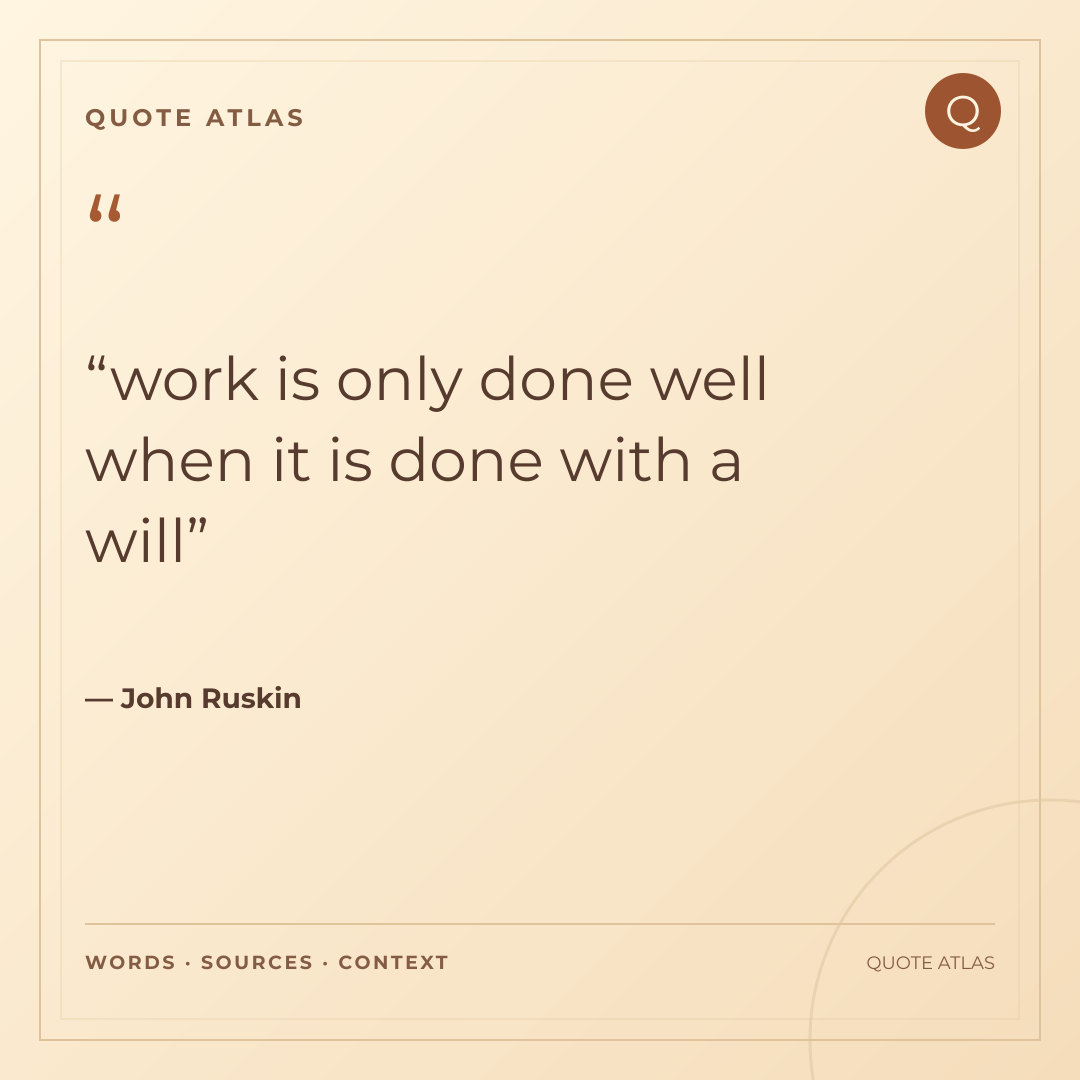
work is only done well when it is done with a will

“work is only done well when it is done with a will”

Ruskin links quality with willing engagement: merely being compelled to perform a task is not, in his argument, enough to produce work done with judgment and commitment.

Source details

The Crown of Wild Olive, lecture on Work; Project Gutenberg #26716. The sentence occurs in a discussion of how hard work should be organized and chosen; its period labor assumptions remain contextualized.

Source identified203
Patience is the finest and worthiest part of fortitude,—and the rarest, too.

“Patience is the finest and worthiest part of fortitude,—and the rarest, too.”

Ruskin separates patience from mere persistence: fortitude is not only continuing to act, but also bearing delay, frustration and incomplete results without losing steadiness.

Source details

The Ethics of the Dust, Lecture IV, Project Gutenberg #4701. Ruskin immediately contrasts many persevering people with the rarer patient person and later insists that genuine patience is not necessarily passive or idle.

Source identified204
There is no act which more imperatively requires to be performed under a strong sense of individual responsibility than the nomination to employments.

“There is no act which more imperatively requires to be performed under a strong sense of individual responsibility than the nomination to employments.”

Mill treats appointments to public office as decisions requiring unusually strong personal accountability because poor nominations can substitute influence or convenience for actual qualification.

Source details

Considerations on Representative Government (1861), Chapter V, “Of the Proper Functions of Representative Bodies,” Project Gutenberg #5669. This is historical constitutional and administrative theory rather than a current hiring standard.

Source identified206
The terrorist and the policeman both come from the same basket. Revolution, legality—counter moves in the same game; forms of idleness at bottom identical.

“The terrorist and the policeman both come from the same basket. Revolution, legality—counter moves in the same game; forms of idleness at bottom identical.”

The Professor collapses revolutionary violence and state policing into one contemptuous theory of power, revealing his alienated and absolutist political outlook.

Source details

The Secret Agent, Project Gutenberg #974. This is fictional dialogue spoken by the Professor, an extremist character; the novel does not present his equivalence between terrorism and policing as neutral political fact.

Source identified208
And whatsoever ye do, do it heartily, as to the Lord, and not unto men.

“And whatsoever ye do, do it heartily, as to the Lord, and not unto men.”

Work is framed around wholehearted effort and an internal standard of responsibility rather than dependence on external praise or supervision.

Source details

Colossians 3:23 in the King James Version; the instruction emphasizes wholehearted work and a higher standard of accountability.

Source identified209
The true life is the life which adds something

“The true life is the life which adds something”

In Tolstoy’s Christian interpretation, meaningful life contributes to a human inheritance received from earlier generations and passed forward to others.

Source details

My Religion, Chapter VIII; Huntington Smith translation, represented 1885 Crowell edition, Project Gutenberg #43794. In Tolstoy’s contrast between isolated personal life and the “true life,” the passage treats inherited human labour and obligation across generations within his Christian argument, not as a secular universal claim.

Source identified210
Man's freedom lies in the power of this choice.

“Man's freedom lies in the power of this choice.”

Tolstoy locates a limited but meaningful freedom in whether a person recognizes and acts upon the truth they believe they have understood.

Source details

The Kingdom of God Is Within You, Chapter XII; Constance Garnett translation, Project Gutenberg #43302. In the concluding chapter Tolstoy locates human freedom in the recognition or rejection of truth already revealed to conscience; the sentence states that freedom lies in this choice.

Source identified211
Fathers and mothers are too absorbed in business and housekeeping to study their children

“Fathers and mothers are too absorbed in business and housekeeping to study their children”

Voice: Narrator voice · Narrator

The narrator criticizes adults who become so occupied with work and household demands that they lose the attentive knowledge needed for trust with their children.

Source details

Eight Cousins; Or, The Aunt-Hill, Chapter 17, Project Gutenberg #38567. Narrator commentary follows Mac's complaint that parents and children have never learned to talk openly.

Source identified212
Never forget that she risked everything for your sake, and don't let it be in vain.

“Never forget that she risked everything for your sake, and don't let it be in vain.”

Voice: Fictional character · Jo Bhaer

Remembering a parent’s sacrifice becomes an ethical obligation: Dan is asked to let that costly act influence the kind of life he chooses afterward.

Source details

Jo's Boys, Chapter 4, Project Gutenberg #3499. Mrs Jo is speaking to Dan about his mother's effort to protect him from harmful influences.

Source identified213
This is the first duty of parents, and no false delicacy should keep them from the watchful care, the gentle warning

“This is the first duty of parents, and no false delicacy should keep them from the watchful care, the gentle warning”

Voice: Fictional character · Jo Bhaer

The passage makes attentive guidance a parental responsibility, arguing that embarrassment should not prevent adults from giving young people timely, gentle warnings.

Source details

Jo's Boys, Chapter 4, Project Gutenberg #3499. Mrs Jo is discussing parental guidance; the excerpt stops before the longer sentence develops self-knowledge and self-control.

Source identified214
If I can make a good man of this wild boy, it will be the best work of my life.

“If I can make a good man of this wild boy, it will be the best work of my life.”

Voice: Fictional character · Jo Bhaer

Care for a difficult child is treated as meaningful work: the aim is not control for its own sake but helping character develop through patience, structure, and attachment.

Source details

Little Men; Jo reflects on the responsibility of guiding a difficult boy and measures success by the person he may become rather than by convenience.

Source identified215
Hope and keep busy, and whatever happens, remember that you never can be fatherless.
Image design Linen

“Hope and keep busy, and whatever happens, remember that you never can be fatherless.”

Mrs March joins hope with continued useful activity while her family faces frightening uncertainty, treating daily responsibility as a way to endure rather than a guarantee that difficulty will disappear.

Source details

Little Women, Chapter 16, “Letters,” Project Gutenberg #514. Mrs. March tells her daughters, “Hope and keep busy, and whatever happens, remember that you never can be fatherless” immediately before leaving for Washington after news of Mr. March’s illness. The line is maternal counsel in a fictional family crisis, not a claim that work removes grief, fear or uncertainty.

Source identified217
First, do nothing inconsiderately, nor without a purpose.

“First, do nothing inconsiderately, nor without a purpose.”

Deliberate action begins by knowing why an act is being done instead of moving from impulse, distraction, or social pressure.

Source details

Meditations, Book XII, section 20, George Long translation.

Source identified218
And let your self-respect forbid you to do imperfectly anything that you do at all.

“And let your self-respect forbid you to do imperfectly anything that you do at all.”

Self-respect becomes a standard for workmanship: valuing oneself should appear not only in feeling but in the care brought to responsibilities and chosen work.

Source details

Woman in the Nineteenth Century and Kindred Papers; the sentence appears in advice about practical education, precision, and the development of the whole person.

Source identified219
Discipline must come through liberty.

“Discipline must come through liberty.”

The short principle contrasts self-directed active discipline with discipline produced only through externally imposed immobility or coercive classroom control.

Source details

The Montessori Method, Chapter V, “Discipline,” printed page 86, Anne E. George translation, Project Gutenberg #39863. “Discipline must come through liberty” introduces Montessori’s account of active discipline and self-mastery in contrast with enforced immobility. It remains early-twentieth-century educational theory rather than a context-free rule for every classroom or child.

Source identified220
We call an individual disciplined when he is master of himself, and can, therefore, regulate his own conduct when it shall be necessary to follow some rule of life.

“We call an individual disciplined when he is master of himself, and can, therefore, regulate his own conduct when it shall be necessary to follow some rule of life.”

Discipline is framed as developed self-regulation: the learner becomes capable of governing conduct appropriately rather than depending entirely on external restraint.

Source details

The Montessori Method, “Discipline,” Anne E. George translation. Montessori calls this “active discipline” and contrasts it with older coercion to immobility; terminology reflects the educational theory of her period.

Source identified221
I ardently wished to extinguish that life which I had so thoughtlessly bestowed.

“I ardently wished to extinguish that life which I had so thoughtlessly bestowed.”

Voice: Fictional narrator · Victor Frankenstein

Victor’s regret is inseparable from responsibility and revenge: after William and Justine’s deaths, he wishes he could reverse the act of creation whose consequences he believes he failed to foresee or govern.

Source details

Frankenstein, Chapter 9 in Project Gutenberg #84. Victor narrates the wish to extinguish the life he created after William’s murder and Justine’s execution, amid remorse, guilt, hatred and a stated desire for revenge. It is fictional first-person narration, not a healthy coping model or clinical guidance.

Source identified222
Reverencing the rights of humanity, I shall dare to assert them.

“Reverencing the rights of humanity, I shall dare to assert them.”

Wollstonecraft presents public argument as an obligation to defend human rights even when ridicule or social pressure makes such advocacy uncomfortable.

Source details

A Vindication of the Rights of Men, opening pages; the sentence immediately follows her statement that she contends for the rights of men and liberty of reason.

Source identified223
truly sublime is the character that acts from principle, and governs the inferior springs of activity without slackening their vigour;

“truly sublime is the character that acts from principle, and governs the inferior springs of activity without slackening their vigour;”

The passage praises principled character that can use emotion and energy without allowing immediate feeling to overrule deliberate judgment.

Source details

A Vindication of the Rights of Men; this clause appears in Wollstonecraft’s contrast between habit, manipulated passion, and a character governed by principle.

Source identified224
We should never give pain without a design to amend.

“We should never give pain without a design to amend.”

Correction should aim at improvement rather than humiliation; causing pain without a constructive purpose turns discipline into unnecessary cruelty.

Source details

Thoughts on the Education of Daughters (1787), “EXTERIOR ACCOMPLISHMENTS,” printed page 29, Project Gutenberg #67466. Wollstonecraft says pain should not be given without a design to amend while criticizing ridicule, affectation and correction that humiliates rather than improves; this is historical conduct guidance.

Source identified225
The governing of our temper is truly the business of our whole lives.

“The governing of our temper is truly the business of our whole lives.”

Emotional self-command is not a childhood lesson completed once; it remains a lifelong practice because new circumstances continually test established habits.

Source details

Thoughts on the Education of Daughters (1787), “The TEMPER,” printed page 62, Project Gutenberg #67466. Wollstonecraft calls governing the temper the business of the whole life while discussing habits of self-command and conduct; the passage is moral-educational argument rather than clinical emotion-regulation advice.

Source identified226
It is the duty of a parent to preserve a child from receiving wrong impressions.

“It is the duty of a parent to preserve a child from receiving wrong impressions.”

Early impressions can become durable habits of judgment, so parents carry responsibility for the examples, expectations, and environments surrounding a child.

Source details

Thoughts on the Education of Daughters (1787), “MORAL DISCIPLINE,” printed page 20, Project Gutenberg #67466. Wollstonecraft says parents should preserve children from wrong impressions while discussing early prejudices and habits; this is eighteenth-century child-rearing argument rather than current developmental or clinical guidance.

Source identified227
Character is power.

“Character is power.”

The compressed maxim treats durable conduct and reliability as forms of influence that do not depend entirely on position or display.

Source details

Architects of Fate; Project Gutenberg #21622. The short maxim appears in Marden’s discussion of character.

Source identified228
Mere energy is not enough, it must be concentrated on some steady, unwavering aim.

“Mere energy is not enough, it must be concentrated on some steady, unwavering aim.”

Effort becomes more useful when it is directed consistently toward a defined aim rather than spent in unrelated bursts of activity.

Source details

Architects of Fate; Project Gutenberg #21622, in Marden’s discussion of definite purpose and concentrated effort.

Source identified229
The only way to get rid of a temptation is to yield to it.

“The only way to get rid of a temptation is to yield to it.”

Voice: Fictional character · Lord Henry Wotton

The line is a deliberately seductive paradox rather than practical advice, expressing the character’s philosophy of appetite and indulgence.

Source details

The Picture of Dorian Gray, 1890 Lippincott magazine text, Chapter 2; Lord Henry states the temptation paradox while influencing Dorian in Basil Hallward’s garden.

Source identified230
Whether I should sink or swim depended wholly upon my own energy.

“Whether I should sink or swim depended wholly upon my own energy.”

Barnum frames the newly acquired museum as a situation in which sustained personal effort and management would determine whether the venture survived.

Source details

Struggles and Triumphs, 1872 author’s edition; Barnum is describing the beginning of his ownership and management of the American Museum.

Source identified231
The foundation of success in life is good health.

“The foundation of success in life is good health.”

Achievement is treated as dependent on the physical capacity to work, think, and sustain effort rather than as a purely financial or professional matter.

Source details

The Art of Money Getting; Barnum places health before the business maxims that follow.

Source identified232
Young men starting in life should avoid running into debt.

“Young men starting in life should avoid running into debt.”

Barnum treats consumer debt as a constraint on future choices and recommends avoiding obligations incurred simply to consume before payment is possible.

Source details

The Art of Money Getting, section “Avoid Debt”; Project Gutenberg #8581. The advice is period-specific and not a blanket claim that every productive use of credit is harmful.

Source identified233
True economy consists in always making the income exceed the out-go.

“True economy consists in always making the income exceed the out-go.”

Barnum defines practical economy through a durable margin between income and spending rather than through isolated acts of penny-pinching.

Source details

The Art of Money Getting, unheaded opening economy discussion before the first formal contents section, Project Gutenberg #8581. “True economy consists in always making the income exceed the out-go” follows Barnum’s contrast between real economy and penny-wise meanness and leads into his margin-of-income example. The queue parser’s inherited “rule i” hint is not a printed heading in this witness. This remains nineteenth-century conduct-of-life and financial rhetoric, not individualized financial planning or a guaranteed savings rule.

Source identified234
You cannot accumulate a fortune by taking the road that leads to poverty.

“You cannot accumulate a fortune by taking the road that leads to poverty.”

Barnum argues that spending patterns incompatible with saving cannot be reconciled merely by hoping for future wealth or higher income.

Source details

The Art of Money Getting, economy discussion; Project Gutenberg #8581. The road metaphor appears in Barnum’s warning against living fully up to one’s means.

Source identified235
Debt robs a man of his self-respect, and makes him almost despise himself.

“Debt robs a man of his self-respect, and makes him almost despise himself.”

The rhetoric emphasizes the psychological burden Barnum associated with unpaid consumption debt, linking financial obligation with dependence and loss of confidence.

Source details

The Art of Money Getting, “Avoid Debt”; Project Gutenberg #8581. This is Barnum’s forceful moral rhetoric, not a clinical claim about every debtor’s mental state.

Source identified236
The real comforts of life cost but a small portion of what most of us can earn.

“The real comforts of life cost but a small portion of what most of us can earn.”

The sentence distinguishes basic comfort from status consumption, arguing that many discretionary expenses arise from luxury and comparison rather than necessity.

Source details

The Art of Money Getting, expense-account discussion; Project Gutenberg #8581. This is Barnum’s historical generalization about comfort and spending, not a modern cost-of-living statistic.

Source identified237
Prosperity is a more severe ordeal than adversity, especially sudden prosperity.

“Prosperity is a more severe ordeal than adversity, especially sudden prosperity.”

Sudden financial improvement can test restraint because rising income may encourage equally rapid expansion of spending, display, and recurring obligations.

Source details

The Art of Money Getting, economy section; Project Gutenberg #8581. Barnum introduces the line while describing lifestyle expansion after financial success.

Source identified238
People ought to be as sensible on the subject of money-getting as on any other subject.

“People ought to be as sensible on the subject of money-getting as on any other subject.”

Financial choices are presented as ordinary matters for judgment and cause-and-effect reasoning rather than as exceptions governed by appearance or wishful thinking.

Source details

The Art of Money Getting, economy discussion; Project Gutenberg #8581. The sentence follows Barnum’s warning about trying to appear richer than one is.

Source identified239
Money is in some respects like fire; it is a very excellent servant but a terrible master.

“Money is in some respects like fire; it is a very excellent servant but a terrible master.”

Money is framed as useful when directed toward chosen purposes but harmful when debt, interest, or appetite begins directing the person instead.

Source details

The Art of Money Getting, “Avoid Debt”; Project Gutenberg #8581. Barnum uses the servant-and-master metaphor while contrasting interest working for versus against the borrower.

Source identified240
Ambition, energy, industry, perseverance, are indispensable requisites for success in business.

“Ambition, energy, industry, perseverance, are indispensable requisites for success in business.”

The sentence presents business success as a compound result of sustained energy and persistence rather than a single clever idea or fortunate moment.

Source details

The Art of Money Getting, in Barnum’s discussion of thorough work and business effort.

Source identified241
Watch ye, stand fast in the faith, quit you like men, be strong.

“Watch ye, stand fast in the faith, quit you like men, be strong.”

The sequence emphasizes alertness, steadiness, and strength, presenting courage as sustained conduct rather than one dramatic moment.

Source details

1 Corinthians 16:13 in the King James Version.

Source identified242
I shall obey God rather than you.

“I shall obey God rather than you.”

Voice: Dialogue speaker · Socrates

Socrates presents moral and philosophical duty as more binding than compliance with pressure from political authority.

Source details

Apology, Jowett translation; Socrates says he would continue practicing philosophy even if acquittal were conditioned on silence.

Source identified243
Then we must do no wrong?

“Then we must do no wrong?”

Voice: Dialogue speaker · Socrates

The brief question tests whether the previously accepted principle against wrongdoing still holds when obedience to it becomes personally costly.

Source details

Crito, Benjamin Jowett translation; Socrates is testing the moral premises that will govern his decision about escaping prison.

Source identified244
Ought a man to do what he admits to be right, or ought he to betray the right?
Image design Golden Hour

“Ought a man to do what he admits to be right, or ought he to betray the right?”

Voice: Dialogue speaker · Socrates

Socrates asks whether acting on one’s considered judgment about right and wrong should be set aside when the costs are severe. In the prison conversation, the question tests whether escaping a wrongful sentence can be justified under the principles he and Crito have accepted.

Source details

Crito, Socrates questioning Crito during the prison discussion after establishing a rule against retaliation; Benjamin Jowett English translation, Project Gutenberg #1657. The sentence begins after Socrates says he will put the next point as a question. The question is not an unqualified defense of obedience to every law; the dialogue stages an argument about obligations to the city.

Source identified245
Now I mean by education that training which is given by suitable habits to the first instincts of virtue in children;
Image design Lavender

“Now I mean by education that training which is given by suitable habits to the first instincts of virtue in children;”

Voice: Dialogue speaker · Athenian Stranger

In this account, education forms early habits of feeling and response so that they can later accord with reason. It is an account of moral formation within the dialogue, not an empirical generalization about childhood.

Source details

Laws, Book II, Benjamin Jowett English translation. The Athenian Stranger opens a longer definition linking early instincts and pleasure or pain with later rational understanding; this quotation preserves the opening clause and its original semicolon.

Source identified246
When anger and fear, and pleasure and pain, and jealousies and desires, tyrannize over the soul, whether they do any harm or not—I call all this injustice.
Image design Coastal

“When anger and fear, and pleasure and pain, and jealousies and desires, tyrannize over the soul, whether they do any harm or not—I call all this injustice.”

Voice: Dialogue speaker · Athenian Stranger

The Athenian Stranger defines injustice in terms of uncontrolled impulses ruling a person, even before judging the harmful consequences of a particular act. He is distinguishing a disordered character from the later task of classifying and punishing wrongdoing under civic law.

Source details

Laws, Book IX, the Athenian Stranger replying to Cleinias while designing criminal laws for an imagined city. Benjamin Jowett English translation, Project Gutenberg #1750. This is the concluding clause of a longer first-person definition that begins “And now I can define to you clearly”; preserving it as an extract does not make it a remark by Socrates (who is absent from Laws).

Source identified247
The best way of training the young is to train yourself at the same time; not to admonish them, but to be always carrying out your own admonitions in practice.
Image design Botanical Sage

“The best way of training the young is to train yourself at the same time; not to admonish them, but to be always carrying out your own admonitions in practice.”

Voice: Dialogue speaker · Athenian Stranger

The Athenian Stranger argues that adults teach ethical habits through consistent conduct as much as through instruction. Within the proposed city’s civic code, self-discipline and example help to shape a life shared across generations; this is not a randomized modern study of parenting.

Source details

Plato, Laws, Book V, the Athenian Stranger giving an extended civic-ethical exhortation to Cleinias and Megillus; Benjamin Jowett English, Gutenberg #1750. This is dialogue speech, not commentary in Jowett’s introduction. The local dramatic voice is the Athenian Stranger, not Socrates or Plato personally.

Source identified248
Justice was doing one’s own business, and not being a busybody.

“Justice was doing one’s own business, and not being a busybody.”

Voice: Dialogue speaker · Socrates

Justice in the city is connected with people fulfilling appropriate responsibilities rather than constantly interfering in roles that are not theirs.

Source details

The Republic, Book IV; the statement summarizes a definition developed within Socrates’ argument about the ordered city.

Source identified249
Then to injure a friend or any one else is not the act of a just man, but of the opposite, who is the unjust?
Image design Lavender

“Then to injure a friend or any one else is not the act of a just man, but of the opposite, who is the unjust?”

Voice: Dialogue speaker · Socrates

Socrates argues that deliberately harming another person cannot be a proper exercise of justice, including when someone calls the target an enemy. This challenges the earlier suggestion that a just person should help friends and hurt enemies.

Source details

The Republic, Book I, Socrates replying to Polemarchus in the examination of the maxim that justice helps friends and harms enemies. Benjamin Jowett English translation, Project Gutenberg #1497. The source presents a question in dialogue, not a standalone personal motto from Plato; the moral argument considers whether hurting someone can make that person better.

Source identified250
And ought not the rational principle, which is wise, and has the care of the whole soul, to rule, and the passionate or spirited principle to be the subject and ally?
Image design Golden Hour

“And ought not the rational principle, which is wise, and has the care of the whole soul, to rule, and the passionate or spirited principle to be the subject and ally?”

Voice: Dialogue speaker · Socrates

Socrates argues that self-government involves a rational faculty attending to the whole person while spirited impulses support its judgment. The passage is a question within his analogy between a well-ordered city and the three parts of the soul. It does not mean that all emotion should be suppressed or that Plato established a modern psychological theory.

Source details

Plato, The Republic, Book IV, approximately 441e–442a; Socrates addressing Glaucon while contrasting the rational, spirited and appetitive parts of the soul. Exact sentence from Benjamin Jowett English, Project Gutenberg #1497, Book IV main dialogue (not introductory editorial matter). The premise belongs to an ancient account of the soul and remains open to philosophical interpretation; not clinical or neuroscientific evidence.

Source identified251
Without counsel purposes are disappointed: but in the multitude of counsellors they are established.

“Without counsel purposes are disappointed: but in the multitude of counsellors they are established.”

Important plans improve when they are tested against more than one perspective, making counsel part of sound decision-making rather than a sign of weakness.

Source details

Proverbs 15:22 in the King James Version.

Source identified252
Go to the ant, thou sluggard; consider her ways, and be wise.

“Go to the ant, thou sluggard; consider her ways, and be wise.”

The proverb uses the ant as an example of self-directed preparation, turning observation of repeated practical behavior into a lesson about disciplined habits.

Source details

Proverbs 6:6 in the King James Version; the following verses describe the ant preparing food without an overseer.

Source identified253
Receive an injury rather than do one.

“Receive an injury rather than do one.”

Personal suffering is treated as morally preferable to becoming the person who deliberately inflicts unjust harm on another.

Source details

The Moral Sayings of Publius Syrus, maxim 5, in Darius Lyman’s 1856 English rendering; maxim order can vary across editions.

Source identified254
To do two things at once is to do neither.

“To do two things at once is to do neither.”

Divided attention can reduce the quality of both tasks, making concentration a practical condition for completing work well.

Source details

The Moral Sayings of Publius Syrus, maxim 7, in Darius Lyman’s 1856 English rendering; maxim order can vary across editions.

Source identified255
Bitter for a free man is the bondage of debt.

“Bitter for a free man is the bondage of debt.”

Debt can restrict future choices and independence, so borrowing is framed not only financially but also as a constraint on freedom.

Source details

The Moral Sayings of Publius Syrus, maxim 14, in Darius Lyman’s 1856 English rendering; maxim order can vary across editions.

Source identified256
The evil you do to others you may expect in return.

“The evil you do to others you may expect in return.”

Harm has consequences that often return through retaliation, damaged trust, reputation, or the patterns of conduct we create.

Source details

The Moral Sayings of Publius Syrus, maxim 2, in Darius Lyman’s 1856 English rendering; maxim order can vary across editions.

Source identified257
Nothing great was ever achieved without enthusiasm.

“Nothing great was ever achieved without enthusiasm.”

Enthusiasm is treated as the emotional force that turns ideas into sustained effort rather than leaving them as passive intentions.

Source details

Essay “Circles,” in Essays: First Series; the line closes a passage about energetic action.

Source identified258
A foolish consistency is the hobgoblin of little minds.

“A foolish consistency is the hobgoblin of little minds.”

Emerson attacks rigid consistency when it prevents people from revising judgment in the light of new thought.

Source details

Essay “Self-Reliance”; Emerson criticizes rigid adherence to past opinions when fresh judgment requires revision.

Source identified259
He has a power and influence, both direct and indirect, which may be the means of much good or much evil.

“He has a power and influence, both direct and indirect, which may be the means of much good or much evil.”

Voice: Authorial / signed preface voice · Richard Henry Dana Jr.

Dana argues that authority magnifies personal conduct: a leader’s character can improve or damage the behavior and conditions of the people under that authority.

Source details

The Seaman's Friend, represented by Project Gutenberg #40958 (fifth edition, 1847; copyright entered 1841). Dana is discussing the master of a merchant vessel and the effect of his conduct on officers and crew. This is nineteenth-century maritime professional guidance, not current maritime law.

Source identified261
there are lower degrees of constancy necessary to common virtue

“there are lower degrees of constancy necessary to common virtue”

Johnson distinguishes heroic steadfastness from the smaller, repeated forms of constancy needed for ordinary moral life.

Source details

The Idler, No. 11; this paper is not among the numbers Johnson’s own advertisement excluded from his authorship.

Source identified262
Character is property.

“Character is property.”

A good name and dependable conduct are described as forms of value that belong to a person even when material circumstances change.

Source details

Character, Chapter I, “Influence of Character,” Project Gutenberg #2541. The brief statement introduces Smiles’s comparison of character with property: an enduring possession expressed through goodwill, esteem and an honourably earned reputation.

Source identified263
Not a day passes without its discipline, whether for good or for evil.

“Not a day passes without its discipline, whether for good or for evil.”

Daily experience is always training something, so ordinary choices can reinforce either constructive habits or patterns that make later self-command harder.

Source details

Character, Chapter I, “Influence of Character,” Project Gutenberg #2541. Smiles introduces the sentence while explaining that character is formed by many minute circumstances under partial individual control, so each day contributes discipline for good or ill.

Source identified264
Thus reliableness becomes a passport to the general esteem and confidence of mankind.

“Thus reliableness becomes a passport to the general esteem and confidence of mankind.”

Smiles connects trust with repeated dependability rather than image: people become credible when others learn that their words, knowledge claims and commitments can be relied on in practice.

Source details

Character, Chapter I, “Influence of Character,” Project Gutenberg #2541. The sentence closes Smiles’s paragraph on truthfulness as veracity, rectitude and practical reliableness, explaining why dependable words and actions earn general confidence.

Source identified265
It is always the Man society wants.

“It is always the Man society wants.”

In context, Smiles argues that social and industrial progress still depends on capable people willing to lead, follow and work persistently.

Source details

Men of Invention and Industry, Chapter X, “Industry in Ireland: Through Connaught and Ulster to Belfast”; Project Gutenberg #725. Period capitalization and gendered wording are preserved as source text.

Source identified266
This was, in truth the secret of his success

“This was, in truth the secret of his success”

Smiles uses Bianconi’s minute-conscious working habits to illustrate how disciplined use of time contributed to practical business success.

Source details

Men of Invention and Industry, Chapter IX, “Charles Bianconi: A Lesson of Self-Help in Ireland”; Project Gutenberg #725. This excerpt is Smiles’s narrative conclusion immediately after an anecdote about saving time.

Source identified267
Help from without is often enfeebling in its effects, but help from within invariably invigorates.

“Help from without is often enfeebling in its effects, but help from within invariably invigorates.”

Smiles contrasts external direction with cultivated internal agency, arguing in his nineteenth-century self-help framework that people become stronger by exercising their own capacities rather than depending entirely on outside support.

Source details

Self-Help, Chapter I, “Self-Help—National and Individual,” Project Gutenberg #935. The sentence immediately follows Smiles’s statement that the spirit of self-help is the root of individual growth. It is preserved as Victorian conduct-of-life rhetoric, not as evidence that receiving help is generally harmful.

Source identified268
Lost wealth may be replaced by industry, lost knowledge by study, lost health by temperance or medicine, but lost time is gone for ever.

“Lost wealth may be replaced by industry, lost knowledge by study, lost health by temperance or medicine, but lost time is gone for ever.”

Many losses can be repaired through later effort, but spent time cannot be recovered, giving attention and method unusual importance.

Source details

Self-Help, Chapter IX, “Men of Business,” Project Gutenberg #935. The sentence appears in Smiles’s discussion of method, punctuality and the economical use of time, contrasting losses that may be repaired with time once spent, which cannot be recovered.

Source identified269
Thrift is the spirit of order in human life.

“Thrift is the spirit of order in human life.”

Order means aligning limited resources with real priorities so that unnecessary disorder does not repeatedly consume time, money, and attention.

Source details

Thrift, Chapter V, “Examples of Thrift,” Project Gutenberg #14418. In the chapter’s opening discussion of domestic management, Smiles develops thrift as orderly use of household resources and then calls it the spirit of order in human life.

Source identified270
It works for to-day, but also provides for to-morrow.

“It works for to-day, but also provides for to-morrow.”

Good stewardship balances present needs with future obligations instead of treating either immediate enjoyment or distant security as the only concern.

Source details

Thrift, Chapter I, “Industry,” Project Gutenberg #14418. The sentence occurs in the same definition of thrift as an acquired principle of conduct: present enjoyment is subordinated to forethought so that action serves today while providing for tomorrow.