Quote Atlassourced quotes & context
Page 2 of 6 · 490 quotations total

Deep quotes — Page 2

This continuation page contains additional source-backed quotations not shown in the initial 50-quotation overview. Return to the topic guide and browse collection.

100 shown · 490 total
Source identified51
This self-deceit, this fatal weakness of mankind, is the source of half the disorders of human life.

“This self-deceit, this fatal weakness of mankind, is the source of half the disorders of human life.”

Smith treats distorted self-judgment as a major moral problem because people can preserve flattering interpretations of conduct instead of examining themselves impartially.

Source details

The Theory of Moral Sentiments, Part III, discussion of self-examination and the impartial spectator; Smith is describing the difficulty of judging one’s own conduct fairly.

Source identified52
Money is neither a material to work upon, nor a tool to work with.

“Money is neither a material to work upon, nor a tool to work with.”

Money facilitates exchange and payment but is distinguished from the materials, tools, and subsistence that directly enable productive work.

Source details

The Wealth of Nations, Book II, Chapter II; Project Gutenberg #3300. Smith is explaining money as part of circulating capital rather than denying its practical usefulness.

Source identified53
Wages, profit, and rent, are the three original sources of all revenue, as well as of all exchangeable value.

“Wages, profit, and rent, are the three original sources of all revenue, as well as of all exchangeable value.”

Smith separates major forms of income according to labour, stock, and land, providing a historical framework for how revenue is distributed.

Source details

The Wealth of Nations, Book I, Chapter VI; Project Gutenberg #3300. The statement is part of Smith’s eighteenth-century theory of price and income distribution.

Source identified54
The real price of every thing, what every thing really costs to the man who wants to acquire it, is the toil and trouble of acquiring it.

“The real price of every thing, what every thing really costs to the man who wants to acquire it, is the toil and trouble of acquiring it.”

Smith distinguishes nominal money price from the labour and sacrifice required to acquire something, making cost broader than the number printed on a transaction.

Source details

The Wealth of Nations, Book I, Chapter V; Project Gutenberg #3300. This belongs to Smith’s labour-command discussion of real and nominal price.

Source identified55
Every man is rich or poor according to the degree in which he can afford to enjoy the necessaries, conveniencies, and amusements of human life.

“Every man is rich or poor according to the degree in which he can afford to enjoy the necessaries, conveniencies, and amusements of human life.”

Smith defines economic command in terms of access to goods and services rather than the mere possession of coins, linking wealth with purchasing capacity.

Source details

The Wealth of Nations, Book I, Chapter V; Project Gutenberg #3300. The historical spelling “conveniencies” is retained; this is classical political economy, not a modern household-wealth metric.

Source identified56
A liar will not be believed, even when he speaks the truth.

“A liar will not be believed, even when he speaks the truth.”

Voice: Fictional character · Wise man of the village

Repeated deception damages credibility beyond the original lie: once listeners have learned to expect false alarms, even a later truthful warning can fail to restore belief in time.

Source details

Joseph Jacobs, The Fables of Aesop, “The Shepherd Boy and the Wolf,” Project Gutenberg #28. The wise man of the village gives the moral after the boy’s repeated false cries cause the villagers to ignore his real warning.

Source identified57
What mighty contests rise from trivial things,

“What mighty contests rise from trivial things,”

Voice: Poetic speaker · Mock-heroic narrator

The mock-heroic opening announces the poem’s central comic method: treating a small social quarrel with the scale and language of epic conflict.

Source details

The Rape of the Lock, Canto I, line 2 in the 1717 recension. The retained catalog wording ‘What mighty contests rise from trivial things’ is verified in The Works of Mr. Alexander Pope (1717), scan page 157; the 1714 second edition instead reads ‘What mighty Quarrels rise from trivial things,’ so the synchronized source year is 1717. The line is part of Pope’s mock-heroic invocation and should be read as satire.

Source identified58
How vain are all these glories, all our pains, Unless good sense preserve what beauty gains:

“How vain are all these glories, all our pains, Unless good sense preserve what beauty gains:”

Voice: Fictional character · Clarissa

Clarissa’s speech argues that appearance and social admiration are unstable unless judgment and character give them something more durable to rest on.

Source details

The Rape of the Lock, Canto V, lines 15–16 in Pope’s 1717 revision; spoken by Clarissa. Her moralizing speech (Canto V lines 7–36) was added in 1717, so the inherited 1714 source year is corrected to 1717. The reviewed evidence opens the 1717 Canto V scan start; the exact couplet is independently preserved in the complete final-form text.

Source identified59
But there is this terrible thing in evil thoughts, that evil minds soon grow familiar with them.

“But there is this terrible thing in evil thoughts, that evil minds soon grow familiar with them.”

Voice: Fictional narrator · Narrator

The narrator warns that repeatedly entertaining a harmful idea can reduce the resistance a person initially feels toward acting on it.

Source details

The Black Tulip, Chapter VIII, “An Invasion,” Project Gutenberg #965. Exact-witness review corrects the inherited Chapter VI locator: the narrator says that evil minds soon grow familiar with evil thoughts immediately after Boxtel first shrinks from informing against Van Baerle and before he rationalizes the act.

Source identified60
’Tis better to have loved and lost Than never to have loved at all.

“’Tis better to have loved and lost Than never to have loved at all.”

Love can remain worth having even when it ends in loss, because avoiding grief by avoiding attachment would also remove the relationship itself.

Source details

In Memoriam A.H.H., Canto XXVII, closing stanza; represented by the Wikisource canto transcription and independently visible on printed page 44 / scan leaf 64 of a public-domain edition. Tennyson's 'loved and lost' conclusion belongs to the elegy's grief for Arthur Hallam and its argument that love remains valuable despite bereavement; it is poetry, not a clinical grief prescription.

Source identified62
Death is a dignitary who when he comes announced is to be received with formal manifestations of respect, even by those most familiar with him.

“Death is a dignitary who when he comes announced is to be received with formal manifestations of respect, even by those most familiar with him.”

Bierce’s narrator describes the rigid military ceremony around an execution, using formal language to make the scene feel colder and more unsettling.

Source details

“An Occurrence at Owl Creek Bridge,” represented by Project Gutenberg #375. The sentence is narrator commentary immediately before Peyton Farquhar’s execution; it belongs to Civil War fiction and does not endorse the killing.

Source identified63
There are colors that we cannot see.

“There are colors that we cannot see.”

The fictional journal proposes an unseen color as an explanation for the story’s impossible creature, extending ordinary limits of perception into supernatural horror.

Source details

‘The Damned Thing,’ section IV, ‘An Explanation from the Tomb,’ in Can Such Things Be?, Project Gutenberg #4366. ‘There are colors that we cannot see’ appears in Hugh Morgan's fictional October 7 diary entry as he speculates that the invisible creature occupies a color outside ordinary human vision. It is late-nineteenth-century speculative-horror explanation using period scientific language, not a current scientific claim establishing the story's creature or a new human-visible color.

Source identified64
Education, n. That which discloses to the wise and disguises from the foolish their lack of understanding.

“Education, n. That which discloses to the wise and disguises from the foolish their lack of understanding.”

Bierce’s satirical definition suggests that learning may deepen understanding in reflective people while giving the unreflective additional ways to conceal ignorance.

Source details

The Devil’s Dictionary, entry “Education,” Project Gutenberg #972. This is a deliberately cynical comic dictionary definition and should be read as satire rather than as a literal educational theory.

Source identified65
All true histories contain instruction; though, in some, the treasure may be hard to find,

“All true histories contain instruction; though, in some, the treasure may be hard to find,”

Agnes opens her story by claiming that lived experience can teach, while immediately admitting that some narratives yield only modest lessons.

Source details

Agnes Grey, Chapter I, “The Parsonage,” Project Gutenberg #767. The frozen catalog is the opening clause of the narrator’s longer first sentence, which continues that the instructional “treasure” may be hard to find. Agnes Grey is a fictional first-person narrator; the passage should not be presented as literal Anne Brontë autobiography.

Source identified66
What on earth could be more luxurious than a sofa, a book, and a cup of coffee?

“What on earth could be more luxurious than a sofa, a book, and a cup of coffee?”

Mr Harding’s delight in a sofa, books and coffee turns an ordinary London room into temporary luxury through comfort, leisure and changed perspective.

Source details

The Warden, Project Gutenberg #619. The narrator describes Mr Harding settling into Tom Towers’s comfortable rooms after an exhausting day; this is comic fictional narration, not a claim about universal happiness.

Source identified67
All men by nature desire to know.

“All men by nature desire to know.”

Aristotle treats the desire for knowledge as a basic human tendency, giving curiosity a foundational place in the movement from perception toward understanding.

Source details

Aristotle, Metaphysics, Book I, Chapter I, W. D. Ross translation (1908), validated Wikisource scan leaf 21. 'All men by nature desire to know' opens the work before the discussion of sensation, memory, experience, art and knowledge. This remains ancient philosophy mediated by translation, not a modern empirical finding about cognition.

Source identified68
Every action and moral choice, aims, it is thought, at some good.

“Every action and moral choice, aims, it is thought, at some good.”

Actions and choices are intelligible because they pursue something taken to be good, even when people disagree about what the good actually is.

Source details

Nicomachean Ethics, Book I; the opening argument begins from the idea that action aims at a perceived good.

Source identified69
No one would choose to live without friends though he should have all the other good things in the world.

“No one would choose to live without friends though he should have all the other good things in the world.”

Friendship is treated not as an optional luxury but as part of a flourishing life, even when material needs and other advantages are already supplied.

Source details

Nicomachean Ethics, Book VIII; Aristotle begins his discussion of friendship by treating it as necessary to a good life.

Source identified70
Virtue then is a state apt to exercise deliberate choice, being in the relative mean, determined by reason.

“Virtue then is a state apt to exercise deliberate choice, being in the relative mean, determined by reason.”

Virtue is treated as a stable capacity for deliberate choice, guided by practical judgment rather than by extremes of impulse or deficiency.

Source details

Nicomachean Ethics, Book II, Chapter VI; the public-domain English translation defines virtue through deliberate choice and the relative mean.

Source identified71
Law is reason without desire.

“Law is reason without desire.”

Good law is idealized as judgment governed by reason rather than by the changing appetites or personal passions of an individual ruler.

Source details

Politics: A Treatise on Government, Book III, Chapter XVI, William Ellis translation; represented through the 1912 Dent witness / Project Gutenberg #6762. In comparing rule by a person with rule by law, Aristotle says that passion can affect even the best rulers and concludes that law is reason without desire.

Source identified72
Time is a great deal more than money.

“Time is a great deal more than money.”

Bennett treats time as the more fundamental resource because money can be gained or lost within time, whereas each passing hour is the fixed medium in which every other activity occurs.

Source details

How to Live on 24 Hours a Day, opening discussion of the daily allotment of time. The represented public-domain Project Gutenberg text is #2274; the line is conduct-of-life rhetoric, not a literal economic equivalence.

Source identified73
It is a capital mistake to theorize before one has data.

“It is a capital mistake to theorize before one has data.”

Holmes argues that explanations should follow evidence because an early theory can tempt a person to force later facts into a preferred story.

Source details

“A Scandal in Bohemia,” The Adventures of Sherlock Holmes (1891), Project Gutenberg #1661. Holmes immediately warns that premature theorizing leads people to twist facts to suit theories; it is fictional detective dialogue.

Source identified74
The world is full of obvious things which nobody by any chance ever observes.

“The world is full of obvious things which nobody by any chance ever observes.”

Holmes distinguishes mere visibility from real observation: information can be plainly present and still go unused when attention remains superficial.

Source details

The Hound of the Baskervilles, Chapter III, “The Problem,” Project Gutenberg #2852. Sherlock Holmes says that the world is full of obvious things nobody observes after inferring from Watson’s clean clothes and boots that he spent the rainy day indoors, then asks Watson to infer where Holmes himself has been. It remains fictional detective dialogue illustrating Holmes’s observational method rather than a universal scientific rule.

Source identified75
Knowledge is hard to seek, and harder yet to adhere to. Knowledge is painful often; and yet when we know we are happy.

“Knowledge is hard to seek, and harder yet to adhere to. Knowledge is painful often; and yet when we know we are happy.”

Voice: Fictional character · Claude

Claude presents knowledge as difficult to obtain and live with, yet still capable of giving a kind of clarity or satisfaction once it is possessed.

Source details

Amours de Voyage, Letter X, “Claude to Eustace,—from Rome,” Project Gutenberg #1393. Claude’s two sentences about knowledge appear in the fictional verse-letter sequence after he turns from Roman politics toward study. This is Clough’s fictional epistolary voice, not direct autobiography or an empirical claim about happiness.

Source identified76
In a world where all is fleeting, change alone endures.

“In a world where all is fleeting, change alone endures.”

Stability is temporary, so practical judgment requires expecting change rather than treating present arrangements as permanent.

Source details

Counsels and Maxims, T. Bailey Saunders translation, in a discussion of fortune and apparent stability.

Source identified77
For the safest way of not being very miserable is not to expect to be very happy.

“For the safest way of not being very miserable is not to expect to be very happy.”

Lowering unrealistic expectations can reduce avoidable disappointment, though the maxim deliberately sets a restrained rather than exuberant ideal of happiness.

Source details

Counsels and Maxims, opening general rules on happiness and avoiding unnecessary suffering.

Source identified78
Reading is thinking with some one else's head instead of one's own.

“Reading is thinking with some one else's head instead of one's own.”

Reading supplies another mind’s thought, but Schopenhauer warns that consuming ideas should not replace the work of forming one’s own connected judgment.

Source details

Essay “On Books and Reading,” in a public-domain English collection of Schopenhauer’s essays.

Source identified79
One can never read too little of bad, or too much of good books: bad books are intellectual poison; they destroy the mind.

“One can never read too little of bad, or too much of good books: bad books are intellectual poison; they destroy the mind.”

The deliberately severe contrast argues that reading quality matters because repeated exposure influences the habits and material of thought.

Source details

Essay “On Books and Reading,” public-domain English text.

Source identified80
What a man is, and so what he has in his own person, is always the chief thing to consider.

“What a man is, and so what he has in his own person, is always the chief thing to consider.”

The line directs attention toward qualities carried within the person rather than status or possessions, grounding a durable sense of value in character, capacity, and inner life.

Source details

The Wisdom of Life; Schopenhauer develops a three-part distinction between what a person is, what a person has, and what a person represents in the eyes of others.

Source identified81
What a man is contributes much more to his happiness than what he has, or how he is regarded by others.

“What a man is contributes much more to his happiness than what he has, or how he is regarded by others.”

Schopenhauer places personal character and inner constitution above possessions and reputation, making well-being depend more on what a person is than on external valuation.

Source details

The Wisdom of Life; T. Bailey Saunders’s public-domain translation distinguishes what a person is from possessions and from the opinions of other people.

Source identified82
The world in which a man lives shapes itself chiefly by the way in which he looks at it, and so it proves different to different men

“The world in which a man lives shapes itself chiefly by the way in which he looks at it, and so it proves different to different men”

Schopenhauer emphasizes interpretation as a major part of lived experience: the same world can appear very different depending on the qualities and habits of the person perceiving it.

Source details

The Wisdom of Life, T. Bailey Saunders translation; Project Gutenberg #10741. The claim belongs to Schopenhauer’s philosophical account of personality and subjective experience.

Source identified83
What a man is and has in himself,—in a word personality, with all it entails, is the only immediate and direct factor in his happiness and welfare.

“What a man is and has in himself,—in a word personality, with all it entails, is the only immediate and direct factor in his happiness and welfare.”

Personality is presented as the nearest and most continuous condition of well-being, because possessions and reputation affect life only through the person who experiences them.

Source details

The Wisdom of Life; Schopenhauer argues that personality has a more direct relation to happiness than property, rank, or external opinion.

Source identified84
The world is my idea.

“The world is my idea.”

Schopenhauer opens his system by arguing that the experienced world is always presented in relation to a knowing subject, making perception and consciousness conditions of the world as it is known.

Source details

The World as Will and Idea, Vol. I, First Book, §1, Haldane and Kemp translation, Project Gutenberg #38427. “Idea” translates Vorstellung in this historical philosophical vocabulary and should not be read as the everyday sense of a passing thought.

Source identified85
Stand for truth, and ’tis enough.

“Stand for truth, and ’tis enough.”

Jonson argues that loyalty should attach to what is true rather than to a teacher, sect or personal faction.

Source details

Timber, or Discoveries Made Upon Men and Matter, represented by Project Gutenberg #5134. Jonson follows the sentence with his refusal to have readers defend a position merely because it is his; the aphorism belongs to a direct prose reflection on independent judgment and truth.

Source identified86
the terms good and evil are only applied relatively, so that the same thing may be called both good and bad according to the relations in view,

“the terms good and evil are only applied relatively, so that the same thing may be called both good and bad according to the relations in view,”

Spinoza asks readers to examine evaluative terms in relation to purposes and comparisons instead of assuming that every judgment of good or bad names an absolute property.

Source details

On the Improvement of the Understanding, section 12, Project Gutenberg #1016 in R. H. M. Elwes's public-domain English translation. Spinoza says the terms good and evil are applied relatively while introducing his distinction between ordinary relative goods and the true/highest good sought by the unfinished treatise. It remains translation-mediated seventeenth-century methodological philosophy rather than a claim that all moral distinctions are meaningless.

Source identified87
The value of philosophy is, in fact, to be sought largely in its very uncertainty.

“The value of philosophy is, in fact, to be sought largely in its very uncertainty.”

Russell argues that uncertainty can be intellectually valuable because it loosens inherited assumptions and makes room for examined alternatives.

Source details

The Problems of Philosophy, Chapter XV, “The Value of Philosophy,” printed page 242 / scan leaf 246 in the 1912 Williams & Norgate edition on Wikisource, cross-checked against Project Gutenberg #5827. “The value of philosophy is, in fact, to be sought largely in its very uncertainty” begins Russell’s concluding account of how philosophical doubt can loosen unexamined certainty; this is philosophical argument, not an empirical psychological finding.

Source identified88
The heart has its reasons, which reason knows not.

“The heart has its reasons, which reason knows not.”

Human judgment includes forms of intuition, feeling, and commitment that cannot always be reduced to explicit logical argument.

Source details

Pensées; Pascal contrasts forms of knowing associated with the heart and with discursive reason.

Source identified89
Discourses on humility give occasion for pride to the boastful, and for humility to the humble.

“Discourses on humility give occasion for pride to the boastful, and for humility to the humble.”

Pascal points to a self-referential danger: even learning or speaking about humility can become another stage for vanity unless a person is willing to examine the motives behind the performance.

Source details

The Thoughts of Blaise Pascal, C. Kegan Paul translation, Project Gutenberg #46921. The next sentence extends the paradox by observing how difficult it is to speak humbly about humility.

Source identified90
Diversity repels; likeness attracts.

“Diversity repels; likeness attracts.”

The concise axiom is one premise in Boethius’s metaphysical argument: things are described as tending toward what is like them, not as a modern empirical rule about human attraction or relationships.

Source details

How Substances Can Be Good in Virtue of Their Existence Without Being Absolute Goods (De Hebdomadibus), preliminary proposition IX, H. F. Stewart / E. K. Rand 1918 edition, Project Gutenberg #13316. Kept as a historical metaphysical premise, not social-science evidence.

Source identified91
There are many things which can be separated by a mental process, though they cannot be separated in fact.

“There are many things which can be separated by a mental process, though they cannot be separated in fact.”

Boethius distinguishes conceptual analysis from physical separation: the mind can consider a feature on its own even when the thing and that feature cannot actually be pulled apart in reality.

Source details

How Substances Can Be Good in Virtue of Their Existence Without Being Absolute Goods (De Hebdomadibus), H. F. Stewart / E. K. Rand 1918 edition, Project Gutenberg #13316. The sentence introduces a metaphysical method by distinguishing mental abstraction from actual separation.

Source identified92
All things, then, seek the good.

“All things, then, seek the good.”

Boethius frames action as movement toward some perceived good, making the nature of genuine goodness central to understanding desire, purpose, and happiness.

Source details

The Consolation of Philosophy, Book III, Chapter XI, H. R. James translation (Elliot Stock, 1897), printed page 149 in Project Gutenberg #14328. Lady Philosophy reaches ‘All things, then, seek the good’ after arguing that things naturally seek continued existence and unity, and that unity and goodness are the same. This remains late-antique metaphysical/philosophical argument mediated by translation, not an empirical description of every human motive or modern behavioral science.

Source identified93
Nothing is wretched, but thinking makes it so.

“Nothing is wretched, but thinking makes it so.”

Misfortune and judgment are separated: external circumstances can be painful, but the interpretation attached to them strongly influences whether a life is experienced as wholly ruined.

Source details

The Consolation of Philosophy, Book II, Chapter IV, H. R. James translation (Elliot Stock, 1897), printed page 60 in Project Gutenberg #14328. The retained catalog wording ‘Nothing is wretched, but thinking makes it so.’ is a frozen clause extract from James’s longer sentence beginning ‘So true is it that...’ in Lady Philosophy’s argument about Fortune, judgment and the instability of external circumstances. It remains late-antique philosophical consolation mediated by translation, not modern cognitive-science or clinical mental-health evidence.

Source identified94
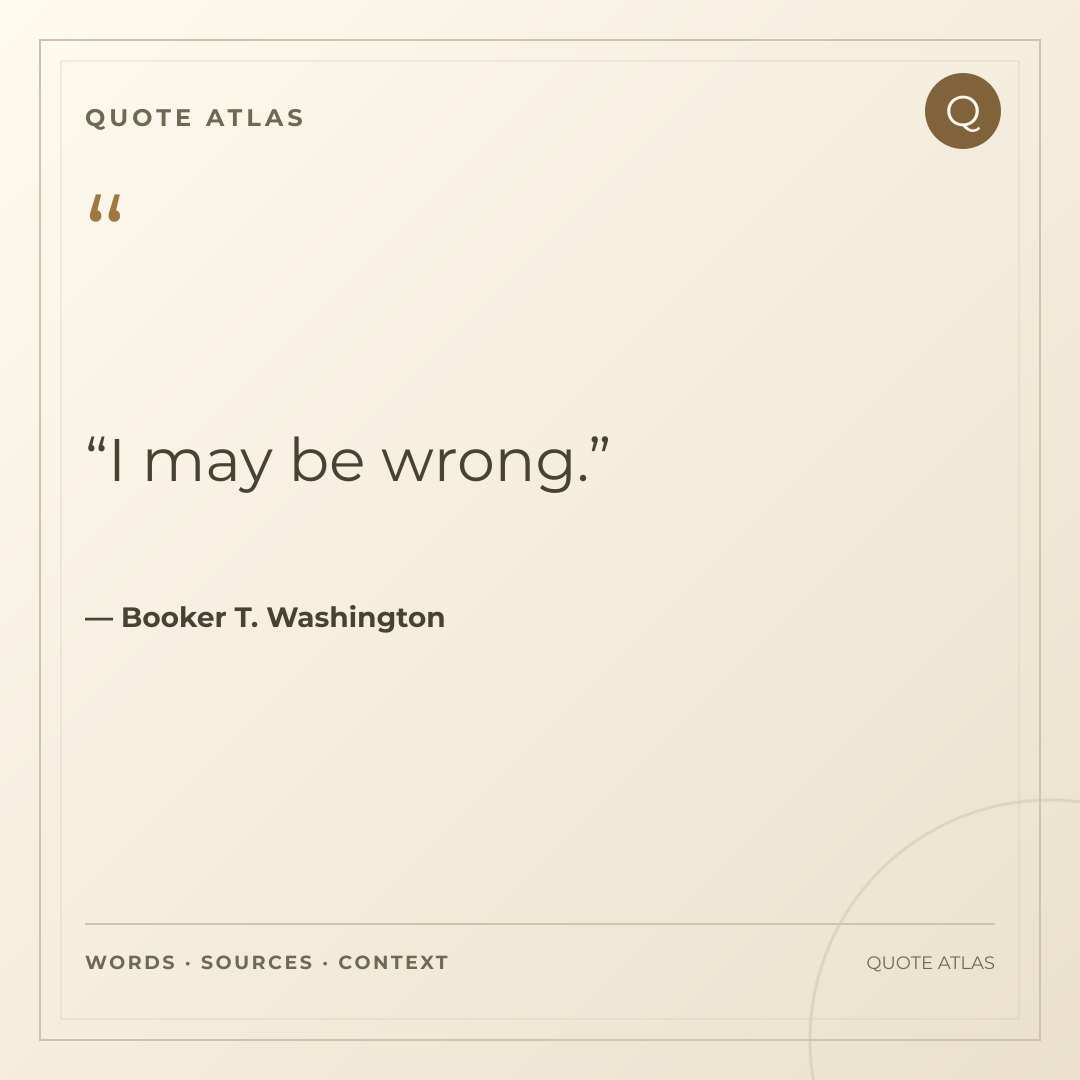
I may be wrong.

“I may be wrong.”

The admission places a limit on Washington’s own policy claims and models intellectual uncertainty rather than presenting judgment as infallible.

Source details

The Future of the American Negro, Chapter VIII; Project Gutenberg #26507. The sentence appears in Washington’s closing policy discussion immediately after his summary of dangers and immediately before his qualification that he may also be in some degree right.

Source identified95
It is better not to know wants than not to know want!

“It is better not to know wants than not to know want!”

The maxim distinguishes being free from manufactured desires from being ignorant of hardship, valuing enoughness without denying the lessons of real need.

Source details

The Lady of the Shroud, Project Gutenberg #3095. The wording is quoted in a letter as the remembered wisdom of Rupert’s mother; “wants” and “want” are deliberately contrasted.

Source identified96
There is grandeur in this view of life, with its several powers, having been originally breathed into a few forms or into one;

“There is grandeur in this view of life, with its several powers, having been originally breathed into a few forms or into one;”

Darwin closes the first edition by presenting evolutionary change from simple beginnings as a source of intellectual grandeur rather than diminishment.

Source details

On the Origin of Species, closing paragraph, first-edition wording represented by Project Gutenberg #1228. Later editions inserted “by the Creator” into this sentence; this record deliberately follows the 1859 form and keeps the quotation inside Darwin’s scientific argument about descent with modification.

Source identified98
Take nothing on its looks; take everything on evidence. There’s no better rule.

“Take nothing on its looks; take everything on evidence. There’s no better rule.”

Voice: Fictional character · Mr. Jaggers

Appearances are weak evidence; better judgment comes from examining what can actually be supported.

Source details

Great Expectations (1861), global Chapter XL / Volume III Chapter I in the Chapman & Hall three-volume first book edition. Mr. Jaggers tells Pip “Take nothing on its looks; take everything on evidence. There’s no better rule” while insisting that he has stayed to the strict line of fact about Pip’s benefactor. Verified against the scan-backed Wikisource Volume III Chapter I transcription and cross-checked with Project Gutenberg #1400. This remains fictional legal dialogue and character method rather than a modern legal or scientific standard.

Source identified99
Suffering has been stronger than all other teaching, and has taught me to understand what your heart used to be.

“Suffering has been stronger than all other teaching, and has taught me to understand what your heart used to be.”

Voice: Fictional character · Estella

Pain can deepen understanding of another person when it breaks through earlier self-absorption and makes similar suffering imaginable.

Source details

Great Expectations (1861), global Chapter LIX / Volume III Chapter XX in the Chapman & Hall three-volume first book edition. Estella tells Pip that suffering has taught her to understand what his heart used to be and hopes that being “bent and broken” has left her in a better shape. Verified against the scan-backed Wikisource Volume III Chapter XX transcription and cross-checked with Project Gutenberg #1400. This remains a fictional character’s moral self-assessment, not empirical evidence that suffering reliably improves people.

Source identified100
Regrets are the natural property of grey hairs; and I enjoy, in common with all other men, at least my share of such inheritance.

“Regrets are the natural property of grey hairs; and I enjoy, in common with all other men, at least my share of such inheritance.”

Voice: Fictional character · Old Martin Chuzzlewit

Old Martin treats regret as an almost ordinary inheritance of age: living long enough produces memories of choices, estrangements and missed opportunities that cannot all be revisited without hindsight.

Source details

Martin Chuzzlewit, Chapter X, Project Gutenberg #968. Old Martin Chuzzlewit says that regrets are the natural property of grey hairs while speaking to Pecksniff during a deliberately strategic performance. The maxim remains fictional character speech shaped by manipulation and family conflict rather than direct Dickens autobiography or a clinical claim about aging.

Source identified101
There are dark shadows on the earth, but its lights are stronger in the contrast.

“There are dark shadows on the earth, but its lights are stronger in the contrast.”

Dickens uses contrast to suggest that hardship can make moments of goodness and happiness more visible without pretending that the darker parts of life are unreal.

Source details

The Pickwick Papers, near the closing chapter, Project Gutenberg #580. The narrator deliberately leaves Pickwick and his companions in a moment of happiness and contrasts life’s “dark shadows” with its stronger lights; this is literary narration, not a promise that suffering always ends well.

Source identified102
Those that wish to be clean, clean they will be; and those that wish to be foul, foul they will be.

“Those that wish to be clean, clean they will be; and those that wish to be foul, foul they will be.”

Voice: Fictional character · Irishwoman

The fairy-tale warning connects desired moral change with the direction a person repeatedly chooses, while the surrounding story makes that lesson part of Tom’s larger transformation.

Source details

The Water-Babies, represented by Project Gutenberg #1018. Tom recalls the mysterious Irishwoman’s warning while half asleep. The cleanliness language participates in Kingsley’s Victorian Christian moral fantasy and is not a scientific claim about character or hygiene.

Source identified103
The most precious possessions of the heart of humanity manifest themselves most simply.

“The most precious possessions of the heart of humanity manifest themselves most simply.”

What matters most in human feeling is pictured as needing less display, not more, because affection and moral seriousness can be weakened by theatrical presentation.

Source details

The Simple Life, Chapter IV, “Simplicity of Speech,” Mary Louise Hendee translation, Project Gutenberg #23092; Wagner is arguing that deep feeling often appears plainly.

Source identified104
No one is so old as to think that he may not live a year.

“No one is so old as to think that he may not live a year.”

Voice: Dialogue speaker · Marcus Cato (Cato the Elder)

Even late in life people naturally continue to imagine a future, which helps explain why worthwhile work and planning do not simply stop with age.

Source details

Cato on Old Age, Shuckburgh translation, in a passage about older people planting for those who come after them.

Source identified105
The course of life is fixed, and nature admits of its being run but in one way, and only once.

“The course of life is fixed, and nature admits of its being run but in one way, and only once.”

Voice: Dialogue speaker · Marcus Cato (Cato the Elder)

Each stage of life occurs only once, so wisdom includes accepting its appropriate strengths instead of endlessly trying to restore an earlier stage.

Source details

Cato on Old Age, Shuckburgh translation, in Cicero’s discussion of the distinctive advantages of each season of life.

Source identified106
Learning without thought is labour lost; thought without learning is perilous.

“Learning without thought is labour lost; thought without learning is perilous.”

Study and reflection are treated as partners: information without examination is shallow, while speculation without learning can drift away from reality.

Source details

Analects 2:15 in James Legge’s translation; the saying balances study with independent reflection.

Source identified107
The superior man is satisfied and composed; the mean man is always full of distress.

“The superior man is satisfied and composed; the mean man is always full of distress.”

The contrast treats composure as a feature of cultivated character rather than as freedom from all difficulty: the “superior man” is represented as settled enough not to live in continual inward distress.

Source details

The Analects of Confucius, Book VII, Chapter XXXVI, James Legge translation, Project Gutenberg #3330.

Source identified108
I saw the cloud, though I did not foresee the storm.

“I saw the cloud, though I did not foresee the storm.”

Moll recognizes warning signs in the household’s changing treatment of her but admits she did not understand how serious the coming consequences would become.

Source details

Moll Flanders, Project Gutenberg #370. The fictional first-person narrator uses weather metaphor while recalling an early relationship crisis and the family’s growing hostility toward her.

Source identified109
It is never too late to be wise;

“It is never too late to be wise;”

Crusoe reflects that judgment can improve even after years of mistakes, using later experience to reinterpret earlier choices and warnings he once ignored.

Source details

Robinson Crusoe, represented by Project Gutenberg #38705. Crusoe says this while reflecting on what he interprets as secret intimations of Providence; the sentence is fictional first-person religious reflection, not evidence for supernatural guidance.

Source identified110
Reason is, and ought only to be, the slave of the passions,

“Reason is, and ought only to be, the slave of the passions,”

Hume argues that reasoning can inform means and consequences but does not by itself supply the motivating ends that move a person to act.

Source details

A Treatise of Human Nature, Book II, Part III, Section III, “Of the Influencing Motives of the Will,” Project Gutenberg #4705. The frozen catalog retains the opening clause “Reason is, and ought only to be, the slave of the passions,” from a longer sentence. It remains Hume’s historical philosophical thesis rather than contemporary empirical psychology.

Source identified111
A wise man, therefore, proportions his belief to the evidence.

“A wise man, therefore, proportions his belief to the evidence.”

Hume argues that confidence should rise or fall with the strength and consistency of the available evidence rather than remain fixed regardless of what experience supports.

Source details

An Enquiry Concerning Human Understanding, Section X, ‘Of Miracles,’ Part I, paragraph 87 in the represented Selby-Bigge text, Project Gutenberg #9662. ‘A wise man, therefore, proportions his belief to the evidence’ follows Hume's discussion of varying degrees of assurance from experience. It is eighteenth-century epistemological argument and preserves the connective ‘therefore’; it is not a complete modern statistical or scientific decision rule.

Source identified112
rolling on through the land slowly and surely, like a good man's life

“rolling on through the land slowly and surely, like a good man's life”

Voice: Fictional narrator · Phineas Fletcher (first-person narrator)

The narrator compares a steady river to a good life, using natural movement as an image for patient continuity and moral character.

Source details

John Halifax, Gentleman, represented by Project Gutenberg #2351. The phrase belongs to the first-person narrator Phineas Fletcher while describing the river; it is a literary simile inside the novel, not direct autobiography by Craik.

Source identified113
Do! Why, if you love him, you must tell him so, and give him your whole life-long faith and affection.

“Do! Why, if you love him, you must tell him so, and give him your whole life-long faith and affection.”

Voice: Fictional character · Olive Rothesay

Olive argues that genuine love should be communicated openly and joined to lasting loyalty rather than hidden behind silence.

Source details

Olive: A Novel, Chapter XI, Project Gutenberg #22121. Olive Rothesay tells Sara that if she loves Charles she should tell him so and give him her ‘whole life-long faith and affection’ while responding to Sara's first love-letter. This is fictional character counsel inside a nineteenth-century courtship plot rather than Craik autobiography or universally applicable relationship advice.

Source identified114
Adventures do occur, but not punctually.

“Adventures do occur, but not punctually.”

The narrator notes that meaningful or unexpected experiences cannot be scheduled simply because a person has decided that a particular moment ought to become interesting.

Source details

A Passage to India, Project Gutenberg #61221. The narrator explains Mrs. Moore’s more patient response to disappointment after an outing fails to materialize on cue; the sentence belongs to fictional narration.

Source identified115
Life is easy to chronicle, but bewildering to practice.

“Life is easy to chronicle, but bewildering to practice.”

Forster’s narrator contrasts the clarity of describing another person’s life from outside with the confusion of recognizing one’s own desires while actually living them.

Source details

A Room with a View, Chapter XIV, Project Gutenberg #2641. The frozen catalog wording is a clause extract from the narrator’s longer sentence: “Life is easy to chronicle, but bewildering to practice, and we welcome ‘nerves’ or any other shibboleth that will cloak our personal desire.” The passage concerns Lucy Honeychurch’s self-deception in fiction, not modern psychological evidence.

Source identified116
Only connect! That was the whole of her sermon.

“Only connect! That was the whole of her sermon.”

Forster summarizes Margaret’s ideal of bringing separated parts of life into relationship, especially practical intellect and emotional connection.

Source details

Howards End, Chapter XXII, Project Gutenberg #2946. The narrator summarizes Margaret’s hope of reconciling “the prose and the passion” in Henry with “Only connect! That was the whole of her sermon.” The sentence belongs to the novel’s thematic and character context rather than serving as a complete formula for every relationship.

Source identified117
It is wonderful how quickly you get used to things, even the most astonishing.

“It is wonderful how quickly you get used to things, even the most astonishing.”

Nesbit’s narrator humorously observes how quickly the children normalize the impossible once a magical creature becomes part of their ordinary conversation.

Source details

Five Children and It, Chapter I, “Beautiful as the Day,” Project Gutenberg #17314. The narrator observes how quickly the children become accustomed to the astonishing after they begin conversing with the Psammead. This is playful children’s-fantasy narration rather than an empirical psychological claim about adaptation.

Source identified118
To every thing there is a season, and a time to every purpose under the heaven.

“To every thing there is a season, and a time to every purpose under the heaven.”

The verse places change inside a larger rhythm of seasons and purposes, making it useful for thinking about acceptance when one phase of life gives way to another.

Source details

Ecclesiastes 3:1 in the King James Version, opening the sequence of contrasting times and seasons.

Source identified119
There are chords in the hearts of the most reckless which cannot be touched without emotion.

“There are chords in the hearts of the most reckless which cannot be touched without emotion.”

Poe’s narrator suggests that even people who treat danger and death as entertainment retain emotional limits beyond which mockery turns into genuine horror.

Source details

The Masque of the Red Death, Project Gutenberg #1064. The sentence appears as the masked figure violates even Prince Prospero’s extreme masquerade conventions by embodying the Red Death; it is Gothic narration inside fiction, not a psychological law.

Source identified120
Deep into that darkness peering, long I stood there wondering, fearing, Doubting, dreaming dreams no mortal ever dared to dream before;

“Deep into that darkness peering, long I stood there wondering, fearing, Doubting, dreaming dreams no mortal ever dared to dream before;”

Poe intensifies the bereaved speaker’s uncertainty by turning a dark doorway into a space where fear, imagination and longing for Lenore feed one another.

Source details

“The Raven,” first published in 1845 and represented by Poetry Foundation. These lines belong to the poem’s unnamed bereaved speaker as he searches darkness after hearing the mysterious tapping; they are dramatic Gothic narration, not Poe describing a personal supernatural event.

Source identified121
What then is to be done? Be wise with speed; A fool at forty is a fool indeed.

“What then is to be done? Be wise with speed; A fool at forty is a fool indeed.”

Voice: Authorial persona / framed maxim · Edward Young (satirical speaker)

Young’s satirical couplet urges people not to postpone the cultivation of judgment until age has made long-standing folly harder to excuse.

Source details

Love of Fame, the Universal Passion, Satire II, from the seven-satire sequence issued in the 1720s and represented in Project Gutenberg #18827. The couplet belongs to Young’s satirical moral persona; its age-based sting is period rhetoric rather than an empirical claim about people at forty.

Source identified122
Procrastination is the thief of time;

“Procrastination is the thief of time;”

Young personifies procrastination as something that steadily steals finite time while people postpone decisions and assume future opportunities will remain available.

Source details

Night Thoughts, Night I. The line appears in Young’s long religious and philosophical poem about mortality, delay and preparation for death; it is poetic moral reflection rather than productivity research.

Source identified123
you yourself can make it beautiful if you will.

“you yourself can make it beautiful if you will.”

Voice: Fictional character · David's father (letter)

David’s father tells him that even when the world appears bleak, his own choices and actions can still contribute something beautiful to it.

Source details

Just David, represented by Project Gutenberg #440. The sentence appears in a farewell letter from David’s father that other characters read after his death. It is framed fictional advice inside the novel, not Porter speaking autobiographically, and it does not imply that personal attitude can remove every external hardship.

Source identified124
How do I love thee? Let me count the ways.

“How do I love thee? Let me count the ways.”

The question opens a deliberate accounting of love, suggesting that affection becomes clearer when its different forms, depths, and expressions are named.

Source details

Sonnet 43 from Sonnets from the Portuguese; the poem proceeds by describing multiple dimensions of love.

Source identified125
For grief indeed is love and grief beside.

“For grief indeed is love and grief beside.”

The sonnet treats grief as attachment plus the pain attached to what has been lost, refusing to separate sorrow cleanly from love.

Source details

Sonnets from the Portuguese, Sonnet XXXV, Project Gutenberg #2002. “For grief indeed is love and grief beside” occurs as the lyric speaker asks whether a new beloved can fill a place still occupied by family memory and bereavement. It remains intimate Victorian love poetry, not a clinical model or universal definition of grief.

Source identified126
It has been a most toilsome lesson to translate my thought into the common language of life.

“It has been a most toilsome lesson to translate my thought into the common language of life.”

Voice: Authorial / signed preface voice · Elizabeth Blackwell (letter to Lady Noel Byron)

Blackwell reflects on how difficult it was to turn a large reforming ideal into language and action understandable within ordinary life.

Source details

Pioneer Work in Opening the Medical Profession to Women, represented by Project Gutenberg #65496. The autobiography reproduces this sentence in Blackwell’s letter to Lady Noel Byron. It is historical first-person reform correspondence embedded in the memoir, not current medical guidance.

Source identified127
Our inner being, which we call ourself, no eye nor touch of man or angel has ever pierced.

“Our inner being, which we call ourself, no eye nor touch of man or angel has ever pierced.”

The private interior of a person cannot be fully occupied by anyone else; Stanton uses that irreducible inwardness to ground responsibility, dignity, and the need for independent development.

Source details

Solitude of Self; Stanton’s concluding meditation on the “solitude of self” describes an inward domain inaccessible even to the people who love or protect us.

Source identified128
But sometimes one likes foolish people for their folly, better than wise people for their wisdom.

“But sometimes one likes foolish people for their folly, better than wise people for their wisdom.”

Mr. Gibson affectionately suggests that an imprudent act motivated by care can sometimes make a person more lovable than detached good judgment.

Source details

Wives and Daughters, Chapter LIV, “Molly Gibson’s Worth Is Discovered,” Project Gutenberg #4274. Mr. Gibson smiles at Cynthia after she returns because she heard Molly was ill and says that one may like foolish people for their folly better than wise people for wisdom. It is affectionate fictional dialogue about a specific act of care, not Gaskell’s general rule against wisdom.

Source identified129
No human being is sole master of his fate when he has united it with another’s.

“No human being is sole master of his fate when he has united it with another’s.”

Voice: Authorial / signed preface voice · Ellen Key (translated authorial voice)

Key emphasizes interdependence in intimate partnership: once lives are joined, each person’s choices and development partly affect the other’s future.

Source details

Love and Marriage, represented by Project Gutenberg #57592, English edition copyright 1911, translated from Swedish by Arthur G. Chater. The sentence appears in Key’s historical discussion of fidelity, personality and reciprocal development in love; it is early-twentieth-century social philosophy, not relationship therapy.

Source identified130
Whatever our souls are made of, his and mine are the same.

“Whatever our souls are made of, his and mine are the same.”

Voice: Fictional character · Catherine Earnshaw

The line describes intimacy as profound likeness rather than surface compatibility, making identity and attachment almost inseparable in the speaker’s imagination.

Source details

Wuthering Heights; Catherine explains the depth and identity-level nature of her attachment to Heathcliff.

Source identified131
But nature is a stranger yet; The ones that cite her most Have never passed her haunted house, Nor simplified her ghost.

“But nature is a stranger yet; The ones that cite her most Have never passed her haunted house, Nor simplified her ghost.”

Even close observers do not fully explain nature in this ending; familiarity with natural objects leaves room for strangeness, uncertainty and intellectual humility.

Source details

“A Well,” Poems: Third Series (1896), Project Gutenberg #12242. The ghost and haunted-house language is metaphorical, emphasizing nature's unresolved mystery.

Source identified132
The sky is low, the clouds are mean, A travelling flake of snow Across a barn or through a rut Debates if it will go.

“The sky is low, the clouds are mean, A travelling flake of snow Across a barn or through a rut Debates if it will go.”

Low cloud, uncertain snow and cramped rural space give the weather a subdued emotional atmosphere without turning the natural scene into a simple moral lesson.

Source details

“Beclouded,” in Poems: First Series (1890), Project Gutenberg #12242. Nature is personified in the poem; the editorial heading and punctuation reflect the early printed edition.

Source identified133
I reason, earth is short, And anguish absolute, And many hurt; But what of that?

“I reason, earth is short, And anguish absolute, And many hurt; But what of that?”

The poem begins from mortality and undeniable anguish, then presses beyond those observations by asking what explanatory or consoling conclusion can actually follow from them.

Source details

“Earth Is Short,” Poems: First Series (1890), Project Gutenberg #12242. The poem proceeds into questions about heaven and God; its religious questions remain questions rather than verified metaphysical claims.

Source identified134
I measure every grief I meet With analytic eyes; I wonder if it weighs like mine, Or has an easier size.

“I measure every grief I meet With analytic eyes; I wonder if it weighs like mine, Or has an easier size.”

Personal grief becomes a lens for noticing other people's suffering, with the speaker comparing losses while admitting that another person's burden cannot be known directly.

Source details

“Griefs,” Poems: Third Series (1896), Project Gutenberg #12242. The poem explores comparison and recognition of suffering rather than offering a clinical scale for grief.

Source identified135
I never lost as much but twice, And that was in the sod; Twice have I stood a beggar Before the door of God!

“I never lost as much but twice, And that was in the sod; Twice have I stood a beggar Before the door of God!”

Two deaths are remembered as losses so severe that the speaker figures herself as spiritually impoverished and dependent before God.

Source details

Poem in Poems: First Series (1890), represented by its opening line for source disambiguation; Project Gutenberg #12242. Its theological language belongs to the lyric speaker.

Source identified136
My life closed twice before its close; It yet remains to see If Immortality unveil A third event to me.

“My life closed twice before its close; It yet remains to see If Immortality unveil A third event to me.”

The speaker treats profound separations as deaths within a still-living life, leaving the final meaning of another separation to the poem's religious-metaphysical horizon.

Source details

“Parting,” Poems: Third Series (1896), Project Gutenberg #12242. The poem is lyric and metaphysical; its language of immortality is not presented as empirical evidence about an afterlife.

Source identified137
Success is counted sweetest by those who ne’er succeed.

“Success is counted sweetest by those who ne’er succeed.”

People who lack an achievement may understand its value more intensely because distance and deprivation make the desire clearer.

Source details

Opening line of Poem 112; Dickinson links desire with the sharpness of perceived value.

Source identified138
“Hope” is the thing with feathers — That perches in the soul —

““Hope” is the thing with feathers — That perches in the soul —”

Dickinson makes hope feel small, persistent, and alive: an inner presence that keeps singing through difficult conditions.

Source details

Opening lines; punctuation follows a common scholarly transcription.

Source identified142
Demand not that events should happen as you wish; but wish them to happen as they do happen, and you will go on well.

“Demand not that events should happen as you wish; but wish them to happen as they do happen, and you will go on well.”

Peace is sought by aligning desire with reality rather than requiring reality to obey preference, a central Stoic distinction between response and circumstance.

Source details

Enchiridion, section 8; Epictetus applies Stoic acceptance to events outside personal control.

Source identified143
Place then thy happiness in that wherein thou art equal to the Gods.

“Place then thy happiness in that wherein thou art equal to the Gods.”

Epictetus locates happiness in the rational and moral capacities a person can exercise rather than in rank, possessions, or bodily advantages.

Source details

The Golden Sayings of Epictetus, saying XXXIII, Hastings Crossley translation.

Source identified144
It is a mere and miserable solitude to want true friends, without which the world is but a wilderness.

“It is a mere and miserable solitude to want true friends, without which the world is but a wilderness.”

Bacon distinguishes physical company from genuine companionship: crowds and acquaintances cannot replace the kind of trusted relationship that makes social life feel inhabited rather than empty.

Source details

Essays, “Of Friendship,” Project Gutenberg #56463. Bacon follows his contrast between crowds and real company by describing the absence of true friends as a deeper form of solitude.

Source identified145
Read not to contradict and confute; nor to believe and take for granted; nor to find talk and discourse; but to weigh and consider.

“Read not to contradict and confute; nor to believe and take for granted; nor to find talk and discourse; but to weigh and consider.”

Bacon describes reading as active judgment rather than passive agreement or reflexive opposition, making careful consideration the central habit of serious study.

Source details

Of Studies, in Bacon’s instructions for how different kinds of books should be read.

Source identified146
If a man will begin with certainties, he shall end in doubts; but if he will be content to begin with doubts, he shall end in certainties.

“If a man will begin with certainties, he shall end in doubts; but if he will be content to begin with doubts, he shall end in certainties.”

Intellectual confidence can be improved by beginning with questions rather than pretending certainty too early.

Source details

The Advancement of Learning, First Book, Project Gutenberg #5500, transcribed from the 1893 Cassell & Company edition. Bacon contrasts impatience of doubt with mature suspension of judgment and then sets out two ways of contemplation before saying that beginning with certainties ends in doubts while beginning with doubts can end in certainties. It remains early-modern epistemological argument rather than a modern experimental rule for scientific method.

Source identified147
The silver trump of freedom had roused my soul to eternal wakefulness.

“The silver trump of freedom had roused my soul to eternal wakefulness.”

Once freedom became imaginable, awareness could not simply be reversed; the possibility of liberty changed how Douglass perceived every part of his condition.

Source details

Narrative, Chapter VII; Douglass describes how literacy and reflection made the idea of freedom permanently present to him.

Source identified148
I would at times feel that learning to read had been a curse rather than a blessing.

“I would at times feel that learning to read had been a curse rather than a blessing.”

Knowledge can intensify suffering before it provides a remedy: literacy exposed the full structure of his condition while escape still seemed unavailable.

Source details

Narrative, Chapter VII; Douglass immediately explains that reading opened his eyes to the pit of slavery without yet showing a ladder out.

Source identified149
Power concedes nothing without a demand. It never did and it never will.

“Power concedes nothing without a demand. It never did and it never will.”

The line argues that meaningful reform usually requires explicit demands rather than passive hope that power will surrender itself.

Source details

Speech in Canandaigua, New York, August 3, 1857.

Source identified150
What is done out of love always takes place beyond good and evil.

“What is done out of love always takes place beyond good and evil.”

Nietzsche presents love as a motive that can resist simple moral classification, complicating attempts to judge every action by one fixed formula.

Source details

Beyond Good and Evil, aphorism 153, Helen Zimmern translation.