Quote Atlassourced quotes & context
Page 3 of 4 · 289 quotations total

Mind quotes — Page 3

This continuation page contains additional source-backed quotations not shown in the initial 50-quotation overview. Return to the topic guide and browse collection.

100 shown · 289 total
Source identified151
As you succeed in overcoming self you will begin to see things in their right relations.

“As you succeed in overcoming self you will begin to see things in their right relations.”

For Allen, clearer perception follows disciplined work on one’s own impulses and biases; self-mastery changes not only conduct but the proportions in which problems are seen.

Source details

The Way of Peace; Allen links self-mastery with clearer perception and a less distorted relationship to circumstances and other people.

Source identified152
The end of meditation is, therefore, direct knowledge of Truth, God, and the realization of divine and profound peace.

“The end of meditation is, therefore, direct knowledge of Truth, God, and the realization of divine and profound peace.”

Allen describes meditation as a disciplined route toward direct understanding and settled inward peace rather than as passive daydreaming or escape.

Source details

The Way of Peace, “The Power of Meditation”; Allen closes his account of meditation by connecting sustained contemplation with knowledge of truth and profound peace.

Source identified153
The only malady I could conclude I had not got was housemaid’s knee.

“The only malady I could conclude I had not got was housemaid’s knee.”

Voice: Fictional narrator · J. (first-person narrator)

After reading through a medical reference alphabetically, the narrator is disappointed to find only one illness missing, making hypochondria funny through impossible comprehensiveness.

Source details

Three Men in a Boat, Chapter I; after reading disease symptoms at the British Museum, the narrator concludes housemaid’s knee is the sole exception.

Source identified154
I was a hospital in myself. All they need do would be to walk round me, and, after that, take their diploma.

“I was a hospital in myself. All they need do would be to walk round me, and, after that, take their diploma.”

Voice: Fictional narrator · J. (first-person narrator)

The narrator exaggerates imagined illness into an entire teaching hospital, using absurd scale to expose how thoroughly he has mistaken reading symptoms for medical diagnosis.

Source details

Three Men in a Boat, Chapter I; the narrator imagines medical students using his supposedly comprehensive collection of illnesses for training.

Source identified155
Secrets lurk on all sides.

“Secrets lurk on all sides.”

The brief line frames observation as discovery: familiar landscapes still contain details that reward patience, questions, and repeated looking.

Source details

Wake-Robin; the phrase belongs to Burroughs’s description of the naturalist’s expectant attention to the world nearby.

Source identified156
There is everywhere the vigorous and masculine winter air, and the impalpable sustenance the mind draws from all natural forms.

“There is everywhere the vigorous and masculine winter air, and the impalpable sustenance the mind draws from all natural forms.”

Burroughs describes winter landscape as mentally sustaining, suggesting that austere natural forms can nourish attention even when seasonal abundance is absent.

Source details

Winter Sunshine, “The Exhilarations of the Road.” “Masculine” is Burroughs’s nineteenth-century descriptive adjective in this sentence; this collection preserves rather than modernizes the historical wording.

Source identified157
Experience is primarily an active-passive affair; it is not primarily cognitive.

“Experience is primarily an active-passive affair; it is not primarily cognitive.”

Dewey treats experience as a combination of doing and undergoing consequences, with understanding developing through the relationship between action and what follows from it.

Source details

Democracy and Education (1916), Chapter XI, “Experience and Thinking.” Dewey describes experience as a relation between doing and undergoing consequences, then immediately qualifies the active-passive formulation by saying that valuable experience includes cognition insofar as relationships and continuities are perceived. Verified against Project Gutenberg #852 and the scan-backed Wikisource Chapter XI transcription. The sentence is not a denial that cognition matters and is not presented as modern neuroscientific evidence.

Source identified158
The thinker has to decide, to choose; and there is always a risk.

“The thinker has to decide, to choose; and there is always a risk.”

Choosing among plausible interpretations necessarily involves uncertainty, so sound thinking requires a cautious selection that remains open to confirmation or correction by later events.

Source details

How We Think (1910), Chapter VIII, “Judgment: The Interpretation of Facts,” section 1, printed page 106, Project Gutenberg #37423. Dewey says the thinker must choose among candidate meanings for a perplexing situation and therefore accepts risk; the prudent thinker selects warily and remains answerable to later confirmation or frustration. This is part of Dewey’s historical educational/logical account of reflective judgment, not a modern decision-science finding.

Source identified159
The judgment when formed is a decision; it closes (or concludes) the question at issue.

“The judgment when formed is a decision; it closes (or concludes) the question at issue.”

Reflective judgment is not endless suspension: Dewey describes it as the point at which a particular uncertainty is concluded in a way that can also inform later judgments.

Source details

How We Think (1910), Chapter VIII, “Judgment: The Interpretation of Facts,” section 1, printed page 107, Project Gutenberg #37423. Dewey identifies a formed judgment as a decision that closes the issue at hand and may help establish a method for analogous later cases. The statement belongs to his early-twentieth-century theory of reflective judgment rather than current clinical, neuroscientific or experimentally settled cognitive science.

Source identified161
Our business here is not to know all things, but those which concern our conduct.

“Our business here is not to know all things, but those which concern our conduct.”

Locke places useful limits around intellectual ambition: human inquiry need not comprehend everything in order to guide life well, and knowing where understanding stops is part of using it responsibly.

Source details

An Essay Concerning Humane Understanding, Book I, Chapter I, section 6, Project Gutenberg #10615. Locke follows his sounding-line analogy by saying that our business is not to know all things but those concerning conduct. The passage belongs to seventeenth-century epistemology and moral reflection, not a modern cognitive-science finding.

Source identified162
Curiosity in children is but an appetite after knowledge; and therefore ought to be encouraged in them.

“Curiosity in children is but an appetite after knowledge; and therefore ought to be encouraged in them.”

Locke treats curiosity as a natural drive toward knowledge and argues that education should protect and guide it rather than shame sincere questions.

Source details

Some Thoughts Concerning Education, Part VIII, section 118. Locke calls children's curiosity an appetite after knowledge and gives practical directions for encouraging questions. The passage remains seventeenth-century educational/parenting counsel rather than contemporary developmental-science or guaranteed learning-outcome evidence.

Source identified163
Where there is much desire to learn, there of necessity will be much arguing, much writing, many opinions.

“Where there is much desire to learn, there of necessity will be much arguing, much writing, many opinions.”

Milton treats disagreement as a natural consequence of serious learning: intellectual activity produces competing arguments because knowledge is still being worked out.

Source details

Areopagitica, in Milton’s defense of a city actively reading, discussing, and testing ideas.

Source identified164
The mind is its own place.

“The mind is its own place.”

Voice: Poetic speaker · Satan

The statement emphasizes how mental framing can alter the experience of circumstances, for good or ill.

Source details

Paradise Lost (1667), Book I, line 254; retained legacy short extract from the fuller Satan sentence beginning ‘The mind is its own place’ and continuing into line 255. It is the same underlying passage as the longer catalog record, not a separate fifth passage.

Source identified165
The mind is its own place, and in itself can make a Heaven of Hell, a Hell of Heaven.

“The mind is its own place, and in itself can make a Heaven of Hell, a Hell of Heaven.”

Voice: Fictional character · Satan

The line gives mental interpretation enormous power, while its speaker and dramatic context also caution against treating self-deception as wisdom.

Source details

Paradise Lost (1667), Book I, lines 254–255; Satan speaks the sentence beginning ‘The mind is its own place.’ This collection retains normalized modern orthography; the scan-backed 1667 transcription reads forms including ‘in it self’ and ‘Heav’n.’ Character context matters because this is Satan’s argument, not Milton speaking autobiographically.

Source identified166
Ask yourself whether you are happy, and you cease to be so.

“Ask yourself whether you are happy, and you cease to be so.”

The aphoristic warning concerns excessive self-monitoring: repeatedly testing an experience for happiness can interrupt the very absorption that makes enjoyment possible.

Source details

Autobiography, Chapter V; Mill states this within his post-crisis philosophy of pursuing ends beyond happiness itself.

Source identified167
A pupil from whom nothing is ever demanded which he cannot do, never does all he can.

“A pupil from whom nothing is ever demanded which he cannot do, never does all he can.”

The sentence argues that education needs genuine stretch: always keeping demands inside proven ability can leave capacity underused.

Source details

Autobiography, Chapter I; Mill reflects critically on his father’s demanding teaching while preserving this principle about intellectual effort.

Source identified168
The maintenance of a due balance among the faculties now seemed to be of primary importance.

“The maintenance of a due balance among the faculties now seemed to be of primary importance.”

Mill describes a shift away from developing intellect in isolation toward cultivating a more balanced range of human capacities.

Source details

Autobiography, Chapter V; Mill is describing the intellectual and emotional lessons he drew from his mental crisis and recovery.

Source identified169
Anything which could be found out by thinking I never was told, until I had exhausted my efforts to find it out for myself.

“Anything which could be found out by thinking I never was told, until I had exhausted my efforts to find it out for myself.”

Mill describes an education built around discovery before explanation, emphasizing active reasoning rather than passive recall.

Source details

Autobiography, Chapter I; Mill describes his father’s method of making him attempt a problem independently before being told the solution.

Source identified170
He who chooses his plan for himself, employs all his faculties.

“He who chooses his plan for himself, employs all his faculties.”

Choosing for oneself exercises observation, reasoning, discrimination, and self-command in ways that passive imitation does not.

Source details

On Liberty, Chapter III, in Mill’s discussion of individuality and self-directed choice.

Source identified171
He who lets the world, or his own portion of it, choose his plan of life for him, has no need of any other faculty than the ape-like one of imitation.

“He who lets the world, or his own portion of it, choose his plan of life for him, has no need of any other faculty than the ape-like one of imitation.”

A life copied from convention leaves important human faculties unused; choosing deliberately requires observation, judgment and firmness.

Source details

On Liberty, Chapter III; Mill contrasts imitation with actively choosing one’s own plan of life.

Source identified172
Society in equality is its normal state.

“Society in equality is its normal state.”

Mill contrasts relations organized around command and obedience with equal association, presenting equality as the normal direction of an improving society.

Source details

The Subjection of Women (1869), Chapter II, printed page 79, Project Gutenberg #27083. Mill contrasts command-and-obedience relations with equal association and states that society in equality is the normal state toward which improving social relations should move.

Source identified173
The a priori presumption is in favour of freedom and impartiality.

“The a priori presumption is in favour of freedom and impartiality.”

Mill places the burden of proof on restrictions and unequal privilege rather than treating inherited inequality as self-justifying.

Source details

The Subjection of Women (1869), Chapter I, printed page 3, Project Gutenberg #27083. Mill places the burden of proof on restrictions and unequal privilege, stating that the a priori presumption is in favour of freedom and impartiality.

Source identified174
What women by nature cannot do, it is quite superfluous to forbid them from doing.

“What women by nature cannot do, it is quite superfluous to forbid them from doing.”

The argument exposes a contradiction in claims about natural incapacity: if an activity were truly impossible by nature, legal prohibition would be unnecessary.

Source details

The Subjection of Women (1869), Chapter I, printed page 48, Project Gutenberg #27083. Mill argues that if an activity were truly contrary to women’s nature, legal or social prohibition would be superfluous; the sentence belongs to his case for free development and open competition.

Source identified175
Each of you is right, and none of you is wrong.

“Each of you is right, and none of you is wrong.”

The parable resists a simple either-or verdict by showing that apparently competing explanations can each describe part of a larger movement.

Source details

The Forerunner, “The Two Learned Men”; the line concludes a parable about different explanations of motion and perspective.

Source identified176
My friend, I am not what I seem.

“My friend, I am not what I seem.”

The outward persona is not treated as the whole self, reminding readers that appearances and social roles can conceal a much larger private inner life.

Source details

The Madman, “My Friend”; the speaker contrasts the visible self with the quieter self that remains inaccessible.

Source identified177
Why dispute what we shall be, when we know not even what we are.

“Why dispute what we shall be, when we know not even what we are.”

Speculation about future identity becomes less certain when present self-knowledge is incomplete, making humility a reasonable response to confident predictions about becoming.

Source details

The Madman, parable of the pomegranate; the line closes a dispute among voices imagining different futures.

Source identified178
Your hearts know in silence the secrets of the days and the nights.

“Your hearts know in silence the secrets of the days and the nights.”

Voice: Fictional character · Almustafa

In the work’s poetic frame, inward knowledge exists before it is fully verbalized; the line values listening closely to one’s own interior understanding without claiming that intuition is automatically infallible.

Source details

The Prophet, section “Self-Knowledge.” A man asks Almustafa to speak about self-knowledge, and Almustafa answers with this line before describing the heart’s knowledge and the self as a boundless sea. The represented wording is the 1923 text preserved by Wikisource/Project Gutenberg #58585.

Source identified179
Imagination and a fixed idea will do a great deal, and we were sure we knew the direction a dragon would naturally take.

“Imagination and a fixed idea will do a great deal, and we were sure we knew the direction a dragon would naturally take.”

Grahame humorously shows childhood imagination turning ambiguous tracks into convincing evidence, illustrating how expectation can organize perception before the facts are settled.

Source details

Dream Days, “The Reluctant Dragon,” Project Gutenberg #270. The child narrator and Charlotte are following uncertain tracks in snow and imagining a dragon; the sentence is playful literary narration about imagination and fixed expectations.

Source identified180
For God hath not given us the spirit of fear; but of power, and of love, and of a sound mind.

“For God hath not given us the spirit of fear; but of power, and of love, and of a sound mind.”

Fear is contrasted with capacities for strength, care, and disciplined judgment, encouraging action that is not governed solely by anxiety.

Source details

2 Timothy 1:7 in the King James Version; the verse contrasts fear with power, love, and disciplined-mindedness.

Source identified181
Take therefore no thought for the morrow.

“Take therefore no thought for the morrow.”

Voice: Reported speaker · Jesus

The teaching redirects attention from imagined future trouble toward responsibilities that actually belong to today.

Source details

Matthew 6:34 in the King James Version; the opening sentence is quoted here.

Source identified182
The excellence of the mind is in abysmal stillness.

“The excellence of the mind is in abysmal stillness.”

The water analogy extends inward: excellence of mind is associated with depth and stillness rather than constant display, rivalry, or restless reaction.

Source details

Tao Teh King, chapter 8, James Legge translation; the line is one element in a broader comparison between highest excellence and water.

Source identified183
The farther that one goes out (from himself), the less he knows.

“The farther that one goes out (from himself), the less he knows.”

The paradox warns that outward accumulation can become a distraction from direct understanding; more movement is not automatically the same as deeper knowledge.

Source details

Tao Teh King, chapter 47, James Legge translation; the sentence belongs to a passage about knowing without compulsive outward searching.

Source identified184
Who can (make) the muddy water (clear)? Let it be still, and it will gradually become clear.

“Who can (make) the muddy water (clear)? Let it be still, and it will gradually become clear.”

The muddy-water image makes stillness a condition for clarity: agitation can keep disturbance suspended, while enough quiet allows what is clouding perception to settle without force.

Source details

Tao Teh King, Chapter 15, James Legge translation, Project Gutenberg #216. The next sentence asks how the condition of rest is secured and answers through the gradual relation between movement and rest; the passage belongs to Taoist philosophy, not a clinical relaxation technique.

Source identified185
To know and yet (think) we do not know is the highest (attainment); not to know (and yet think) we do know is a disease.

“To know and yet (think) we do not know is the highest (attainment); not to know (and yet think) we do know is a disease.”

The chapter values an awareness of the limits of knowledge and treats false certainty as a disorder of judgment, making intellectual humility a form of protection against confident ignorance.

Source details

Tao Teh King, Chapter 71, James Legge translation, Project Gutenberg #216.

Source identified186
What am I? A part of the infinite.

“What am I? A part of the infinite.”

Tolstoy frames the self as finite yet participating in something larger, shifting the question of meaning away from isolated individual duration toward a relation with the infinite.

Source details

My Confession, Leo Wiener translation; the question appears in Tolstoy’s investigation of how finite human life might be related to an infinite reality.

Source identified187
I cannot ever endure to write anything to you unless with mind at ease and untroubled and free.

“I cannot ever endure to write anything to you unless with mind at ease and untroubled and free.”

Marcus links intimate correspondence with mental composure: he wants to write to Fronto from an unhurried and settled state rather than forcing a personal letter while distracted or troubled.

Source details

Project Gutenberg #2680, correspondence appendix, reference iii. 21. Marcus explains why he had not written earlier while discussing Fronto’s health. This is a personal letter-writing preference in context, not a general productivity prescription.

Source identified189
Therefore the mind which is free from passions is a citadel.

“Therefore the mind which is free from passions is a citadel.”

A disciplined mind is compared with a fortress because its judgments provide a place of refuge that external events cannot directly occupy.

Source details

Meditations, Book VIII, section 48, George Long translation.

Source identified190
Think not so much of what thou hast not as of what thou hast.

“Think not so much of what thou hast not as of what thou hast.”

Attention to what is already present can reduce the restless comparison created by constantly measuring life against what is missing.

Source details

Meditations, Book VII, section 27, George Long translation.

Source identified191
Say nothing more to thyself than what the first appearances report.

“Say nothing more to thyself than what the first appearances report.”

The instruction separates observation from added interpretation, helping prevent an initial event from becoming a larger story of injury or fear.

Source details

Meditations, Book VIII, section 49, George Long translation.

Source identified192
Be cheerful also, and seek not external help nor the tranquillity which others give.

“Be cheerful also, and seek not external help nor the tranquillity which others give.”

Marcus places steadiness inside the governing mind rather than in reassurance supplied by other people, emphasizing an internal source of composure while still writing within a larger Stoic ethic of social duty.

Source details

Meditations, Book III, section 5, George Long translation; Project Gutenberg #6920/#15877. The sentence immediately precedes “A man then must stand erect, not be kept erect by others,” making the inward-reliance context explicit.

Source identified193
Take away thy opinion, and then there is taken away the complaint, “I have been harmed.”

“Take away thy opinion, and then there is taken away the complaint, “I have been harmed.””

The statement asks whether part of suffering is sustained by the story attached to an event rather than by the event alone.

Source details

Meditations, Book IV, in George Long’s translation.

Source identified194
Liberty is the experimental condition for studying the phenomena of the child's attention.

“Liberty is the experimental condition for studying the phenomena of the child's attention.”

Montessori argues that attention can be studied meaningfully only when children have enough freedom for spontaneous patterns of attention to become visible.

Source details

Spontaneous Activity in Education, discussion of attention. The surrounding physiological terminology is early-twentieth-century educational psychology and is preserved as historical theory rather than modern clinical evidence.

Source identified195
These authors write pictures and frame rhapsodies, and lesser men follow and see with the author's eyes instead of their own, and speak with his tongue.

“These authors write pictures and frame rhapsodies, and lesser men follow and see with the author's eyes instead of their own, and speak with his tongue.”

Twain criticizes derivative travel writing in which later visitors repeat earlier descriptions instead of observing, judging, and describing the place for themselves.

Source details

The Innocents Abroad (1869), Chapter XLVIII. Twain criticizes travel writers who frame rhapsodic pictures and later pilgrims who see through those authors’ eyes and speak with their language instead of observing independently. Verified against the scan-backed 1869 first edition.

Source identified196
No man ever originates anything.

“No man ever originates anything.”

Voice: Dialogue speaker · Old Man

This deliberately extreme claim summarizes the Old Man’s thesis that thought is assembled from inherited experience and external influence rather than created from nothing.

Source details

What Is Man?, Old Man speaking in the opening dialogue. This collection treats the sentence as a provocative deterministic position inside the dialogue, not as settled psychology.

Source identified197
You can’t yourself, but exterior influences can do it.

“You can’t yourself, but exterior influences can do it.”

Voice: Dialogue speaker · Old Man

The Old Man claims that opinions can change, but attributes the change to new evidence, conversation, study, and other influences entering from outside the individual.

Source details

What Is Man?, Old Man replying to the Young Man’s question about changing an automatic opinion; this is dialogic determinism, not neutral cognitive science.

Source identified198
Prejudices must be removed by outside influences or not at all.

“Prejudices must be removed by outside influences or not at all.”

Voice: Dialogue speaker · Old Man

The Old Man argues that entrenched assumptions change through encounters, teaching, experience, and other influences rather than simply disappearing by private command.

Source details

What Is Man?, opening dialogue between the Old Man and Young Man; this sentence belongs to the Old Man’s deterministic argument about education and outside influence.

Source identified199
A rational mind will be employ’d, it will never be satisfy’d in doing nothing, and if you neglect to furnish it with good materials, ’tis like to take up with such as come to hand.

“A rational mind will be employ’d, it will never be satisfy’d in doing nothing, and if you neglect to furnish it with good materials, ’tis like to take up with such as come to hand.”

Voice: Authorial / signed preface voice · Mary Astell

Astell argues that the mind naturally seeks occupation, so denying people serious intellectual material does not make the mind inactive; it leaves it to whatever material happens to be available.

Source details

A Serious Proposal to the Ladies, Part I, printed page 56 in the represented 1697 two-part edition, Project Gutenberg #54984. Astell writes that a rational mind will be employed while arguing that women denied serious intellectual education may be driven toward inferior materials. Original spelling is retained; the passage belongs to her explicitly religious and educational proposal, not contemporary educational-outcome research.

Source identified200
If God had not intended that women should use their reason, He would not have given them any, for He does nothing in vain.

“If God had not intended that women should use their reason, He would not have given them any, for He does nothing in vain.”

Voice: Authorial / signed preface voice · Mary Astell

Within her Christian framework, Astell argues that women’s capacity for reason implies a responsibility to exercise it rather than surrender judgment to others.

Source details

The Christian Religion, as Profess'd by a Daughter of the Church of England (1705), opening section, first-edition Google Books scan, around p. 6 before the p. 7 heading represented in the scan’s contents. The first edition uses period spelling/capitalization (“Women shou’d use their Reason … wou’d”), while the frozen catalog record modernizes those forms. Astell’s argument is explicitly Christian and concerns women’s rational agency in religion; it is not a modern empirical finding.

Source identified201
Nothing is so painful to the human mind as a great and sudden change.

“Nothing is so painful to the human mind as a great and sudden change.”

Voice: Fictional narrator · Victor Frankenstein

Abrupt change can overwhelm the mind because adaptation requires time, making disruption painful even before its long-term consequences are understood.

Source details

Frankenstein; the narrator reflects on the psychological strain created by sudden changes in circumstances.

Source identified202
truth, in morals, has ever appeared to me the essence of the sublime; and, in taste, simplicity the only criterion of the beautiful.

“truth, in morals, has ever appeared to me the essence of the sublime; and, in taste, simplicity the only criterion of the beautiful.”

Wollstonecraft makes moral truth and aesthetic simplicity standards of seriousness, rejecting ornate politeness when it conceals what a writer actually believes.

Source details

A Vindication of the Rights of Men, opening letter to Edmund Burke, second edition (1790); this sentence follows Wollstonecraft’s refusal to disguise her sentiments behind courtly politeness.

Source identified203
I wish to persuade women to endeavour to acquire strength, both of mind and body.

“I wish to persuade women to endeavour to acquire strength, both of mind and body.”

Wollstonecraft rejects cultivated helplessness and argues for developing women's intellectual and physical capacities so they can stand as rational agents rather than depend on flattering ideals of weakness.

Source details

A Vindication of the Rights of Woman, Introduction, Project Gutenberg #3420. The frozen quotation 'I wish to persuade women to endeavour to acquire strength, both of mind and body' is a clause from a longer sentence beginning 'I earnestly wish to point out...' and continuing through Wollstonecraft's criticism of delicacy and weakness as feminine ideals. It remains eighteenth-century feminist political-moral argument rather than a modern clinical or physiological prescription.

Source identified204
Strengthen the female mind by enlarging it, and there will be an end to blind obedience.

“Strengthen the female mind by enlarging it, and there will be an end to blind obedience.”

Education enlarges judgment and weakens obedience based only on power, making intellectual development a condition of genuine independence.

Source details

A Vindication of the Rights of Woman; Wollstonecraft argues that deliberately narrowing women’s education preserves dependence and obedience.

Source identified205
They must only bow to the authority of reason, instead of being the modest slaves of opinion.

“They must only bow to the authority of reason, instead of being the modest slaves of opinion.”

Respectability is grounded in independent reasoning rather than deference to social opinion, making judgment more important than approval.

Source details

A Vindication of the Rights of Woman; Wollstonecraft explicitly connects independence of character with the exercise of understanding.

Source identified206
The contemplation of noble ruins produces a melancholy that exalts the mind.

“The contemplation of noble ruins produces a melancholy that exalts the mind.”

Ruins become a prompt for reflective melancholy: visible traces of the past enlarge thought by placing present concerns against time, mortality, and historical change.

Source details

Letters Written During a Short Residence in Sweden, Norway, and Denmark, Letter VII; represented Cassell & Company 1889 text in Project Gutenberg #3529. “The contemplation of noble ruins produces a melancholy that exalts the mind” occurs during Wollstonecraft’s visit to a church recess containing long-preserved bodies and her reflections on death, ruins, historical change and mortality. It remains Romantic-era reflective prose rather than a modern psychological finding about melancholy.

Source identified207
I wish them to be taught to think.

“I wish them to be taught to think.”

Education should produce independent judgment rather than polished imitation, so the ability to think becomes more important than accumulating accomplishments for display.

Source details

Thoughts on the Education of Daughters (1787), “MORAL DISCIPLINE,” beginning on printed page 22, Project Gutenberg #67466. “I wish them to be taught to think” follows Wollstonecraft’s recommendation that children compare similar and different ideas; the sentence continues into the next printed page and remains historical educational reform argument.

Source identified208
Judicious books enlarge the mind and improve the heart.

“Judicious books enlarge the mind and improve the heart.”

Good reading can develop both judgment and moral feeling, making intellectual enlargement and character formation parts of the same educational process.

Source details

Thoughts on the Education of Daughters (1787), “READING,” printed page 49, Project Gutenberg #67466. “Judicious books enlarge the mind and improve the heart” appears in Wollstonecraft’s case for carefully chosen reading that joins intellectual cultivation with moral formation; the passage remains historical educational and conduct writing.

Source identified209
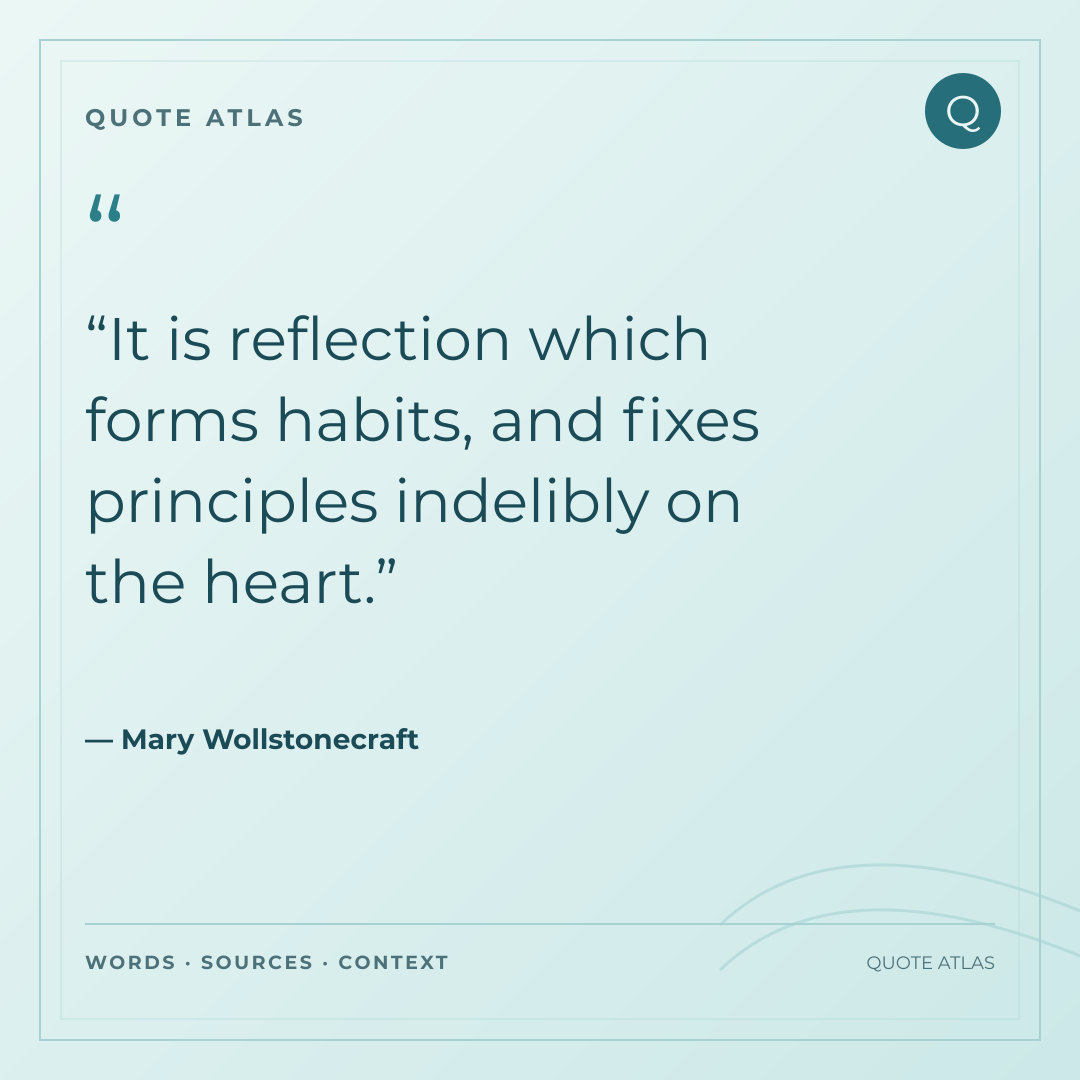
It is reflection which forms habits, and fixes principles indelibly on the heart.

“It is reflection which forms habits, and fixes principles indelibly on the heart.”

Habit formation becomes stronger when action is joined with reflection, because principles understood and revisited are more likely to guide later choices.

Source details

Thoughts on the Education of Daughters (1787), “THE BENEFITS WHICH ARISE FROM DISAPPOINTMENTS,” printed page 111, Project Gutenberg #67466. Wollstonecraft says reflection forms habits and fixes principles while opening a religious-moral discussion of disappointment, self-examination and character.

Source identified210
Culture is then properly described not as having its origin in curiosity, but as having its origin in the love of perfection.

“Culture is then properly described not as having its origin in curiosity, but as having its origin in the love of perfection.”

Curiosity becomes more than collecting information when it is directed toward fuller development, better judgment, and a serious desire to improve understanding.

Source details

Culture and Anarchy; Arnold distinguishes idle curiosity from the pursuit of intellectual and moral perfection.

Source identified211
Nothing is so firmly believed, as what we least know.

“Nothing is so firmly believed, as what we least know.”

Certainty can be strongest where understanding is weakest, so confidence by itself is poor evidence that a belief has been examined well.

Source details

Essays of Montaigne, Book I, Chapter XXXI, ‘That a Man Is Soberly to Judge of the Divine Ordinances,’ Charles Cotton translation edited by William Carew Hazlitt (1877); Project Gutenberg Volume 06 #3586 / Complete Essays #3600. The sentence appears in Montaigne’s skeptical warning about confidence concerning unknown things and speculative claims about divine purposes.

Source identified212
He who fears he shall suffer, already suffers what he fears.

“He who fears he shall suffer, already suffers what he fears.”

Anticipatory fear can add suffering before any feared event occurs, effectively extending pain through imagination and expectation.

Source details

Essays of Montaigne, Book III, Chapter XIII, “Of Experience,” Charles Cotton translation; Project Gutenberg Volume 19 #3599 / Complete Essays #3600. Montaigne argues that anticipatory fear can add suffering before the feared event arrives.

Source identified213
I only gathered acquaintance with the public aspect of the city, the same that she shows to the meanest stranger.

“I only gathered acquaintance with the public aspect of the city, the same that she shows to the meanest stranger.”

Even after deliberate observation, Montaigne admits that a visitor may know only the public face of a place, making limits of access and outsider perspective part of responsible travel judgment.

Source details

The Journal of Montaigne’s Travels in Italy, Volume II, Rome, W. G. Waters translation, Project Gutenberg #70839. Montaigne says this after describing how actively he sought out Roman public life; the point is epistemic modesty about what a stranger can really know, not a claim that travel is futile.

Source identified214
Right occasion and opportunity have their privileges, and often hold out to ordinary folk what they deny to kings.

“Right occasion and opportunity have their privileges, and often hold out to ordinary folk what they deny to kings.”

Montaigne observes that access and success do not follow rank mechanically: timing, circumstance and temperament can open an ordinary person’s path even when status or power fails to secure the same result.

Source details

The Journal of Montaigne’s Travels in Italy, Volume II, entry for March 6, 1581 during his visit to the Vatican Library, W. G. Waters translation, Project Gutenberg #70839. The sentence follows Montaigne’s surprise that he gained access where the French ambassador had failed; it is first-person journal reflection, not a general law that opportunity always defeats privilege.

Source identified215
For, what other dungeon is so dark as one’s own heart! What jailer so inexorable as one’s self!

“For, what other dungeon is so dark as one’s own heart! What jailer so inexorable as one’s self!”

Hawthorne’s narrator turns imprisonment inward, suggesting that guilt, memory and self-judgment can confine a person more relentlessly than an external cell.

Source details

The House of the Seven Gables, Project Gutenberg #77. This is Gothic literary narration surrounding Clifford’s long history of confinement and inner suffering; the metaphor is not a clinical account of mental illness.

Source identified216
Insanity is often the logic of an accurate mind overtasked.

“Insanity is often the logic of an accurate mind overtasked.”

Voice: Fictional narrator · Narrator

Holmes’s narrator links mental breakdown with a mind pushed beyond its capacity, reflecting a nineteenth-century literary-medical way of reasoning about distress.

Source details

Elsie Venner, represented by Project Gutenberg #2696 and corroborated by Gutenberg’s Holmes quotation index. The sentence belongs to nineteenth-century literary and medical-philosophical discourse; it is not current psychiatric guidance, diagnosis or a clinically validated rule.

Source identified217
A moment's insight is sometimes worth a life's experience.

“A moment's insight is sometimes worth a life's experience.”

Holmes’s breakfast-table speaker argues that a concentrated moment of perception can sometimes yield understanding that ordinary experience accumulates only slowly.

Source details

The Professor at the Breakfast-Table, Project Gutenberg #2665. The sentence appears in a reflection on young poets whose sensitivity can seem older than their years; it is literary-philosophical observation by the book’s conversational persona, not a measurable law of learning.

Source identified218
The old believe everything: the middle-aged suspect everything: the young know everything.

“The old believe everything: the middle-aged suspect everything: the young know everything.”

The epigram compresses three stereotypes of certainty into one balanced joke, mocking credulity, suspicion, and youthful overconfidence at once.

Source details

“Phrases and Philosophies for the Use of the Young,” first published in The Chameleon in 1894.

Source identified219
The truth is rarely pure and never simple.

“The truth is rarely pure and never simple.”

Voice: Fictional character · Algernon Moncrieff

Wilde resists neat moral simplification by reminding the reader that truth often arrives mixed with context and contradiction.

Source details

The Importance of Being Earnest, Act I; Algernon Moncrieff. Exact catalog wording is preserved in the scan-backed Samuel French acting text on Wikisource, scan leaf 14 / printed page 12. The acting-text witness is abridged elsewhere, so this record is bound only to its independently verified page.

Source identified220
All art is at once surface and symbol.

“All art is at once surface and symbol.”

Voice: Authorial / signed preface voice · Oscar Wilde — Preface

The aphorism resists a simple choice between appearance and hidden meaning: an artwork can operate through both at the same time.

Source details

The Picture of Dorian Gray, 1891 edition, Preface; part of Wilde’s warning about reading beneath artistic surfaces.

Source identified221
It is not selfish to think for oneself.

“It is not selfish to think for oneself.”

Independent thought is distinguished from selfishness: forming one’s own judgment can protect individuality without requiring indifference to other people.

Source details

The Soul of Man under Socialism; Wilde defends individual thought while criticizing social pressure that mistakes conformity for moral virtue.

Source identified222
If the principle of final causes were a first principle, and a priori, like the principle of causality, we would apply it everywhere and in all circumstances; but it is not so.

“If the principle of final causes were a first principle, and a priori, like the principle of causality, we would apply it everywhere and in all circumstances; but it is not so.”

Janet begins by denying that teleological explanation functions as an automatic first principle, making its use something that must itself be examined and justified.

Source details

Final Causes, Book I, Chapter I, “The Principle,” opening sentence, William Affleck translation (1878). The represented public-domain scan prints the sentence on p. 17 after Robert Flint’s prefatory matter. Janet begins by denying that finality functions as an automatic a priori principle like causality; this remains nineteenth-century philosophical teleology rather than current scientific consensus.

Source identified223
And the peace of God, which passeth all understanding, shall keep your hearts and minds through Christ Jesus.

“And the peace of God, which passeth all understanding, shall keep your hearts and minds through Christ Jesus.”

The verse describes peace as something capable of guarding both feeling and thought even when it cannot be fully reduced to a rational explanation.

Source details

Philippians 4:7 in the King James Version.

Source identified224
I neither know nor think that I know.

“I neither know nor think that I know.”

Voice: Dialogue speaker · Socrates

Socrates locates a small advantage in recognizing the boundary of his own knowledge: uncertainty is intellectually healthier than possessing the same ignorance while mistaking it for wisdom.

Source details

Plato, Apology, Benjamin Jowett translation, Project Gutenberg #1656. Socrates says this after examining a politician whom others considered wise; the wording is dialogue speech attributed to Socrates within Plato’s work, not a claim that Socrates knew literally nothing.

Source identified226
But why, my dear Crito, should we care about the opinion of the many?

“But why, my dear Crito, should we care about the opinion of the many?”

Voice: Dialogue speaker · Socrates

Socrates challenges the idea that widespread approval should decide a moral question, directing attention toward informed judgment rather than numerical popularity.

Source details

Crito, Benjamin Jowett translation; Socrates responds to Crito’s concern about public opinion while awaiting execution.

Source identified227
And is the soul seen or not seen?

“And is the soul seen or not seen?”

Voice: Dialogue speaker · Socrates

Socrates advances the dialogue by separating what can be perceived directly from what must be examined through argument, preparing the discussion of body and soul.

Source details

Phaedo, Benjamin Jowett translation; Socrates asks the question during the dialogue’s argument about visible bodies and the unseen soul.

Source identified228
Then the soul is more like to the unseen, and the body to the seen?

“Then the soul is more like to the unseen, and the body to the seen?”

Voice: Dialogue speaker · Socrates

Within the dialogue’s metaphysical argument, Socrates associates soul with the unseen and body with the visible; the record preserves that historical philosophical context rather than treating it as established fact.

Source details

Phaedo, Benjamin Jowett translation; Socrates is reasoning with Cebes about visibility, mortality and the proposed nature of soul and body.

Source identified229
Do not then suppose that these words are rashly spoken by us, O Protarchus, for they are in harmony with the testimony of those who said of old time that mind rules the universe.
Image design Botanical Sage

“Do not then suppose that these words are rashly spoken by us, O Protarchus, for they are in harmony with the testimony of those who said of old time that mind rules the universe.”

Voice: Dialogue speaker · Socrates

Socrates invokes earlier thinkers in a discussion of whether intelligence helps order the cosmos. The claim concerns an ancient metaphysical account of mind as a cause, not the modern sense of an individual person’s mental health or an experimentally settled account of the universe.

Source details

Plato, Philebus, approximately 30c–d; Socrates addressing Protarchus amid the argument that reason or mind belongs with the ordering cause rather than with limitless pleasure. Benjamin Jowett English, Project Gutenberg #1744, dialogue text.

Source identified230
the beauty of the mind is more honourable than the beauty of the outward form.

“the beauty of the mind is more honourable than the beauty of the outward form.”

Voice: Reported speaker · Diotima, recounted by Socrates

The ascent described by Diotima shifts attention from outward appearance toward qualities of mind, making intellectual and moral beauty more important within this stage of the dialogue’s argument.

Source details

Symposium, Diotima’s ascent toward beauty as recounted by Socrates, Benjamin Jowett translation, Project Gutenberg #1600. This is one stage in an ancient philosophical account of beauty and love, not a modern psychological ranking of attractiveness.

Source identified231
For herein is the evil of ignorance, that he who is neither good nor wise is nevertheless satisfied with himself: he has no desire for that of which he feels no want.

“For herein is the evil of ignorance, that he who is neither good nor wise is nevertheless satisfied with himself: he has no desire for that of which he feels no want.”

Voice: Reported speaker · Diotima, recounted by Socrates

Ignorance becomes difficult to correct when a person feels no lack in understanding, because satisfaction with one’s present judgment removes the motivation to seek what is missing.

Source details

Symposium, Socrates recounting Diotima’s teaching, Benjamin Jowett translation, Project Gutenberg #1600. Diotima is a reported speaker within the dialogue; the passage is philosophical argument about ignorance and desire for wisdom.

Source identified232
Knowledge which is acquired under compulsion obtains no hold on the mind.

“Knowledge which is acquired under compulsion obtains no hold on the mind.”

Voice: Dialogue speaker · Socrates

Learning forced without engagement may fail to become durable understanding because the learner has not made the knowledge intellectually their own.

Source details

The Republic, Book VII, Jowett translation; Socrates argues that education should draw the mind rather than rely only on compulsion.

Source identified233
Opinion appears to you to be darker than knowledge, but lighter than ignorance?

“Opinion appears to you to be darker than knowledge, but lighter than ignorance?”

Voice: Dialogue speaker · Socrates

Opinion is treated as an intermediate state: it is not complete ignorance, but it also lacks the clarity and stability of knowledge.

Source details

The Republic, Book V; Socrates places opinion between knowledge and ignorance in the argument about what each apprehends.

Source identified234
Is the attempt to determine the way of man’s life so small a matter in your eyes—to determine how life may be passed by each one of us to the greatest advantage?
Image design Charcoal

“Is the attempt to determine the way of man’s life so small a matter in your eyes—to determine how life may be passed by each one of us to the greatest advantage?”

Voice: Dialogue speaker · Socrates

In Book I Socrates refuses to treat the dispute about justice as mere verbal sparring, because the argument bears on the kind of life people should choose. He addresses Thrasymachus while challenging whether injustice really benefits a person; his question does not settle that dispute on its own.

Source details

Plato, The Republic, Book I, around 344e, Socrates in dialogue with Thrasymachus. Wording verified in Benjamin Jowett, third edition (1888), transcribed in Gutenberg #55201. This is dialogue speech following Thrasymachus’s defence of injustice, not the translator’s prefatory analysis. Edition-specific wording must be preserved.

Source identified235
And ought not the rational principle, which is wise, and has the care of the whole soul, to rule, and the passionate or spirited principle to be the subject and ally?
Image design Golden Hour

“And ought not the rational principle, which is wise, and has the care of the whole soul, to rule, and the passionate or spirited principle to be the subject and ally?”

Voice: Dialogue speaker · Socrates

Socrates argues that self-government involves a rational faculty attending to the whole person while spirited impulses support its judgment. The passage is a question within his analogy between a well-ordered city and the three parts of the soul. It does not mean that all emotion should be suppressed or that Plato established a modern psychological theory.

Source details

Plato, The Republic, Book IV, approximately 441e–442a; Socrates addressing Glaucon while contrasting the rational, spirited and appetitive parts of the soul. Exact sentence from Benjamin Jowett English, Project Gutenberg #1497, Book IV main dialogue (not introductory editorial matter). The premise belongs to an ancient account of the soul and remains open to philosophical interpretation; not clinical or neuroscientific evidence.

Source identified237
A hasty judgement is a first step to a recantation.

“A hasty judgement is a first step to a recantation.”

Rushing to a conclusion increases the chance that later evidence will force an embarrassing or costly reversal.

Source details

The Moral Sayings of Publius Syrus, maxim 8, in Darius Lyman’s 1856 English rendering; maxim order can vary across editions.

Source identified238
The invariable mark of wisdom is to see the miraculous in the common.

“The invariable mark of wisdom is to see the miraculous in the common.”

Emerson connects wisdom with renewed attention, suggesting that curiosity does not always require exotic objects because ordinary experience becomes remarkable when examined closely.

Source details

Nature (first published 1836), Chapter VIII, “Prospects,” in James Munroe and Company’s 1849 new-edition witness represented by Project Gutenberg #29433. “The invariable mark of wisdom is to see the miraculous in the common” appears near the essay’s close during Emerson’s discussion of prayer, study, facts and ideas. This collection retains 1836 as first-publication year while the evidence layer identifies the reviewed 1849 witness; the sentence remains Transcendentalist philosophical rhetoric rather than an experimentally established measure of wisdom.

Source identified239
A foolish consistency is the hobgoblin of little minds.

“A foolish consistency is the hobgoblin of little minds.”

Emerson attacks rigid consistency when it prevents people from revising judgment in the light of new thought.

Source details

Essay “Self-Reliance”; Emerson criticizes rigid adherence to past opinions when fresh judgment requires revision.

Source identified240
There is then creative reading as well as creative writing.

“There is then creative reading as well as creative writing.”

Reading can be an active intellectual act when the reader interprets, connects, questions, and produces new understanding rather than merely receiving words passively.

Source details

The American Scholar; Emerson argues that books should awaken independent thought rather than replace it.

Source identified241
The optimist has the power of seeing things in their entirety and in their right relations.

“The optimist has the power of seeing things in their entirety and in their right relations.”

Optimism is defined here as a broader way of interpreting circumstances: the positive outlook is linked to seeing relationships and the whole situation rather than only one discouraging part.

Source details

In Tune with the Infinite, Prelude; Project Gutenberg #23559. The sentence belongs to Trine’s philosophical New Thought contrast between optimist and pessimist and should not be treated as a clinical definition.

Source identified242
Reading is to the mind what exercise is to the body.

“Reading is to the mind what exercise is to the body.”

Regular reading is compared with physical exercise because repeated intellectual use can strengthen attention, knowledge, and mental capacity over time.

Source details

The Tatler No. 147; the comparison presents reading as a form of regular exercise for the mind.

Source identified243
We shall never learn the affinities of beauty

“We shall never learn the affinities of beauty”

Stevenson treats beauty as deeper than any complete technical explanation, warning that analysis of artistic mechanism does not exhaust why form can move or delight.

Source details

Essays in the Art of Writing, “On Some Technical Elements of Style in Literature,” represented by the 1905 Chatto & Windus edition in Project Gutenberg #492. The collection is posthumous; the excerpt concerns literary aesthetics.

Source identified244
A distinct university walks about under each man's hat.

“A distinct university walks about under each man's hat.”

Voice: Authorial / signed preface voice · Russell H. Conwell

Conwell’s metaphor presents each person’s powers of observation and reflection as a continuing source of self-education beyond formal institutions.

Source details

Every Man His Own University, Chapter I, “Every Man’s University,” Project Gutenberg #36955, copyright 1917 witness. Conwell opens the chapter with “A distinct university walks about under each man’s hat” and develops the metaphor through observation, reading and independent thought. It is historical motivational/educational rhetoric, not evidence that formal education is unnecessary.

Source identified245
Perhaps he confused cause and effect; the excellent digestion may have been responsible for at least some of the philosophical serenity.

“Perhaps he confused cause and effect; the excellent digestion may have been responsible for at least some of the philosophical serenity.”

Voice: Fictional narrator · Narrator

The narrator humorously reverses a character’s explanation of his calm temperament, using causal inversion to puncture self-satisfied philosophy.

Source details

When William Came, represented by Project Gutenberg #14540 from the 1914 John Lane edition. This is the narrator’s satirical aside about Herr von Kwarl; the digestion comparison is literary humor, not medical or psychological advice.

Source identified246
Customs are not to be changed but for better.

“Customs are not to be changed but for better.”

The maxim sets a burden on reform: novelty alone is not enough; a proposed change should be able to show a practical or rational advantage.

Source details

The Idler, No. 90; Johnson is discussing gesture and public speaking, not asserting that every inherited custom should remain untouched.

Source identified247
We do not indeed so often disappoint others as ourselves.

“We do not indeed so often disappoint others as ourselves.”

Private expectations can exceed what anyone else demands of us, so a life may feel disappointing chiefly by comparison with unfulfilled plans known only to oneself.

Source details

The Idler, No. 88; the surrounding paragraph concerns private hopes, proposed tasks and the gap between imagined achievement and lived action.

Source identified248
And pause awhile from Learning to be wise;

“And pause awhile from Learning to be wise;”

Johnson distinguishes accumulating learning from exercising judgment, asking the scholar to interrupt pursuit of knowledge long enough to examine what wisdom requires.

Source details

The Vanity of Human Wishes (1749), first-edition scholar passage, Wikisource scan leaf 28. “And pause awhile from Learning to be wise” turns from the ambitious student’s pursuit of knowledge toward Johnson’s satirical warning that learning does not by itself remove grief, danger or error. This is eighteenth-century moral-satirical poetry after Juvenal, not a modern educational rule.

Source identified249
Pour forth thy Fervours for a healthful Mind, Obedient Passions, and a Will resign'd;

“Pour forth thy Fervours for a healthful Mind, Obedient Passions, and a Will resign'd;”

Johnson’s closing prayer prioritizes soundness of mind, governed passions and a will capable of acceptance over many external forms of success.

Source details

The Vanity of Human Wishes (1749), explicitly devotional closing movement, Wikisource first-edition scan leaf 41. “Pour forth thy Fervours for a healthful Mind, Obedient Passions, and a Will resign’d” belongs to Johnson’s concluding prayer for inward goods, patience and faith. “Healthful Mind” is preserved as historical religious-moral language and is not presented as modern medical or mental-health advice.

Source identified250
We suffer more often in imagination than in reality.

“We suffer more often in imagination than in reality.”

The line distinguishes anticipated suffering from what is actually happening, challenging imagination when it magnifies uncertainty.

Source details

Moral Letters to Lucilius, Letter 13, section 4, Richard M. Gummere translation. 'We suffer more often in imagination than in reality' occurs in 'On Groundless Fears' as Seneca distinguishes feared possibilities from harms that have actually arrived. It remains Roman Stoic moral counsel rather than modern anxiety-treatment or clinical evidence.