Quote Atlassourced quotes & context
Page 2 of 3 · 242 quotations total

Self-trust quotes — Page 2

This continuation page contains additional source-backed quotations not shown in the initial 50-quotation overview. Return to the topic guide and browse collection.

100 shown · 242 total
Source identified51
Self-reverence, self-knowledge, self-control, These three alone lead life to sovereign power.

“Self-reverence, self-knowledge, self-control, These three alone lead life to sovereign power.”

Voice: Poetic speaker · Pallas

Tennyson joins respect for oneself with knowledge and restraint: durable personal power is presented as the result of living by an inward law rather than seeking power merely for its own sake.

Source details

Oenone, in The Early Poems of Alfred, Lord Tennyson, Project Gutenberg #8601. Pallas speaks the lines while arguing that self-reverence, self-knowledge and self-control lead to a life governed by right rather than by reward; this is poetic character speech, not a prose maxim detached from the poem.

Source identified52
And so the good man ought to be Self-loving: because by doing what is noble he will have advantage himself and will do good to others.

“And so the good man ought to be Self-loving: because by doing what is noble he will have advantage himself and will do good to others.”

Aristotle distinguishes a worthy form of self-love from selfish appetite: the good person values the rational and noble part of life in a way that benefits both the self and other people.

Source details

Nicomachean Ethics, Book IX, Chapter VIII, Project Gutenberg #8438. The surrounding argument explicitly contrasts this noble “Self-loving” with the blameworthy form that grasps at wealth, honours and bodily pleasures, so the line is not a defense of simple selfishness.

Source identified53
One man cannot tell another man where the other man wants to go.

“One man cannot tell another man where the other man wants to go.”

Self-development begins with aims that actually belong to the individual; another person can suggest methods but cannot supply a genuinely personal destination.

Source details

Mental Efficiency, opening discussion of self-development. Project Gutenberg #23347. Bennett is distinguishing method from personal purpose, not claiming that advice or collaboration has no value.

Source identified54
If a man is to turn everything whatsoever into his own calm, dignity, and happiness, he must make this use even of his own failures.

“If a man is to turn everything whatsoever into his own calm, dignity, and happiness, he must make this use even of his own failures.”

Failure becomes useful when it is examined and incorporated into future conduct instead of being allowed to settle a person’s sense of dignity or possibility.

Source details

The Human Machine, discussion of using experience for self-command. Bennett’s claim is philosophical self-training advice; it does not imply that every failure is beneficial or emotionally easy.

Source identified55
We have to forfeit three-fourths of ourselves in order to become like other people.

“We have to forfeit three-fourths of ourselves in order to become like other people.”

Conformity is described as costly when fitting in requires surrendering too much individuality, judgment, or temperament.

Source details

Counsels and Maxims, in Schopenhauer’s discussion of society and individuality; T. Bailey Saunders translation.

Source identified56
A man can be himself only so long as he is alone; and if he does not love solitude, he will not love freedom; for it is only when he is alone that he is really free.

“A man can be himself only so long as he is alone; and if he does not love solitude, he will not love freedom; for it is only when he is alone that he is really free.”

Schopenhauer links solitude with freedom from the constant accommodation that social life requires, especially for strongly individual temperaments.

Source details

Counsels and Maxims, chapter on our relation to others, translated by T. Bailey Saunders.

Source identified57
Otherwise, a man is the slave of what other people are pleased to think.

“Otherwise, a man is the slave of what other people are pleased to think.”

Dependence on approval can turn other people’s judgments into a form of control; self-respect requires allowing outside opinion to inform rather than govern one’s sense of worth.

Source details

The Wisdom of Life; the sentence appears in Schopenhauer’s criticism of giving excessive weight to reputation and social opinion.

Source identified58
What a man is, and so what he has in his own person, is always the chief thing to consider.

“What a man is, and so what he has in his own person, is always the chief thing to consider.”

The line directs attention toward qualities carried within the person rather than status or possessions, grounding a durable sense of value in character, capacity, and inner life.

Source details

The Wisdom of Life; Schopenhauer develops a three-part distinction between what a person is, what a person has, and what a person represents in the eyes of others.

Source identified59
What a man is contributes much more to his happiness than what he has, or how he is regarded by others.

“What a man is contributes much more to his happiness than what he has, or how he is regarded by others.”

Schopenhauer places personal character and inner constitution above possessions and reputation, making well-being depend more on what a person is than on external valuation.

Source details

The Wisdom of Life; T. Bailey Saunders’s public-domain translation distinguishes what a person is from possessions and from the opinions of other people.

Source identified60
It would be a miserable existence which should make its value or want of value depend upon what other people think.

“It would be a miserable existence which should make its value or want of value depend upon what other people think.”

A life whose value rises and falls with public opinion has no stable center; Schopenhauer argues for locating worth somewhere less volatile than other people’s changing judgments.

Source details

The Wisdom of Life; Schopenhauer criticizes the habit of measuring the value of one’s existence by reputation or the fluctuating opinions of others.

Source identified61
Hide not your talents. They for use were made. What’s a sundial in the shade?
Image design Coastal

“Hide not your talents. They for use were made. What’s a sundial in the shade?”

Ability has little practical value when it is permanently hidden; talent becomes useful through application and visibility.

Source details

Poor Richard’s Almanack.

Source identified62
He that hath a trade hath an estate.

“He that hath a trade hath an estate.”

Voice: Authorial persona / framed maxim · Poor Richard maxim, repeated through Father Abraham

A useful skill or trade is treated as a durable asset because it can keep producing value even when stored wealth is limited.

Source details

The Way to Wealth, where Father Abraham repeats maxims associated with Poor Richard.

Source identified63
Industry pays debts, while despair increaseth them.

“Industry pays debts, while despair increaseth them.”

Voice: Authorial persona / framed maxim · Poor Richard maxim, repeated through Father Abraham

Franklin contrasts productive effort with passive discouragement, presenting earned income and continued work as practical ways to reduce obligations.

Source details

The Way to Wealth / Poor Richard Improved, industry section; represented by Project Gutenberg #43855. Father Abraham is compiling maxims from Franklin’s earlier Almanacks.

Source identified64
If you would know the value of money, go and try to borrow some.

“If you would know the value of money, go and try to borrow some.”

Voice: Authorial persona / framed maxim · Poor Richard maxim, repeated through Father Abraham

Borrowing makes the cost and scarcity of money concrete, turning an abstract idea of value into an immediate obligation.

Source details

The Way to Wealth, in Franklin’s discussion of debt and credit.

Source identified65
A ploughman on his legs is higher than a gentleman on his knees.

“A ploughman on his legs is higher than a gentleman on his knees.”

Voice: Authorial persona / framed maxim · Poor Richard maxim, repeated through Father Abraham

Financial independence earned through ordinary work is valued above status maintained through borrowing, dependence, or costly appearance.

Source details

The Way to Wealth, frugality section; Project Gutenberg #43855. Father Abraham contrasts industrious people with those reduced to borrowing by extravagance.

Source identified66
We do not want all men to be alike.

“We do not want all men to be alike.”

Human development should not be forced into one standardized mold because individuality and creative difference are themselves goods worth protecting.

Source details

Political Ideals, early discussion of individual development. Russell immediately criticizes the bad teacher who imposes one opinion and produces pupils giving the same answer to doubtful questions.

Source identified67
I am no bird; and no net ensnares me; I am a free human being with an independent will.

“I am no bird; and no net ensnares me; I am a free human being with an independent will.”

Voice: Fictional character · Jane Eyre

The speaker refuses a relationship defined by captivity or unequal power and asserts freedom, dignity, and the right to choose.

Source details

Jane Eyre; Jane insists on moral and personal independence during a decisive conversation with Rochester.

Source identified68
I care for myself. The more solitary, the more friendless, the more unsustained I am, the more I will respect myself.

“I care for myself. The more solitary, the more friendless, the more unsustained I am, the more I will respect myself.”

Voice: Fictional character · Jane Eyre

Jane’s self-care is inseparable from moral self-respect: the fewer external supports she has, the more firmly she refuses to abandon principles that preserve her dignity.

Source details

Jane Eyre, Chapter XXVII, Project Gutenberg #1260. Jane answers the pressure to remain with Rochester by saying she cares for herself and will respect herself more when friendless and unsupported, then explicitly invokes law, principles and temptation. It is fictional first-person moral reasoning under dramatic pressure, not Charlotte Brontë autobiography or universal relationship advice.

Source identified69
Never free to compromise her self-respect, to seek where she had been shunned.

“Never free to compromise her self-respect, to seek where she had been shunned.”

Voice: Narrator voice · Narrator

The narration marks self-respect as a boundary: rejection does not create an obligation to keep pursuing acceptance at the cost of dignity.

Source details

Shirley; fictional narrative description within the novel’s relationship context. The line describes a character’s restraint and must not be presented as a direct autobiographical maxim by Charlotte Brontë.

Source identified70
I felt light and liberated. I had got away from Bigben Close without a breach of resolution; without injury to my self-respect.

“I felt light and liberated. I had got away from Bigben Close without a breach of resolution; without injury to my self-respect.”

Voice: Fictional narrator · William Crimsworth

William Crimsworth experiences freedom as preserving both his resolution and his self-respect while leaving a situation he finds degrading.

Source details

The Professor, early first-person narration by the fictional William Crimsworth. The novel was published posthumously in 1857; the line is character narration, not Brontë autobiography.

Source identified71
I should make some advance in life, take another step towards an independent position.

“I should make some advance in life, take another step towards an independent position.”

Voice: Fictional narrator · Lucy Snowe

Lucy frames progress in terms of greater independence, making self-directed position and livelihood part of how she imagines moving forward.

Source details

Villette; excerpt from Lucy Snowe’s reflection on how to advance toward a more independent position. This is fictional first-person narration, and the excerpt is not presented as Brontë speaking autobiographically.

Source identified72
For we have confidence in those who we think have more understanding than ourselves

“For we have confidence in those who we think have more understanding than ourselves”

Cicero treats confidence in another person as partly a judgment about competence: people are more willing to rely on someone they believe can understand difficult circumstances and reach sound decisions.

Source details

De Officiis, Book II, section 33, Project Gutenberg #47001. Cicero’s larger argument says public confidence depends on practical wisdom joined with justice; intelligence alone is not presented as sufficient for trust.

Source identified73
What the superior man seeks, is in himself. What the mean man seeks, is in others.

“What the superior man seeks, is in himself. What the mean man seeks, is in others.”

Mature judgment begins with one’s own conduct and capacities rather than making other people the first explanation for every outcome.

Source details

The Analects of Confucius, James Legge’s public-domain English translation; Book XV contrasts inward self-examination with dependence on others.

Source identified74
The individual was primary; the State, the Church, society, the family, secondary.

“The individual was primary; the State, the Church, society, the family, secondary.”

The hierarchy places inherent personhood before social institutions, arguing that family, church, society, and government should serve rather than erase individual conscience and dignity.

Source details

Eighty Years and More (1898), Chapter XIV, “Views on Marriage and Divorce,” Project Gutenberg #11982. This sentence immediately follows Stanton’s individual-sovereignty claim inside her quoted April 1894 Arena article: she contrasts older state/family primacy with the Christian claim of individual conscience and judgment. The passage is historical reform argument, not modern constitutional or family-law doctrine.

Source identified75
The true standpoint from which to view this question is individual sovereignty, individual happiness.

“The true standpoint from which to view this question is individual sovereignty, individual happiness.”

Stanton makes the individual rather than an institution the starting point for judging intimate social arrangements, linking personal sovereignty with the pursuit of happiness.

Source details

Eighty Years and More (1898), Chapter XIV, “Views on Marriage and Divorce,” Project Gutenberg #11982. Stanton introduces the surrounding passage as “my latest thought on this question” from The Arena of April 1894, then argues that marriage and divorce should be judged from individual sovereignty and individual happiness. The 1898 memoir remains the represented source while the embedded 1894 article origin is preserved.

Source identified76
To guide our own craft, we must be captain, pilot, engineer; with chart and compass to stand at the wheel.

“To guide our own craft, we must be captain, pilot, engineer; with chart and compass to stand at the wheel.”

The voyage metaphor makes personal preparation unavoidable: support from others matters, but a person still needs judgment and capacity when circumstances require independent action.

Source details

Solitude of Self; Stanton develops an extended navigation metaphor to argue that every person must be equipped for the emergencies and decisions of an individual life.

Source identified77
The isolation of every human soul and the necessity of self-dependence must give each individual the right, to choose his own surroundings.

“The isolation of every human soul and the necessity of self-dependence must give each individual the right, to choose his own surroundings.”

Because each person ultimately bears an individual life, Stanton argues that self-dependence requires meaningful authority over the conditions in which that life is lived.

Source details

Solitude of Self, 1892 congressional address; punctuation follows a widely reproduced transcription of Stanton’s public-domain speech.

Source identified78
Self-development is a higher duty than self-sacrifice.

“Self-development is a higher duty than self-sacrifice.”

Stanton challenges a moral standard that praises women mainly for self-denial, arguing instead that developing one’s capacities is itself an important obligation.

Source details

The Woman’s Bible, Stanton commentary; the line appears in her critique of idealizing women’s self-sacrifice and is preserved in the Project Gutenberg text.

Source identified79
My first duty is to develop all the powers given to me and to make the most of myself and my own life.

“My first duty is to develop all the powers given to me and to make the most of myself and my own life.”

Voice: Imagined speaker · Jephthah’s daughter (imagined by Stanton)

The imagined speaker refuses to let another person dispose of her life, grounding dignity in the responsibility to develop her own capacities and possibilities.

Source details

The Woman's Bible, The Book of Judges, Chapter II, Judges xi, Project Gutenberg #9880. Stanton imagines Jephthah's unnamed daughter rejecting sacrifice: ‘My first duty is to develop all the powers given to me and to make the most of myself and my own life.’ This is Stanton's invented protest voice within her commentary, not a biblical quotation or speech preserved in Judges.

Source identified80
’Tis the set of the soul that decides its goal and not the calm or the strife.

“’Tis the set of the soul that decides its goal and not the calm or the strife.”

The nautical metaphor places direction in the stance a person adopts toward conditions, arguing that purpose can survive both ease and adversity.

Source details

Poems of Optimism, “The Winds of Fate,” first published in this collection in 1913; Project Gutenberg #7421. The statement is metaphorical poetry about agency, not a denial of material constraints or unequal circumstances.

Source identified81
Riches I hold in light esteem, And Love I laugh to scorn; And lust of fame was but a dream, That vanished with the morn.

“Riches I hold in light esteem, And Love I laugh to scorn; And lust of fame was but a dream, That vanished with the morn.”

The speaker strips wealth, romantic attachment and fame of ultimate authority in order to define freedom through an inwardly independent stance.

Source details

“The Old Stoic,” in Poems by Currer, Ellis, and Acton Bell; Project Gutenberg #1019. The poem uses a deliberately severe persona and should not be treated as a complete ethical system.

Source identified82
The soul selects her own society, then shuts the door.

“The soul selects her own society, then shuts the door.”

Dickinson’s compressed image emphasizes selective attention and the right to decide what receives intimate access.

Source details

“The Soul Selects Her Own Society”; capitalization is lightly normalized.

Source identified83
We shall both be cautious and confident, and indeed confident because of our caution.

“We shall both be cautious and confident, and indeed confident because of our caution.”

Epictetus rejects confidence as recklessness: confidence becomes rational when caution is directed toward one’s own judgments and choices rather than toward externals that cannot be controlled.

Source details

Discourses of Epictetus, Book II, Chapter I, “That confidence (courage) is not inconsistent with caution,” George Long translation; 1877 George Bell & Sons witness on Wikisource, cross-checked against Project Gutenberg #10661. Epictetus distinguishes confidence toward externals from moral caution in the use of one’s own will.

Source identified84
On the occasion of every accident that befalls you, remember to turn to yourself and inquire what power you have for turning it to use.

“On the occasion of every accident that befalls you, remember to turn to yourself and inquire what power you have for turning it to use.”

Instead of beginning with what an event has taken away, the practice asks which capacity—endurance, restraint, patience, or judgment—can still be exercised.

Source details

Enchiridion, section X, George Long translation; Epictetus gives examples such as endurance under pain and patience under abuse.

Source identified85
What then? have you not received greatness of heart, received courage, received fortitude?

“What then? have you not received greatness of heart, received courage, received fortitude?”

The rhetorical question redirects attention from hardship toward capacities already available for meeting it—courage, endurance, and largeness of spirit.

Source details

The Golden Sayings of Epictetus, saying XIV, in the passage comparing life’s difficulties with enduring the Olympic festival.

Source identified86
If I am a princess in rags and tatters, I can be a princess inside.

“If I am a princess in rags and tatters, I can be a princess inside.”

Voice: Fictional character · Sara Crewe

Dignity is separated from possessions and appearance, locating self-worth in conduct and inner standards when external status has been stripped away.

Source details

A Little Princess; Sara uses an imagined inner identity to preserve dignity during poverty and mistreatment.

Source identified87
It recalled to life my crushed self-respect, and my self-confidence, and inspired me with a renewed determination to be a free man.

“It recalled to life my crushed self-respect, and my self-confidence, and inspired me with a renewed determination to be a free man.”

Douglass describes confidence as something restored through resistance: the change is not abstract positive thinking but a renewed sense of personal agency after physically resisting the violence of enslavement.

Source details

Life and Times of Frederick Douglass, Project Gutenberg #71893, in Douglass’s retrospective account of resisting Edward Covey. The passage belongs to the history of slavery and self-emancipation; it should not be reduced to a generic motivational slogan detached from that violence.

Source identified88
I WAS A MAN NOW.

“I WAS A MAN NOW.”

The emphatic line records Douglass’s restored sense of manhood and dignity after resisting physical domination; it belongs to a specific autobiographical struggle against enslavement.

Source details

My Bondage and My Freedom, immediately after Douglass describes his resistance to Covey; capitalization follows the represented Project Gutenberg text.

Source identified89
I was a changed being after that fight.

“I was a changed being after that fight.”

Douglass identifies resistance to Covey as a decisive psychological turning point in which a previously crushed sense of agency and personhood begins to return.

Source details

My Bondage and My Freedom, Chapter XVII, ‘The Last Flogging,’ Project Gutenberg #202. Douglass calls his fight with Edward Covey the turning point in his ‘life as a slave’ and writes ‘I was a changed being after that fight’ immediately before ‘I WAS A MAN NOW.’ The passage is autobiographical testimony about resistance to enslavement and restored self-respect, not a universal prescription for violence or a clinical theory of agency.

Source identified90
My long-crushed spirit rose, cowardice departed, bold defiance took its place.

“My long-crushed spirit rose, cowardice departed, bold defiance took its place.”

Resistance restored a sense of personhood and self-command, marking a psychological turning point even before Douglass obtained legal freedom.

Source details

Narrative, Chapter X; the line follows Douglass’s physical resistance to Edward Covey and precedes his resolve never again to be a slave in fact.

Source identified91
Personal independence is a virtue.

“Personal independence is a virtue.”

Douglass values personal agency and self-dependence while rejecting the idea that anyone creates a life entirely alone, placing independence within a wider network of social assistance and obligation.

Source details

Self-Made Men lecture, commonly dated to 1872 in edited versions. The compact statement occurs within an argument that values self-dependence while the lecture’s opening explicitly denies that anyone is literally or completely self-made; Library of Congress manuscript materials anchor the source identity and preserve later versions.

Source identified92
Public opinion—private laziness.

“Public opinion—private laziness.”

The epigram provocatively suggests that adopting public opinion can sometimes substitute borrowed judgment for the harder work of forming one’s own view.

Source details

Human, All-Too-Human, Part I, aphorism 482, “Repeated Once More”; Helen Zimmern translation.

Source identified93
What dost thou Believe in?—In this: That the weights of all things must be determined anew.

“What dost thou Believe in?—In this: That the weights of all things must be determined anew.”

The aphorism calls for a revaluation of inherited measures rather than accepting established rankings of importance as final.

Source details

The Joyful Wisdom, aphorism 269; Thomas Common translation.

Source identified94
To go wrong in one’s own way is better than to go right in someone else’s.

“To go wrong in one’s own way is better than to go right in someone else’s.”

Voice: Fictional character · Razumihin

Razumihin values the capacity to make and correct one’s own mistakes over passive dependence on borrowed conclusions, making independent error part of an active search for truth.

Source details

Crime and Punishment, Part III, Chapter I, printed page 203 / Wikisource scan leaf 235, Constance Garnett translation in the scan-backed 1917 Harvard Classics Shelf of Fiction / P. F. Collier & Son edition, cross-checked against Project Gutenberg #2554. Razumihin argues that going wrong in one’s own way is better than going right in someone else’s while defending the role of making one’s own errors in reaching truth; it remains energetic fictional character dialogue rather than direct Dostoevsky autobiography.

Source identified95
Above all, don’t lie to yourself.

“Above all, don’t lie to yourself.”

Voice: Fictional character · Father Zossima

Self-deception is presented as especially damaging because it corrupts the person’s ability to recognize truth both inwardly and around them.

Source details

The Brothers Karamazov, Book II, Chapter 4, “A Lady of Little Faith,” Constance Garnett translation, verified against Project Gutenberg #28054 and Wikisource. Father Zossima tells the visitor, “Above all, don’t lie to yourself,” and develops the warning into an argument about self-deception, respect and love; this is fictional character counsel inside the novel.

Source identified96
Independent! Oh, Alice, what a blessed thing is independence!

“Independent! Oh, Alice, what a blessed thing is independence!”

Virginia Madden reacts to even temporary financial independence as a profound relief from dependence on employers, relatives and the marriage market.

Source details

The Odd Women, represented by Project Gutenberg #4313. Virginia speaks to her sister Alice early in the novel; the exclamation sits inside Gissing’s wider treatment of unmarried women, paid work and constrained choices in Victorian England.

Source identified97
It is imitation, and as such it is lifeless.

“It is imitation, and as such it is lifeless.”

Surface imitation may reproduce another writer’s recognizable manner without reproducing the thought or experience that originally gave that manner vitality.

Source details

The Principles of Success in Literature, chapter on Style, Project Gutenberg #10420; Lewes criticizes attempts to copy the verbal mannerisms of famous writers.

Source identified98
They ought to be illustrations not authorities, studies not models.

“They ought to be illustrations not authorities, studies not models.”

Great predecessors can teach principles without becoming templates to copy, preserving the learner’s responsibility to develop independent judgment and expression.

Source details

The Principles of Success in Literature, chapter on Style, Project Gutenberg #10420; Lewes is warning writers against imitating Cicero, Titian or other masters.

Source identified99
At any rate see that it be your own, and not another's; on no other terms will the world listen to it.

“At any rate see that it be your own, and not another's; on no other terms will the world listen to it.”

Distinctive style is tied to ownership of thought and expression: the writer is urged to develop a voice grounded in genuine perception rather than borrowed manner.

Source details

The Principles of Success in Literature, chapter on Style, Project Gutenberg #10420; the sentence concludes a warning against imitation and affected literary manner.

Source identified100
The Lord is my helper, and I will not fear what man shall do unto me.

“The Lord is my helper, and I will not fear what man shall do unto me.”

Fear of other people loses some power when confidence rests on support that is believed to be larger than social threat.

Source details

Hebrews 13:6 in the King James Version.

Source identified101
My intellectual horizon is infinitely wide.

“My intellectual horizon is infinitely wide.”

Intellectual possibility is framed as expansive because reading, thought, language, and imagination can continue enlarging a person’s world beyond immediate sensation.

Source details

The World I Live In (1908), Chapter XII, “The Larger Sanctions,” printed page 160, Project Gutenberg #27683. The sentence “My intellectual horizon is infinitely wide” immediately follows Keller’s assertion about mental vision and belongs to the same first-person philosophical defense of intellectual and imaginative range.

Source identified102
Blindness has no limiting effect upon mental vision.

“Blindness has no limiting effect upon mental vision.”

Physical limitation does not automatically determine the range of thought, imagination, learning, or intellectual ambition available to a person.

Source details

The World I Live In (1908), Chapter XII, “The Larger Sanctions,” printed page 160, Project Gutenberg #27683. Keller states that blindness has no limiting effect upon mental vision while defending the role of imagination, correspondence and inherited language in apprehending realities beyond immediate sensation.

Source identified103
Do no violence to yourself, respect in yourself the oscillations of feeling.

“Do no violence to yourself, respect in yourself the oscillations of feeling.”

Self-respect here means refusing to force inner life into an artificial uniformity; changing feelings can be observed and treated with patience instead of self-aggression.

Source details

Amiel's Journal, entry dated April 28, 1852, in Mary Augusta Ward’s public-domain translation; Amiel counsels patience with the movement of feeling.

Source identified104
The gentleman, then, is the man who is master of himself, who respects himself, and makes others respect him.

“The gentleman, then, is the man who is master of himself, who respects himself, and makes others respect him.”

Amiel links dignity with self-command and self-respect, suggesting that social respect is strongest when it grows from conduct and standards rather than from demanded recognition.

Source details

Amiel's Journal, entry dated April 6, 1866, in Mary Augusta Ward’s public-domain English translation; the entry reflects on the qualities of a gentleman.

Source identified105
Descend still deeper into yourself, until you hear nothing but a clear and undivided voice, a voice which does away with doubt and brings with it persuasion, light and serenity.

“Descend still deeper into yourself, until you hear nothing but a clear and undivided voice, a voice which does away with doubt and brings with it persuasion, light and serenity.”

Amiel portrays reflection as a movement beneath mental noise toward a clearer judgment, where conviction is accompanied by serenity rather than by restless argument with oneself.

Source details

Amiel's Journal, 1851 diary entry, translated by Mary Augusta Ward; the passage belongs to Amiel’s introspective effort to reach clarity beneath divided feeling.

Source identified106
I must think over things for myself and get to understand them.

“I must think over things for myself and get to understand them.”

Voice: Fictional character · Nora Helmer

Nora claims the responsibility to examine received beliefs for herself, making independent thought part of her attempt to understand her own identity and circumstances.

Source details

A Doll’s House, Act III, R. Farquharson Sharp translation, Project Gutenberg #15492. Nora Helmer says she must think things over for herself during the final confrontation with Torvald, after saying she must educate herself and stand alone. This is fictional dramatic speech, not Ibsen autobiography or contemporary family / legal guidance.

Source identified107
The strongest man in the world is he who stands most alone.

“The strongest man in the world is he who stands most alone.”

Voice: Fictional character · Dr. Thomas Stockmann

Dr. Stockmann turns social isolation into a claim about independence of conviction: within the play’s conflict, standing without majority approval becomes evidence of his determination to continue rather than a neutral rule that solitude always makes a person stronger.

Source details

An Enemy of the People, Act V, R. Farquharson Sharp public-domain translation, Project Gutenberg #2446. Dr. Thomas Stockmann tells his family that “the strongest man in the world is he who stands most alone” after deciding to remain in town and educate boys despite public hostility. This is fictional dramatic speech within a contentious political conflict, not a neutral empirical rule about isolation.

Source identified108
I am not alone if I stand by myself.

“I am not alone if I stand by myself.”

Thoreau separates physical solitude from helpless isolation: while navigating alone in the mountains, he insists that standing by oneself need not mean being lost or without inner resources.

Source details

A Week on the Concord and Merrimack Rivers, in the mountain-travel passage represented by Project Gutenberg #4232. The line follows Thoreau's argument that travellers often exaggerate difficulties and that a person who thinks himself lost can recover steadiness by recognizing where he actually stands.

Source identified109
Every path but your own is the path of fate. Keep on your own track, then.

“Every path but your own is the path of fate. Keep on your own track, then.”

The passage favors an examined personal direction over drifting into a life selected by convention.

Source details

Walden; Thoreau contrasts one’s own deliberate track with paths chosen by others.

Source identified110
Go confidently in the direction of your dreams. Live the life you have imagined.

“Go confidently in the direction of your dreams. Live the life you have imagined.”

Vision matters most when it changes direction and conduct; imagination becomes useful when a person begins to live toward it.

Source details

Walden, Conclusion; Thoreau urges readers to move deliberately toward the life they have imagined.

Source identified111
What a man thinks of himself, that it is which determines, or rather indicates, his fate.

“What a man thinks of himself, that it is which determines, or rather indicates, his fate.”

Thoreau argues that private self-judgment can become a powerful constraint or permission, shaping choices more strongly than public opinion alone.

Source details

Walden, “Economy,” in the passage contrasting public opinion with a person’s own private opinion of himself.

Source identified112
If a man does not keep pace with his companions, perhaps it is because he hears a different drummer.

“If a man does not keep pace with his companions, perhaps it is because he hears a different drummer.”

Different timing or choices do not automatically mean failure; an individual may be responding to values others cannot hear.

Source details

Conclusion of Walden; Thoreau argues for following one’s own measure and direction.

Source identified113
I have never allowed a gentleman to dictate to me, or to interfere with anything I do.

“I have never allowed a gentleman to dictate to me, or to interfere with anything I do.”

Daisy rejects Winterbourne’s attempt to direct her behavior, asserting personal agency within the restrictive social expectations surrounding her.

Source details

Daisy Miller: A Study, Project Gutenberg #208. Daisy speaks to Winterbourne in Rome; the line is fictional dialogue shaped by the novella’s conflict over convention, reputation and autonomy.

Source identified114
If there’s a thing in the world I’m fond of, it’s my personal independence.

“If there’s a thing in the world I’m fond of, it’s my personal independence.”

Isabel Archer states the value she places on choosing for herself, establishing independence as a central desire that later decisions will test.

Source details

The Portrait of a Lady, Volume I, Project Gutenberg #2833. Isabel says this to Caspar Goodwood while resisting his proposal and his argument that marriage would make her more independent.

Source identified115
I would prefer not to.

“I would prefer not to.”

Bartleby’s mild repeated refusal becomes the story’s central form of resistance, forcing the narrator to confront limits on authority, obligation and understanding.

Source details

Bartleby, the Scrivener, Project Gutenberg #11231. Bartleby speaks this line when the lawyer asks him to help examine copied documents; it is fictional character dialogue, not a general prescription to refuse work or obligations.

Source identified116
the moment you doubt whether you can fly, you cease for ever to be able to do it.

“the moment you doubt whether you can fly, you cease for ever to be able to do it.”

Voice: Fictional narrator · Narrator

Inside Barrie's fantasy narration, Peter's ability to fly is tied to undivided belief in that ability; as a quotation, the line works as a literary image of doubt interrupting action rather than as a literal psychological law.

Source details

Peter Pan in Kensington Gardens, Project Gutenberg #26998. The narrator comments on Peter after he feels shunned by the birds, explaining that losing faith in his power to fly would itself end that power within the story's fantasy logic. The line is narrator voice, not an autobiographical claim by Barrie.

Source identified119
There is a stubbornness about me that never can bear to be frightened at the will of others. My courage always rises with every attempt to intimidate me.

“There is a stubbornness about me that never can bear to be frightened at the will of others. My courage always rises with every attempt to intimidate me.”

Voice: Fictional character · Elizabeth Bennet

Elizabeth frames self-respect as resistance to intimidation: another person’s status or deliberate pressure does not automatically earn the power to determine how she speaks or behaves.

Source details

Pride and Prejudice, Chapter XXXI, Project Gutenberg #1342. Elizabeth Bennet says this to Mr. Darcy at Rosings while he stands near the pianoforte as she plays. Darcy immediately teases her that she sometimes enjoys professing opinions that are not entirely her own, so the line also carries Austen’s character comedy.

Source identified120
whatever school you follow, it must be only to learn method, not to imitate result

“whatever school you follow, it must be only to learn method, not to imitate result”

Studying earlier schools should teach method without turning the student into an imitator, preserving space for an artistic response rooted in the maker’s own time and nature.

Source details

Lectures on Art, Lecture VII, Project Gutenberg #19164. The surrounding passage explicitly distinguishes learning from past masters from adopting their results as one’s own.

Source identified121
you have to become lowly and strong; to recognise the powers of others and to fulfil your own.

“you have to become lowly and strong; to recognise the powers of others and to fulfil your own.”

Creative development is framed as a balance between recognizing other people’s powers and taking responsibility for developing one’s own rather than copying them.

Source details

Lectures on Art, Lecture VII, Project Gutenberg #19164. Ruskin is warning students against both conceit and servile imitation.

Source identified122
He who chooses his plan for himself, employs all his faculties.

“He who chooses his plan for himself, employs all his faculties.”

Choosing for oneself exercises observation, reasoning, discrimination, and self-command in ways that passive imitation does not.

Source details

On Liberty, Chapter III, in Mill’s discussion of individuality and self-directed choice.

Source identified123
He who does anything because it is the custom, makes no choice.

“He who does anything because it is the custom, makes no choice.”

Mill argues that genuine individuality requires active judgment rather than automatic conformity: a person develops the faculties of choice only by deciding for reasons he has actually examined.

Source details

On Liberty, Chapter III, “Of Individuality, as One of the Elements of Well-Being”; Project Gutenberg #34901. The sentence follows Mill's list of perception, judgment, discriminative feeling, mental activity and moral preference as faculties exercised through making a choice.

Source identified124
Over himself, over his own body and mind, the individual is sovereign.

“Over himself, over his own body and mind, the individual is sovereign.”

Mill draws a boundary around mature individual self-government: social power requires justification when it coerces a person in matters that principally concern that person rather than preventing harm to others.

Source details

On Liberty, Chapter I, Project Gutenberg #34901. This sentence follows Mill’s harm-principle formulation and belongs to a political-philosophical argument about the legitimate limits of social and legal interference. It is not a claim that every private action has no effects or obligations toward other people.

Source identified125
He who lets the world, or his own portion of it, choose his plan of life for him, has no need of any other faculty than the ape-like one of imitation.

“He who lets the world, or his own portion of it, choose his plan of life for him, has no need of any other faculty than the ape-like one of imitation.”

A life copied from convention leaves important human faculties unused; choosing deliberately requires observation, judgment and firmness.

Source details

On Liberty, Chapter III; Mill contrasts imitation with actively choosing one’s own plan of life.

Source identified126
The question rests with women themselves—to be decided by their own experience, and by the use of their own faculties.

“The question rests with women themselves—to be decided by their own experience, and by the use of their own faculties.”

Mill argues that women themselves must test capacities and choices through experience rather than having those possibilities defined in advance by others.

Source details

The Subjection of Women (1869), Chapter I, printed page 48, Project Gutenberg #27083. Mill argues that questions about women’s capacities and vocations should be decided by women’s own experience and use of their faculties rather than imposed in advance by men.

Source identified127
Human beings are no longer born to their place in life, and chained down by an inexorable bond to the place they are born to.

“Human beings are no longer born to their place in life, and chained down by an inexorable bond to the place they are born to.”

Mill contrasts modern ideals of social mobility and personal freedom with older hereditary arrangements that fixed people permanently into inherited stations.

Source details

The Subjection of Women (1869), Chapter I, printed page 29, Project Gutenberg #27083. Mill contrasts inherited fixed social stations with the modern principle that people should be free to employ their faculties and pursue available opportunities.

Source identified128
He who would rightly appreciate the worth of personal independence as an element of happiness, should consider the value he himself puts upon it as an ingredient of his own.

“He who would rightly appreciate the worth of personal independence as an element of happiness, should consider the value he himself puts upon it as an ingredient of his own.”

Mill asks readers to evaluate another person’s need for independence by first recognizing how strongly they value independence in their own lives.

Source details

The Subjection of Women (1869), Chapter IV, printed page 179, Project Gutenberg #27083. Mill asks readers to estimate another person’s need for independence by considering the value they themselves place on personal independence as an element of happiness.

Source identified130
Your hearts know in silence the secrets of the days and the nights.

“Your hearts know in silence the secrets of the days and the nights.”

Voice: Fictional character · Almustafa

In the work’s poetic frame, inward knowledge exists before it is fully verbalized; the line values listening closely to one’s own interior understanding without claiming that intuition is automatically infallible.

Source details

The Prophet, section “Self-Knowledge.” A man asks Almustafa to speak about self-knowledge, and Almustafa answers with this line before describing the heart’s knowledge and the self as a boundless sea. The represented wording is the 1923 text preserved by Wikisource/Project Gutenberg #58585.

Source identified131
The artist must possess the courageous soul that dares and defies.

“The artist must possess the courageous soul that dares and defies.”

Mademoiselle Reisz defines artistic vocation as requiring courage to risk judgment, convention and difficulty rather than talent alone.

Source details

The Awakening, Project Gutenberg #160. Mademoiselle Reisz first explains that an artist needs “the courageous soul,” later repeating the fuller wording as Edna’s story reaches its end; it is character dialogue within a novel, not a universal test of artistic legitimacy.

Source identified132
Free! Body and soul free!

“Free! Body and soul free!”

Louise Mallard whispers the phrase as she imagines a future in which her own will and time are no longer organized around marriage.

Source details

“The Story of an Hour,” first published in 1894 and represented by Wikisource. The words belong to Louise Mallard’s private reaction after she is told her husband has died; the story’s irony and ending are essential context.

Source identified133
For God hath not given us the spirit of fear; but of power, and of love, and of a sound mind.

“For God hath not given us the spirit of fear; but of power, and of love, and of a sound mind.”

Fear is contrasted with capacities for strength, care, and disciplined judgment, encouraging action that is not governed solely by anxiety.

Source details

2 Timothy 1:7 in the King James Version; the verse contrasts fear with power, love, and disciplined-mindedness.

Source identified135
Keep thy heart with all diligence; for out of it are the issues of life.

“Keep thy heart with all diligence; for out of it are the issues of life.”

Guarding inner life is presented as practical because attention and motives influence conduct downstream.

Source details

Proverbs 4:23 in the King James Version.

Source identified136
The farther that one goes out (from himself), the less he knows.

“The farther that one goes out (from himself), the less he knows.”

The paradox warns that outward accumulation can become a distraction from direct understanding; more movement is not automatically the same as deeper knowledge.

Source details

Tao Teh King, chapter 47, James Legge translation; the sentence belongs to a passage about knowing without compulsive outward searching.

Source identified137
A man then must stand erect, not be kept erect by others.

“A man then must stand erect, not be kept erect by others.”

The line values inner steadiness over dependence on constant external reassurance, praise, or support.

Source details

Meditations, Book III, section 5, George Long translation.

Source identified138
Practise thyself even in the things which thou despairest of accomplishing.

“Practise thyself even in the things which thou despairest of accomplishing.”

Practice is offered as an answer to discouragement: inability today does not establish permanent inability when the skill itself can be trained.

Source details

Meditations, Book XII, section 6, George Long translation.

Source identified139
Be cheerful also, and seek not external help nor the tranquillity which others give.

“Be cheerful also, and seek not external help nor the tranquillity which others give.”

Marcus places steadiness inside the governing mind rather than in reassurance supplied by other people, emphasizing an internal source of composure while still writing within a larger Stoic ethic of social duty.

Source details

Meditations, Book III, section 5, George Long translation; Project Gutenberg #6920/#15877. The sentence immediately precedes “A man then must stand erect, not be kept erect by others,” making the inward-reliance context explicit.

Source identified140
Look within. Within is the fountain of good, and it will ever bubble up, if thou wilt ever dig.

“Look within. Within is the fountain of good, and it will ever bubble up, if thou wilt ever dig.”

Moral resources are pictured as something cultivated inwardly through continued examination rather than obtained only from external approval or circumstance.

Source details

Meditations, Book VII, section 59, George Long translation in Thoughts of Marcus Aurelius Antoninus.

Source identified141
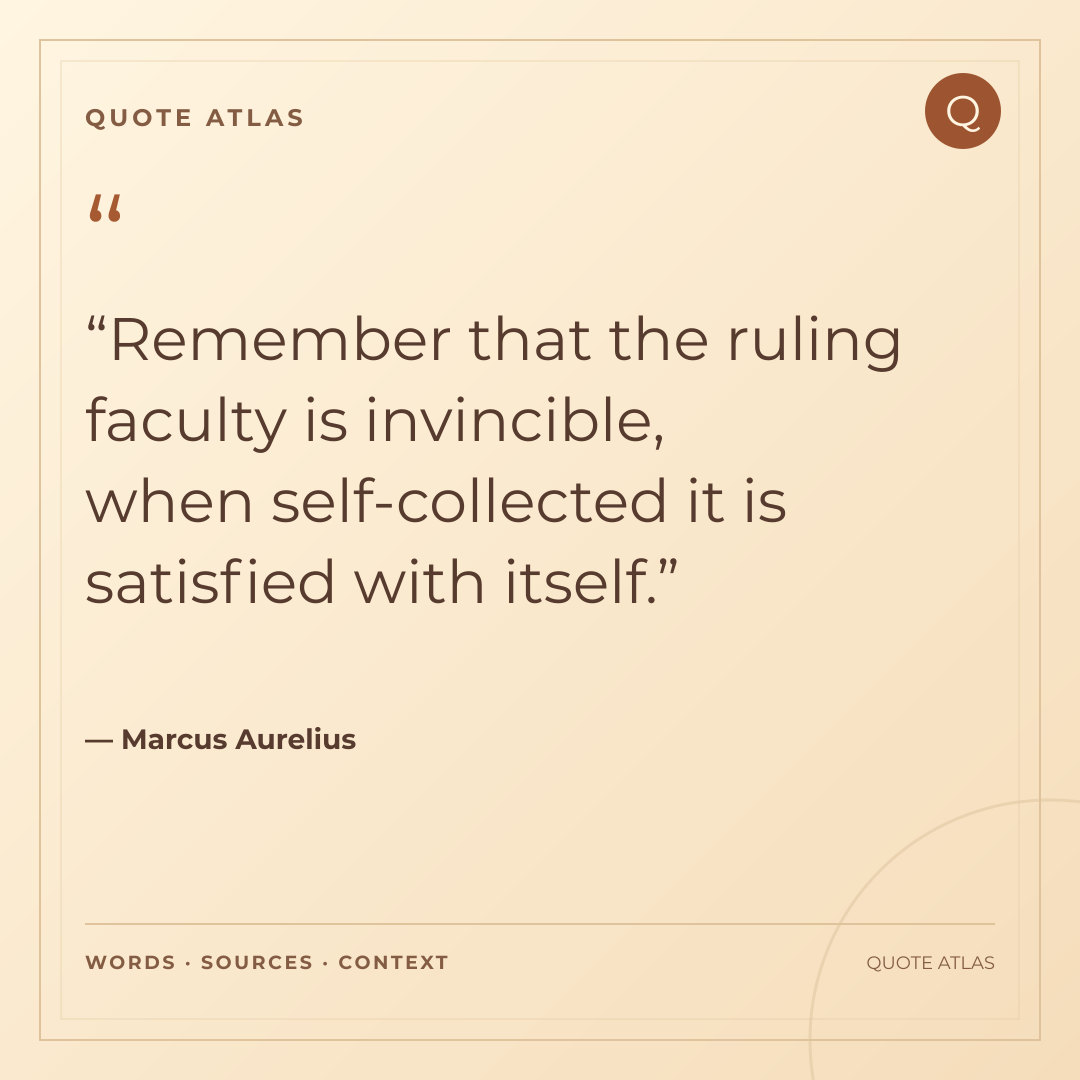
Remember that the ruling faculty is invincible, when self-collected it is satisfied with itself.

“Remember that the ruling faculty is invincible, when self-collected it is satisfied with itself.”

The governing mind becomes difficult to defeat when it can collect itself and choose by reason rather than react automatically to pressure.

Source details

Meditations, Book VIII, section 48, George Long translation.

Source identified142
For the soul seeks not adorers, but peers.

“For the soul seeks not adorers, but peers.”

Respectful relationship is distinguished from worship or dependency: a developed person seeks equals capable of intelligent sympathy rather than admirers who surrender judgment.

Source details

Life Without and Life Within, Part I ‘Reviews,’ essay ‘Menzel's View of Gœthe,’ Project Gutenberg #39037. ‘For the soul seeks not adorers, but peers’ appears in Fuller's discussion of the youth of genius, mockers and worshippers, immediately contrasting blind worship with ‘intelligent sympathy.’ It remains nineteenth-century literary criticism and intellectual reflection rather than a universal social or relationship rule.

Source identified143
There is reason and reality in some degree of self-reliance.

“There is reason and reality in some degree of self-reliance.”

Self-reliance becomes credible when it grows from tested knowledge of what one can actually endure and do, rather than from empty confidence or social display.

Source details

Life Without and Life Within, “The Poor Man”; Fuller argues that difficult experience can produce realistic knowledge of one’s resources and a grounded degree of self-reliance.

Source identified144
Whether this be the best way is of no consequence, if it be the one individual character points out.

“Whether this be the best way is of no consequence, if it be the one individual character points out.”

Fuller gives individual character real authority in choosing a path: the decisive question is whether the course belongs honestly to the person living it.

Source details

Summer on the Lakes, in 1843; the sentence appears in Fuller’s dialogic reflection on temperament, inquiry, and following the direction one’s own character requires.

Source identified145
I must depend on myself as the only constant friend.

“I must depend on myself as the only constant friend.”

The statement does not deny friendship with others; it names the continuity of one’s relationship with oneself as a reason to cultivate dependable inward resources.

Source details

Woman in the Nineteenth Century; spoken by Fuller’s illustrative figure Miranda while explaining the self-dependence encouraged by her upbringing.

Source identified146
I have urged upon the sex self-subsistence in its two forms of self-reliance and self-impulse.

“I have urged upon the sex self-subsistence in its two forms of self-reliance and self-impulse.”

Fuller argues for the ability to stand and act from within rather than living only through prescribed dependence, making self-reliance part of a wider claim to human development.

Source details

Woman in the Nineteenth Century; Fuller explicitly names self-subsistence, self-reliance, and self-impulse within her argument about women’s independence.

Source identified147
That faith and self-respect had early been awakened which must always lead, at last, to an outward serenity and an inward peace.

“That faith and self-respect had early been awakened which must always lead, at last, to an outward serenity and an inward peace.”

Self-respect and inward faith are presented as foundations that can survive adversity and gradually produce greater steadiness in both outward life and inner experience.

Source details

Woman in the Nineteenth Century, in the discussion of Miranda; Fuller explicitly connects awakened self-respect with serenity and inward peace.

Source identified148
I contend for the rights of men and the liberty of reason.

“I contend for the rights of men and the liberty of reason.”

The line joins political rights with intellectual liberty: the argument is not merely for a different ruler but for people’s capacity to reason without inherited deference.

Source details

A Vindication of the Rights of Men, opening letter to Edmund Burke; Wollstonecraft frames the pamphlet as a defense of human rights and the liberty of reason.

Source identified149
I wish to persuade women to endeavour to acquire strength, both of mind and body.

“I wish to persuade women to endeavour to acquire strength, both of mind and body.”

Wollstonecraft rejects cultivated helplessness and argues for developing women's intellectual and physical capacities so they can stand as rational agents rather than depend on flattering ideals of weakness.

Source details

A Vindication of the Rights of Woman, Introduction, Project Gutenberg #3420. The frozen quotation 'I wish to persuade women to endeavour to acquire strength, both of mind and body' is a clause from a longer sentence beginning 'I earnestly wish to point out...' and continuing through Wollstonecraft's criticism of delicacy and weakness as feminine ideals. It remains eighteenth-century feminist political-moral argument rather than a modern clinical or physiological prescription.

Source identified150
They must only bow to the authority of reason, instead of being the modest slaves of opinion.

“They must only bow to the authority of reason, instead of being the modest slaves of opinion.”

Respectability is grounded in independent reasoning rather than deference to social opinion, making judgment more important than approval.

Source details

A Vindication of the Rights of Woman; Wollstonecraft explicitly connects independence of character with the exercise of understanding.